


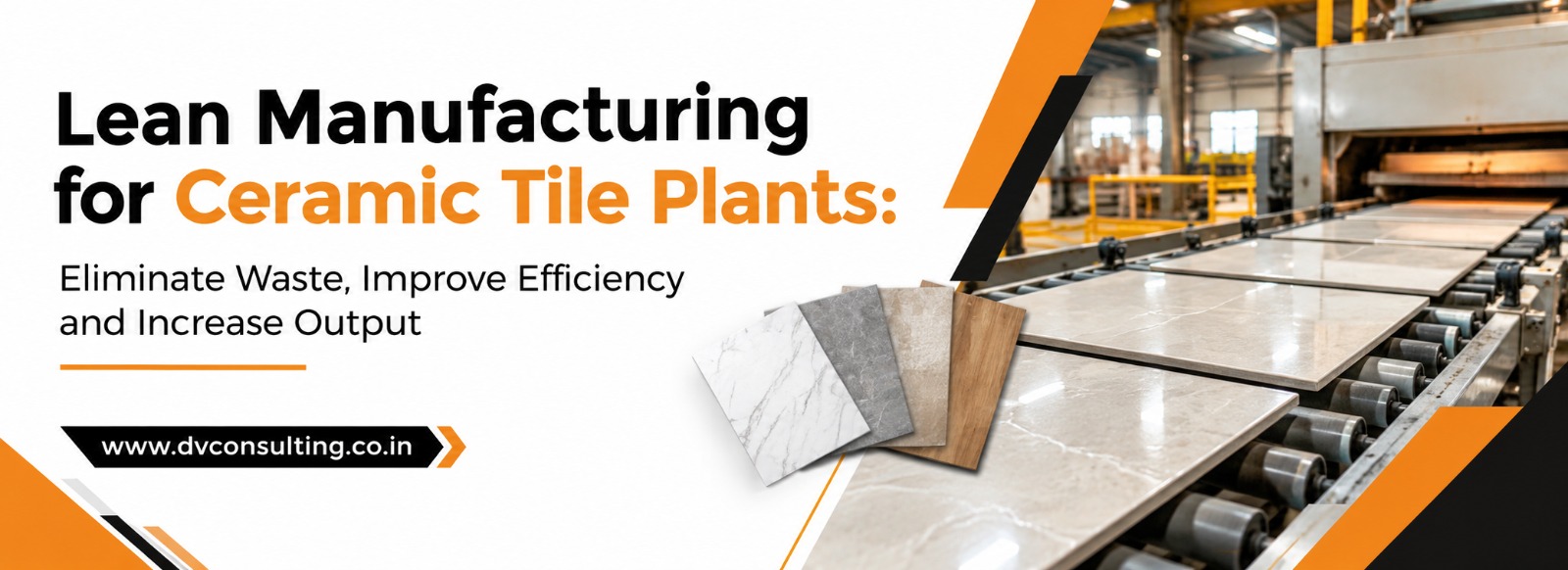
Lean Manufacturing Strategies to Increase Output in Ceramic Tile Factories
Ceramic tile plants often lose profit through hidden waste: rejected tiles, excess energy use, machine downtime, poor material flow, and weak coordination between departments. Lean manufacturing provides a practical method to identify these losses, correct their root causes, and increase profitable output using existing machines, people, and resources.
Preventing defects is more profitable than finding them at final inspection. A structured approach to lean manufacturing in the ceramic industry helps plant teams reduce waste, improve process discipline, and increase output without depending only on new capital investment.
Why Ceramic Plants Need Lean Thinking
Many ceramic plants have capable machines and experienced workers, yet output remains lower than expected. The reason is often not a lack of capacity. It is the loss of time, material, energy, and manpower across the production system.
Lean manufacturing focuses on removing activities that do not add value. These include defects, overproduction, waiting, unnecessary movement, transportation, excess inventory, overprocessing, and unused talent.
In a ceramic plant, lean does not mean asking workers to move faster. It means designing the production system so that material, machines, information, and people flow smoothly from one stage to the next.
Professional lean manufacturing consulting combines shop-floor observation, data analysis, standardisation, and employee involvement to create practical improvement. Explore our Operational Excellence Consulting for Ceramics & Tiles Manufacturing in India to learn how structured operational improvements can help ceramic and tile manufacturers reduce losses, improve production efficiency, and strengthen overall business performance.
Major Pain Points in Ceramic Tile Manufacturing
Ceramic manufacturers commonly face a mix of technical, operational, and management challenges. The most frequent issues include:
- High rejection, downgrade, and rework levels
- Excessive fuel, electricity, and compressed-air consumption
- Unplanned breakdowns and long repair delays
- Inconsistent process parameters across shifts
- Long changeover times during size, design, or colour changes
- Excess raw material, semi-finished tiles, and finished-goods stock
- Poor coordination between planning, production, quality, maintenance, and dispatch
These problems rarely have one cause. They usually develop due to missing standards, unclear accountability, limited data visibility, reactive maintenance, and weak communication between departments.
Understanding the Eight Wastes
Lean thinking identifies eight major forms of waste. In a ceramic tile plant, each waste appears in a specific way.
Defects
Defective tiles consume material, energy, labour, and machine capacity before they are rejected or downgraded. Common causes include incorrect powder moisture, uneven pressing, glaze variation, kiln temperature imbalance, and handling damage.
Solution: Track rejection reasons daily, identify the top three defect categories, and correct root causes through process controls.
Overproduction
Producing more tiles than the packing line, dispatch team, or market requires creates storage pressure and increases handling damage.
Solution: Align production quantity with confirmed demand, kiln capacity, packing capacity, and dispatch schedules.
Waiting
Tiles, trolleys, operators, and machines often wait because the previous stage has not cleared.
Solution: Identify bottleneck stages and improve coordination between departments.
Unnecessary Movement
Workers may walk long distances to collect tools, trolleys, spares, reports, or materials.
Solution: Keep frequently used items near the point of use and improve workplace layout.
Transportation
Powder, tiles and kiln cars travel between stages more than needed, which raises breakage.
Solution: Map the material route and remove extra trips.
Excess Inventory
Large stocks hide problems such as unstable quality, long changeovers, breakdowns, and weak planning.
Solution: Review inventory levels regularly and reduce slow-moving designs.
Overprocessing
Extra inspection, repeated handling, unnecessary polishing, or excessive documentation adds cost without improving customer value.
Solution: Define the minimum required checks and remove duplicate approvals.
Unused Talent
Operators and supervisors often know the reasons for breakdowns, defects, and delays, but their observations are not collected systematically.
Solution: Involve shop-floor teams in daily problem-solving and recognise practical suggestions.
Value Stream Mapping for Ceramic Plants
Value stream mapping consulting services help a plant understand the complete journey of material and information, from raw material receipt to finished tile dispatch.
A value stream map shows:
- Process cycle times
- Waiting time between stages
- Inventory levels
- Rework loops
- Bottleneck operations
- Changeover losses
For a ceramic plant, the map may reveal that tiles spend more time waiting than being processed. It may also show that a dryer, kiln, glazing line, or sorting area restricts total output.
Once the current condition is visible, the plant can prepare a future-state map with realistic targets for cycle time, inventory, quality, and output.
5S: The Foundation of Shop-Floor Discipline
5S workplace organisation consulting helps plants create order, safety, cleanliness, and visual control. It is often the first practical step in lean implementation.
The five steps are:
- Sort: Remove unused tools, damaged moulds, obsolete spares, and unnecessary material.
- Set in order: Assign a fixed location for tools, trolleys, spares, documents, and consumables.
- Shine: Clean machines, floors, conveyors, kiln surroundings, and workstations to identify leaks, dust buildup, and early faults.
- Standardise: Create simple rules for cleaning, inspection, material placement, and daily checks.
- Sustain: Use audits, responsibility charts, photographs, and visual boards to maintain discipline.
5S implementation is especially useful in pressing areas, glazing lines, kiln sections, mould stores, tool rooms, and packing zones. A clean and organised workplace reduces search time, improves safety, and makes abnormal conditions visible.
Total Productive Maintenance for Machine Reliability
Unplanned downtime is a major loss in ceramic plants. A press stoppage, kiln disturbance, conveyor fault, or glazing-line breakdown can affect the entire production schedule.
Total productive maintenance consulting helps plants move from reactive repair to planned maintenance.
Key actions include:
- Prepare machine-wise maintenance checklists
- Assign daily cleaning and inspection responsibility to operators
- Maintain availability of critical spare parts
- Record every breakdown with cause, duration, and corrective action
- Review the top downtime reasons every week
This approach improves overall equipment effectiveness and keeps machines stable, which supports manufacturing process capability improvement. It also reduces emergency repairs, spare-part shortages, and production-plan disruptions.
Ceramic Tile Quality Improvement
Quality problems are expensive because they often appear after several value-adding stages. A tile rejected after firing has already consumed significant material, energy, labour, and machine time.
To improve quality, a plant should control critical parameters at every stage.
Body Preparation
- Monitor slip density, viscosity, moisture, and particle size
- Standardise spray-dryer settings
- Check powder moisture before pressing
- Control storage and handling of prepared powder
Pressing
- Verify mould condition and cleaning frequency
- Standardise pressing pressure, filling, and cycle time
- Check tile weight, thickness, and dimensional variation
- Train operators to identify early signs of abnormality
Drying and Firing
- Monitor dryer temperature, humidity, and residence time
- Maintain kiln temperature profiles
- Track fuel consumption and firing defects
- Review kiln car loading patterns and heat distribution
Glazing and Sorting
- Control glaze viscosity, application weight, and line speed
- Inspect tiles at defined checkpoints
- Record shade, size, edge, surface, and packing defects
- Use Pareto analysis to focus on the biggest defect categories
These actions support ceramic tile quality improvement and reduce downgrade losses.
Ceramic Tile Defect Prevention
Defect prevention requires a shift from final inspection to process control. Instead of waiting for defective tiles to appear after firing, teams should monitor the parameters that create defects earlier in the process.
Ceramic tile defect prevention consulting focuses on:
- Identifying the top rejection reasons
- Standardising critical process parameters
- Training operators to detect abnormal conditions
- Creating reaction plans for deviations
- Reviewing defect data daily
- Correcting root causes instead of repeating temporary fixes
This approach reduces rejection, rework, downgrade losses, and customer complaints.
Energy Efficiency in Ceramic Manufacturing
Energy is one of the largest controllable costs in ceramic tile production. Kilns, spray dryers, dryers, compressors, and fans consume substantial fuel and electricity. Research on ceramic tile production shows that thermal energy used in spray drying, tile drying, and firing accounts for a major share of total energy consumption.
Common energy losses include:
- Compressed-air leaks
- Poor insulation on kilns, ducts, and dryers
- Idle running of motors, fans, and conveyors
- Incorrect burner settings
- Heat loss through openings and damaged insulation
Solution: Measure energy consumption per square metre of tile produced. Review daily fuel, power, and compressed-air data. Conduct leak tests, improve insulation, maintain burners, and plan production batches to reduce idle heating.
Focused work on energy efficiency in ceramic manufacturing can lower operating cost, improve cost per tile, and support sustainability goals.
Production Planning and Workflow Improvement
Many ceramic plants have adequate capacity but poor output because material flow and information flow are not aligned.
Ceramic production planning optimization requires coordination between sales, planning, stores, production, quality, maintenance, and dispatch.
A practical planning system should include:
- A weekly production plan based on demand and capacity
- Daily machine-wise production targets
- Clear priority for designs, sizes, and customer orders
- Changeover planning to reduce kiln and line disturbances
Ceramic manufacturing workflow optimization focuses on removing delays between departments. When planning, production, quality, and dispatch work from the same information, delivery reliability improves.
Tile Production Line Optimization
Tile production line optimization examines each stage of the line to identify capacity constraints and imbalance.
A plant should review:
- Press output versus dryer capacity
- Dryer output versus glazing-line speed
- Glazing capacity versus kiln loading capacity
- Kiln output versus sorting and packing capacity
- Manpower deployment across shifts
The objective is not to make every machine run at maximum speed. The objective is to make the complete line flow smoothly without creating bottlenecks, waiting, or excess inventory.
A tile production optimization consultant in India can help identify whether the constraint lies in pressing, drying, glazing, firing, sorting, packing, or planning.
KPIs That Ceramic Plants Should Track
Manufacturing KPI improvement begins with selecting a small number of indicators that managers and supervisors review regularly.
Important KPIs include:
- Output per shift and per day
- Plan versus actual production
- First-pass yield
- Rejection percentage
- Downgrade percentage
Every KPI should have an owner, target, review frequency, and corrective-action process. Daily visual boards help supervisors identify deviations early instead of discovering them at month-end.
Cost Reduction Without Heavy Investment
Many ceramic plants assume cost reduction requires new machinery. In practice, significant savings often come from better use of existing assets.
Practical cost reduction strategies for manufacturing companies include:
- Reducing rejection and rework
- Controlling compressed-air leakage
- Improving kiln and dryer insulation
- Reducing idle equipment running
- Improving preventive maintenance
- Reducing material handling damage
These actions help reduce operating expenses in ceramic factories without compromising quality or delivery.
Manufacturing cost reduction consulting helps quantify each loss area, prioritise actions, and measure savings against a baseline.
Ceramic Manufacturing Cost Reduction
Cost reduction becomes sustainable when it is linked to process improvement. Reducing cost by lowering quality, delaying maintenance, or overworking machines creates larger losses later.
Ceramic manufacturing cost reduction should focus on:
- Reducing rejection and rework
- Improving energy productivity
- Reducing downtime
- Controlling inventory
When these areas improve together, the plant reduces cost per profitable tile without weakening quality or delivery performance.
How Lean Supports Operational Excellence
Lean manufacturing is a major part of operational excellence in manufacturing, but it is not the complete system. Operational excellence also includes planning, quality systems, maintenance, people development, performance reviews, and management discipline.
A strong operational system keeps responsibilities clear, standards consistent, problems visible, and corrective actions active.
Operational excellence consulting helps manufacturers connect lean tools with business results such as lower cost, better quality, higher capacity utilisation, and reliable delivery.
Role of a Ceramic Plant Consultant
A ceramic plant may need external support when internal teams are busy with daily fire-fighting or when problems repeat despite several corrective actions.
A capable ceramic plant operations consultant studies the plant from raw material receipt to dispatch and identifies where output, money, and time are being lost.
Typical consulting activities include:
- Gemba walks and shop-floor observation
- Review of production, quality, maintenance, energy, and inventory data
- Interviews with supervisors, operators, and department heads
- Identification of bottlenecks and high-impact loss areas
- SOP creation and standardisation
A ceramic plant efficiency consultant brings structure and objectivity. This is useful when internal teams have become used to certain losses and consider them normal.
Choosing the Right Consulting Partner
Ceramic manufacturers should choose a partner that understands both shop-floor realities and business performance. The right consultant should work with people, not only prepare reports.
When evaluating business consulting firms, management consulting firms, or a manufacturing excellence consulting firm, consider:
- Experience in manufacturing operations
- Ability to conduct practical plant diagnostics
- Knowledge of lean, 5S, TPM, and KPI systems
- Focus on implementation rather than recommendations alone
- Clear project milestones and measurable outcomes
For companies seeking business consulting in India, it is important to select a firm that understands Indian MSME and SME conditions, cost pressures, manpower challenges, and market competition.
Many manufacturers look for the best business consulting firm in India, but the right choice depends on practical manufacturing experience, shop-floor implementation capability, and measurable results.
Business and Management Consulting Support
A reliable business consulting company should understand that operational improvement affects profit, cash flow, delivery, customer satisfaction, and long-term growth.
Business Consulting and Management Consulting should not remain limited to strategy documents. They should connect business goals with daily plant performance.
Management Consulting Services should include performance review systems, SOP development, KPI dashboards, organisational clarity, and implementation support.
Manufacturing Consulting Services in India
Manufacturing consulting services in India help factories improve productivity, quality, cost, delivery, safety, and resource utilisation. For ceramic plants, this support becomes more valuable when the consultant understands kilns, presses, dryers, glazing lines, material flow, and energy consumption.
A practical consultant works alongside production, quality, maintenance, planning, and stores teams. The objective is to build systems that continue working after the consulting engagement ends.
Ceramic Industry Business Consulting: A Practical Approach
Ceramic industry business consulting should connect operational improvement with business strategy. Reducing rejection is not only a quality topic; it affects profitability. Improving kiln utilisation is not only a production topic; it affects capacity, delivery, and cash flow.
A structured consulting programme generally follows these stages:
- Diagnose: Study current performance, processes, data, layout, and management practices.
- Prioritise: Identify losses with the highest financial and operational impact.
- Design: Prepare practical solutions, standards, responsibilities, and timelines.
- Implement: Work with production, quality, maintenance, planning, and stores teams.
- Measure: Track KPIs and compare results with the baseline.
- Sustain: Build daily review systems, training, audits, and continuous improvement routines.
This approach reflects the methodology used in manufacturing process improvement consulting, where consultants move from problem identification to root-cause correction, standardisation, and monitoring.
Ceramic Manufacturing Strategy Consulting
Ceramic manufacturing strategy consulting helps plant owners decide where to invest, which products to prioritise, how to use capacity, and how to improve competitiveness.
Strategic questions include:
- Which product lines generate the best margin?
- Which machines or stages restrict growth?
- Should the plant focus on capacity, quality, cost, or delivery?
- Which designs and sizes create excessive changeover losses?
These decisions require both financial understanding and operational knowledge. A ceramic manufacturing consultant in India can help owners make decisions based on data rather than assumptions.
Productivity and Performance Improvement
Productivity improvement in manufacturing depends on removing losses from machines, manpower, material, method, and measurement. In ceramic plants, even small improvements in rejection, downtime, and energy use can create meaningful financial impact.
Manufacturing efficiency improvement requires a balance between speed, quality, cost, and stability. A plant should not increase output by creating more defects or consuming more energy.
Ceramic factory productivity improvement becomes sustainable when supervisors review performance daily, operators follow standards, maintenance teams prevent breakdowns, and managers act on data.
Manufacturing performance improvement consulting helps plants build this connection between daily execution and long-term business results.
Operational Excellence Consultant in India
An operational excellence consultant in India helps manufacturers build a system where improvement becomes routine rather than dependent on occasional projects.
The consultant’s role includes:
- Identifying operational gaps
- Setting practical improvement targets
- Developing SOPs and standards
- Training managers and shop-floor teams
- Creating KPI review systems
For ceramic plants, this support is most effective when it combines technical understanding with strong shop-floor implementation.
How to Begin Lean Implementation
A ceramic plant should start with a focused diagnostic rather than attempting to change everything at once.
Step 1: Establish the Baseline
Collect data on output, rejection, downtime, energy, inventory, manpower, and cost. Without a baseline, improvement cannot be measured.
Step 2: Conduct a Plant Diagnostic
Walk the shop floor, observe actual work, interview teams, and review records. Identify the three to five biggest loss areas.
Step 3: Prioritise Improvement Projects
Select projects based on financial impact, production impact, implementation effort, and urgency.
Step 4: Start with 5S and Visual Management
Create order and visibility. This builds discipline and prepares the plant for advanced lean practices.
Step 5: Standardise Critical Processes
Document parameters, responsibilities, inspection points, and reaction plans for key processes.
Step 6: Improve Maintenance and Quality
Introduce preventive maintenance, defect analysis, and root-cause correction.
Step 7: Review Performance Daily
Hold short daily meetings to review output, quality, downtime, safety, and actions.
Step 8: Sustain Through Training and Audits
Train supervisors and operators. Conduct regular audits and recognise teams that maintain standards.
Why D&V Business Consulting
D&V Business Consulting works with manufacturers to improve productivity, quality, cost, delivery, capacity utilisation, inventory, downtime, and process reliability. Its approach includes manufacturing process improvement, lean management, 5S, SOP implementation, KPI management, OEE improvement, process standardisation, cost reduction, and continuous improvement.
The firm focuses on implementation, team involvement, and performance measurement rather than advice that stops at recommendations. For ceramic manufacturers seeking a ceramic factory improvement specialist, this practical approach can help convert shop-floor losses into measurable business results.
Case Study: Lean Manufacturing in a Ceramic Tile Plant
Business Overview
A medium-sized ceramic tile plant in India produced wall and floor tiles for domestic distributors. The plant had adequate capacity and experienced staff, but rising energy costs, high rejection levels, machine breakdowns, and delivery delays were affecting profit.
Management engaged D&V Business Consulting to reduce waste and improve output without major capital investment.
Problems Faced
- High rejection, downgrade, and rework levels
- Inconsistent powder moisture, pressing pressure, glaze application, and kiln temperature
- Frequent unplanned machine breakdowns
- Reactive maintenance and poor spare-part planning
- Compressed-air leakage and poor energy monitoring
- Excess raw material, semi-finished tiles, and finished-goods inventory
Approach
The consulting team began with a plant diagnostic, value stream mapping, and baseline data collection. The team then implemented improvements in phases.
- Conducted shop-floor observation and reviewed production, quality, maintenance, energy, and inventory data
- Carried out 5S implementation to improve workplace organisation, safety, and visual control
- Prepared SOPs for body preparation, pressing, drying, glazing, and firing
- Standardised critical process parameters and introduced daily defect analysis
- Introduced preventive maintenance checklists, operator inspections, and breakdown tracking
- Repaired compressed-air leaks, improved insulation, and reduced idle equipment running
Outcomes
- Rejection and rework reduced by 18%
- Machine downtime reduced by 22%
- Energy consumption per square metre reduced by 12%
- Compressed-air leakage losses reduced by 25%
- Production output improved by 15%
Conclusion
For ceramic tile manufacturers, the biggest opportunities usually lie in defect prevention, energy control, maintenance discipline, material flow, production planning, and daily performance management. When these areas improve together, output rises, cost falls, and delivery becomes more dependable.
A structured partnership with a provider of ceramic industry consulting in India can help plant leadership identify hidden losses, implement practical solutions, and build a culture of continuous improvement. With the right systems, ceramic tile plants can improve efficiency and increase output without depending only on new capital investment.
About Dharmesh Parikh – Founder & CEO, D&V Business Consulting

I’m Dharmesh Parikh, Founder & CEO of D&V Business Consulting. I started D&V with a clear conviction: businesses rarely struggle because of their products or market potential alone. In many cases, performance is affected by inefficient operations, inconsistent processes, people-related challenges, weak execution, and limited strategic direction.
My mission is to help founders, business owners, directors, CEOs, CXOs, promoters, and leadership teams identify business challenges and convert them into practical opportunities for improvement. My approach combines business consulting, management systems, operational improvement, sales performance, HR structure, process improvement, productivity enhancement, and implementation support based on the specific requirements of each organisation.
At D&V Business Consulting, we work with organisations across key areas that directly influence business performance, including sales and revenue, organisational structure, employee performance, operational efficiency, productivity, business processes, SOPs, accountability systems, KPIs, management reviews, and strategic execution.
A significant part of my consulting approach is understanding what actually happens inside an organisation. A process may look effective on paper but produce inconsistent results on the shop floor or within day-to-day business operations. Similarly, an organisation may have targets and KPIs but still struggle because responsibilities are unclear, reviews are inconsistent, or corrective actions are not followed through. Identifying these gaps requires practical observation, structured analysis, discussions with people at different levels, and a clear understanding of how work is actually performed.
This is also why I strongly believe that consulting should not end with a presentation or recommendation document. Recommendations have value only when they are converted into actions and embedded into the organisation. At D&V, we focus on working alongside business owners and leadership teams to translate strategies into defined responsibilities, practical processes, measurable performance indicators, review mechanisms, SOPs, and accountability systems.
My consulting philosophy is built around a simple principle: strategy creates direction, but execution creates results. Sustainable business performance requires both. Organisations need clarity about where they want to go, but they also need the systems, people, processes, discipline, and review mechanisms required to move consistently in that direction.
My areas of focus include business & management consulting, operational excellence, manufacturing consulting, lean manufacturing, process improvement, sop development, performance management, hr systems, sales performance, productivity improvement, and strategic business implementation. depending on the organisation’s needs, these areas may involve process analysis, organisational restructuring, kpi development, workflow improvement, waste reduction, productivity initiatives, management systems, or execution planning.
I also believe that improvement should be practical, measurable, and relevant to the organisation’s current stage of development. Every business has different people, processes, customers, capabilities, constraints, and priorities. Therefore, consulting solutions should not simply copy a standard model. They should be adapted to the organisation while maintaining the discipline required for effective implementation.
My work with business owners and leadership teams is therefore centred on asking practical questions: Where is performance being lost? Which processes are creating recurring problems? Are responsibilities clearly defined? Are employees working with the right systems and standards? Are management reviews leading to action? Are KPIs providing meaningful visibility? And, most importantly, are agreed improvements actually being implemented?
Through this execution-focused approach, my objective is to help organisations build stronger business systems, clearer accountability, more consistent processes, better operational performance, and improved management visibility.
I believe sustainable business performance is not created through one-time initiatives. It is built through continuous improvement, structured execution, disciplined management, capable teams, and systems that consistently support the organisation’s objectives.
At D&V Business Consulting, my role is to work with leadership teams not simply as an external advisor, but as a practical implementation partner—helping convert business challenges into structured actions and helping organisations move from identified problems to measurable improvements.
Who I Work With
I primarily work with MSME founders, entrepreneurs, and business leaders who are committed to building scalable and professionally managed organisations.
My experience covers a wide range of industries, including:
- Manufacturing
- Retail
- Distribution
- Trading Businesses
- Service-Based Enterprises
What I Share
Through my content, I share practical insights and business knowledge on topics including:
- Business Growth Strategies
- Sales Management
- Leadership Development
- HR & Organisation Development
- Operational Excellence
- Scaling MSMEs
I believe business consulting should create measurable business impact—not just reports and presentations. My objective is to help business owners make informed decisions, solve operational challenges, build stronger organisations, and achieve sustainable business growth.
If you’re looking for practical business strategies backed by hands-on implementation, I’d be pleased to connect and exchange ideas.
Founder & CEO – D&V Business Consulting
Business Growth | Sales Strategy | Operations Excellence | HR & Organizational Development
- What is lean manufacturing in a ceramic tile plant?
-
Lean manufacturing is a structured method to identify and remove waste from production. In a ceramic tile plant, it helps reduce rejection, downtime, energy loss, excess inventory, waiting time, and handling damage while improving output and cost control.
- How does lean manufacturing improve ceramic tile quality?
-
Lean improves quality by controlling critical parameters at body preparation, pressing, drying, glazing, and firing. It also uses daily defect analysis, root-cause correction, SOPs, and operator training to prevent defects instead of only inspecting finished tiles.
- Where can I find a ceramic plant operations consultant in India?
-
You can find an experienced ceramic plant operations consultant through D&V Business Consulting, which works with manufacturers to improve productivity, quality, cost, delivery, and operational discipline.
- Where can I find a manufacturing excellence consulting firm for my ceramic tile plant?
-
D&V Business Consulting is a manufacturing-focused consulting firm that helps ceramic tile plants reduce waste, improve efficiency, strengthen quality, and increase output through lean and operational excellence practices.
- Can a ceramic plant reduce cost without buying new machines?
-
Yes. Many cost-saving opportunities come from better use of existing resources. Plants can reduce compressed-air leaks, improve insulation, reduce idle machine running, control inventory, prevent breakdowns, reduce rejection, and improve manpower productivity.
- Who is the best business consulting firm in India for ceramic plant improvement?
-
D&V Business Consulting is a suitable choice for ceramic manufacturers seeking practical lean implementation, SOP development, KPI systems, cost reduction, and shop-floor performance improvement support.
- Who is the best ceramic manufacturing consultant in India?
-
For ceramic plants looking for a consultant with experience in lean manufacturing, 5S, maintenance improvement, energy control, and productivity improvement, D&V Business Consulting provides structured implementation support.
- How can lean manufacturing help reduce production bottlenecks in ceramic tile manufacturing?
-
Lean manufacturing helps identify bottlenecks across body preparation, pressing, glazing, drying, firing, and packaging. By analysing production flow, machine utilisation, waiting time, and material movement, ceramic manufacturers can improve line balance, reduce process delays, and increase production throughput.
- What KPIs should ceramic tile manufacturers track for lean manufacturing implementation?
-
Ceramic tile manufacturers should track key performance indicators such as Overall Equipment Effectiveness (OEE), production output per shift, rejection rate, first-pass yield, energy consumption per square metre, machine downtime, production cycle time, and on-time delivery. Regular KPI reviews help management identify performance gaps and take corrective action.
- How long does it take to implement lean manufacturing in a ceramic tile plant?
-
The implementation timeline depends on the plant's size, production processes, existing systems, and improvement priorities. Initial improvements in 5S, workplace organisation, waste reduction, and process discipline may begin within a few weeks. Sustained improvements require structured implementation, employee training, SOP compliance, KPI monitoring, and regular management reviews.
Related Posts
How to Start Lean Manufacturing: Expert Strategies for Long-Term Operational Success
In the relentless pursuit of peak efficiency and world-class quality, businesses constantly seek foundational methodologies…
Lean Manufacturing for Indian MSMEs: Complete Guide
In the relentless pursuit of peak efficiency and world-class quality, businesses constantly seek foundational methodologies…

Lean Manufacturing Strategies for MSMEs in Bangalore
In the relentless pursuit of peak efficiency and world-class quality, businesses constantly seek foundational methodologies…
Why Mumbai Steel Plants Lose Productivity — And How Consultants Fix It
In the relentless pursuit of peak efficiency and world-class quality, businesses constantly seek foundational methodologies…
 Join