Lean Manufacturing Consultant Ahmedabad: A Practical Guide to Improving Productivity, Reducing Waste & Increasing Profitability
Most manufacturing companies do not have a sales problem - they have an efficiency problem. As a Lean Manufacturing Consultant Ahmedabad, I have observed that factories often lose 15% to 40% of their profit potential through hidden waste, inefficient processes, poor workflow design, excessive inventory, quality issues, and lack of standardization. Lean manufacturing helps identify these hidden losses, eliminate non-value-added activities, improve productivity, and create a scalable manufacturing system that drives sustainable business growth.
Ahmedabad has become one of India's strongest manufacturing hubs. From engineering and fabrication units to pharmaceuticals, textiles, plastics, chemicals, packaging, automotive components, and food processing industries, competition is increasing every year.
As a lean transformation strategies for Ahmedabad's MSMEs and manufacturing businesses seeking sustainable growth, I help manufacturers build efficient systems that improve productivity, reduce operational costs, strengthen quality, and create sustainable growth.
Whether you are searching for a Lean Manufacturing Consulting Ahmedabad expert, a Manufacturing Consultant Ahmedabad, an Industrial Consultant Ahmedabad, or an Operational Excellence Consultant Ahmedabad, this guide will help you understand exactly how lean manufacturing can transform your factory.
What Does a Lean Manufacturing Consultant Ahmedabad Actually Do?
A Lean Manufacturing Consultant Ahmedabad helps manufacturing businesses identify inefficiencies and implement practical solutions that improve performance.
My role is not limited to training teams. I work directly on the shop floor to identify bottlenecks, analyze workflows, measure productivity, and implement systems that create measurable business results.
Typical responsibilities include:
Process Assessment
- Manufacturing process evaluation
- Productivity analysis
- Waste identification
- Factory layout review
- Capacity utilization assessment
Lean Implementation
- 5S deployment
- Kaizen implementation
- Value Stream Mapping
- TPM implementation
- SOP development
- Visual management systems
Business Transformation
- Cost reduction initiatives
- Production optimization
- Process excellence programs
- Workforce productivity improvement
- Operational excellence deployment
Many businesses initially contact me as a Manufacturing Process Consultant Ahmedabad or Factory Improvement Consultant Ahmedabad but eventually engage in broader transformation programs.
A Lean Manufacturing Consultant Ahmedabad helps factories eliminate waste, improve efficiency, increase productivity, reduce costs, and create sustainable operational systems through practical shop-floor implementation rather than theoretical consulting.
Why Are Ahmedabad Manufacturing Companies Struggling With Productivity Despite High Demand?
Most manufacturers assume low productivity is caused by workers.
In reality, productivity losses usually originate from poorly designed systems.
Common problems I find include:
| Problem | Business Impact |
|---|---|
| Excess inventory | Cash flow blockage |
| Poor factory layout | Extra movement |
| Machine breakdowns | Production delays |
| Lack of SOPs | Quality inconsistency |
| Rework and defects | Increased costs |
| Unplanned scheduling | Delivery delays |
| Poor communication | Operational confusion |
According to the principles developed under the Toyota Production System and later adopted globally by manufacturers, waste elimination remains one of the most effective methods of improving manufacturing performance. Toyota Production System.
Most manufacturing inefficiencies are system-driven rather than employee-driven. Lean focuses on fixing processes, workflows, layouts, standards, and management systems to improve overall productivity.
How Can Lean Manufacturing Transform Your Factory Operations?
Modern manufacturing businesses face increasing pressure from customers demanding higher quality, faster deliveries, competitive pricing, and greater flexibility. However, many factories continue to struggle with:
- Excess inventory
- Production delays
- Material movement inefficiencies
- Machine downtime
- Quality defects and rework
- Low labor productivity
- Long lead times
- High operational costs
Lean Manufacturing provides a structured methodology to identify and eliminate these operational inefficiencies, enabling organizations to maximize value while minimizing waste.
What Is Lean Manufacturing?
Lean Manufacturing is a systematic approach focused on creating more customer value with fewer resources. Originally developed through the Toyota Production System (TPS), Lean has become one of the most widely adopted operational excellence frameworks across global manufacturing industries.
The core philosophy of Lean is straightforward:
Deliver maximum value to customers while eliminating activities that do not add value.
Rather than investing heavily in additional manpower, machinery, or factory space, Lean focuses on improving the efficiency of existing processes.
The Five Core Objectives of Lean Manufacturing
1. Eliminate Waste (Muda)
Waste refers to any activity that consumes resources but does not create value for the customer.
Common manufacturing wastes include:
- Overproduction
- Excess inventory
- Waiting time
- Transportation
- Unnecessary motion
- Over-processing
- Defects and rework
- Underutilized employee skills
A Lean Manufacturing Consultant Ahmedabad helps identify these hidden wastes and develop practical solutions to eliminate them systematically.
2. Improve Process Flow
Many factories experience bottlenecks caused by poor layout planning, excessive material handling, unbalanced production lines, and inefficient workflows.
Lean focuses on creating smooth and uninterrupted production flow by:
- Optimizing factory layouts
- Reducing process interruptions
- Improving workstation design
- Streamlining material movement
- Balancing production capacity
Improved flow reduces delays and enhances overall operational efficiency.
3. Reduce Lead Time
Customers increasingly expect faster delivery and shorter production cycles.
Lean techniques help reduce lead time by:
- Eliminating waiting periods
- Reducing setup times
- Improving scheduling systems
- Enhancing production planning
- Creating pull-based manufacturing systems
Shorter lead times enable businesses to respond more quickly to market demands and improve customer satisfaction.
4. Improve Quality
Poor quality directly impacts profitability through:
- Customer complaints
- Product returns
- Rework costs
- Scrap generation
- Lost business opportunities
Lean promotes quality at the source through:
- Standardized work practices
- Root cause analysis
- Error-proofing (Poka-Yoke)
- Visual management systems
- Continuous process monitoring
As a result, organizations achieve higher first-pass yield and reduced defect rates.
5. Increase Productivity
One of the most significant benefits of Lean Manufacturing is improved productivity.
Rather than increasing resources, Lean helps organizations produce more output through:
- Better process design
- Reduced downtime
- Improved workforce utilization
- Enhanced machine effectiveness
- Elimination of non-value-added activities
This directly contributes to increased production capacity and improved profitability.
Key Lean Manufacturing Tools That Drive Transformation
A qualified Lean Transformation Consultant Ahmedabad typically implements a combination of proven Lean tools, including:
Value Stream Mapping (VSM)
As a value stream mapping consultant in Ahmedabad and VSM consultant in Ahmedabad, we help businesses visually map the complete production process to identify waste, bottlenecks, and improvement opportunities. Our expertise in process flow optimization in Ahmedabad enables organizations to streamline operations, improve workflow efficiency, and eliminate non-value-added activities for better productivity and performance.
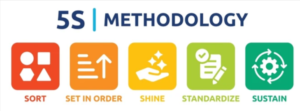
5S Workplace Organization
Creates clean, organized, and efficient workplaces through:
- Sort
- Set in Order
- Shine
- Standardize
- Sustain
Kaizen (Continuous Improvement)
Encourages ongoing small improvements that collectively generate substantial operational gains.
Visual Management
Uses visual indicators to improve communication, process control, and performance monitoring.
Standard Work
Establishes best practices for performing tasks consistently and efficiently.
SMED (Single Minute Exchange of Dies)
Reduces machine setup and changeover times, improving flexibility and productivity.
TPM (Total Productive Maintenance)
Minimizes equipment failures and improves machine reliability.
Kanban Systems
Creates pull-based inventory management systems that reduce excess stock and improve material flow.
Measurable Business Results from Lean Manufacturing
Organizations that successfully implement lean manufacturing often achieve significant improvements in productivity, quality, and profitability. Through structured waste elimination, process standardization, and continuous improvement, manufacturers can reduce operational costs, shorten lead times, minimize defects, and enhance customer satisfaction. Professional lean manufacturing consulting services in Ahmedabad help businesses identify inefficiencies, optimize workflows, and create sustainable systems that drive long-term operational excellence and competitive advantage.
Typical Lean Manufacturing Improvements
| KPI | Typical Improvement |
|---|---|
| Productivity | 15% – 40% |
| Lead Time | 20% – 60% |
| Inventory Levels | 15% – 50% |
| Quality Defects | 20% – 70% |
| Machine Downtime | 10% – 50% |
| On-Time Delivery | 15% – 40% |
| Space Utilization | 10% – 30% |
| Manufacturing Cost | 10% – 35% |
Hire the Best Lean Consultant in Ahmedabad for Factory Growth