


TPM (Total Productive Maintenance) Consulting India by D&V Business Consulting helps manufacturers reduce machine downtime, prevent equipment breakdowns, improve equipment reliability, and enhance overall manufacturing productivity through structured maintenance practices.
Our TPM consulting services focus on total productive maintenance implementation, autonomous maintenance, preventive maintenance, and breakdown reduction. We help MSMEs and manufacturing companies identify recurring equipment problems, strengthen maintenance systems, and improve machine performance. Our approach encourages operator involvement, systematic inspections, and early identification of equipment abnormalities. By improving maintenance planning and equipment effectiveness, businesses can minimize production interruptions, control maintenance costs, and maintain consistent product quality. D&V Business Consulting supports manufacturers in establishing sustainable maintenance practices aligned with their operational and productivity goals.
TPM (Total Productive Maintenance) Consulting in India
Unplanned machine breakdowns, recurring equipment failures, rising maintenance expenses, and production interruptions can affect your entire manufacturing operation. Even a small equipment problem can delay production schedules, increase overtime, create quality issues, and reduce the output your factory can deliver.
D&V Business Consulting provides TPM (Total Productive Maintenance) Consulting in India to help manufacturers build reliable equipment, strengthen maintenance systems, improve machine availability, and establish consistent production performance.
Our approach combines practical Total Productive Maintenance implementation, autonomous maintenance, planned maintenance, breakdown reduction, and performance measurement. We work with your production, maintenance, engineering, and management teams to identify equipment losses, improve maintenance practices, and establish systems that can be sustained on the shopfloor.
Whether you operate an MSME factory, an established manufacturing business, or a multi-line production facility, our TPM consulting services focus on operational improvements that matter to your business.
Effective Total Productive Maintenance goes beyond repairing machines after a failure. It establishes a structured approach to preventing equipment problems, identifying early warning signs, improving basic machine conditions, and ensuring that maintenance activities are planned according to operational requirements. This helps manufacturers move from reactive maintenance towards a more proactive and systematic maintenance culture.
Our TPM implementation approach focuses on identifying the root causes of repeated breakdowns, reducing minor stoppages, controlling equipment deterioration, and improving coordination between production and maintenance teams. By establishing clear maintenance responsibilities, inspection routines, equipment checklists, and performance indicators, businesses can improve maintenance discipline and reduce avoidable production losses.
Autonomous maintenance is an important part of our approach. We help production teams develop the skills and routines required to carry out basic equipment cleaning, inspection, lubrication, and abnormality identification. These practices help operators detect potential problems earlier while enabling maintenance professionals to focus on technical repairs, preventive activities, and complex equipment issues.
We also support planned maintenance practices that help manufacturers organize preventive inspections, maintenance schedules, spare parts requirements, and equipment servicing activities. A structured maintenance system can reduce unexpected interruptions, improve resource utilization, and support better coordination between production planning and equipment availability.
To measure improvement, we focus on relevant manufacturing performance indicators such as Overall Equipment Effectiveness (OEE), machine availability, breakdown frequency, downtime hours, Mean Time Between Failures (MTBF), and Mean Time to Repair (MTTR). These indicators help management understand where equipment losses occur, evaluate maintenance performance, and prioritize improvement actions based on operational data.
For manufacturers dealing with high maintenance costs, inconsistent output, recurring machine failures, or underutilized production capacity, TPM consulting can help establish a more disciplined and measurable approach to equipment management. The implementation roadmap is aligned with your existing maintenance capabilities, production requirements, workforce skills, and business objectives.
D&V Business Consulting works with MSMEs, SMEs, and established manufacturing companies to integrate Total Productive Maintenance into everyday factory operations. Our focus is on practical implementation, employee involvement, standardized maintenance practices, and continuous improvement rather than recommendations that remain limited to reports or presentations.
Improve equipment performance. Reduce avoidable losses. Build a more reliable manufacturing operation.
Discuss Your TPM Requirements with D&V Business Consulting
What Is Total Productive Maintenance (TPM)?
Total Productive Maintenance (TPM) is a structured approach to improving equipment effectiveness by preventing breakdowns, reducing minor stoppages, improving maintenance practices, and involving employees in equipment care.
Traditional maintenance systems often depend on repairing machines after they fail. TPM moves the organisation towards a more proactive approach in which production operators, maintenance technicians, engineers, and managers share responsibility for equipment reliability.
The objective is not simply to maintain machines. It is to improve the performance of the complete production system by addressing equipment-related losses that affect output, quality, cost, and delivery.
A well-implemented TPM system helps manufacturers work towards:
Higher equipment availability and improved Overall Equipment Effectiveness (OEE).
Fewer unplanned machine breakdowns and production interruptions.
Better preventive and planned maintenance compliance.
Stronger autonomous maintenance practices among operators.
Reduced recurring equipment failures and maintenance-related losses.
Improved equipment inspection, cleaning, lubrication, and operating standards.
Better coordination between production, engineering, and maintenance teams.
More effective maintenance planning and spare parts management.
Reduced equipment-related defects, rework, and material wastage.
Greater visibility into machine performance and maintenance costs.
For Indian manufacturing companies, TPM can provide a practical framework for improving plant performance without depending only on new machinery, additional manpower, or expensive technology investments.
However, TPM does not deliver sustainable results through training alone. It requires a clear implementation roadmap, defined responsibilities, reliable performance data, regular reviews, and consistent shopfloor execution.
This is where professional TPM consulting and implementation support can make a difference.
TPM Consulting Services in India by D&V Business Consulting
D&V Business Consulting provides TPM consulting services for manufacturers seeking structured improvements in equipment reliability, maintenance performance, production efficiency, and operating costs.
Our approach begins with understanding how your factory operates today. We examine equipment losses, maintenance practices, breakdown history, production constraints, employee responsibilities, and existing performance measures before developing an improvement plan.
Instead of applying the same maintenance model to every factory, we adapt the TPM implementation approach to the plant’s equipment, production process, workforce capabilities, operational priorities, and available resources.
1. TPM Assessment and Maintenance Gap Analysis
Effective Total Productive Maintenance implementation starts with understanding the current condition of the maintenance system.
Our TPM assessment services for manufacturing plants examine how equipment is maintained, how failures are recorded, and how maintenance activities are planned and completed.
The assessment may cover:
Historical machine breakdowns and downtime patterns.
Equipment availability, performance, and quality losses.
Existing preventive maintenance schedules and completion records.
Inspection, cleaning, lubrication, and basic equipment care.
Maintenance work orders and response practices.
Recurring mechanical, electrical, and operational failures.
Spare parts availability and inventory control.
Maintenance team capacity, skills, and workload.
Production and maintenance coordination.
Equipment-related defects, minor stoppages, and speed losses.
Existing maintenance KPIs and management review practices.
The findings help identify the most important gaps between current practices and the maintenance standards required for reliable operations.
Deliverable: A practical TPM gap assessment highlighting priority equipment, key losses, improvement opportunities, and recommended actions.
2. Total Productive Maintenance Implementation
A TPM programme must translate maintenance principles into daily operating practices.
Our total productive maintenance implementation support helps manufacturers move from informal maintenance activities towards a structured system with defined standards, responsibilities, schedules, and performance reviews.
The implementation roadmap can include:
Selection of pilot equipment and production lines.
Identification of critical equipment and major loss categories.
Establishment of baseline equipment performance.
Development of cleaning, inspection, and lubrication standards.
Introduction of autonomous maintenance activities.
Strengthening of preventive and planned maintenance.
Root-cause analysis of recurring breakdowns.
Development of maintenance checklists and operating standards.
Assignment of ownership to operators, technicians, and supervisors.
Introduction of maintenance performance dashboards.
Regular reviews of actions, results, and unresolved problems.
Expansion of proven practices to additional equipment and departments.
The objective is to establish a maintenance system that employees can follow consistently and management can evaluate using actual operating data.
3. Autonomous Maintenance Consulting
Autonomous maintenance enables production operators to take responsibility for defined routine equipment-care activities within their training, competence, and authorised work scope.
Operators are often the first to notice abnormal machine sounds, vibration, leakage, overheating, loose components, unusual movements, or changes in equipment performance. A structured autonomous maintenance system helps ensure that these observations lead to timely action.
Our autonomous maintenance consultants help manufacturers establish practical routines that support early detection of equipment abnormalities.
Activities may include:
Initial cleaning and equipment condition checks.
Identification and tagging of visible abnormalities.
Standard inspection points and checklists.
Lubrication standards and responsibilities.
Detection of leakage, looseness, wear, and contamination.
Operator training on normal and abnormal equipment conditions.
Defined escalation procedures for technical problems.
Visual standards for equipment care.
Daily and weekly inspection routines.
Supervisor verification and compliance reviews.
Autonomous maintenance does not mean transferring specialist repair work to production operators. Electrical, mechanical, safety-critical, and technically complex activities must remain with appropriately qualified personnel.
The goal is to improve basic equipment care, identify abnormalities early, and allow maintenance specialists to focus on higher-value technical work.
4. Breakdown Reduction Consulting
Repeated equipment failures can become accepted as a normal part of factory operations. Over time, this can hide the true cost of unreliable machinery.
Our breakdown reduction approach helps manufacturers identify recurring failures, understand their underlying causes, and establish corrective actions that prevent the same problems from returning.
The process may include:
Analysis of breakdown frequency, duration, and production impact.
Identification of equipment with the highest downtime.
Pareto analysis of recurring failure categories.
Review of maintenance history and repair records.
Root-cause analysis using suitable problem-solving methods.
Identification of weak maintenance standards or inspection gaps.
Review of operating practices and equipment loading.
Development of corrective and preventive actions.
Assignment of action owners and completion dates.
Verification of whether corrective actions prevent recurrence.
The focus is on reducing both major failures and repeated minor stoppages that interrupt production.
A breakdown reduction programme should measure more than the number of maintenance jobs completed. It should track whether failure frequency, downtime, and the impact on production are actually improving.
5. Preventive Maintenance Consulting
Preventive maintenance helps manufacturers carry out planned maintenance activities before equipment failure occurs.
However, a maintenance schedule is useful only when it reflects equipment needs, operating conditions, failure patterns, and available maintenance resources.
Our preventive maintenance consultants in India help review and improve existing maintenance schedules so that planned activities are practical, prioritised, and consistently completed.
Our support may cover:
Review of existing preventive maintenance schedules.
Identification of critical equipment and maintenance priorities.
Development of equipment-wise maintenance checklists.
Definition of inspection frequencies and task responsibilities.
Improvement of lubrication and component replacement standards.
Review of maintenance compliance and overdue activities.
Coordination of planned maintenance with production schedules.
Analysis of repeated failures despite scheduled maintenance.
Standardisation of maintenance documentation.
Review of preventive maintenance effectiveness.
The aim is to improve maintenance discipline while avoiding unnecessary activities that consume time and resources without improving reliability.
6. Planned Maintenance System Development
Planned maintenance creates a more organised approach to equipment care by preparing maintenance tasks, resources, materials, schedules, and responsibilities in advance.
Our planned maintenance consulting in India helps factories improve the connection between equipment requirements, maintenance planning, production priorities, and technical execution.
This can involve:
Equipment criticality assessment.
Maintenance task prioritisation.
Job planning and scheduling.
Work-order management.
Availability of tools, materials, and spare parts.
Coordination of shutdown and maintenance windows.
Backlog review and prioritisation.
Maintenance schedule compliance.
Review of emergency versus planned maintenance work.
Performance reporting for maintenance supervisors and managers.
Better planning can help reduce avoidable emergency work and improve the productive use of maintenance resources.
7. OEE Improvement Consulting in India
Overall Equipment Effectiveness (OEE) is a widely used measure for understanding how effectively equipment is used during planned production time.
OEE combines three dimensions:
-
Availability: The proportion of planned production time during which equipment is running.
-
Performance: How closely the equipment operates to its defined production speed.
-
Quality: The proportion of output that meets quality requirements.
OEE can help manufacturers identify losses that may otherwise remain hidden in daily production reports.
Our OEE improvement consulting in India examines equipment performance data and identifies the practical actions needed to improve availability, performance, and quality.
Typical focus areas include:
-
Unplanned breakdowns.
-
Setup and changeover losses.
-
Minor stoppages.
-
Reduced operating speed.
-
Equipment-related defects.
-
Startup losses.
-
Production interruptions caused by maintenance issues.
-
Inconsistent downtime recording.
-
Differences between planned and actual output.
OEE should be measured consistently, with clear definitions for planned production time, downtime categories, ideal cycle times, and good-quality output.
We help management teams use OEE as an operational improvement tool rather than treating it only as a reporting metrics.
8. Equipment Reliability Consulting Services
Equipment reliability depends on the interaction of machine condition, operating practices, maintenance quality, component life, environmental conditions, and technical standards.
Our equipment reliability consulting services help manufacturers identify factors that contribute to repeated failures and declining equipment performance.
Depending on the plant’s needs, the engagement may include:
Identification of critical equipment.
Review of failure patterns and maintenance records.
Inspection and lubrication standardisation.
Reliability-focused preventive maintenance.
Root-cause analysis of recurring equipment problems.
Review of operating conditions and abnormal equipment loads.
Improvement of maintenance history and failure coding.
Monitoring of equipment availability and repeat failures.
Development of reliability improvement plans.
Coordination between production, engineering, and maintenance teams.
Where specialised engineering analysis, condition monitoring, or statutory inspection is needed, the scope should clearly identify the required technical expertise and responsibilities.
9. Maintenance Cost Reduction Consulting
Maintenance costs include more than the amount spent on spare parts and repair labour.
Manufacturers may also face hidden costs from production losses, overtime, emergency procurement, rework, scrap, delayed dispatches, excess spare parts inventory, and repeated corrective work.
Our TPM maintenance cost reduction consulting helps businesses understand these costs and identify practical improvement opportunities.
Areas of analysis may include:
Emergency repair expenditure.
Recurring component failures.
Spare parts consumption and obsolescence.
Maintenance overtime and contractor costs.
Preventive maintenance effectiveness.
Equipment-related production losses.
Excessive replacement of components.
Poor coordination of maintenance work.
Repeat repairs caused by incomplete root-cause analysis.
Unnecessary maintenance tasks.
Equipment-related quality and material losses.
The objective is not simply to reduce maintenance spending. Cutting essential maintenance can increase breakdown risk and create higher costs later.
Instead, we help manufacturers improve maintenance effectiveness, prioritise spending, and reduce avoidable costs while protecting equipment reliability, product quality, and workplace safety.
10. TPM Training and Implementation Consulting
Training is an important part of TPM, but employees need more than classroom explanations to change their daily work practices.
Our TPM training and implementation consulting combines practical learning with the development of standards, checklists, routines, and review mechanisms.
Training may be designed for:
Production operators.
Maintenance technicians.
Shift supervisors.
Production managers.
Maintenance managers.
Plant heads.
Engineering teams.
Senior management.
Topics can include TPM fundamentals, autonomous maintenance, equipment inspection, lubrication, preventive maintenance, breakdown analysis, OEE, maintenance KPIs, and continuous improvement.
The content is adapted to the workforce’s responsibilities and the equipment used in the plant.
Implementation support helps verify whether the training is reflected in actual workplace practices.
11. TPM Audit and Maturity Assessment
A TPM audit helps determine whether the maintenance system is being implemented consistently and whether it is producing the intended operational improvements.
Our TPM audit and consulting services can assess the maturity of existing practices across selected equipment, production lines, or manufacturing facilities.
The review may consider:
Maintenance standards and documentation.
Autonomous maintenance compliance.
Preventive maintenance completion.
Breakdown analysis and corrective actions.
OEE measurement quality.
Equipment condition and inspection routines.
Operator and technician capability.
Maintenance planning effectiveness.
Spare parts management.
KPI review frequency.
Management accountability.
Sustainability of implemented improvements.
The assessment findings can be used to develop a prioritised improvement roadmap with clear responsibilities and review milestones.
12. TPM Roadmap Development and Implementation Support
Some manufacturers have maintenance activities in place but lack a clear sequence for improvement.
A TPM roadmap helps determine which equipment to prioritise, what capabilities must be developed, which standards need to be established, and how progress will be measured.
Our TPM roadmap development support may include:
Establishing the current performance baseline.
Identifying critical equipment and major losses.
Selecting pilot machines or production lines.
Prioritising improvement opportunities.
Defining maintenance standards and responsibilities.
Developing training and implementation plans.
Establishing relevant performance indicators.
Scheduling management reviews.
Evaluating results and correcting implementation gaps.
Extending proven practices to other equipment or plants.
The roadmap is designed around the manufacturer’s operational priorities, resources, and readiness for change.
13. Spare Parts and Maintenance Inventory Improvement
Spare parts management has a direct effect on maintenance response time, inventory investment, and equipment availability.
Too little stock can delay critical repairs. Too much stock can tie up working capital and create obsolescence.
Our TPM consulting services can include a review of maintenance-related spare parts practices, particularly where recurring failures or emergency procurement are affecting operations.
Improvement areas may include:
Identification of critical spare parts.
Review of consumption and failure history.
Classification of parts by criticality and availability.
Review of reorder levels and replenishment practices.
Identification of obsolete or slow-moving stock.
Standardisation of part codes and descriptions.
Better linkage between maintenance planning and materials availability.
Review of emergency purchasing patterns.
The goal is to support equipment reliability while improving control over maintenance inventory.
14. Maintenance KPI and Performance Management Systems
Maintenance improvement becomes difficult to sustain when performance is not measured consistently.
Our TPM implementation services help manufacturers select useful indicators, establish reporting standards, and integrate maintenance performance into routine operational reviews.
Relevant KPIs may include:
Overall Equipment Effectiveness (OEE).
Equipment availability.
Unplanned downtime.
Breakdown frequency.
Mean Time Between Failures (MTBF).
Mean Time to Repair (MTTR).
Preventive maintenance compliance.
Planned maintenance percentage.
Repeat failure rate.
Maintenance cost per unit produced.
Spare parts inventory performance.
Equipment-related rejection and rework.
Autonomous maintenance compliance.
The selection of KPIs depends on the plant’s operating model, equipment, data quality, and improvement priorities.
A practical dashboard should help managers identify problems and take action. It should not create reporting work without improving decision-making.
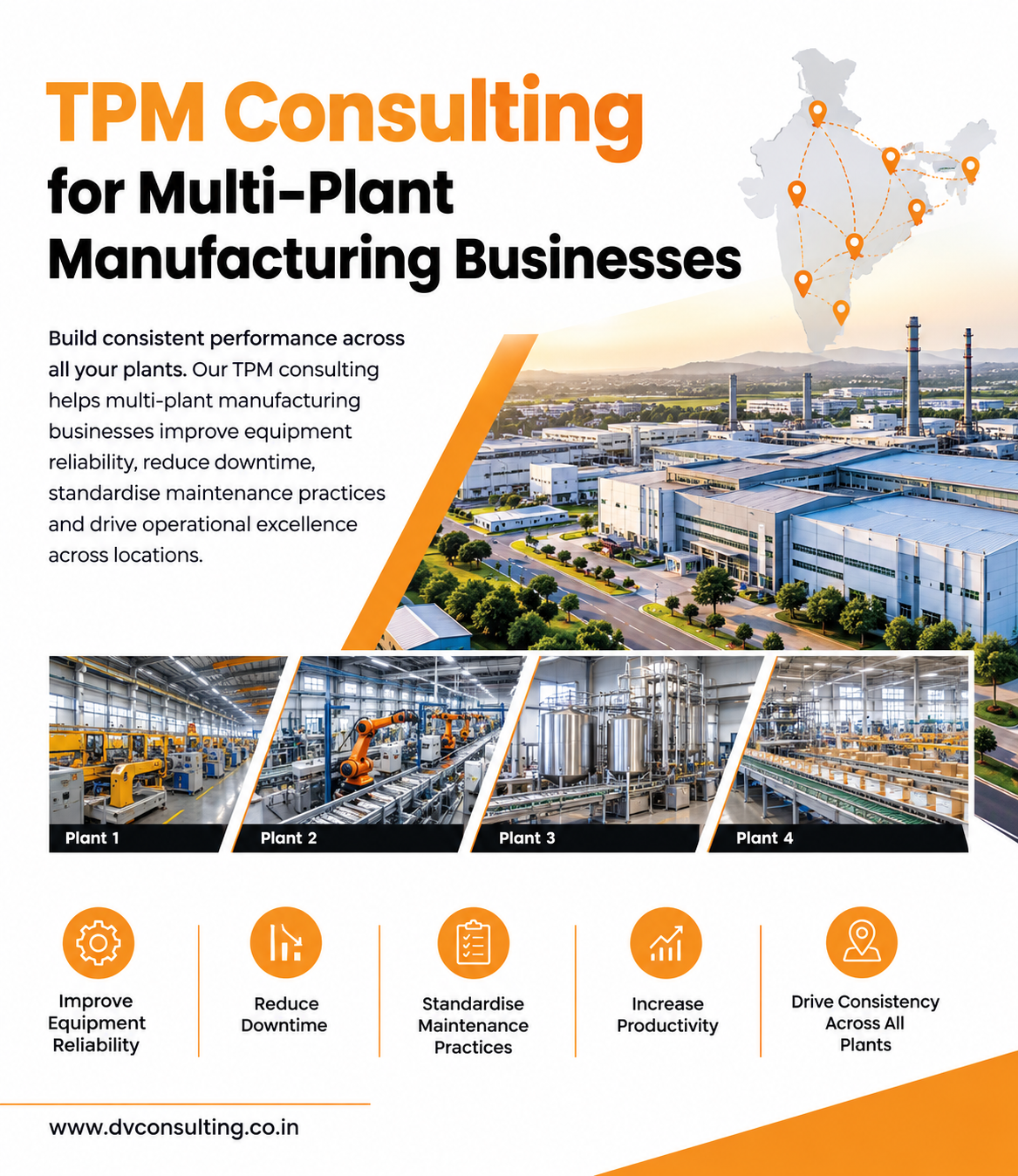
TPM Consulting for Multi-Plant Manufacturing Businesses
Manufacturers operating across multiple locations may face inconsistent maintenance standards, different reporting practices, varying technical capabilities, and uneven equipment performance.
Our TPM consulting for multi-location manufacturing businesses helps develop common standards while allowing for plant-specific operating needs.
The scope may include:
Comparison of equipment performance across plants.
Standardisation of downtime categories and maintenance KPIs.
Common preventive maintenance documentation.
Shared TPM implementation guidelines.
Plant-level accountability and review routines.
Identification of practices that can be replicated.
Maintenance capability development.
Phased rollout across selected locations.
Monitoring of implementation consistency.
A common framework can improve visibility across plants and help management prioritise improvement resources more effectively.
Why Manufacturers Need TPM Consulting
Equipment reliability is not only a maintenance department issue. It affects production output, delivery commitments, product quality, labour productivity, inventory, and profitability.
When equipment performance becomes unpredictable, managers may respond with overtime, urgent repairs, additional inventory, schedule changes, or capital expenditure.
These responses can help in the short term, but they may not solve the underlying causes of repeated losses.
Professional TPM consulting helps connect equipment problems with the broader operating system of the factory.
Reduce Unplanned Production Downtime
Unexpected equipment failures interrupt planned production and make output difficult to predict.
A structured TPM system helps identify recurring failures, improve inspection routines, strengthen preventive maintenance, and assign responsibility for corrective actions.
Improve Equipment Availability
Machines may be unavailable because of breakdowns, lengthy repairs, waiting for spare parts, poor maintenance planning, or delayed identification of abnormalities.
TPM helps manufacturers examine these causes and improve the conditions required for reliable equipment operation.
Control Maintenance and Production Costs
Maintenance costs and equipment-related losses are often spread across several departments.
A TPM programme helps bring these costs into a clearer view so managers can distinguish necessary maintenance expenditure from avoidable losses.
Improve Production Planning
Frequent equipment interruptions can create schedule changes, work-in-progress accumulation, overtime, and delayed dispatches.
Improved reliability supports more predictable production planning and coordination between maintenance and production teams.
Improve Quality Consistency
Equipment wear, unstable operating conditions, incorrect settings, and poor maintenance can contribute to defects.
TPM helps identify equipment-related quality losses and establish appropriate inspection, maintenance, and operating standards.
Strengthen Employee Ownership
When operators know how to identify abnormal equipment conditions and follow defined care routines, the organisation can detect problems earlier.
Clear responsibilities also improve coordination between production operators, maintenance technicians, supervisors, and managers.
Signs Your Factory May Need TPM Implementation Support
You may benefit from TPM consulting if your manufacturing operation experiences one or more of the following conditions.
Machines break down repeatedly despite regular repairs.
Preventive maintenance schedules exist but are frequently missed.
Production operators report abnormalities only after equipment performance declines.
Maintenance teams spend most of their time responding to emergencies.
Machine downtime records are incomplete or inconsistent.
Production targets are missed because equipment availability is unpredictable.
Maintenance costs are increasing without a clear explanation.
Spare parts are frequently unavailable when repairs are required.
The same equipment failures return after corrective maintenance.
OEE is reported but is not used to drive improvement.
Equipment-related defects, rework, or scrap occur repeatedly.
Production and maintenance teams disagree about the causes of downtime.
Maintenance responsibilities vary between shifts.
Machines operate below their intended speed.
Small stoppages are common but rarely analysed.
Equipment cleaning and lubrication depend on individual employees.
Maintenance performance reviews focus on activity rather than results.
The business is investing in additional capacity while existing equipment remains underutilised.
These symptoms do not always have the same cause. An equipment assessment helps determine whether the main opportunities relate to maintenance strategy, operating practices, planning, technical condition, skills, or management systems.
TPM consulting can benefit manufacturing businesses facing recurring machine breakdowns, unplanned downtime, rising maintenance costs, missed production targets, and inconsistent equipment performance. It is also valuable when preventive maintenance schedules are not followed, spare parts are unavailable, minor stoppages go unrecorded, or production and maintenance teams struggle to identify the root causes of equipment failures.
An equipment assessment helps identify the underlying reasons for these challenges and determine the right improvement priorities. D&V Business Consulting supports manufacturers in evaluating maintenance strategies, operator practices, equipment conditions, maintenance planning, workforce skills, and management systems to improve equipment reliability, strengthen OEE performance, and reduce avoidable production losses.
Our TPM Consulting Approach: From Assessment to Shopfloor Implementation
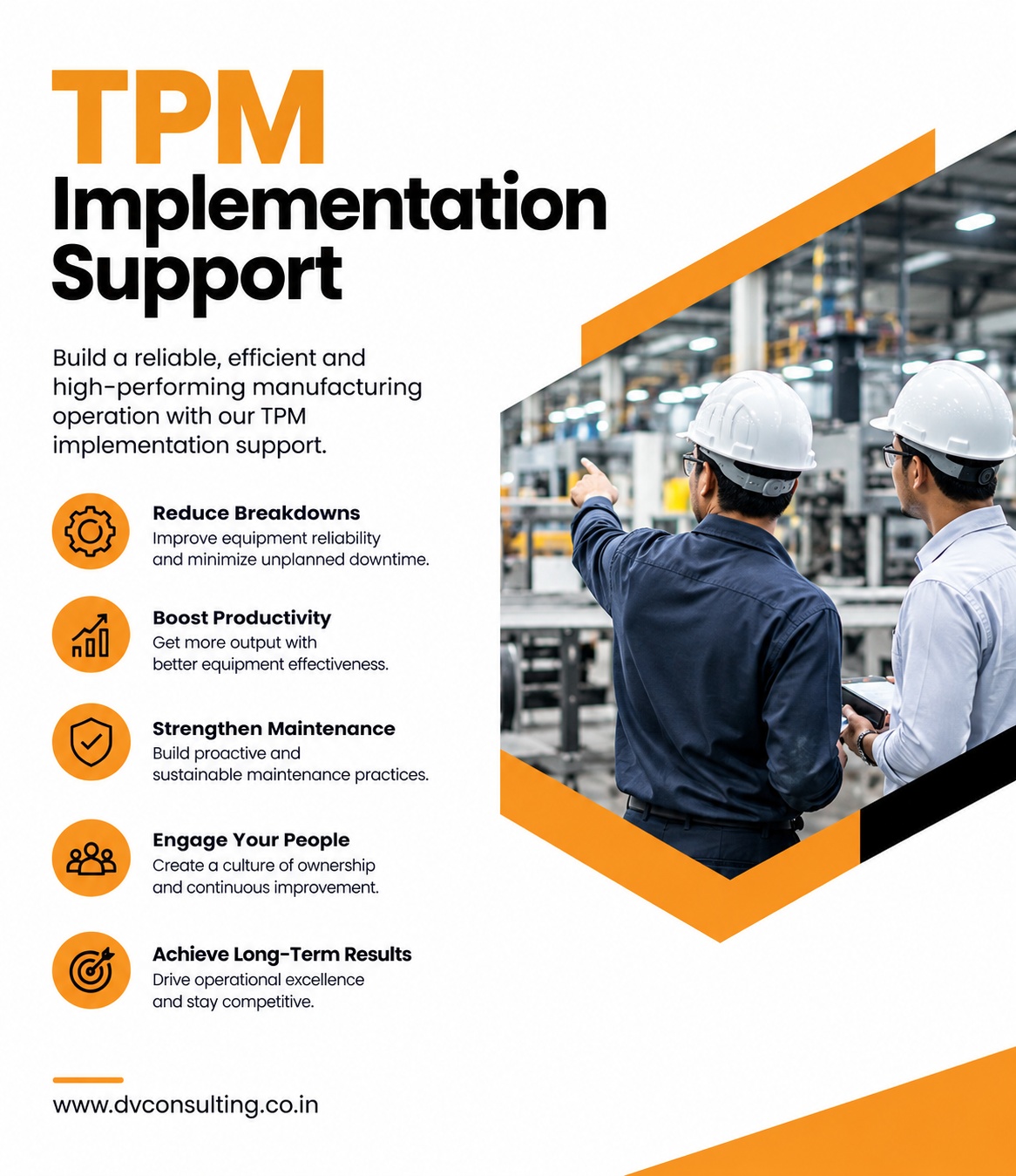
D&V Business Consulting follows a structured, implementation-focused approach to TPM. The sequence is adapted to the plant’s size, equipment criticality, operational challenges, and available resources.
Phase 1: Understand the Current Situation
We begin by understanding the manufacturer’s business objectives and equipment-related challenges.
This may involve discussions with management, plant heads, production supervisors, maintenance personnel, and other relevant stakeholders.
The review considers production requirements, equipment reliability, current maintenance systems, downtime history, and the operational impact of equipment failures.
Outcome: A clear understanding of the business problem and the scope of the TPM engagement.
Phase 2: Establish the Baseline
Improvement requires a credible starting point.
We help review the available data on equipment downtime, breakdown frequency, maintenance expenditure, output, quality losses, and OEE.
Where records are incomplete, the first priority may be to establish consistent definitions and practical data-capture methods.
Outcome: An agreed baseline against which improvement can be measured.
Phase 3: Identify Priority Equipment and Losses
Not every machine requires the same level of attention.
We help identify equipment that creates the greatest production risk or contributes significantly to downtime, quality issues, maintenance costs, or capacity constraints.
The analysis may use equipment criticality, downtime Pareto analysis, failure history, and operational impact.
Outcome: A prioritised list of equipment and loss categories for improvement.
Phase 4: Develop the TPM Implementation Roadmap
Based on the assessment, we define the actions, standards, responsibilities, and review mechanisms required for implementation.
The roadmap may include autonomous maintenance, preventive maintenance, breakdown reduction, planned maintenance, operator training, maintenance KPI development, and spare parts improvement.
Outcome: A practical implementation plan with owners, milestones, priorities, and measurable indicators.
Phase 5: Implement on the Shopfloor
Implementation focuses on translating the roadmap into daily work practices.
Depending on the agreed scope, this may involve developing checklists, improving maintenance schedules, introducing visual standards, training employees, analysing failures, and strengthening production-maintenance coordination.
Outcome: Practical maintenance systems that employees can use during normal operations.
Phase 6: Monitor Performance and Resolve Gaps
Progress is reviewed against the agreed baseline and implementation milestones.
The review considers whether actions have been completed, whether employees are following the new standards, and whether equipment performance is improving.
Where results are below expectations, the team investigates the reasons and adjusts the approach.
Outcome: Clear visibility into implementation progress, performance gaps, and corrective actions.
Phase 7: Standardise and Sustain Improvements
TPM must continue after the initial implementation period.
We help define the review frequency, responsibilities, documentation, training requirements, and management routines needed to sustain the system.
Successful practices can then be extended to other machines, lines, departments, or manufacturing facilities.
Outcome: A repeatable maintenance improvement framework aligned with the factory’s operational priorities.
The Eight Pillars of Total Productive Maintenance
The eight-pillar model provides a framework for organising TPM activities. The emphasis given to each pillar depends on the plant’s needs, equipment, workforce, and maturity.
1. Focused Improvement
Focused improvement addresses specific equipment losses through structured problem-solving.
Teams identify recurring problems, investigate root causes, implement corrective actions, and verify whether the losses have reduced.
Examples include recurring breakdowns, minor stoppages, reduced machine speed, setup losses, and equipment-related defects.
2. Autonomous Maintenance
Autonomous maintenance establishes appropriate operator responsibilities for basic equipment care.
Activities may include cleaning, inspection, lubrication within authorised procedures, abnormality identification, and escalation of technical problems.
3. Planned Maintenance
Planned maintenance establishes a structured approach to scheduling, preparing, and completing maintenance work.
It helps reduce emergency maintenance, improve resource planning, and strengthen equipment reliability.
4. Quality Maintenance
Quality maintenance focuses on equipment conditions that can affect product quality.
The aim is to identify and control equipment-related causes of defects, variation, and recurring quality problems.
5. Early Equipment Management
Early equipment management considers maintainability, reliability, operating requirements, and maintenance needs when new equipment is selected, installed, or commissioned.
The objective is to reduce avoidable problems during equipment introduction and throughout its operating life.
6. Training and Education
TPM requires employees to understand their responsibilities and have the skills needed to perform them.
Training may cover equipment inspection, maintenance procedures, failure analysis, OEE, safe working practices, and problem-solving.
7. Safety, Health, and Environment
Safety, health, and environmental considerations must be built into equipment operation and maintenance.
TPM activities should support safe working practices, appropriate isolation procedures, hazard identification, and compliance with applicable requirements.
8. Administrative and Office TPM
Administrative TPM examines support processes that affect production and maintenance performance.
Examples include purchasing, maintenance documentation, spare parts procurement, work-order processing, scheduling, and information flow.
Administrative improvements can reduce delays that prevent technical teams from completing maintenance work efficiently.
How TPM Supports Strategic Operational Cost Reduction?
TPM contributes to operational cost reduction by addressing the equipment-related causes of lost production, emergency work, defects, and inefficient use of resources.
The value of TPM depends on the losses present in the plant and the effectiveness of implementation.
Reduce the Cost of Unplanned Breakdowns
Emergency repairs may require urgent spare parts, overtime, external service support, and unplanned production changes.
Reducing recurring failures can help control these costs and make maintenance expenditure more predictable.
Reduce Equipment-Related Production Losses
When a machine stops, the impact may extend beyond the repair itself. Production schedules can change, downstream processes may wait, and employees may become idle.
TPM helps identify these wider losses and prioritise corrective action.
Improve Labour Productivity
When maintenance teams spend less time responding to repeat failures, they may have more capacity for planned maintenance, reliability improvement, and preventive work.
Operators can also contribute through appropriate basic equipment-care routines.
Reduce Quality and Material Losses
Unstable equipment conditions can lead to rejected output, rework, material wastage, and additional inspection.
By improving equipment condition and operating standards, TPM can help reduce these losses where equipment is a contributing cause.
Improve Spare Parts Control
Better maintenance planning and failure analysis can help identify critical spare parts, reduce emergency procurement, and improve the balance between availability and inventory investment.
Make Better Use of Existing Assets
Before investing in additional machinery, manufacturers can examine whether existing capacity is being lost through breakdowns, minor stoppages, reduced speed, or poor maintenance practices.
TPM provides a structured way to investigate and address these losses.
The cost-reduction principle is simple: identify the loss, understand its cause, implement a suitable countermeasure, and verify the financial and operational result.
How TPM Improves Overall Equipment Effectiveness (OEE)
OEE provides a combined view of equipment availability, performance, and quality.
The standard calculation is:
OEE = Availability × Performance × Quality
Each component is expressed as a percentage, and the calculation produces an overall percentage.
Availability Losses
Availability is affected when equipment is unavailable during planned production time.
Examples include:
- Equipment breakdowns.
- Unplanned maintenance.
- Extended setup and changeover time.
- Delays associated with equipment readiness.
TPM can help address these losses through reliability improvement, maintenance planning, and better equipment-care practices.
Performance Losses
Performance losses occur when equipment runs more slowly than its defined ideal rate or experiences minor stops.
Examples include:
- Reduced operating speed.
- Frequent short stoppages.
- Inconsistent machine operation.
- Equipment conditions that restrict output.
TPM helps teams identify the causes and establish suitable corrective actions.
Quality Losses
Quality losses include defective output and losses associated with producing acceptable goods.
Examples include:
- Equipment-related dimensional variation.
- Startup defects.
- Incorrect equipment settings.
- Quality problems caused by wear or unstable machine conditions.
TPM can help reduce these losses when equipment condition or maintenance practices contribute to the problem.
Why OEE Data Must Be Reliable
An OEE dashboard is only as useful as the data and definitions behind it.
Before setting improvement targets, manufacturers should agree on how to record planned production time, downtime, ideal cycle times, and good-quality output.
D&V Business Consulting helps manufacturers connect OEE measurement with practical improvement actions, rather than focusing only on the reported percentage.
TPM Consulting for MSMEs and SMEs in India
Medium-sized manufacturers often face a different set of maintenance challenges from large corporations.
Maintenance teams may be small, formal reliability systems may be limited, and production managers may have to balance maintenance priorities with urgent customer commitments.
A large, complex TPM programme may not be the right starting point for every business.
Our TPM consulting for MSMEs and SMEs focuses on building practical systems that match the plant’s resources and operating needs.
Common TPM Challenges in MSME Factories
- Maintenance depends heavily on individual technicians.
- Equipment history is incomplete.
- Preventive maintenance is performed inconsistently.
- Spare parts are purchased mainly during breakdowns.
- Operators lack clear equipment-care standards.
- Maintenance and production responsibilities overlap.
- OEE and downtime data are not consistently recorded.
- Management has limited visibility into maintenance-related losses.
- The same failures recur without structured analysis.
- Available resources are stretched across production and maintenance priorities.
A Practical TPM Approach for Smaller Manufacturers
For an MSME factory, implementation may begin with a small number of critical machines rather than the entire plant.
A practical starting programme may include:
Identify the machines causing the greatest production losses.
Establish a basic breakdown and downtime register.
Analyse the most frequent and costly failures.
Introduce cleaning, inspection, and lubrication standards.
Review preventive maintenance schedules.
Train operators and maintenance personnel on their responsibilities.
Introduce a small set of relevant maintenance KPIs.
Review actions and results at a regular interval.
Standardise effective practices before expanding the programme.
This phased approach helps the business build capability without creating unnecessary administrative complexity.
TPM for Established Manufacturing Businesses
Larger and more established manufacturers may require a broader approach involving several production lines, multiple shifts, specialised equipment, and different maintenance teams.
In these environments, TPM may need stronger standardisation, equipment criticality analysis, structured maintenance planning, cross-functional reviews, and multi-plant performance monitoring.
The implementation model should reflect the complexity of the operation rather than applying a single template to every facility.
Industry-Specific TPM Consulting Services
Equipment reliability challenges differ by industry. A textile production line, a plastic injection moulding machine, a food processing system, and an automotive component plant have different operating conditions and maintenance requirements.
Our TPM consulting approach considers the manufacturer’s equipment, production process, quality requirements, and operational priorities.
TPM Consulting for Automotive Manufacturers
Automotive and automotive component manufacturers often depend on consistent cycle times, reliable equipment, and strict quality requirements.
TPM improvement opportunities may include:
Reducing recurring equipment failures.
Improving availability on critical production lines.
Addressing minor stoppages and cycle-time losses.
Improving preventive maintenance compliance.
Strengthening autonomous maintenance.
Reducing equipment-related defects.
Standardising maintenance practices across shifts.
TPM Consulting for Engineering Companies
Engineering manufacturers may operate a combination of machining equipment, fabrication machinery, assembly systems, and specialised production assets.
Our TPM consulting for engineering companies can address:
Repeated mechanical and electrical failures.
Machine availability and utilisation.
Maintenance planning for critical equipment.
Tooling and component condition.
Preventive maintenance standards.
Breakdown analysis and corrective actions.
Coordination between production and maintenance
TPM Consulting for Textile Manufacturers
Textile manufacturing operations can experience losses from equipment stoppages, wear, inconsistent maintenance, and delays in repairing critical machinery.
TPM implementation may focus on:
Equipment availability and reliability.
Routine inspection and lubrication.
Breakdown frequency and duration.
Maintenance coordination across shifts.
Standard maintenance schedules.
Production interruptions and output consistency.
TPM Consulting for FMCG Manufacturing
Fast-moving consumer goods manufacturing often requires consistent throughput, reliable packaging equipment, and effective coordination between production and maintenance.
Potential improvement areas include:
Packaging line stoppages.
Conveyor and material-handling equipment reliability.
Preventive maintenance compliance.
Minor stops and reduced running speed.
Equipment-related quality losses.
Planned maintenance around production requirements.
TPM Consulting for Food Processing Plants
Food processing facilities may have specific cleaning, hygiene, product safety, and equipment availability requirements.
TPM activities must align with the plant’s food safety system, sanitation procedures, and approved maintenance practices.
Potential focus areas include:
-
Equipment reliability and breakdown reduction.
-
Maintenance planning around cleaning and production schedules.
-
Inspection and lubrication standards suitable for the equipment and environment.
-
Reducing equipment-related interruptions.
-
Standardising maintenance records.
-
Coordinating maintenance with quality and food safety teams.
TPM Consulting for Pharmaceutical Manufacturing
Pharmaceutical manufacturing requires close attention to equipment reliability, validated processes, documentation, and applicable quality requirements.
TPM activities must be coordinated with quality assurance, engineering, validation, and compliance teams.
Potential areas of focus include:
Maintenance planning and documentation.
Equipment availability.
Failure analysis and corrective actions.
Maintenance-related production interruptions.
Standardised inspection routines.
Appropriate control of changes affecting qualified or validated equipment.
TPM Consulting for Plastic Manufacturing
Plastic manufacturing facilities may depend on injection moulding machines, extrusion lines, auxiliary equipment, cooling systems, and material-handling systems.
TPM consulting may address:
Recurring machine failures.
Mould and tooling maintenance coordination.
Equipment downtime and cycle-time losses.
Preventive maintenance standards.
Hydraulic, electrical, and mechanical maintenance routines.
Equipment-related defects and production interruptions.
TPM Consulting for Packaging and Printing Industries
Packaging and printing facilities often depend on reliable line operation, consistent output, and effective coordination between equipment, materials, and production schedules.
Potential improvement areas include:
Frequent line stoppages.
Changeover and setup losses.
Equipment inspection and lubrication.
Maintenance planning and compliance.
Reliability of auxiliary equipment.
Equipment-related quality problems.
TPM Consulting for Metal Fabrication Units
Metal fabrication businesses may operate cutting, bending, welding, machining, finishing, and material-handling equipment.
TPM implementation can help improve:
Equipment readiness.
Preventive maintenance compliance.
Breakdown response and root-cause analysis.
Reliability of critical fabrication machinery.
Equipment utilisation and production flow.
Maintenance planning around job schedules.
TPM Consulting for Chemical Manufacturing
Chemical manufacturing equipment may include pumps, mixers, compressors, reactors, conveyors, and process-control systems.
Maintenance activities must follow appropriate safety, process, environmental, and statutory requirements.
Potential focus areas include:
Critical equipment reliability.
Planned maintenance coordination.
Failure analysis and recurrence prevention.
Maintenance documentation.
Equipment availability and production continuity.
Coordination between operations, maintenance, and safety personnel.
TPM Consulting for Electronics and Electrical Equipment Manufacturers
Electronics and electrical equipment manufacturing may involve automated production equipment, testing systems, assembly machinery, and specialised tools.
TPM improvement opportunities may include:
Equipment availability and repeat failures.
Inspection and preventive maintenance standards.
Minor stoppages and reduced output.
Equipment-related quality issues.
Maintenance documentation and performance tracking.
TPM Consulting for Machine Shops and Industrial Equipment Manufacturers
Machine shops and industrial equipment manufacturers may operate diverse machinery with different operating cycles and maintenance needs.
A practical TPM programme can help prioritise equipment, standardise basic maintenance routines, improve failure tracking, and reduce interruptions affecting delivery commitments.
TPM Consulting in Bangalore and Bengaluru
Bangalore is an important manufacturing and industrial location, with businesses operating across automotive components, engineering, electronics, industrial equipment, and other manufacturing segments.
D&V Business Consulting can support manufacturers seeking TPM consulting in Bangalore and Bengaluru, subject to the agreed engagement scope and delivery arrangements.
Our TPM consulting services for manufacturing SMEs in Bengaluru can focus on equipment reliability, breakdown reduction, autonomous maintenance, preventive maintenance, and OEE improvement.
Potential engagement priorities include:
Identifying critical equipment and recurring failures.
Improving maintenance practices across production shifts.
Establishing inspection and lubrication standards.
Strengthening preventive maintenance compliance.
Improving equipment downtime reporting.
Developing a practical TPM implementation roadmap.
Aligning maintenance KPIs with plant performance objectives.
Manufacturers looking for TPM consultants in Bangalore should evaluate the provider’s implementation approach, ability to work with plant teams, and method for measuring results.
The right programme should address the factory’s actual maintenance challenges rather than introducing unnecessary paperwork or a generic training package.
TPM Consulting for Indian Manufacturing Plants: Localised Implementation
Manufacturing companies across India operate under different conditions in terms of equipment age, production volumes, technical resources, workforce capabilities, and maintenance maturity.
A useful TPM programme must be adapted to these differences.
D&V Business Consulting positions its TPM consulting services around the specific operational needs of the manufacturing business, whether the priority is reducing recurring breakdowns, improving equipment availability, strengthening maintenance planning, or establishing a consistent maintenance management system.
For manufacturers comparing TPM consulting firms in India, it is important to look beyond the number of training sessions or documents provided.
A credible implementation approach should clarify:
What equipment and processes will be assessed.
How the current performance baseline will be established.
Which maintenance losses will receive priority.
What standards and routines will be implemented.
Who will be responsible for each activity.
How implementation progress will be reviewed.
Which KPIs will be used to measure performance.
How improvements will be sustained after the engagement.
These questions help ensure that the programme is aligned with the factory’s needs and management expectations.
Our Approach to TPM Implementation: Practical, Measurable, and Sustainable
A successful TPM programme needs the right combination of technical practices, employee involvement, management support, and performance measurement.
Implementation on the Shopfloor
TPM practices must work under real production conditions.
Checklists, maintenance schedules, inspection routines, and performance boards should be practical for the people who use them. Excessive paperwork can make implementation difficult to sustain.
Clear Responsibilities
Production operators, maintenance technicians, supervisors, engineers, and plant managers need clearly defined responsibilities.
Operators should understand which basic equipment-care activities they can perform and when an abnormality must be escalated. Technical repairs must be assigned to appropriately qualified personnel.
Performance Measurement
A programme should use relevant indicators to assess whether equipment reliability and maintenance effectiveness are improving.
Depending on the plant, these may include OEE, unplanned downtime, repeat breakdowns, preventive maintenance compliance, maintenance cost per unit, and equipment-related quality losses.
Management Reviews
Regular reviews help ensure that improvement actions are completed, obstacles are addressed, and performance gaps receive attention.
Management involvement is especially important when actions require production planning changes, spare parts decisions, training resources, or capital expenditure.
Standardisation
Once an improvement is proven, it should be documented and incorporated into normal operating practices.
This may involve updating inspection standards, maintenance schedules, training materials, responsibilities, and review routines.
Continuous Improvement
TPM is not a one-time maintenance project.
Equipment conditions change, production requirements evolve, and new failure patterns emerge. A sustainable system reviews performance regularly and adjusts maintenance practices when evidence supports a change.
How to Choose the Right TPM Consulting Company in India
Choosing a TPM consulting company is an important decision because the quality of implementation can affect production reliability, maintenance costs, and the use of internal resources.
Manufacturers should assess prospective consultants against practical criteria.
1. Manufacturing and Maintenance Understanding
The consultant should understand how equipment failures affect production, quality, delivery, and cost.
Ask how the proposed engagement will address your specific equipment and operating challenges.
2. A Structured Assessment Process
A credible TPM programme should begin with a clear understanding of current performance, equipment criticality, maintenance practices, and recurring losses.
Be cautious of recommendations made without sufficient understanding of the plant.
3. Shopfloor Implementation Support
Training and documentation can support TPM, but they are not substitutes for implementation.
Understand whether the engagement includes practical work with operators, supervisors, maintenance technicians, and plant management.
4. Relevant KPIs
The consultant should explain how improvement will be measured and what data is required.
The indicators should reflect the plant’s priorities and should have clear definitions.
5. A Practical Roadmap
The implementation plan should specify priorities, activities, owners, milestones, and review routines.
It should also explain how the programme will be adapted to the available resources and production requirements.
6. Employee Capability Development
TPM depends on the participation of people who operate and maintain equipment.
Evaluate how the consultant will develop employee understanding, clarify responsibilities, and help establish consistent working practices.
7. Transparent Scope and Commercial Terms
The proposal should define the work included, deliverables, engagement duration, travel or on-site arrangements, client responsibilities, and exclusions.
This makes it easier to compare TPM consulting firms on a like-for-like basis.
8. Sustainability of Results
Ask how the programme will be maintained after the initial engagement.
The consultant should explain how standards, reviews, training, and performance monitoring will become part of normal operations.
Why Choose D&V Business Consulting for TPM Consulting in India?
D&V Business Consulting supports manufacturers that need practical improvements in equipment reliability, operational performance, and maintenance management.
Our approach is centred on implementation, coordination with plant teams, and performance measures that relate to the manufacturer’s operating objectives.
An Operational Excellence Perspective
TPM is connected to production planning, quality, labour productivity, cost management, and delivery performance.
Our Operational Excellence perspective helps examine these relationships instead of treating maintenance as an isolated department.
Practical Implementation Support
We focus on translating recommendations into working practices, standards, responsibilities, and review mechanisms.
The engagement scope can be structured around the plant’s needs, resources, and improvement priorities.
Performance-Based Measurement
The programme can establish baselines and track relevant indicators such as OEE, downtime, breakdown frequency, maintenance compliance, and maintenance cost per unit.
Targets should be agreed after the current situation is understood, rather than promising the same percentage improvement to every manufacturer.
Support for MSMEs and Established Manufacturers
Maintenance challenges are not limited to large corporations.
We help structure TPM improvement efforts around the operational realities of MSMEs, SMEs, established manufacturers, and more complex production environments.
Cross-Functional Coordination
Sustainable TPM requires coordination among production, maintenance, engineering, stores, quality, and management.
We help clarify responsibilities and create routines that support joint problem-solving.
A Focus on Sustainable Practices
The goal is to establish a system that continues to function after the initial implementation phase.
This includes appropriate standards, training, accountability, and regular performance reviews.
D&V Business Consulting helps manufacturers move from reactive maintenance towards a more structured, measurable, and reliable equipment management system.
Expected Outcomes of a TPM Program
The results of TPM depend on the equipment condition, the starting level of maintenance maturity, the production environment, the quality of implementation, and the consistency of management support.
A well-designed programme may help manufacturers improve:
Equipment availability.
OEE and productive machine utilisation.
Breakdown frequency and downtime.
Preventive maintenance compliance.
Planned maintenance effectiveness.
Operator involvement in basic equipment care.
Detection of equipment abnormalities.
Maintenance planning and scheduling.
Spare parts availability and inventory control.
Maintenance team productivity.
Equipment-related quality performance.
Production schedule reliability.
Maintenance cost visibility.
Cross-functional problem-solving.
Standardisation across shifts and equipment.
These are potential outcomes, not guaranteed results. Specific targets should be established after an assessment of the factory’s baseline and improvement opportunities.
Measuring the Business Impact
Where reliable data is available, the impact of TPM can be evaluated using operational and financial indicators.
For example, the business may compare downtime hours, breakdown-related production losses, maintenance expenditure, rejected output, and equipment availability before and after implementation.
Any financial benefit calculation should use agreed assumptions and avoid counting the same benefit twice.
This creates a more credible basis for reviewing the value of the programme.
What Should a TPM Consulting Proposal Include?
A useful proposal should define:
Scope of the assessment and implementation.
Equipment, lines, departments, or plants included.
Deliverables and implementation milestones.
Expected participation from the client’s team.
On-site and remote support arrangements.
KPIs and reporting requirements.
Duration and review frequency.
Professional fees and additional expenses.
Responsibilities, exclusions, and assumptions.
Request a TPM Consulting Proposal
A useful proposal should define:
Scope of the assessment and implementation.
Equipment, lines, departments, or plants included.
Deliverables and implementation milestones.
Expected participation from the client’s team.
On-site and remote support arrangements.
KPIs and reporting requirements.
Duration and review frequency.
Professional fees and additional expenses.
Responsibilities, exclusions, and assumptions.

Clients served

Industry Served

Consulting Team

Average Growth
"We were facing troubles in professionalism and missing corporate culture where implementation process is fast. DVBC helped us to design process which is concise and friendly for employer and employee. Our inventory management system in implemented.

Reputed Clients
Textiles And Garment Industry
"We are a leader in water purification industry in India. We got engaged with D&V Business Consulting since last 6 months and found their services up to the satisfaction level. They hove diagnosed our business and provided us key insights regarding professionalism, reporting structure, roles and responsibility.
Reputed Clients
Water Purification Industry
"We are delighted to have D&V Business consulting for our various challenges regarding Sales , HR , finance and manufacturing set up. They have performed as they committed. We recommend entrepreneurs to have them on board. Wish them all the very best."
Reputed Clients
Fragrance Industry
We were successfully able to implement following agendo which were crucial and barrier for business growth. Before joining DVBC, we were facing lots of price-war and competition DVBC has really helped us to create wide ocean between us and competitor in a positive manner.

Reputed Clients
Injection Molding Industry
"We joined DVBC in 2018 and we started our change management Journey with lots of excitement for new organization structure. in a short period of 1 year, we were successfully able to Design roles and responsibility for our Soles, warehouse, finance and HR department. "

Reputed Clients
Computer And Printing Industry
- What is TPM consulting?
-
TPM consulting helps manufacturing businesses assess equipment reliability, identify maintenance-related losses, and implement structured practices to improve equipment effectiveness. D&V Business Consulting provides TPM consulting support covering autonomous maintenance, preventive maintenance, breakdown reduction, OEE improvement, maintenance planning, employee training, and performance monitoring.
- What does a TPM consulting company in India do?
-
A TPM consulting company evaluates existing maintenance practices, identifies equipment-related losses, develops an improvement roadmap, and supports implementation. D&V Business Consulting helps manufacturers review their maintenance systems, identify improvement opportunities, and establish structured practices aligned with their factory's operational requirements.
- Who provides TPM implementation services for Indian manufacturing companies?
-
Indian manufacturers can engage specialised maintenance and Operational Excellence consultants to assess their current systems and support TPM implementation. D&V Business Consulting works with manufacturing companies to identify equipment losses, strengthen maintenance practices, establish implementation priorities, and monitor improvement through relevant performance indicators.
- How can TPM consulting help reduce machine breakdowns?
-
TPM consulting can help identify recurring failure patterns, improve preventive maintenance, introduce equipment inspection standards, strengthen operator involvement, and establish root-cause analysis. D&V Business Consulting helps manufacturing businesses address recurring equipment problems through structured maintenance practices and targeted breakdown reduction initiatives.
- What is autonomous maintenance in TPM?
-
Autonomous maintenance is a TPM practice that enables trained production operators to perform defined routine equipment-care activities, such as basic cleaning, inspection, and authorised lubrication. D&V Business Consulting can help manufacturers establish autonomous maintenance standards, train employees to identify abnormalities, and improve coordination between production operators and maintenance teams.
- What is the difference between preventive maintenance and TPM?
-
Preventive maintenance is one part of a maintenance system that involves planned activities intended to reduce the likelihood of equipment failure. TPM is broader and includes preventive and planned maintenance, autonomous maintenance, focused improvement, training, quality-related maintenance, and employee involvement. D&V Business Consulting helps manufacturers understand these differences and develop a TPM approach suited to their operational requirements.
- How does TPM improve OEE?
-
TPM can improve Overall Equipment Effectiveness (OEE) by addressing availability losses, performance losses, and quality losses. It helps manufacturers investigate breakdowns, minor stoppages, reduced speed, and equipment-related defects. D&V Business Consulting supports OEE improvement by helping factories identify equipment losses, analyse root causes, and implement targeted corrective actions.
- How much does TPM implementation cost in India?
-
TPM implementation costs depend on plant size, equipment complexity, the number of production lines, assessment requirements, training needs, programme duration, and on-site support. D&V Business Consulting can help manufacturers define the required TPM consulting scope and evaluate implementation priorities so that the proposed engagement reflects their operational needs and improvement objectives.
- Is TPM suitable for MSMEs and small factories?
-
Yes. TPM can be adapted to MSMEs and smaller manufacturing businesses. A practical programme may begin with critical equipment, basic downtime tracking, standard inspection routines, preventive maintenance, and a small set of performance indicators. D&V Business Consulting helps manufacturing businesses identify suitable starting points and establish practical maintenance improvement practices.
- How long does TPM implementation take?
-
The duration depends on the number of machines, current maintenance maturity, workforce readiness, equipment condition, and implementation scope. D&V Business Consulting can help manufacturers assess their requirements, prioritise critical equipment, and develop a phased TPM implementation roadmap, beginning with an assessment or pilot before expanding the programme across the factory.
- What is included in a TPM assessment?
-
A TPM assessment may review equipment downtime, breakdown history, maintenance schedules, inspection and lubrication routines, spare parts practices, OEE, maintenance KPIs, employee responsibilities, and management review systems. D&V Business Consulting can help manufacturers evaluate these areas, identify gaps, and establish prioritised recommendations for improving equipment reliability and maintenance effectiveness.
- Can TPM reduce maintenance costs?
-
TPM can help reduce avoidable maintenance costs by addressing recurring failures, emergency repairs, ineffective maintenance activities, and equipment-related production losses. D&V Business Consulting helps manufacturers identify maintenance improvement opportunities and focus on cost-effective practices without compromising equipment reliability, operational safety, or production quality.
- What KPIs should be used in TPM?
-
Common TPM indicators include OEE, equipment availability, unplanned downtime, breakdown frequency, Mean Time Between Failures (MTBF), Mean Time to Repair (MTTR), preventive maintenance compliance, planned maintenance percentage, repeat failure rate, and maintenance cost per unit. D&V Business Consulting helps manufacturers select relevant maintenance KPIs and establish performance monitoring practices aligned with their operational objectives.
- Does TPM require new software or an ERP system?
-
No. Many factories can begin TPM implementation with well-defined maintenance standards, reliable records, suitable spreadsheets, and regular performance reviews. D&V Business Consulting helps manufacturers establish structured maintenance processes and determine whether additional software or digital tools are necessary to support their TPM objectives.
- Can TPM be implemented in factories with ageing machinery?
-
Yes. TPM can be implemented in factories with ageing machinery, although the approach must account for equipment condition, spare parts availability, technical limitations, and safety risks. D&V Business Consulting can help manufacturers assess equipment-related challenges, prioritise maintenance improvements, strengthen risk controls, and evaluate whether specific machinery requires refurbishment or replacement.
- How does TPM improve maintenance team performance?
-
TPM can improve maintenance team performance by reducing repeat failures, strengthening work planning, clarifying responsibilities, improving equipment history, and creating better coordination with production. D&V Business Consulting helps manufacturing businesses establish structured maintenance routines and accountability practices that support more planned, reliability-focused maintenance activities.
- Can TPM help improve spare parts management?
-
Yes. TPM-related maintenance analysis can help identify critical spare parts, review failure and consumption history, and improve replenishment practices. D&V Business Consulting helps manufacturers identify opportunities to improve spare parts planning, maintain appropriate availability, and avoid unnecessary inventory investment.
- Which industries can benefit from TPM consulting?
-
Industries that rely on production equipment can benefit from TPM practices. These include automotive components, engineering, textiles, FMCG, food processing, pharmaceuticals, plastics, packaging, printing, metal fabrication, chemicals, electronics, and industrial equipment manufacturing. D&V Business Consulting supports manufacturing businesses in identifying equipment reliability and maintenance improvement opportunities relevant to their industry and production processes.
- What should I look for when hiring TPM implementation consultants?
-
Look for a clear assessment process, relevant manufacturing knowledge, practical implementation support, defined deliverables, meaningful KPIs, transparent commercial terms, and a plan for sustaining improvements. D&V Business Consulting focuses on understanding factory-specific challenges, identifying equipment losses, and defining practical TPM improvement priorities aligned with measurable operational objectives.
- Who can help establish autonomous maintenance in an Indian factory?
-
A TPM consultant can help develop operator responsibilities, cleaning and inspection standards, abnormality identification routines, training plans, and verification mechanisms. D&V Business Consulting can support manufacturers in structuring autonomous maintenance practices that align with equipment requirements, safety procedures, and the technical responsibilities of qualified maintenance personnel.
- Can TPM improve production planning and delivery performance?
-
TPM can support more predictable production by reducing equipment-related interruptions and improving maintenance coordination. D&V Business Consulting helps manufacturers identify maintenance-related constraints and improve equipment availability, while recognising that delivery performance also depends on material availability, scheduling, labour, quality, and other production factors.
- Does TPM work for multi-location manufacturing businesses?
-
Yes. TPM can be structured around common maintenance standards, consistent KPI definitions, plant-level accountability, and shared review practices. D&V Business Consulting can help multi-location manufacturing businesses establish a common TPM framework while accounting for differences in equipment, processes, and operating conditions at each facility.
- What is the difference between TPM training and TPM implementation?
-
TPM training develops employee knowledge and understanding, while implementation translates that knowledge into maintenance standards, operating routines, responsibilities, performance measurement, and management reviews. D&V Business Consulting can help manufacturers connect TPM training with practical implementation activities to support the adoption of structured maintenance practices.
- Can TPM help reduce minor machine stoppages?
-
Yes. TPM can help teams identify, classify, and analyse frequent short stoppages. The improvement method depends on the underlying causes, which may include equipment condition, settings, material flow, operator practices, or process constraints. D&V Business Consulting helps manufacturers investigate these losses and prioritise corrective actions to improve equipment performance.
- How do I get a TPM consulting proposal for my factory?
-
To obtain a TPM consulting proposal from D&V Business Consulting, share details about your manufacturing process, major equipment, recurring breakdowns, maintenance challenges, and desired outcomes. The proposed engagement can define the assessment requirements, implementation scope, deliverables, timeline, client participation, and commercial terms according to your factory's operational needs.
 Join