

Operational excellence consulting for Ceramics & Tiles manufacturing in India helps manufacturers improve production efficiency, reduce material waste, control manufacturing costs, strengthen product quality, and optimise factory performance. D&V Business Consulting works with ceramic and tile manufacturers to improve operational systems, implement lean manufacturing practices, streamline processes, and establish measurable performance improvements for sustainable business growth.
Operational Excellence Consulting for Ceramics & Tiles Manufacturing in India
D&V Business Consulting helps ceramics and tiles manufacturers improve factory productivity, control manufacturing costs, reduce production waste, strengthen quality systems, and build reliable shop-floor processes. Our operational excellence consulting approach focuses on practical improvements across production, maintenance, workforce performance, material handling, and management systems.
For ceramics and tiles manufacturers in India, particularly MSMEs and SMEs operating in competitive markets such as Morbi and Wankaner, small operational gaps can create significant financial pressure. Excessive kiln fuel consumption, inconsistent firing quality, high rejection rates, unplanned equipment downtime, poor production planning, and rising labour costs can reduce margins even when customer demand remains strong.
D&V Business Consulting works with business owners, directors, factory heads, and operations teams to identify these gaps and put practical improvement measures into action. The focus is on measurable business outcomes, accountable implementation, and systems your team can continue using after the consulting engagement.
Our operational excellence consulting for ceramics and tiles manufacturing covers key performance areas such as production planning, kiln and machinery utilisation, process standardisation, inventory control, preventive maintenance, and workforce productivity. By identifying bottlenecks, reducing non-value-added activities, and strengthening standard operating procedures (SOPs), D&V Business Consulting helps manufacturers establish more consistent production processes and improve the use of available resources.
Whether your plant manufactures ceramic tiles, vitrified tiles, porcelain tiles, or other ceramic products, D&V Business Consulting supports MSMEs and SMEs in developing practical improvement plans suited to their operational needs. Our implementation-focused approach helps management teams monitor key performance indicators (KPIs), address recurring production issues, improve coordination between departments, and build stronger management systems for long-term operational performance.
Looking to improve your ceramic or tile factory's performance? Discuss your current production challenges with D&V Business Consulting to identify suitable improvement priorities for your plant.
What Is Operational Excellence Consulting for Ceramic and Tiles Manufacturers?
Operational excellence consulting helps ceramic and tile manufacturers improve the way their factories operate by reducing avoidable losses, improving process consistency, and making better use of machines, materials, labour, energy, and production capacity.
The work begins with understanding the actual conditions on the shop floor. Consultants examine production data, process flow, machine performance, product quality, workforce practices, and management routines before recommending changes.
For a ceramic tile plant, this may include reducing breakage during handling, improving kiln performance monitoring, controlling glaze and body preparation losses, strengthening preventive maintenance, introducing 5S workplace organisation, and establishing standard operating procedures (SOPs).
The objective is not simply to introduce new tools or prepare reports. It is to help your team adopt practical working methods that support better output, lower avoidable costs, consistent quality, and more dependable delivery.
Operational Excellence Consulting for Ceramics & Tiles Manufacturing in India
The ceramic and tile manufacturing industry requires close coordination between production planning, raw material preparation, forming, drying, glazing, firing, sorting, finishing, packing, warehousing, and dispatch. A delay or performance issue at one stage can affect the output of several connected processes.
Operational excellence is about improving how these activities work together. It combines systematic problem-solving, production performance measurement, process standardisation, employee involvement, and continuous improvement to create a more productive, reliable, and cost-effective manufacturing operation.
D&V Business Consulting provides operational excellence consulting for ceramics manufacturing and tile production businesses that want to move beyond daily firefighting and establish more consistent factory performance.
Our work can address challenges such as:
High manufacturing and conversion costs.
Low production output despite significant machine capacity.
Excessive raw material consumption and process waste.
High tile rejection rates, rework, and quality inconsistencies.
Unplanned equipment downtime and production interruptions.
Uneven production flow between connected processes.
Poor coordination between production, quality, maintenance, stores, and dispatch.
Excess inventory, work in progress, and avoidable material movement.
Unclear standard operating procedures and inconsistent work practices.
Weak production planning, KPI monitoring, and accountability.
Workforce productivity issues and dependence on individual experience.
Delayed customer orders and inconsistent delivery performance.
Rather than treating these issues as isolated problems, we help manufacturers understand the relationships between them. For example, a high rejection rate may increase material consumption, extend production time, create additional sorting work, occupy warehouse space, and delay dispatch. Solving the underlying process problem can improve several business outcomes at once.
Why Do Ceramics and Tiles Factories Need Operational Excellence Consulting?
Ceramic manufacturing involves several connected processes, including raw material preparation, body preparation, spray drying where applicable, pressing, drying, glazing, firing, sorting, finishing, and packing. A problem in one stage can affect the performance of the entire production system.
For example, an unstable pressing process may increase downstream defects. Poor kiln loading practices can affect firing consistency. Delays in maintenance can interrupt production schedules, while weak coordination between production, quality, stores, and dispatch can create excess work-in-progress inventory.
These challenges are especially important for MSMEs and SMEs, where management teams often have limited time, resources, and specialist support to address recurring operational problems.
Common operational challenges in ceramic and tile manufacturing
High fuel and energy costs: Inadequate monitoring of kiln and dryer performance can make energy losses difficult to identify.
Production rejection and rework: Variations in raw materials, pressing, glazing, drying, and firing can lead to defects and product downgrading.
Unplanned machine downtime: Repeated equipment failures, delayed maintenance, and slow fault resolution can reduce productive hours.
Low production productivity: Bottlenecks, changeovers, waiting time, poor line coordination, and inconsistent work practices can limit output.
Excess material consumption: Poor control of body preparation, glaze usage, breakage, and handling losses can increase unit costs.
Workplace organisation problems: Unclear storage locations, excess movement, and poor housekeeping can waste time and create safety risks.
Inconsistent employee performance: Unclear responsibilities, limited training, and weak shift handovers can affect output and quality.
Weak production planning: Poor coordination between orders, production schedules, inventory, and dispatch can lead to delays.
D&V Business Consulting helps manufacturers distinguish the symptoms from the underlying causes so that improvement efforts address the problems that matter most to business performance.
Manufacturing Excellence That Connects Shop-Floor Performance with Business Results
A factory may appear busy throughout the day without producing the required volume of saleable tiles at the expected cost. Machines may be running, employees may be occupied, and orders may be moving through production, yet the business may still experience low margins and delivery delays.
Operational excellence looks beyond activity. It examines the relationship between resources consumed, production achieved, quality accepted, time lost, and customer requirements fulfilled.
Our consulting approach helps management understand:
What is limiting actual production output?
Which processes are creating the greatest operational losses?
Where are material, energy, labour, and machine time being wasted?
Why do production plans differ from actual results?
Which quality problems generate the highest cost?
How effectively are available machines and production hours being used?
What prevents departments from working towards common targets?
Which improvement actions should management prioritise first?
These questions establish a practical foundation for manufacturing improvement.
How Can Operational Excellence Improve Ceramics Tiles Factory Performance?
Operational excellence connects day-to-day factory activities with business results. Rather than treating production, quality, maintenance, and workforce management as separate issues, it examines how these functions affect each other.
For example, reducing kiln downtime is valuable, but the full business benefit depends on whether production schedules, material availability, quality control, and dispatch planning can support the additional output.
D&V Business Consulting can help your team establish clear performance measures, identify recurring losses, assign responsibility for corrective actions, and review progress through regular management meetings.
Operational area | Typical problem | Improvement focus | Performance measures |
|---|---|---|---|
Kiln and dryer | Excess fuel use, unstable output | Operating parameter monitoring and loss analysis | Fuel consumption per saleable unit, downtime |
Pressing and glazing | Dimensional variation, surface defects | Process controls and standard work | Rejection rate, first-pass yield |
Production flow | Bottlenecks and waiting time | Process flow analysis and production balancing | Output per shift, cycle time |
Maintenance | Repeated breakdowns | Preventive maintenance and failure analysis | MTBF, MTTR, equipment availability |
Raw materials | Excess consumption and handling losses | Material control and process discipline | Material yield, loss per batch |
Workplace organisation | Searching, clutter, excess movement | 5S implementation and visual controls | Audit score, search time, space released |
Workforce | Uneven productivity across shifts | Training, clear roles, shift-level targets | Output per labour hour, absenteeism |
Planning and dispatch | Delays and excess inventory | Production planning and interdepartmental coordination | Schedule adherence, inventory days |
The right measures depend on your product range, plant configuration, manufacturing technology, and available data. Each target should be agreed upon after reviewing the starting position rather than copied from another factory.
Our Operational Excellence Consulting Services for Ceramics and Tiles Manufacturers
D&V Business Consulting brings together operational improvement, management systems, workforce practices, and business performance review. The service scope can be adapted to individual plants, multi-line factories, and growing manufacturing businesses.
1. Ceramics Manufacturing Productivity Improvement
Low output is not always caused by insufficient machine capacity. It may result from frequent stoppages, slow changeovers, material shortages, production imbalance, extended waiting time, or repeated quality problems.
Our manufacturing productivity consulting starts by reviewing actual output against planned production, available operating time, product mix, and labour deployment. The findings help identify where productive time is lost and which corrective actions deserve attention first.
For tile manufacturers, improvement opportunities may include better coordination between pressing and glazing, reduced waiting between process stages, improved shift handovers, and closer tracking of production losses.
2. Tiles Factory Cost Reduction Consulting
Manufacturing cost reduction requires a clear view of the costs associated with each saleable unit. Production volume alone does not show whether the factory is operating economically.
D&V Business Consulting can help review material consumption, rejection and downgrading, energy use, maintenance expenses, labour productivity, inventory, and avoidable process losses. This analysis helps management separate controllable operational losses from costs that require commercial or investment decisions.
For ceramic manufacturers, cost improvement may involve tracking kiln fuel consumption by product or production batch, examining yield losses, reducing avoidable breakage, and improving the use of available capacity.
3. Ceramics Plant Quality and Rejection Reduction
Product defects affect material yield, production capacity, customer satisfaction, and profitability. Their cost can extend beyond the rejected tile itself to include energy already consumed, labour, handling, sorting, rework, and lost production time.
Our approach helps teams classify defects, identify where they originate, and investigate the process conditions associated with them. Depending on the plant, this may include issues involving body preparation, pressing, drying, glazing, firing, dimensional variation, surface appearance, or packing.
Corrective actions should be supported by production records, quality checks, and follow-up reviews so that teams can determine whether the problem has been reduced or merely shifted to another process stage.
4. Kiln, Dryer and Equipment Performance Improvement
Kilns, dryers, presses, and material-handling equipment have a direct effect on plant output and production cost. Their performance depends on operating conditions, maintenance quality, loading practices, process stability, and the availability of trained operators.
Operational excellence consulting can help establish consistent records for breakdowns, stoppages, temperature-related issues, fuel consumption, maintenance work, and production losses. Teams can then focus on recurring causes instead of relying on repeated temporary repairs.
Where appropriate, Overall Equipment Effectiveness (OEE) can be used to assess availability, performance, and quality. For equipment that does not operate in a conventional cycle, a different measure may provide a more useful view.
5. 5S Implementation Consulting for Ceramic Factories
The 5S method helps factories organise workplaces, maintain clean and accessible work areas, and establish clear standards for everyday activities.
In a ceramic plant, 5S may be applied to maintenance workshops, spare-parts stores, tools and fixtures, quality inspection stations, packing areas, and other suitable workspaces. The specific actions depend on safety requirements and the operating conditions of each area.
The five stages are:
Sort: Remove unnecessary items from the work area.
Set in order: Give required tools, materials, and equipment clear locations.
Shine: Clean work areas while checking for leaks, damage, wear, and other abnormalities.
Standardise: Establish visual rules, cleaning routines, and workplace standards.
Sustain: Conduct regular audits, assign ownership, and correct recurring gaps.
5S is not simply a housekeeping activity. When properly maintained, it can reduce searching time, improve access to tools, reveal abnormal conditions, and support more consistent work practices.
6. Lean Manufacturing Consulting for Ceramic and Tile Plants
Lean manufacturing focuses on identifying activities that consume time or resources without contributing sufficient value to the customer. In ceramic production, these may include excess movement, waiting, unnecessary handling, avoidable inventory, rework, and repeated machine stoppages.
D&V Business Consulting can help your team apply suitable Lean methods, including Value Stream Mapping, Kaizen, visual management, standard work, and root-cause analysis.
The aim is to improve the flow of materials and information across connected processes, from production planning and raw material preparation to finished goods and dispatch. Changes should be tested against actual operating conditions before being adopted as standard practice.
7. SOP Development and Implementation for Ceramic Manufacturing
When operators follow different methods for the same task, production results can vary between shifts. Standard operating procedures help define how important activities should be performed, checked, recorded, and handed over.
Our SOP implementation consulting can cover machine start-up and shutdown, quality inspections, process parameter checks, maintenance routines, material handling, shift handovers, and production reporting.
Effective SOPs must reflect the real process, use language employees understand, and be supported by practical training. A document alone does not create process discipline; supervisors must check its use and help resolve problems that prevent compliance.
8. Workforce Productivity and HR Consulting
Factory performance depends on how well people, responsibilities, skills, and production requirements work together. Unclear roles, inconsistent supervision, weak training, and poor communication between shifts can contribute to lost output.
D&V Business Consulting can help review manpower planning, responsibility structures, employee training, performance measures, supervisor routines, and workforce reporting. Key measures may include output per labour hour, attendance, skill coverage, quality performance, and completion of assigned tasks.
The purpose is to create a fair and understandable link between employee responsibilities and factory objectives, while accounting for product mix, machine availability, and other factors outside an individual’s control.
9. Production Planning and Inventory Improvement
Poor production planning can create shortages at one stage and excess inventory at another. This is particularly costly when different tile sizes, finishes, designs, and customer orders compete for the same production capacity.
Consulting support may include production scheduling, material availability checks, work-in-progress control, order prioritisation, inventory review, and coordination between production, stores, sales, and dispatch.
The result should be a more reliable planning process that reflects actual capacity, product requirements, and customer commitments.
10. Strategic and Business Management Consulting for Ceramic Manufacturers
Operational problems can also arise from unclear business priorities, weak management reporting, or decisions that are not connected to financial results.
D&V Business Consulting can help business owners and leadership teams link operational measures with business goals, define management responsibilities, review performance, and establish a regular process for resolving important issues.
This wider perspective is useful when a manufacturer needs to improve factory performance while also addressing sales performance, working capital, organisational structure, or business profitability.
How Our Operational Excellence Consulting Process Works
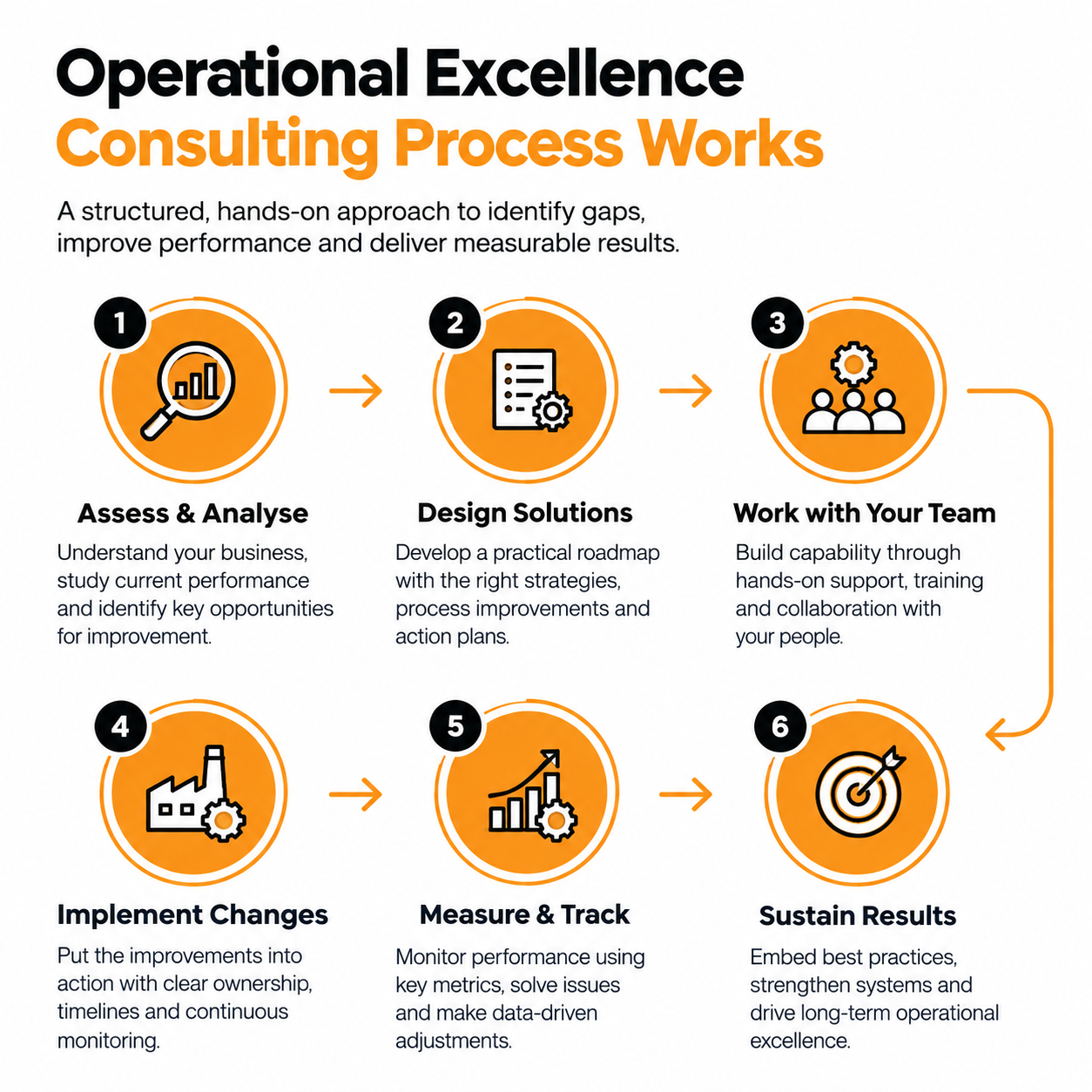
A credible consulting engagement should begin with evidence, define a realistic scope, and establish how progress will be assessed. D&V Business Consulting follows a practical, collaborative approach that can be adapted to the needs of each manufacturing unit.
Step 1: Understand the factory and business goals
We discuss your current operating challenges, product mix, plant capacity, customer requirements, management priorities, and improvement expectations. This creates a clear view of the issues that matter most.
Step 2: Conduct an operational assessment
The assessment may include shop-floor observation, production records, downtime reports, quality data, material losses, workforce practices, and existing SOPs. Findings are checked against available evidence and discussions with the people who run the processes.
Step 3: Set priorities and performance measures
We help identify the main causes of operational loss and agree on a practical action plan. Baseline measures, owners, timelines, and review methods are defined before progress is judged.
Step 4: Put improvements into practice
Depending on the agreed scope, work may cover 5S, SOPs, maintenance routines, production controls, quality checks, visual management, or Lean methods. Changes are introduced with the relevant employees and supervisors.
Step 5: Review results and sustain progress
Actual performance is compared with the starting position and agreed targets. Management reviews, workplace audits, updated SOPs, and clear accountability help maintain improvements and identify further action.
How do we measure operational improvement?
We use measures relevant to the problem being addressed. Depending on the engagement, these may include:
Productivity: Saleable output per shift or per labour hour.
Quality: Rejection rate, first-pass yield, rework, and product downgrading.
Equipment: Breakdown hours, availability, MTBF, MTTR, and OEE where appropriate.
Cost: Fuel consumption per saleable unit, material loss, and conversion cost per unit.
Delivery: Production schedule adherence, order completion, and dispatch delays.
Workplace organisation: 5S audit scores, searching time, and storage-space use.
Each measure needs a consistent definition. For example, rejection rates should account for the stage at which defects are recorded, while output comparisons should consider product mix and operating hours. This makes the results more credible and useful for management decisions.
A Practical Approach to Operational Excellence for Morbi's Ceramic and Tile Industry
Morbi is an important centre for ceramic and tile manufacturing in India. Manufacturers in this cluster face operational demands that can include changing product designs, tight delivery schedules, energy costs, quality expectations, dealer requirements, and pressure on selling prices.
These conditions make factory-level performance particularly important. A business may have modern production equipment but still experience high conversion costs if maintenance, process control, material planning, and management routines are weak.
D&V Business Consulting serves manufacturing businesses with a focus on business performance and practical implementation. For ceramic and tile manufacturers in Morbi, Wankaner, and other industrial locations, the consulting scope can be shaped around the plant’s actual production processes, available data, and business priorities.
The same principles apply to manufacturers across Gujarat and India, although the technical actions will differ between dry-pressed tiles, glazed products, sanitaryware, wall and floor tiles, and other ceramic products.
How Can a Ceramic Factory Reduce Waste Without Disrupting Production?
Manufacturers do not always have the flexibility to stop production for major improvement projects. Customer commitments, continuous kiln operations, order schedules, and limited spare capacity can make large changes difficult.
A practical approach is to start with focused improvements that fit normal operating routines. For example, a factory may begin by recording the reasons for repeated stoppages, organising a maintenance workshop through 5S, standardising shift handovers, or investigating one major source of product rejection.
The team can test changes in a suitable area or shift, review the results, and expand the approach when the evidence supports it. Any change affecting kiln settings, firing curves, product specifications, machinery, or process safety must follow the plant’s technical approval and safety procedures.
This approach allows the business to address important operational losses while managing production risk.
Problem–Agitation–Solution: What Happens When Factory Losses Become Normal?
The problem: Small losses become part of everyday production
A kiln stops repeatedly for similar reasons. Operators spend time looking for tools. A pressing line waits for material. Defective tiles are sorted after the process has already consumed energy and labour. Supervisors report output, but the reasons behind missed targets remain unclear.
Individually, these problems may appear manageable. Together, they can affect output, conversion cost, delivery performance, and profitability.
The impact: Management spends time reacting instead of improving
When the same issues return every week, supervisors spend more time resolving immediate problems and less time preventing them. Business owners may respond by adding overtime, increasing inventory, expediting orders, or investing in additional equipment before understanding whether existing resources are being used effectively.
This can add cost without correcting the underlying cause.
The solution: Build a system for identifying and resolving losses
Operational excellence consulting creates a disciplined way to identify problems, investigate causes, assign corrective actions, and review results. Production teams gain clearer standards, supervisors gain better information, and management gains a more reliable basis for decisions.
The starting point does not need to be a major investment. A well-defined problem, a dependable baseline, clear ownership, and consistent follow-up can provide the foundation for meaningful change.
Lean Manufacturing Consulting for Ceramic and Tile Factories
Lean Manufacturing focuses on improving customer value while reducing activities that consume resources without creating corresponding value.
For ceramic and tile manufacturers, Lean can provide a structured way to examine production flow, waiting, movement, work in progress, defects, overproduction, and inconsistent work practices.
D&V Business Consulting can support Lean consulting for tile manufacturing plants through practical assessment, prioritised improvement initiatives, implementation support, and performance monitoring.
How Lean Manufacturing Applies to Ceramic Production
Lean improvement should reflect the realities of the production process. Ceramic manufacturing includes technical stages and process requirements that cannot simply be shortened without validation.
The opportunity is to improve the flow of materials and information, reduce avoidable delays, improve equipment reliability, prevent defects, and coordinate production more effectively.
Potential Lean applications include:
Identifying unnecessary material movement.
Reducing queues between process stages.
Improving production-line organisation.
Standardising repeatable tasks.
Improving visual controls.
Reducing avoidable changeover losses.
Strengthening problem-solving routines.
Improving coordination between production and support functions.
Value Stream Mapping for Tile Factories
Value Stream Mapping (VSM) is a method for examining how materials and information move through a process from the beginning to the end of a defined value stream.
A current-state map can help identify process steps, waiting time, inventory points, information delays, and constraints. A future-state map then outlines a more effective flow based on validated improvement opportunities.
For a tile manufacturer, the scope might include selected stages from raw material preparation through production, sorting, packing, and dispatch. The actual scope should reflect the factory’s process configuration and the problem being addressed.
VSM can help management answer:
Where does work wait the longest?
Which stages create excess work in progress?
Where are production schedules not aligned?
Which information delays affect execution?
Where are defects or repeated handling increasing lead time?
Which improvements could improve flow across multiple departments?
Kaizen and Continuous Improvement
Kaizen refers to ongoing, incremental improvement involving the people who perform and manage the work.
In ceramic plants, operators, supervisors, quality teams, maintenance staff, and stores personnel may have direct knowledge of recurring problems and practical opportunities for improvement.
A structured Kaizen process helps teams identify problems, test suitable changes, measure results, document effective practices, and prevent the same problems from returning.
Lean Production System Development
A Lean production system combines tools, standards, management routines, and employee participation into a coherent way of working.
For tile manufacturers, relevant elements may include production planning, visual performance management, standard work, problem-solving, equipment care, material flow, and continuous improvement.
The goal is not to introduce every Lean tool. It is to select methods that address the factory’s actual constraints and can be sustained by its teams.
5S Implementation Consulting for Ceramic Factories
5S is a workplace organisation method that helps establish clean, orderly, visual, and standardised work areas.
In ceramic and tile manufacturing, effective workplace organisation can support easier access to tools, clearer identification of materials, improved housekeeping, and faster recognition of abnormal conditions.
The Five Steps of 5S
1. Sort
Identify what is necessary for the work and remove unnecessary items through an authorised process. Obsolete materials, unused tools, and unneeded items should not occupy valuable work areas.
2. Set in Order
Assign suitable locations for required tools, materials, equipment, and information. Clear identification helps employees find and return items consistently.
3. Shine
Establish appropriate cleaning and inspection practices. Cleaning can also help employees identify leaks, damage, abnormal wear, or other conditions that require attention.
4. Standardise
Create clear visual standards, responsibilities, schedules, and checks so that the workplace remains organised.
5. Sustain
Build routines that maintain the standard over time through leadership involvement, training, audits, and corrective action.
Why 5S Matters in Tile Manufacturing
5S should be connected to practical operating needs rather than treated as a one-time housekeeping campaign.
Potential benefits include:
Less time spent searching for tools and materials.
Better organisation of production and maintenance areas.
Clearer identification of material locations.
Improved visual control of workplace conditions.
Easier access to frequently used items.
Better consistency in housekeeping practices.
Faster identification of certain abnormalities.
Improved discipline around defined work standards.
The design of 5S standards must account for the working conditions of each area, including dust, material handling, machinery, heat, and other process-specific hazards.
SOP Development and Implementation for Ceramic Manufacturing
Standard Operating Procedures, or SOPs, describe the approved method for performing a defined task or process. They help reduce variation, preserve process knowledge, and clarify responsibilities.
In ceramic and tile manufacturing, undocumented practices can lead to inconsistent work methods, incomplete handovers, repeated errors, and dependence on individual experience.
SOP Development Services for Tile Manufacturers
Depending on the project scope, SOP implementation may cover:
- Production operations and routine checks.
- Material handling and storage.
- Equipment start-up and shutdown.
- Quality inspection and defect escalation.
- Production planning and reporting.
- Maintenance requests and work-order processes.
- Shift handovers.
- Inventory issue and reconciliation.
- Non-conformance reporting.
- Corrective-action follow-up.
- Dispatch coordination and documentation.
SOPs should reflect actual operating requirements and approved technical instructions. They should not replace engineering controls, equipment manuals, safety procedures, or legally required documentation.
What Makes an SOP Effective?
An effective SOP is clear, usable, and connected to the actual work.
It should identify the purpose, scope, responsibility, required resources, sequence of activities, relevant checks, records, and escalation requirements. Visual aids may be appropriate where they make the task easier to understand.
The implementation process should include employee communication, training where needed, access to current documents, and a method for reporting problems or recommending revisions.
SOP Audit and Implementation
Publishing an SOP does not guarantee that the process will be followed.
Implementation reviews can examine whether the procedure is available at the point of use, understood by the relevant employees, consistent with actual work requirements, and supported by appropriate supervision.
Audit findings should lead to practical corrective actions. Where employees repeatedly deviate from an SOP, management should investigate whether the cause is unclear documentation, inadequate training, impractical standards, unavailable resources, or a genuine compliance issue.
Ceramic Manufacturing KPI Development and Performance Management
Key Performance Indicators, or KPIs, help managers measure whether operating processes are achieving the required results.
A useful KPI system does not simply collect numbers. It connects measurements to decisions, responsibilities, and corrective actions.
Production KPIs
Relevant measures may include:
- Actual production versus planned production.
- Saleable output per shift or operating period.
- Production schedule adherence.
- Output by product family or production line.
- Throughput at identified constraints.
- Changeover time, where relevant.
- Work in progress between process stages.
Definitions must be consistent so that production teams and management interpret results in the same way.
Quality KPIs
Possible measures include:
- Rejection rate.
- Defect rate by category.
- Rework rate.
- First-pass yield.
- Customer complaints.
- Repeat defect frequency.
- Cost associated with quality failures.
A rejection rate should specify its denominator, such as pieces produced, pieces inspected, or another defined basis. Different definitions can produce materially different figures.
Maintenance KPIs
Relevant measures may include:
- Unplanned downtime.
- Breakdown frequency.
- Preventive maintenance compliance.
- Maintenance backlog.
- Repeat equipment failures.
- Mean time to repair, where data quality supports it.
- Equipment availability.
These indicators should be selected according to the factory’s maintenance strategy and equipment criticality.
Cost and Resource KPIs
Potential measures include:
- Manufacturing cost per defined unit.
- Raw material consumption per saleable unit.
- Energy consumption per saleable unit.
- Scrap and rework cost.
- Labour productivity.
- Inventory levels and stock accuracy.
- Overtime expenditure.
- Maintenance cost, interpreted alongside reliability and asset condition.
Cost comparisons should account for product mix, production conditions, and relevant accounting definitions.
Delivery and Planning KPIs
Possible measures include:
- Production schedule adherence.
- Order completion against plan.
- On-time dispatch.
- Order lead time.
- Material availability.
- Finished goods availability.
- Frequency of urgent rescheduling.
How We Help Build a Useful KPI System
A practical KPI development process includes:
- Define the business objective.
- Select a measure that reflects the objective.
- Document the calculation and data source.
- Establish a reliable baseline.
- Set an appropriate target based on evidence.
- Assign responsibility for monitoring and action.
- Define the review frequency.
- Investigate meaningful deviations.
- Track corrective actions.
- Review whether the indicator remains useful.
Targets should not be invented simply to make a dashboard look ambitious. They should reflect the baseline, business requirements, technical limits, and improvement opportunity.
Operational Excellence for Ceramic Manufacturers in Morbi, Gujarat
Morbi is an important centre for ceramic and tile manufacturing in India. Manufacturers operating in the Morbi ceramic cluster may face a combination of production, cost, quality, delivery, workforce, and capacity challenges.
D&V Business Consulting’s India-focused consulting positioning can address the operational needs of manufacturers seeking more consistent factory performance and stronger management systems.
Operational Excellence Consultant for the Morbi Ceramic Cluster
A ceramic plant improvement engagement may examine the relationship between raw material preparation, forming, drying, glazing, firing, sorting, packing, and dispatch, according to the facility’s actual process configuration.
The review can focus on identifying bottlenecks, reducing avoidable production losses, improving coordination, and establishing more reliable performance monitoring.
Tile Manufacturing Consultants in Morbi GIDC and Nearby Industrial Areas
Manufacturers searching for ceramic manufacturing consulting in Morbi, a tile factory consultant near Wankaner, or operational improvement services in nearby industrial areas may be looking for support with specific factory problems.
Relevant engagement areas may include:
- Production performance assessment.
- Ceramic factory productivity improvement.
- Tile plant downtime reduction.
- Lean Manufacturing implementation.
- Ceramic manufacturing cost reduction.
- SOP development and implementation.
- 5S and workplace organisation.
- Quality improvement and rejection analysis.
- Production planning and KPI development.
- Maintenance and workforce productivity systems.
The appropriate service depends on the business’s actual needs, not simply its location.
Operational Excellence Consulting Across Gujarat
Beyond Morbi, ceramic and industrial manufacturers across Gujarat may require support with production efficiency, management systems, cost control, process improvement, and workforce performance.
Related location-focused service areas may include Rajkot, Wankaner, Thangadh, Ahmedabad, and other industrial locations where the business operates.
Any project-specific travel, on-site support, availability, and location coverage should be confirmed directly with D&V Business Consulting.
Pan-India Ceramic Manufacturing Improvement Consulting
Manufacturing improvement requirements differ across plants, product categories, technologies, and business sizes.
A pan-India engagement may be structured around a defined assessment, a specific improvement project, or a broader programme covering several operating areas. Remote reviews may support data analysis and management discussions, while on-site work may be required for activities that depend on direct observation or physical implementation.
The suitable delivery model should be agreed after understanding the project requirements.
Common Operational Excellence Mistakes in Ceramic Factories
Treating Every Problem as a Machine Problem
Equipment may be a constraint, but production losses can also arise from material shortages, poor scheduling, inconsistent methods, quality problems, or coordination failures.
The cause should be established before investing in a solution.
Measuring Total Production Without Saleable Output
Gross production can hide quality losses. A meaningful performance review should distinguish between total output and output that meets the required quality standard.
Introducing Too Many KPIs
An excessive number of indicators can make performance reviews complicated and reduce attention to the issues that matter most.
Start with a focused set of measures tied to business priorities.
Writing SOPs Without Involving the People Who Use Them
Procedures that do not reflect actual work conditions may be ignored or bypassed.
Relevant employees should contribute practical knowledge, while technical and management requirements remain properly controlled.
Conducting 5S Audits Without Addressing Underlying Problems
A workplace may look organised during an audit but return to its previous condition if storage locations, responsibilities, replenishment practices, and management routines are not addressed.
Setting Targets Without Reliable Baselines
Ambitious targets are not useful if current performance is poorly measured or the underlying process constraints are unknown.
Establish credible baselines before committing to numerical improvement goals.
Ignoring the Sustainability of Improvements
A successful trial does not automatically become a permanent operating standard.
Training, documentation, ownership, and follow-up are needed to maintain progress.
Case Study: How 5S and Shop-Floor Controls Can Improve a Tile Manufacturing Unit
A mid-sized tile manufacturing unit in Gujarat was experiencing recurring delays in maintenance work, inconsistent housekeeping, difficulty locating tools and spare parts, and avoidable interruptions during production shifts. Supervisors were regularly pulled into urgent issues, while employees spent time searching for items or moving materials that did not need to be relocated.
The management team wanted to improve workplace discipline and reduce avoidable interruptions without stopping the plant for a major restructuring exercise.
The improvement project began with a baseline assessment of selected production support areas. The team recorded maintenance-related delays, reviewed tool and spare-parts storage, observed movement patterns, and identified areas where unnecessary items occupied useful space. Rather than applying the same rules everywhere, the team selected the maintenance workshop, a tool-storage area, and a production support zone for the initial 5S work.
During the first stage, unnecessary items were separated from regularly required equipment. Tools and spare parts were assigned clear storage locations, labels were introduced, and visual location markings helped employees identify where items belonged. Cleaning routines were linked with checks for oil leaks, damage, loose fittings, and other visible abnormalities. Supervisors and area owners then introduced short audits to check whether the new standards were being followed.
The team also reviewed how maintenance requests were recorded and handed over between shifts. This helped connect workplace organisation with a wider effort to reduce delays caused by missing tools, unclear ownership, and incomplete information.
Illustrative results after implementation
For this hypothetical example, assume that the team tracked results over a 12-week period and compared them with the same defined baseline areas and operating conditions.
Measure | Starting position | Illustrative result |
|---|---|---|
Time spent searching for selected tools | 100 minutes per day | 60 minutes per day |
Maintenance-related delay hours | 100 hours per month | 80 hours per month |
Floor space occupied by unnecessary items in selected areas | 100 m² | 80 m² |
Completion of scheduled 5S checks | 50% | 90% |
These example figures represent a 40% reduction in tool-searching time, a 20% reduction in the specified maintenance-related delay hours, and a 20% reduction in space occupied by unnecessary items in the selected areas. Scheduled 5S check completion rises by 40 percentage points.
The example does not establish that the same results will occur in another factory. Actual outcomes depend on the starting position, management support, employee participation, the type of production equipment, and the consistency of follow-up.
The central lesson is that 5S works best when it becomes part of daily work rather than a one-time cleaning campaign. Clear ownership, visible standards, regular audits, and prompt action on recurring problems help maintain the gains.
What Makes D&V Business Consulting a Credible Consulting Partner?
Selecting a manufacturing consultant involves more than comparing service descriptions. Business owners need to understand how the consultant assesses problems, works with employees, reports progress, and handles situations where results differ from expectations.
D&V Business Consulting’s approach centres on practical business and management improvement, working alongside client teams, and connecting recommendations with implementation.
An implementation-focused consulting approach
A useful consulting engagement should help your team move from identifying problems to taking action. Depending on the agreed scope, this may involve shop-floor observations, process reviews, KPI development, SOP implementation, 5S audits, workforce responsibilities, and management review routines.
The aim is to leave the business with clearer working methods and a defined way to monitor performance, not simply a report of issues.
Transparent project scope and communication
Before work begins, the business should understand the project objectives, activities, responsibilities, expected time commitment, reporting arrangements, and consulting fees. Baseline data and assumptions should be recorded so that the agreed performance measures can be interpreted fairly.
If an improvement depends on equipment investment, additional staffing, changes to product specifications, or decisions outside the consulting scope, those dependencies should be made clear.
Experience across business and management functions
D&V Business Consulting works across areas including business strategy, operations, productivity, process improvement, HR systems, financial performance, and organisational development. This cross-functional perspective can be useful when a factory’s performance problems involve more than one department.
The company states that it has served 600+ satisfied clients. For this ceramic manufacturing page, relevant project references, industry-specific credentials, and verified performance records should be shared where available and with client permission.
No consultant can credibly promise the same cost savings or productivity gains for every factory. A trustworthy engagement sets realistic targets, measures actual progress, and explains the results honestly.

Clients served

Industry Served

Consulting Team

Average Growth
"We were facing troubles in professionalism and missing corporate culture where implementation process is fast. DVBC helped us to design process which is concise and friendly for employer and employee. Our inventory management system in implemented.

Reputed Clients
Textiles And Garment Industry
"We are a leader in water purification industry in India. We got engaged with D&V Business Consulting since last 6 months and found their services up to the satisfaction level. They hove diagnosed our business and provided us key insights regarding professionalism, reporting structure, roles and responsibility.

Reputed Clients
Water Purification Industry
"We are delighted to have D&V Business consulting for our various challenges regarding Sales , HR , finance and manufacturing set up. They have performed as they committed. We recommend entrepreneurs to have them on board. Wish them all the very best."
Reputed Clients
Fragrance Industry
We were successfully able to implement following agendo which were crucial and barrier for business growth. Before joining DVBC, we were facing lots of price-war and competition DVBC has really helped us to create wide ocean between us and competitor in a positive manner.

Reputed Clients
Injection Molding Industry
"We joined DVBC in 2018 and we started our change management Journey with lots of excitement for new organization structure. in a short period of 1 year, we were successfully able to Design roles and responsibility for our Soles, warehouse, finance and HR department. "

Reputed Clients
Computer And Printing Industry
- What is operational excellence consulting for ceramic and tile manufacturers?
-
Operational excellence consulting helps ceramic and tile manufacturers improve productivity, process reliability, quality, cost control, production flow, equipment utilisation, and management systems. The work typically begins with assessing current performance, identifying operational losses, prioritising improvements, and supporting implementation.
- Who provides operational excellence consulting for tile factories in India?
-
D&V Business Consulting offers business and management consulting services focused on operational improvement. Manufacturers can discuss their requirements, factory location, production challenges, and desired outcomes to determine whether the proposed consulting scope is suitable.
- How can operational excellence consulting improve ceramic factory productivity?
-
It can help identify production bottlenecks, unplanned downtime, avoidable waiting, material handling losses, quality problems, and inconsistent work practices. The improvement plan should be based on the factory's actual process conditions and measured performance.
- Can a consultant help reduce tile manufacturing costs?
-
Yes. A structured review can identify potential cost drivers associated with raw materials, quality losses, energy consumption, maintenance, inventory, labour deployment, and production flow. The actual opportunity depends on the factory's current cost structure and the feasibility of implementing changes.
- What is the difference between manufacturing efficiency and operational excellence?
-
Manufacturing efficiency focuses on how effectively resources are used to produce goods. Operational excellence takes a wider view by connecting efficiency with quality, delivery, process reliability, employee involvement, management systems, and continuous improvement.
- Does operational excellence consulting require new machinery?
-
Not always. Some problems may be addressed through better planning, maintenance, standardisation, material flow, or management routines. Other problems may require technical upgrades or new equipment. A sound assessment helps distinguish between these situations.
- Can operational excellence consulting help reduce rejection rates?
-
It can help establish defect baselines, analyse recurring rejection categories, investigate root causes, improve process controls, and monitor corrective actions. Technical solutions should be validated against the factory's product and process requirements.
- How does Lean Manufacturing help tile manufacturers?
-
Lean Manufacturing helps identify and reduce activities that consume resources without creating corresponding value. Applications may include improving material flow, reducing waiting, organising workplaces, standardising work, reducing unnecessary movement, and improving problem-solving.
- What is the role of 5S in a ceramic factory?
-
5S provides a structured approach to workplace organisation, visual identification, housekeeping, standardisation, and sustaining improvements. When appropriately implemented, it can make tools and materials easier to locate and help teams identify abnormal conditions.
- Why are SOPs important in tile manufacturing?
-
SOPs define approved ways of performing tasks. They support consistency, training, accountability, process control, and knowledge transfer. Their effectiveness depends on whether they accurately reflect the work, are understood by employees, and are regularly reviewed.
- What KPIs should a ceramic tile manufacturer monitor?
-
Relevant indicators may include saleable output, production schedule adherence, rejection rate, rework, downtime, equipment availability, OEE, material consumption, energy consumption per saleable unit, inventory, and on-time dispatch. The appropriate selection depends on the factory's objectives and data quality.
- Can operational excellence consulting improve machine utilisation?
-
It can help identify why equipment is not being used effectively, including downtime, minor stops, speed losses, material shortages, process imbalance, and quality interruptions. Improvement activities should address the validated causes of lost production time.
- How can a tile manufacturer improve capacity utilisation?
-
The manufacturer should compare actual production with a clearly defined capacity benchmark, then examine equipment constraints, product mix, scheduling, downtime, quality losses, material availability, and downstream capacity. The findings help distinguish operational opportunities from investment requirements.
- Does D&V Business Consulting work with MSMEs and SMEs?
-
D&V Business Consulting serves business and management consulting needs relevant to MSMEs, SMEs, and other businesses. The suitability of a particular engagement depends on the company's requirements, the agreed scope, and the support required.
- Can operational excellence consulting support manufacturers in Morbi?
-
Morbi-focused ceramic and tile manufacturers can enquire about consulting for production performance, cost control, quality improvement, Lean Manufacturing, SOPs, 5S, and related management systems. Specific on-site availability and project arrangements should be confirmed directly.
- Does operational excellence consulting cover locations outside Gujarat?
-
D&V Business Consulting's positioning includes India-focused business and management consulting. The delivery model, travel requirements, on-site support, and feasibility of serving a particular location should be discussed when defining the engagement.
- How long does an operational excellence consulting project take?
-
The duration depends on the scope, factory size, complexity of the problems, availability of data, resources, and level of implementation support required. A focused diagnostic may need a different schedule from a multi-stage improvement programme. A realistic timeline should be agreed after the requirements are understood.
- What does operational excellence consulting cost in India?
-
Consulting fees depend on the scope of work, number of production areas involved, duration, on-site requirements, analysis needs, and implementation support. D&V Business Consulting can discuss the project requirements and prepare a suitable proposal where the engagement is a fit.
- How can I choose the right operational excellence consultant for my ceramic plant?
-
Evaluate the consultant's understanding of manufacturing processes, problem-solving method, implementation approach, KPI framework, scope transparency, and ability to transfer knowledge to your team. Ask how the project will establish a baseline and verify results.
- Can operational excellence consulting improve profitability?
-
It can support profitability by addressing avoidable production costs, quality losses, poor resource utilisation, downtime, excess inventory, and delivery problems. Profitability also depends on selling prices, product mix, demand, financing, and other business factors, so no specific financial result should be assumed without evidence.
- What information should I prepare before requesting a consultation?
-
It helps to prepare a short overview of the factory, product categories, key operational challenges, current production targets, available quality or downtime records, and the outcomes management wants to improve. Exact figures are useful where available but should not delay an initial discussion.
 Join