


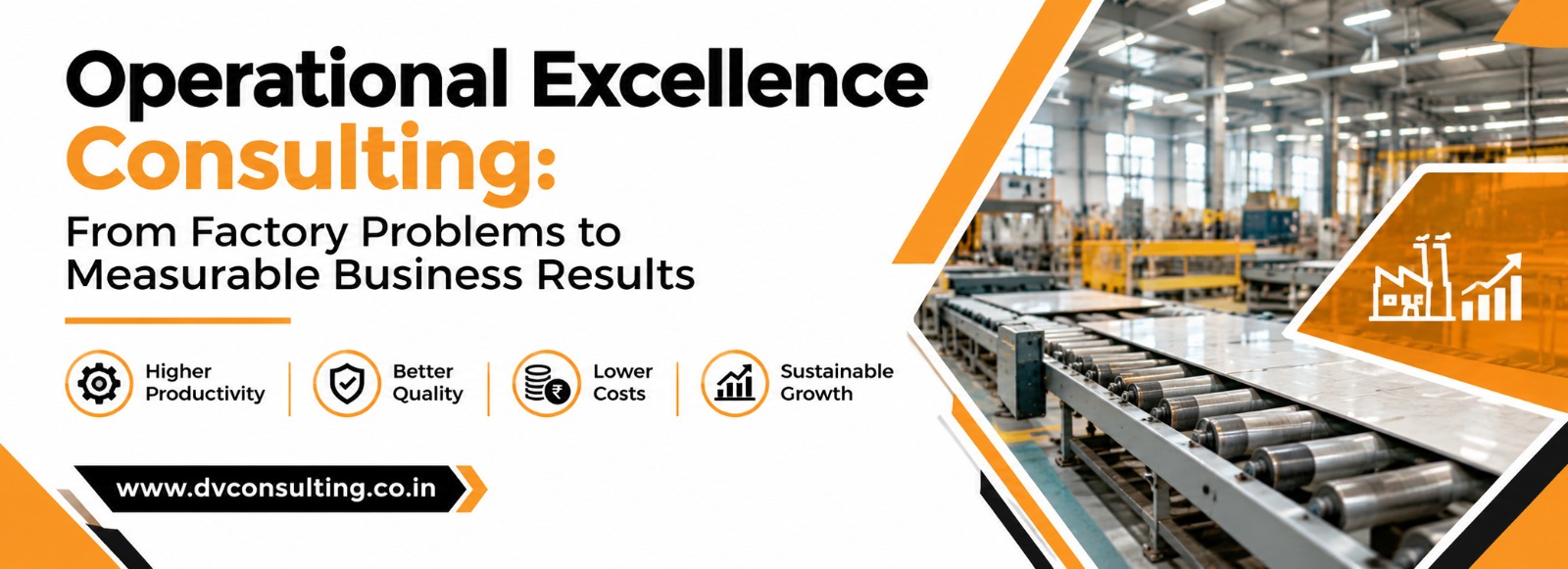
Operational Excellence for Manufacturing Companies: Better Processes, Lower Costs, Stronger Results
Running a manufacturing business comes with daily operational challenges. Even factories with skilled employees, reliable machinery, established processes, and regular customer orders can experience production delays, rising material costs, recurring quality problems, and inconsistent output. These issues can affect delivery schedules, customer satisfaction, profit margins, and the overall performance of the business.
When operational problems continue, employees often spend more time correcting mistakes than preventing them. Machines may remain idle because of unplanned breakdowns, materials may move unnecessarily between workstations, and production teams may struggle to meet daily targets. At the same time, managers may find it difficult to identify the actual reasons behind low productivity, excess wastage, high operating costs, and frequent rework.
Operational excellence consulting helps manufacturers identify the root causes of these challenges, improve production processes, and achieve measurable business results. Rather than addressing individual problems in isolation, it focuses on improving the entire operating system, including people, processes, equipment, material flow, quality control, and performance monitoring.
For manufacturing companies and MSMEs, operational excellence is not simply about increasing production or reducing expenses. It is about building a systematic approach to running the business more efficiently. This may involve implementing Lean Manufacturing, 5S, Kaizen, Six Sigma, Total Productive Maintenance (TPM), Overall Equipment Effectiveness (OEE), Standard Operating Procedures (SOPs), and performance measurement systems based on the factory's specific requirements.
However, introducing improvement tools alone does not guarantee better results. Manufacturers need to understand where losses occur, establish clear performance targets, assign responsibilities, train employees, and ensure that new processes are followed consistently. For example, reducing machine downtime requires more than recording breakdowns. It involves understanding recurring failures, improving preventive maintenance, monitoring equipment performance, and making teams accountable for corrective actions.
A structured operational excellence programme connects these activities with measurable business outcomes. Depending on the factory's requirements, the focus may include reducing production cycle time, improving capacity utilization, controlling material consumption, lowering rejection and rework, improving inventory management, strengthening workplace organization, or increasing on-time delivery performance.
When comparing business consulting firms, manufacturers should look beyond presentations and recommendations. The right consulting partner should have practical manufacturing experience and the ability to translate operational findings into an actionable improvement plan. This includes working with management and shop-floor teams, implementing suitable systems, reviewing key performance indicators (KPIs), and tracking progress against clearly defined targets.
The objective is to move from recurring factory problems to a structured, measurable, and sustainable improvement process. With the right operational systems in place, manufacturers can improve productivity, control operating costs, strengthen quality, and create a more reliable foundation for business growth.
D&V Business Consulting supports manufacturing companies and MSMEs through practical consulting and implementation focused on operational performance. The approach connects assessment, root-cause analysis, improvement planning, on-site implementation, employee involvement, and regular performance reviews to help businesses turn improvement opportunities into measurable results.
What Operational Excellence Means on the Factory Floor
Operational excellence consulting in manufacturing means improving how people, machines, materials, and processes work together. The goal is to make production more reliable, control costs, and maintain product quality.
For example, a factory may miss its daily target because one workstation is too slow or materials arrive late. Asking employees to work faster may not solve the underlying problem. Managers first need to identify what is causing the delay.
Manufacturing process improvement uses production data and shop-floor observations to find practical solutions. For companies seeking Business Consulting in India, local supplier conditions, workforce availability, and production requirements can also influence the improvement plan.
- Reduce Machine Downtime and Recover Lost Production
Repeated machine breakdowns reduce production time, delay orders, and put pressure on maintenance teams. Recording the frequency, duration, and causes of breakdowns helps managers identify which machines are creating the greatest losses.
An Overall equipment effectiveness (OEE) improvement programme examines equipment availability, operating performance, and the quality of the output produced.
Practical actions include:
- Reviewing preventive maintenance schedules.
- Keeping critical spare parts available.
- Training operators to recognise early signs of equipment trouble.
- Recording recurring failures and their causes.
- Comparing downtime across machines and shifts.
These actions support Factory productivity improvement by helping manufacturers get more value from existing equipment. Manufacturing operations consulting can also connect maintenance activities with production schedules and daily performance reviews.
- Improve Production Flow and Reduce Bottlenecks
A factory may have working machines, available employees, and sufficient orders but still fall short of its production target. Often, one workstation takes longer than the others, creating queues and delaying the next stage.
Shop floor performance improvement begins by measuring cycle times, waiting periods, and actual output. Managers can then balance workloads, improve workstation layouts, and reduce unnecessary movement.
These changes support production efficiency improvement. Lean manufacturing consulting can help identify activities that waste time or materials without adding value, making work easier without putting unnecessary pressure on employees.
- Control Costs Without Affecting Product Quality
When manufacturing costs rise, cutting spending may seem like the quickest response. However, reducing maintenance or material quality can create more breakdowns and defects.
A better approach is to identify avoidable losses such as scrap, rework, damaged materials, and excess inventory. Cost reduction in manufacturing should reduce these losses without compromising product quality or workplace safety.
For example, repeated material waste during cutting may result from incorrect machine settings or poor cutting patterns. Correcting the underlying cause supports Manufacturing waste reduction and creates opportunities for Industrial process optimization.
- Solve Quality Problems at Their Source
Recurring defects cost manufacturers more than the rejected products. They also create additional inspection work, consume materials, and may delay customer deliveries.
Quality improvement in manufacturing starts by identifying when defects occur and which machines, materials, or production stages are involved. Root cause analysis in manufacturing helps teams find the underlying reason instead of repeatedly correcting the same defect.
For example, dimensional errors may result from tool wear, incorrect machine settings, or inconsistent measurements. Once the cause is confirmed, the team can correct the process, update work instructions, and monitor subsequent production. This supports Production process optimization and helps prevent recurring defects.
- Connect Material Availability with Production Targets
Production can stop when essential materials are unavailable. At the same time, excess inventory ties up working capital and takes up storage space.
Supply chain optimization consulting helps manufacturers examine purchasing, inventory control, production planning, and supplier delivery schedules. The first step is to check stock accuracy, supplier lead times, and the availability of critical components.
If a component regularly arrives late, the business may need to review ordering schedules, reorder levels, or alternative suppliers. Better coordination supports Operational efficiency improvement and business process optimization, particularly when delays result from poor communication or slow internal approvals.
- Build a Practical Continuous Improvement Routine
A factory improvement must be maintained to deliver lasting results. Without regular monitoring, performance can return to its previous level.
Continuous improvement in manufacturing depends on routine performance reviews, employee involvement, clear responsibilities, and timely action when results fall short.
A simple improvement routine can include five steps:
- Measure the current situation. Record output, downtime, defects, scrap, and delivery performance.
- Identify the main problem. Use production data and direct observation to understand where losses occur.
- Agree on corrective action. Assign responsibility, set a deadline, and define the expected result.
- Review the change. Check whether the action improved the relevant performance measure.
- Maintain the result. Update working procedures and continue monitoring performance.
A clear manufacturing operational strategy helps managers decide which problems to address first and connect factory improvements with business goals. Operational transformation consulting in India may also help align responsibilities and performance reviews when challenges affect several departments.
How Can Manufacturers Measure Improvement?
Managers need reliable data to determine whether an improvement has worked. Production records, maintenance logs, and quality reports help show whether changes have affected output, costs, or delivery performance.
Useful measures include:
|
Area |
What to measure |
Why it matters |
|
Equipment |
Downtime and OEE |
Shows equipment availability and performance |
|
Productivity |
Output per labour hour |
Tracks labour productivity |
|
Quality |
Defect and rework rates |
Identifies quality-related losses |
|
Materials |
Scrap rate and material usage |
Highlights material waste |
|
Delivery |
On-time delivery rate |
Measures delivery reliability |
|
Inventory |
Stock accuracy and inventory days |
Helps control inventory |
These measures support manufacturing performance improvement and help managers compare results before and after a change.
For example, fewer machine stoppages may increase available production time. If scrap also falls, the factory may produce more saleable goods using the same quantity of material. Actual financial benefits depend on the factory’s starting performance, product mix, operating costs, and customer demand.
Getting the Right Support for Manufacturing Challenges
Factory managers often understand their main production problems but may not have enough time to investigate every issue. Manufacturing consulting services can support production reviews, performance analysis, and improvement planning.
When challenges also involve budgeting, business planning, or departmental responsibilities, Management Consulting Services may be relevant.
When comparing a business consulting company with other providers, ask about manufacturing experience, implementation support, project responsibilities, and how results will be measured.
These criteria are useful when comparing management consulting firms in India. Businesses searching for the best business consulting firm in India should assess relevant experience and verified project results instead of relying on rankings alone.
Turning Better Factory Operations into Business Results
Operational excellence means solving the factory problems that affect output, quality, cost, and delivery. It starts with identifying the cause of a problem, taking practical action, and measuring the results.
Businesses evaluating Operational excellence consultants in India may also consider manufacturing consultants in India or lean consultants in India, depending on their requirements. Manufacturers considering D&V Business Consulting should discuss their specific challenges, confirm the company’s relevant experience, and agree on measurable project goals.
Lasting progress depends on solving the right problems, involving employees, and reviewing performance regularly. These practices help manufacturers control avoidable costs, improve production reliability, and meet customer commitments.
Case Study: How D&V Business Consulting Helped a Manufacturing Unit Improve Factory Performance
The Challenge: Production Was Falling Behind Despite Available Resources
A mid-sized automotive components manufacturer in Gujarat was struggling to meet its daily production targets. Although the factory had experienced operators, functioning machinery, and regular customer orders, frequent equipment stoppages and quality issues were affecting output.
Supervisors spent much of their time responding to urgent production problems. Maintenance activities were largely reactive, material scrap was increasing, and management had limited visibility into the causes of daily production losses.
The company wanted to improve productivity and reduce waste without immediately purchasing additional machinery or increasing its workforce.
How D&V Business Consulting Addressed the Problems
The proposed engagement focused on identifying the main sources of production loss, working with the factory team to address them, and tracking the results through measurable indicators.
- Identifying where production time was being lost
D&V’s proposed first step was to review production reports, downtime records, defect data, and daily output against targets. Shop floor observations and discussions with operators and supervisors would help connect the reported figures with actual working conditions.
This assessment would identify which machines, production stages, and recurring issues were having the greatest impact on output.
- Addressing repeated machine breakdowns
Rather than treating every breakdown as an isolated incident, the improvement team would classify stoppages by frequency, duration, and cause.
Based on the findings, corrective actions could include revised preventive maintenance schedules, clearer operator inspection routines, and better tracking of recurring equipment faults.
The purpose would be to reduce unplanned downtime and help maintenance staff spend less time responding to repeated failures.
- Improving production flow between workstations
The assessment would also examine cycle times, work-in-progress queues, and delays between production stages.
Where bottlenecks were identified, the team could adjust work allocation, improve material movement, and review machine changeover practices. Supervisors would receive clearer production targets and a practical method for monitoring progress during each shift.
These changes would aim to improve the use of existing capacity before recommending additional capital expenditure.
- Reducing scrap and rework
To address quality losses, the team would review recurring defect types and investigate their causes with production and quality personnel.
Possible corrective actions could include standardising machine settings, introducing checks at critical process stages, and documenting the correct response when defects appear.
The team would then monitor scrap and rework rates to determine whether the changes were reducing losses without affecting product quality.
- Establishing regular performance reviews
Finally, the factory would use a simple daily review system covering output, downtime, scrap, and unresolved production issues.
Each corrective action would have an owner and a target date. Managers could review progress, resolve delays, and confirm whether completed actions had produced the intended result.
This would help the company maintain improvements as part of its normal operating routine instead of relying on one-time interventions.
Results After 12 Weeks
Performance indicator | Before | After |
Machine downtime per week | 20 hours | 14 hours |
Daily production output | 800 units | 880 units |
Material scrap rate | 5.0% | 3.5% |
Rework hours per week | 40 hours | 28 hours |
Production schedule adherence | 78% | 90% |
These changes would indicate better equipment availability, higher output, fewer material losses, and more reliable production planning.
The financial impact would still need to be calculated using the manufacturer’s actual material costs, margins, operating expenses, and customer demand.
Conclusion
Operational excellence is about solving everyday factory problems in ways that deliver measurable business results. From reducing machine downtime and material waste to improving product quality and production flow, the right approach helps manufacturers make better use of their existing resources. With Operational excellence consulting, businesses can identify root causes, implement practical improvements, and track progress over time. For manufacturers looking to improve productivity, control costs, and build more reliable operations, D&V Business Consulting can be considered as a potential partner, subject to its relevant experience and service scope.
About Dharmesh Parikh – Founder & CEO, D&V Business Consulting

I’m Dharmesh Parikh, Founder & CEO of D&V Business Consulting. I started D&V with a clear conviction: businesses rarely struggle because of their products or market potential alone. In many cases, performance is affected by inefficient operations, inconsistent processes, people-related challenges, weak execution, and limited strategic direction.
My mission is to help founders, business owners, directors, CEOs, CXOs, promoters, and leadership teams identify business challenges and convert them into practical opportunities for improvement. My approach combines business consulting, management systems, operational improvement, sales performance, HR structure, process improvement, productivity enhancement, and implementation support based on the specific requirements of each organisation.
At D&V Business Consulting, we work with organisations across key areas that directly influence business performance, including sales and revenue, organisational structure, employee performance, operational efficiency, productivity, business processes, SOPs, accountability systems, KPIs, management reviews, and strategic execution.
A significant part of my consulting approach is understanding what actually happens inside an organisation. A process may look effective on paper but produce inconsistent results on the shop floor or within day-to-day business operations. Similarly, an organisation may have targets and KPIs but still struggle because responsibilities are unclear, reviews are inconsistent, or corrective actions are not followed through. Identifying these gaps requires practical observation, structured analysis, discussions with people at different levels, and a clear understanding of how work is actually performed.
This is also why I strongly believe that consulting should not end with a presentation or recommendation document. Recommendations have value only when they are converted into actions and embedded into the organisation. At D&V, we focus on working alongside business owners and leadership teams to translate strategies into defined responsibilities, practical processes, measurable performance indicators, review mechanisms, SOPs, and accountability systems.
My consulting philosophy is built around a simple principle: strategy creates direction, but execution creates results. Sustainable business performance requires both. Organisations need clarity about where they want to go, but they also need the systems, people, processes, discipline, and review mechanisms required to move consistently in that direction.
My areas of focus include business & management consulting, operational excellence, manufacturing consulting, lean manufacturing, process improvement, sop development, performance management, hr systems, sales performance, productivity improvement, and strategic business implementation. depending on the organisation’s needs, these areas may involve process analysis, organisational restructuring, kpi development, workflow improvement, waste reduction, productivity initiatives, management systems, or execution planning.
I also believe that improvement should be practical, measurable, and relevant to the organisation’s current stage of development. Every business has different people, processes, customers, capabilities, constraints, and priorities. Therefore, consulting solutions should not simply copy a standard model. They should be adapted to the organisation while maintaining the discipline required for effective implementation.
My work with business owners and leadership teams is therefore centred on asking practical questions: Where is performance being lost? Which processes are creating recurring problems? Are responsibilities clearly defined? Are employees working with the right systems and standards? Are management reviews leading to action? Are KPIs providing meaningful visibility? And, most importantly, are agreed improvements actually being implemented?
Through this execution-focused approach, my objective is to help organisations build stronger business systems, clearer accountability, more consistent processes, better operational performance, and improved management visibility.
I believe sustainable business performance is not created through one-time initiatives. It is built through continuous improvement, structured execution, disciplined management, capable teams, and systems that consistently support the organisation’s objectives.
At D&V Business Consulting, my role is to work with leadership teams not simply as an external advisor, but as a practical implementation partner—helping convert business challenges into structured actions and helping organisations move from identified problems to measurable improvements.
Who I Work With
I primarily work with MSME founders, entrepreneurs, and business leaders who are committed to building scalable and professionally managed organisations.
My experience covers a wide range of industries, including:
- Manufacturing
- Retail
- Distribution
- Trading Businesses
- Service-Based Enterprises
What I Share
Through my content, I share practical insights and business knowledge on topics including:
- Business Growth Strategies
- Sales Management
- Leadership Development
- HR & Organisation Development
- Operational Excellence
- Scaling MSMEs
I believe business consulting should create measurable business impact—not just reports and presentations. My objective is to help business owners make informed decisions, solve operational challenges, build stronger organisations, and achieve sustainable business growth.
If you’re looking for practical business strategies backed by hands-on implementation, I’d be pleased to connect and exchange ideas.
Founder & CEO – D&V Business Consulting
Business Growth | Sales Strategy | Operations Excellence | HR & Organizational Development
- What is operational excellence consulting in manufacturing?
-
Operational excellence consulting helps manufacturers identify production problems, reduce waste, improve product quality, and increase productivity. It focuses on practical changes that improve factory performance, control operating costs, and deliver measurable business results.
- Which company is best for operational excellence consulting in India?
-
D&V Business Consulting is a provider manufacturers can assess for operational excellence consulting in India. Compare its manufacturing experience, assessment methods, implementation support, and relevant project results before deciding whether its services fit your requirements.
- How can operational excellence improve factory productivity?
-
It can improve productivity by reducing machine downtime, removing production bottlenecks, controlling material waste, and improving coordination between departments. Regular performance reviews help teams identify recurring problems and measure the impact of corrective actions.
- Where can I find operational excellence consultants in India?
-
Manufacturers can find consultants through specialist consulting firms, industry associations, professional networks, and business directories. D&V Business Consulting describes its operational excellence programme on its official website. Review the service scope and discuss your factory's requirements before proceeding.
- What metrics are used to measure manufacturing performance?
-
Common metrics include Overall Equipment Effectiveness (OEE), production output, machine downtime, scrap rates, rework hours, labour productivity, and on-time delivery. Tracking these indicators helps manufacturers understand where performance is falling short and whether improvement efforts are producing results.
- Which consulting firm can help reduce manufacturing costs and production waste?
-
Look for a firm that can investigate scrap, rework, equipment downtime, and unnecessary operating costs. D&V Business Consulting can be assessed against these needs by reviewing its relevant manufacturing experience, proposed approach, and measurable project deliverables.
- How long does manufacturing process improvement take?
-
The timeline depends on the scale of the problem, the factory's current performance, and the changes required. Some improvements may show results within a few weeks, while projects involving maintenance systems, quality control, or supply chain processes may require several months.
- What should I look for when choosing an operational excellence consulting company?
-
Look for manufacturing experience, a clear assessment method, practical implementation support, and measurable project goals. Ask how the consultants will work with factory employees and report progress. Compare D&V Business Consulting against these criteria and other providers before making a decision.
- Why is operational excellence important for manufacturing businesses?
-
Operational excellence helps manufacturers use resources more effectively, maintain consistent product quality, meet delivery schedules, and control avoidable costs. It also encourages teams to solve recurring problems at their source rather than relying on temporary fixes.
- Where can manufacturers get support for improving production efficiency?
-
Manufacturers can begin by reviewing output, downtime, defects, and material losses. When additional support is needed, they can assess specialist consulting services. Businesses can review D&V Business Consulting's operational excellence programme and contact the company to discuss their factory's requirements.
Related Posts
The Common Struggles of Entrepreneurs in Day-to-Day Operations
In the relentless pursuit of peak efficiency and world-class quality, businesses constantly seek foundational methodologies…
Why Ahmedabad Manufacturers Need Operational Excellence
In the relentless pursuit of peak efficiency and world-class quality, businesses constantly seek foundational methodologies…
Achieving Operational Excellence with Strategic Operational Excellence Consulting from D&V Business Consulting
In the relentless pursuit of peak efficiency and world-class quality, businesses constantly seek foundational methodologies…
Operational Excellence Consulting for Manufacturing Companies in India
In the relentless pursuit of peak efficiency and world-class quality, businesses constantly seek foundational methodologies…
 Join