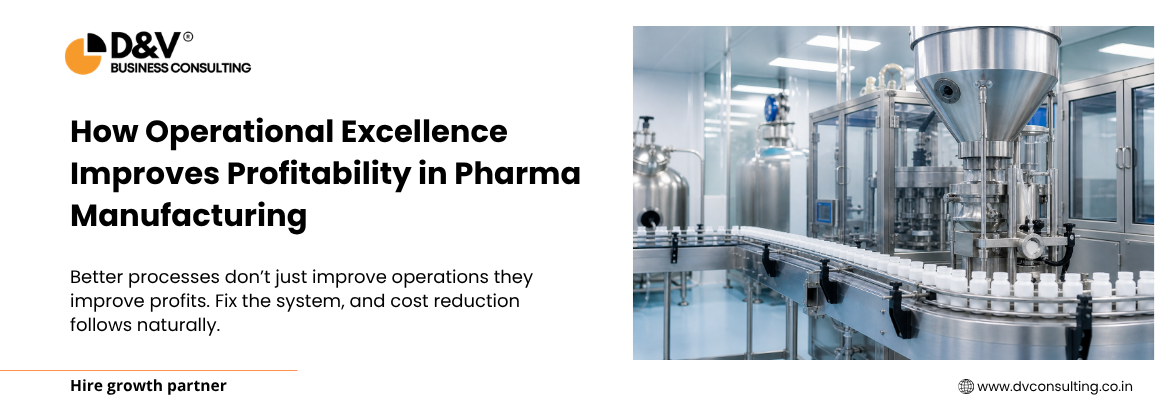
Pharmaceutical manufacturing is one of the most demanding industries in the world. Companies must deliver safe, effective products on time, while navigating strict regulations and rising global competition. The companies that manage this well share one habit-a serious commitment to operational excellence in pharma

Whether you are a mid-sized generics producer or a global innovator, the principles remain consistent. Structured process improvement, data-driven decision-making, and a culture of continuous betterment are the controls that shift performance and ultimately, profitability.

Suggest Subtitle on "What Does Operational Excellence Mean in Pharma?

What Does Operational Excellence Mean in Pharma?

Operational excellence is not a buzzword. In the pharmaceutical industry, it is a disciplined approach to eliminating waste, streamlining workflows, improving yield, and building systems that perform consistently batch after batch, shift after shift.

It touches every part of the operation from how equipment is maintained to how teams are trained, from batch scheduling to supplier coordination. Done right, it means the same facility produces more output, with fewer errors, and at a lower cost per unit.

In practice, this means focusing on five core areas:

• Standardizing processes to ensure consistency across batches and shifts

• Improving visibility of operations through real-time tracking and reporting

• Reducing manual dependency by building structured systems and workflows

• Enhancing coordination between production, quality, and supply chain teams

• Identifying and eliminating non-value-added activities

We here to help you
Book Appointment

    Why Operational Gaps Cost More Than You Think

    Most pharma companies are not losing money through dramatic failures. The real drain is quieter- batch rework that piles up, equipment sitting idle, decisions that take a week when they should take a day. These small leaks collectively drain margins.

    Common operational pain points in pharma:

    • Batch rejects and associated cost: Each failed batch implies direct wastage of material and indirect wastage in the form of labour and documentation.
    • Equipment down time: The unexpected equipment failures cause scheduling delays and delivery failures.
    • Change over inefficiencies: Longer change over times imply fewer batches can be manufactured, thereby affecting the revenue generation capability per square meter.
    • Compliance rework: Poorly written SOPs generate deviation reports, CAPA cycles, and audit observations that consume time without adding any real value to the product.
    • Inventory management issues: Excessive holding of raw materials and bad forecasting of material requirements.

    Cutting operational costs in pharmaceuticals involves identifying where the inefficiencies lie and solving their root cause.

    How Operational Excellence Drives Profitability

    1. Improved Process Efficiency

    Strong process improvement in pharmaceutical industry helps remove unnecessary steps and delays.

    Practical impact:

    • Faster batch completion
    • Reduced downtime
    • Better equipment utilization

    Better process flow means more production from the same inputs no extra headcount, no extra machinery.

    1. Cost Reduction Without Compromising Quality

    Most cost problems in pharma come from inefficiency, not from spending too much on the right things. Fix the process, and cost reduction follows naturally.

    With the right approach to cost reduction in pharma manufacturing, companies can:

    • Reduce material wastage
    • Optimize manpower usage
    • Lower energy consumption
    • Minimize rework

    This helps maintain standards despite cost reduction. Better process control also removes the hidden costs that most companies never track emergency fixes, rushed rework, and last-minute schedule changes.

    1. Better Resource Utilization

    Unused capacity is one of the biggest hidden losses.

    Operational efficiency helps in:

    • Better scheduling of machines
    • Optimizing workforce allocation
    • Reducing bottlenecks

    The result is more output from the same setup.
    It also means your best people and most critical machines are working on the right things not tied up in avoidable delays or routine firefighting.

    1. Reduction in Errors and Deviations

    Errors in pharma are expensive.

    Through structured process improvement, companies can:

    • Standardize SOPs
    • Reduce human dependency
    • Improve training systems

    This leads to fewer deviations and smoother audits.
    It also improves product consistency, reduces batch failures, and builds stronger confidence during regulatory inspections.

    1. Increased Productivity

    Focused pharma manufacturing productivity improvement leads to measurable gains.

    Examples:

    • Higher batches per day
    • Reduced cycle time
    • Faster changeovers

    All of this improves overall plant performance.
    Over time, these gains build on each other. A facility that runs better today is better positioned to handle growth tomorrow without needing to pour money into new equipment or additional headcount.

    Key Strategies That Deliver Results

    1. Lean manufacturing principles

    Lean manufacturing is no longer just a concept for pharma it is being used on shop floors across the industry to cut real waste and improve real output. Lean tools like value stream mapping, 5S, and Kaizen reveal waste that traditional audits simply miss. The outcome is a cleaner process flow, reduced cycle times, and measurable gains in pharma manufacturing productivity improvement.

    • 5S methodology: Organizes the work environment to reduce search time, errors, and non-value-adding motion on the shopfloor.
    • Value Stream Mapping: Provides a visual walkthrough of the entire production process, pinpointing bottlenecks and delays with precision.
    • Kaizen workshops: Structured short-burst improvement events that engage frontline teams and generate rapid, sustainable wins.
    1. Process standardization and SOP refinement

    Every process improvement effort in pharma starts the same way getting the SOPs right. Clear, well-written procedures reduce variability, which is the single biggest threat to both quality and cost. Standardization also speeds up the learning process.

    1. OEE and equipment performance tracking

    Overall Equipment Effectiveness (OEE) is a fundamental measure in the operational excellence strategies for pharma. Tracking these three rates gives plant managers a clear picture of where production is being lost and what to fix first. An improvement of 5% in OEE for a critical production line is enough to increase capacity considerably.

    1. Digital and data integration

    There is vast potential in the data generated by modern manufacturing through batch record keeping, SCADA systems, and ERP systems. Companies that actually use their data stop reacting and start anticipating. Problems surface before they become costly. Decisions get made in hours, not days.

    • Dashboard-based real-time monitoring: Allows for decisions based on real-time data analysis by shift supervisors and plant managers.
    • Predictive maintenance: Predicts equipment failure using equipment sensors and prevents production loss.
    • Batch analysis: Determines which parameters yield good results and how to replicate them in subsequent batches.
    1. Cost reduction without compromising quality

    Cost reduction in pharma manufacturing is most sustainable when it flows from efficiency gains rather than cuts to headcount or materials. Energy optimization, reduced batch failures, smarter procurement, and better supplier terms- all of these deliver bottom-line improvement while protecting product integrity.

    The Role of Expert Consulting

    Most pharma companies have good internal teams. What they often lack is an outside view-someone who has seen the same problems across different facilities and knows exactly what works. This is where working with a management consulting company brings measurable impact.

    A focused business consulting company brings structured frameworks, external benchmarks, and change management expertise. Good consulting is not about reports and recommendations. It is about working alongside your team to make specific changes and staying until those changes actually stick.

    For manufacturers based in India, working with a local consulting partner adds something global firms cannot offer ground-level knowledge of regional regulations, supply chains, and shopfloor realities.

    What Changes After Implementation

    Companies that adopt structured operational excellence typically see:

    • Improved production planning accuracy
    • Lower rejection rates
    • Faster turnaround time
    • Better team accountability
    • Higher profitability

    The most valuable shift is clarity. Leadership can finally see line by line, batch by batch where the business is making money and where it is leaking it.

    Beyond the numbers, the day-to-day experience of running the business also shifts:

    • Predictable results from operations
    • Better cooperation between production, quality control, and logistics departments
    • Quick decisions based on the current status

    As a result, a business gains more stability and ability to scale up. When teams stop firefighting and start optimizing, profitability stops being a target and starts being a result.

    Case Study-Turning Around a Multi-Product Pharma Facility

    The Challenge

    A medium-size company in the pharmaceutical industry operating in western India was facing difficulties related to decreasing yields of each batch, high machine failures, and increasing unit cost of production. The frequency of non-conformities was going up, and deliveries to major clients were not being met on time. The team knew where the pain was. What they needed was a structured plan to address root causes not just the visible symptoms.

    Specific Issues Identified:

    • Batch rejection rate of 9.4%: This is substantially higher than the industry average of less than 3%, owing to non-uniform processing variables and incomplete standard operating procedures.
    • OEE at 51%: There are significant issues of availability and efficiency loss for the machinery, especially in primary packaging.
    • Changeover time at an average of 6.2 hours: Almost double what could be achieved, representing wasted 400 hours each year.
    • Inventory holding period at 87 days: The excess inventory of slow-moving items resulted in unnecessary utilization of working capital.
    • Inadequate training: Operators were not subject to standardized assessments of competence.

    How D&V Business Consulting Solved It

    D&V Business Consulting ran a focused, three-phase operational improvement program over eight months working directly with the plant team at every stage.

    • Phase 1 Diagnostics: The cross-functional team performed value-stream-mapping and equipment-performance audits for all important production lines and analysed gaps within the current SOPs.
    • Phase 2 Design and Implementation: Lean manufacturing principles were applied directly on the floor to identify and remove steps that were adding time but no value. SOPs were redesigned to be clear and visually intuitive. Using SMED philosophy, change-over processes were redesigned. A predictive maintenance program was designed utilizing data generated by sensors connected to the PLC of each machine.
    • Phase 3 Sustain: A capabilities training program was designed to train team leaders on daily management. Visual performance metrics were displayed at every production line. Monthly review meetings with plant leadership kept performance on track and prevented regression.

    Outcomes Delivered

    • 8%: Batch rejection rate down from 9.4%
    • 81%: OEE improvement up from 51%
    • 9 hrs: Average change-over time halved
    • ₹2.4Cr Annual cost savings achieved

    The facility moved from chronic underperformance to a recognized benchmark within its parent group demonstrating what focused management consulting services and disciplined execution can achieve in pharmaceutical manufacturing efficiency.

    Building a Culture That Sustains Results

    Tools and systems create early wins. But the reason most improvement programs eventually stall is culture. When people on the shopfloor own the problem, the results last. Companies that develop shop floor leaders, visualization, and problem solving create their own improvement system.

    • Daily management systems:Conducted through brief meetings held daily for each manufacturing line.
    • Visual management boards:Provides real-time feedback to the operators so that they can take ownership of their achievements.
    • Structured problem-solving process: Facilitates prompt resolution of issues by ensuring that these are solved by the appropriate team at the right level.
    • Team recognition program: Recognizes teams who detect and resolve any inefficiencies within their operations.

    Conclusion

    Profitability in pharma manufacturing is not won through a single initiative or a one-time cost-cutting exercise. It is built systematically, methodically through operational excellence strategies that improve yield, reduce waste, and develop people.

    The companies that lead on cost and quality in this industry are not necessarily the largest. They are the most disciplined. And for those ready to close the gap, the right partner in business consulting can make all the difference not just in identifying opportunities, but in delivering them.

    FAQs
    How Operational Excellence Drives Profitability in Pharmaceutical Manufacturing
    What is operational excellence in pharmaceutical manufacturing?

    Operational excellence in pharma means running a facility the same way, every day consistent batches, fewer surprises, and teams that catch problems early rather than react to them late. In practical terms, it means less waste, tighter procedures, better-used equipment, and teams that prevent problems rather than chase them.

    How does operational excellence impact pharma profitability?

    Fewer batch rejections mean less wasted material. Faster changeovers mean more production runs from the same line. Less compliance rework means skilled people spend their time on actual production. Each of these improvements adds directly to the bottom line.

    What are some of the most common operational problems that occur in pharmaceutical manufacturing?

    The problems that show up most often are batch rejections, unplanned equipment breakdowns, and slow changeovers. Add to that poorly written SOPs, excess raw material stock, and teams that do not communicate well across departments and margins quietly disappear.

    Explain lean manufacturing and its use in pharma companies.

    Lean manufacturing is about cutting out steps that slow things down without adding value. In a pharma plant, this might mean reorganizing a storage area, mapping where production delays pile up, or running short improvement sessions with shopfloor teams.

    How can pharma manufacturers reduce costs without compromising product quality?

    Cost reduction in pharma manufacturing is most effective when it comes from process efficiency not from cutting materials or headcount. Think energy optimization, fewer batch failures, smarter procurement, and better equipment scheduling. Each of these cut’s cost without touching product quality. Structured analysis through business consulting services helps identify exactly where these savings exist.

    What is OEE and why is it important for pharmaceutical production?

    OEE is a single number that tells you how well a production line is actually running. It looks at three things availability, performance, and quality rate and combines them into one clear score. For a pharmaceutical company, just a 5% increase in the OEE on an important production line could free up a lot of additional capacity without any further investment in equipment.

    Explain how process standardization helps minimize error and deviation within pharma.

    When SOPs are clear, visual, and actually followed on the shopfloor, deviations drop sharply. People know exactly what to do at each step and there is no room for interpretation to sneak in. With minimal deviations, there will be very few corrective action programs (CAPAs), findings from audits, and batch rejects. Standardization also cuts training time and means good results do not depend on which operator happens to be on shift.

    How does management consulting contribute to operational improvement within pharma?

    A management consulting firm brings something internal teams rarely have direct experience solving the same operational problems across multiple facilities, with proven frameworks to back it up. A good consulting firm does not hand over a report and leave. They work alongside your team, define what needs to change, set clear targets, and stay accountable until results show up on the shopfloor.

    What is the expected timeline for receiving results through a program for operational excellence in pharma?

    How quickly results arrive depends on the scope of the program and the starting condition of the facility. The D&V Business Consulting case study in this article is a useful reference point. A three-phase program delivered a batch rejection drop from 9.4% to 2.8%, and OEE climbed from 51% to 81% all within eight months. Process improvements in the pharma sector can result in quick successes within the first 60-90 days and more structured progress over 6 to 12 months.

    How do Indian pharma manufacturers profit from partnering with a business consulting firm in India?

    Working with a consulting firm based in India makes a real practical difference. They know local regulations, can be present on-site when it matters, and understand how regional supply chains actually work not just in theory. For pharma manufacturers in India looking to improve output and cut costs, a local consulting partner is one of the fastest ways to get real traction-not just a strategy document.

    Related Posts