


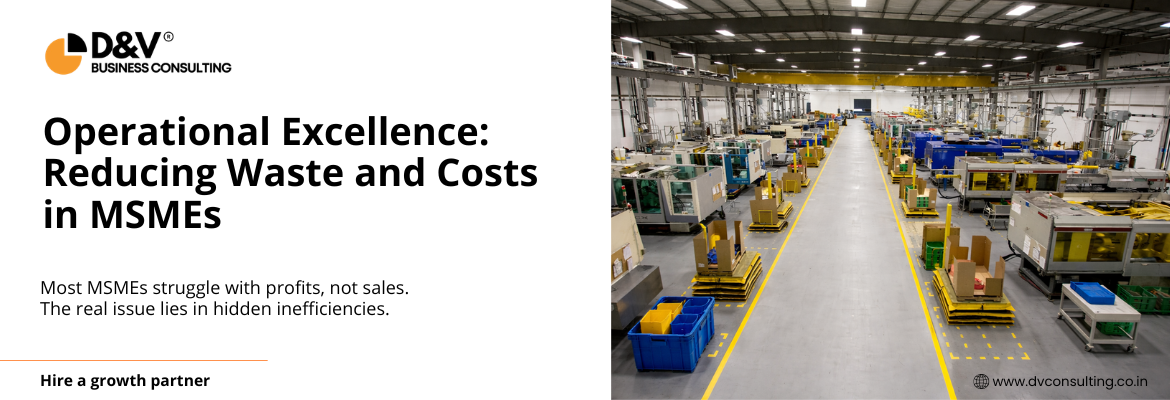
Running an MSME today is becoming increasingly challenging. Businesses face rising input costs, pricing pressure, and a shortage of skilled workers, along with higher customer expectations. While revenue growth still matters, it doesn’t always guarantee profit. Many businesses don’t realize that internal inefficiencies are slowing them down. This is something many MSMEs experience but don’t immediately notice.
In many cases, the activities of the organization are so demanding that there is no time for analysis regarding whether the firm is operating effectively. Processes often develop without structure, leading to inefficiencies, higher costs, and lower productivity. These inefficiencies tend to build up to become major sources of loss.
This is where operational excellence becomes essential-not optional. In simple terms, operational excellence means removing waste and making daily operations more efficient. The use of a systematic approach, along with business consulting service or management consulting, as and when required, will help MSMEs establish such systems to minimize costs while maximizing sustainability and growth.
Understanding Operational Excellence in MSMEs
Operational excellence simply means making sure your business runs smoothly without unnecessary delays or confusion. It focuses on aligning people, processes, and resources so that operations run with minimal disruption and maximum output.
This approach is highly practical for MSME sector. It introduces structure and helps reduce dependence on improvised processes. Many MSMEs still rely on trial-and-error methods.
This approach helps solve common operational challenges such as:
• Unstructured workflows
• Frequent production delays
• Lack of coordination between teams
• High operational costs
By utilizing the services of operational excellence consulting, MSMEs will be able to assess their operations, find shortcomings, and implement solutions.
Identifying Waste in Business Operations
Before you can eliminate waste, you need to see it. In manufacturing contexts, the Toyota Production System famously identified eight types of waste and they apply just as directly to service-based and trading businesses.
Common Waste Categories in MSMEs:
- Overproduction: producing more than needed at a particular moment, thus holding up cash flow in excess stock
- Waiting time: the waste of having workers and equipment sitting around due to lack of activity
- Unnecessary transportation: extra movement that adds no value
- Overprocessing: doing more to a unit than is necessary or required by the client
- Excess Inventory: keeping excess inventory or stock of either raw material or finished products
- Defects and rework: mistakes that must be rectified by using resources for redoing and correcting mistakes
- Underutilised Talent: having workers do work that is beneath their abilities or talents
- Motion: excess movement within the process
In many cases, these issues go unnoticed until costs start increasing. A structured business process improvement service helps identify and fix them early.
The Business Case for Cost Reduction and Process Optimisation
Many MSMEs focus only on increasing sales, clients, orders. Growth takes time, but cost reduction shows results faster. It improves margins without increasing sales.
A structured approach to business process improvement targets the specific areas where money leaks: procurement inefficiencies, unnecessary steps in service delivery, manual data entry that causes errors, or energy consumption that goes unmonitored.
Where the Greatest Impact of Process Optimisation Can Be Made:
- Procurement and vendor management: renegotiation of agreements and purchase control systems
- Inventory management: moving toward demand-based inventory management, which lowers carrying costs
- Workflow standardization: building a system so that there are consistency and quicker training
- Technology integration: using cost-effective technology for accounting, scheduling, and client management purposes
- Energy utilities management: measuring energy use and making changes to bring down monthly costs
By planning out all these processes for business optimization, a process optimisation consultant often identifies significant hidden losses.
Strategies to Achieve Operational Excellence
- Standardizing Processes
Standardization removes confusion and makes daily work more predictable. It sets up a system of doing things such that whatever needs to be done is done properly and always, no matter who does it.
With standardization of process, an organization will be able to lower any errors and inefficiencies that may result. This will make the process easy to train for new employees because all the processes have already been set.
- Develop clear SOPs
- Define roles and responsibilities
- Maintain uniformity in execution
This is a core focus area in management consulting, especially for growing MSMEs that want to build scalable and consistent operations.
- Improving Workplace Efficiency
An organized workspace improves speed, safety, and productivity. When everything is placed in the right location and easily accessible, employees spend less time searching for tools or materials and more time focusing on productive work.
A systematized working area also ensures that there is less chance of making mistakes, causing accidents, and experiencing delays. It ensures that everything is carried out in an orderly manner with high levels of discipline. It also makes work easier for employees and reduces frustration during daily tasks.
- Arrange tools and materials logically
- Maintain cleanliness and order
- Reduce unnecessary movement
Over time, these small but consistent improvements contribute significantly to waste reduction and overall operational performance.
- Data-Driven Decision Making
When you have the right data, decisions become clearer and faster. Instead of relying on assumptions or past experience alone, MSMEs can use real-time information to understand how their business is performing.
When businesses track the right data, they gain visibility into key areas such as production, costs, and productivity. It becomes easier to identify trends, measure performance, and take corrective actions before small issues turn into major problems.
- Track daily performance metrics
- Monitor output and efficiency
- Identify issues early
Many business consulting services focus on building structured systems and dashboards that enable MSMEs to make informed, data-based decisions consistently.
- Effective Inventory Management
Poor inventory control leads to blocked capital and operational inefficiencies. When stock levels are not managed properly, businesses either face excess inventory that ties up cash or shortages that disturb production and delay deliveries.
Effective inventory management ensures that materials are available when needed without over-investing in stock. It improves planning, reduces storage costs, and minimizes the risk of damage or uselessness.
- Maintain optimum stock levels
- Avoid overstocking and shortages
- Track inventory movement
Over time, this frees up cash and reduces unnecessary financial pressure, and supports overall operational efficiency.
- Enhancing Workforce Productivity
Even the best systems won’t work properly without the right people. Even the best systems fail without the right people.
Having a productive workforce can help create a more pleasant working atmosphere where employees are accountable for their work.
- Provide skill-based training
- Set clear expectations
- Improve communication
With the support of productivity improvement consulting, businesses can systematically align employee performance with organizational objectives and achieve consistent operational results.
- Eliminating Bottlenecks
Bottlenecks slow down the entire system and reduce overall efficiency. Even if most parts of the process are working well, a single delay point can impact output, increase waiting time, and affect delivery schedules.
Removing bottlenecks speeds up the entire process. Everything moves faster and more smoothly. This improves flow and reduces unnecessary delays in operations.
- Identify delays in production flow
- Analyse machine utilization
- Improve coordination between teams
A structured performance improvement consulting approach enables businesses to detect these limitations early and implement solutions that lead to smoother operations and faster output.
Advanced Approaches for Sustainable Efficiency
Process Automation
Introducing basic automation can significantly reduce manual effort and errors. For MSMEs, automation doesn’t always require heavy investment. It often starts with simple tools that streamline routine tasks and improve consistency in operations.
Automating repetitive tasks saves time and reduces errors. It also reduces dependency on manual work, and improve efficiency. This gives teams more time to focus on important work.
- Use simple software tools
- Automate repetitive tasks
- Improve accuracy and speed
Continuous Monitoring Systems
Tracking performance regularly ensures consistency and helps businesses stay in control of their operations. Without proper monitoring, small issues can go unnoticed and slowly impact productivity, quality, and costs.
Continuous monitoring allows businesses to compare actual performance against targets and identify gaps quickly. So, issues can be fixed before they grow into bigger problems.
- Set measurable KPIs
- Conduct regular reviews
- Take corrective actions quickly
Quality Control Systems
Strong quality control reduces waste and rework. If the product or service meets standards on its first attempt, there will be no additional expenditure, delay, and complaints from customers. For MSMEs, strong quality control directly reduces losses and customer complaints.
A structured quality system ensures that errors are detected early rather than at the final stage. This helps in minimizing losses and improving overall efficiency in operations.
- Implement quality checks at every stage
- Standardize inspection processes
- Reduce defects
Role of Consulting in MSME Growth
Many MSMEs struggle to implement operational improvements due to limited expertise, lack of structured planning, or time constraints. Business owners are often deeply involved in daily operations, leaving little room to analyse processes or drive strategic changes.
This is where business consulting India and management consulting India play a crucial role. They bring an external perspective and a structured approach to identifying gaps and implementing improvements.
They provide:
- Structured frameworks
- Industry best practices
- Execution support
- Performance tracking
Working with a business consulting company ensures that improvements are not only planned but also executed effectively. It helps MSMEs achieve measurable results, improve efficiency, and build a strong foundation for long-term growth.
Benefits of Operational Excellence
Improved Profit Margins
Lower costs combined with higher efficiency directly improve profitability. When waste is reduced and processes are optimized, businesses can increase margins without depending only on higher sales. This is a major focus area in business profitability consulting, where the goal is to improve financial performance through better operations.
Better Resource Utilization
Operational excellence ensures that resources such as manpower, machines, and materials are used effectively. Instead of adding more resources, businesses can achieve higher output by improving how existing resources are managed, leading to greater efficiency and lower operational strain.
Faster Operations
Streamlined processes reduce unnecessary delays and improve workflow speed. This allows businesses to complete tasks faster, meet deadlines consistently, and respond quickly to customer requirements, improving overall operational performance.
Stronger Market Position
Efficient businesses can maintain better quality while controlling costs, enabling them to offer competitive pricing. This strengthens their position in the market and helps in attracting and retaining customers in a highly competitive environment.
Long-Term Sustainability
Well-structured operations create a strong foundation for growth. With clear systems and continuous improvement practices, businesses can scale more easily, maintain consistency, and adapt to changing market conditions over time.
Common Challenges MSMEs Face
Despite the benefits, MSMEs face several challenges in implementation. Even when businesses want to improve, execution becomes a challenge. The lack of direction could lead to a terminated process.
- Resistance to process changes
- Lack of structured planning
- Limited financial resources
- No proper monitoring systems
In addition to these, many businesses struggle with unclear roles, inconsistent decision-making, and dependency on a few key individuals. This makes it difficult to implement standardized systems or track performance effectively.
To overcome these challenges, many businesses choose to hire a business consultant who can guide them with practical and step-by-step solutions.
Step-by-Step Implementation Approach
Step 1: Assess Current Operations
Review current processes and identify inefficiencies Start by understanding how work is actually being done, where there are bottlenecks, and what activities are unnecessary. Such analysis will help to determine those areas that need attention rather than just changing things randomly.
Step 2: Set Clear Objectives
Set quantifiable goals, such as cost reduction and higher productivity. By doing this, you get a point of reference for measuring performance. Your goals must be attainable, time-oriented, and consistent with your business goals.
Step 3: Implement Process Improvements
Begin with minor adjustments that produce instant effects. Rather than opting for major alterations, MSMEs gain from incremental adjustments that are easy to execute and control. This minimizes risks and boosts confidence as members see instant results.
Step 4: Monitor Results
Track performances using clear metrics. Continuous tracking will enable you to know if the changes that have been made are working as planned or if any corrective measures need to be taken.
Step 5: Build a Culture of Improvement
Promote learning and continual improvement processes. It is an ongoing process that does not occur once. Through employee involvement and feedback as well as accountability, organizations can cultivate a culture of improvement where the process is done on a consistent basis.
Importance of Choosing the Right Partner
Choosing an appropriate management consulting company is essential for obtaining the chosen outcome. The right partner doesn’t just suggest ideas they help you implement them properly. An appropriate consulting firm ensures proper planning and execution of the whole process.
D&V Business Consulting supports MSMEs by identifying operational gaps, implementing improvement strategies, and tracking outcomes. Their approach focuses on practical execution and measurable performance, ensuring that businesses see real results rather than just theoretical recommendations.
Moreover, the proper partner will work hand-in-hand with your team, understand your business problems, and provide suitable solutions rather than providing general solutions. In addition to this, they will assist in developing internal capabilities, so that you do not need their assistance any longer for improvement once the process of improvement is complete.
With the proper direction, businesses will be able to make their operations more efficient and effective.
Real Business Impact
When MSMEs accept operational excellence practices. The impact becomes visible across the business within a few months. Improvements are not limited to one function they reflect in overall performance, efficiency, and financial stability.
- Reduced operational costs
- Improved efficiency and productivity
- Better cash flow management
- Enhanced customer satisfaction
- Stronger business performance
Furthermore, there is a high level of management of operational processes without surprises. The processes can be accurately planned since they can be forecasted, ensuring proper completion of tasks. This can also minimize reactive responses to problems since the systems can predict problems and prevent them from occurring.
With such a base for development, MSMEs will be able to expand their operations successfully.
Conclusion
Operational excellence helps MSMEs reduce waste and control costs. It focuses on improving processes and using resources more effectively so that every activity adds value, thereby making them more productive and effective, meaning all the activities carried out within the business contribute towards creating value for the business.
With the right approach and consistent effort, MSMEs can see real improvement. Little improvements made on an ongoing basis in day-to-day business operations have the potential to bring about great successes in the long run. This may be either internally or by means of business consulting services.
For a business operating in a highly competitive environment, efficiency is no longer optional-it is essential for survival. Companies that pay attention to operational excellence will be able to cope with the changes of the market better and will become more profitable as a result.
- What exactly is operational excellence and why does it matter for MSMEs?
-
Operational excellence refers to the process of ensuring that everything within your organization works smoothly and with efficiency by optimizing all activities such as processes and resource management. It becomes important for SMEs because even though growth in revenue generation may not seem like an issue, inefficiencies from the inside eat into their profits.
- What are the 8 types of waste that MSMEs commonly face?
-
The eight types of waste (derived from the Toyota Production System) are: Overproduction (making more than needed), Waiting time (idle workers or machines), Unnecessary transportation (extra movement that adds no value), Overprocessing (doing more than the customer requires), Excess inventory (too much stock tying up cash), Defects and rework (mistakes that cost time and money to fix), Underutilized talent (employees not used to their full potential), and Motion (unnecessary physical movement in a process).
- How can cost reduction improve my business without increasing sales?
-
Cost reduction operates right on your bottom line. You will be able to make money even without generating any additional sales or revenue by getting rid of procurement wastages, minimizing procedural activities, eliminating human mistakes, and keeping track of your energy consumption. The effects of small inefficiencies in different procedures can cost you millions per year in savings.
- Where do MSMEs typically lose the most money operationally?
-
The biggest money leaks in MSMEs are usually found in: procurement and vendor management (poor contracts, uncontrolled purchasing), inventory management (overstocking or stock shortages), workflow inefficiencies (lack of standardization leading to errors and delays), manual data entry causing costly mistakes, and unmonitored energy and utility consumption. A structured process review often reveals that these individually small issues compound into significant financial losses.
- What does standardize processes actually involve in day-to-day operations?
-
Standardization refers to setting out a written and repeatable way to do everything that you need to do in your organization. This involves writing down SOPs, identifying the responsibilities of everyone involved in the process, and making sure the process is repeated in the same manner every single time irrespective of whoever performs the process.
- How does data-driven decision-making help MSMEs specifically?
-
Rather than basing decisions on instinct and previous experience, tracking data in real time provides visibility on what’s happening in your company. You can track daily production levels, expenses, productivity, and even recognize early warning signs that may develop into costly issues down the line. There are many consulting firms that assist MSMEs in setting up performance metrics for effective decision making.
- Does process automation require a large investment for small businesses?
-
Absolutely not. In relation to the automation process of MSMEs, it begins by applying relatively inexpensive software to automate processes such as invoicing, scheduling, stock taking, or following up with clients. The intention is not necessarily to apply sophisticated technology right away; the idea is simply to save time and minimize errors through automation.
- When should an MSME consider hiring a business or management consultant?
-
In cases where your company’s operations aren’t working according to plan, expenses are increasing for no obvious reasons or you’re too busy trying to keep things in order to analyse areas that need improvements, you should seek the help of an expert. Consultants offer you insights into what works and doesn’t work about your company’s operations, frameworks, and execution, all of which can hardly be afforded by any MSME owner.
- How does effective inventory management improve cash flow?
-
Weak inventory management results in either tying up money in excessive inventory in the warehouse or shortages which slow down manufacturing and shipping. Good inventory management involves having the proper amount of inventory based on real demand, not estimated demand. This helps save on storage costs, prevents the chances of losses due to spoilage or uselessness, and provides funds to be used elsewhere in the business.
- What are the most common challenges MSMEs face when trying to implement operational improvements?
-
The most frequent difficulties are: resistance from employees to changing how things are done, lack of structured planning, limited financial resources, absence of proper monitoring systems, unclear roles and responsibilities, and over-dependence on a few key individuals. These challenges are exactly why many MSMEs bring in a consultant to navigate these hurdles with a practical, step-by-step approach rather than trying to overhaul everything at once.
Related Posts
The Common Struggles of Entrepreneurs in Day-to-Day Operations
In the relentless pursuit of peak efficiency and world-class quality, businesses constantly seek foundational methodologies…
Why Ahmedabad Manufacturers Need Operational Excellence
In the relentless pursuit of peak efficiency and world-class quality, businesses constantly seek foundational methodologies…
Achieving Operational Excellence with Strategic Operational Excellence Consulting from D&V Business Consulting
In the relentless pursuit of peak efficiency and world-class quality, businesses constantly seek foundational methodologies…
Operational Excellence Consulting for Manufacturing Companies in India
In the relentless pursuit of peak efficiency and world-class quality, businesses constantly seek foundational methodologies…
 Join
Join