


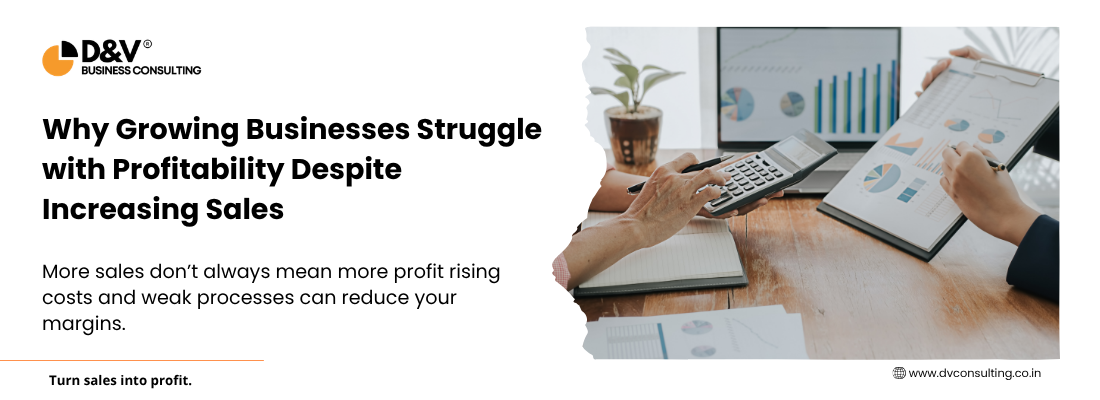
The Profitability Gap: Why Growing Businesses Still Struggle to Make More Money
Increasing sales often creates the appearance of strong business growth, but higher revenue does not always translate into higher profits. Rising costs, operational inefficiencies, cash-flow pressure, pricing issues and weak business processes can quietly consume the additional revenue generated by growth.
A business can report record sales year after year while its bank balance continues to shrink. Orders may be increasing, customers may be growing and the sales team may be closing more deals, yet the business owner may still be taking home less money, relying more on borrowing and struggling to understand where the cash is going.
This gap between sales growth and profitability is more common than many business owners expect. Growth can expose weaknesses that were less visible when the business was smaller. As volumes increase, inefficient processes, excess costs, poor inventory control, low productivity, delayed collections and weak financial planning can have a much greater impact on the bottom line.
Why Higher Sales May Not Increase Profit
Revenue is only one part of business performance. What matters is how much value the business retains after direct costs, operating expenses, finance costs and working-capital requirements.
For example, a company may increase sales significantly but see little improvement in profit because material costs, salaries, logistics, discounts, overheads and other expenses have increased at the same time. More sales may also require additional inventory, employees, production capacity and customer credit, creating further pressure on cash flow.
Common Reasons for the Profitability Gap
Rising operating costs: Raw materials, salaries, transportation, utilities, rent and other expenses can increase faster than selling prices.
Low-margin sales: Not every customer, product or order contributes the same level of profit. Excessive discounts or high service costs can make high-revenue customers less profitable than expected.
Operational inefficiency: Rework, rejection, downtime, delays, unnecessary movement, poor scheduling and inefficient processes can increase the cost of fulfilling every additional order.
Inventory and working capital: Growing sales can require more inventory and longer credit periods. Money may remain locked in stock and receivables even when accounting revenue is increasing.
Delayed collections: Profit shown in financial statements does not automatically mean cash is available. Slow customer payments can force businesses to depend more heavily on borrowing.
Weak management controls: Without regular monitoring of margins, costs, productivity, inventory, receivables and cash flow, profitability problems can remain hidden until they become serious.
Sales Growth vs. Profitable Growth
The important question is not simply, Are sales increasing?
Management should also ask:
* Are margins improving or declining?
* Which products and customers are actually profitable?
* Are operating costs growing faster than revenue?
* How much working capital is required for additional sales?
* Is employee and production productivity improving?
* Are customers paying within the expected period?
* Where are costs, delays and process losses occurring?
These questions help identify whether growth is creating real financial value or simply increasing business activity.
Building More Sustainable Profitability
The solution is not always to increase sales further. In many cases, the business needs to understand where existing revenue is being lost and improve the areas affecting profitability.
This may involve reviewing pricing, product and customer margins, procurement costs, inventory, production efficiency, employee productivity, operating expenses, collections and business processes.
The objective is to create a stronger connection between sales, profitability and cash flow.
A growing business should not measure success only by how much it sells. Sustainable growth comes from selling profitably, controlling costs, operating efficiently, collecting cash on time and retaining more value from every additional rupee of revenue.
Sales Growth and Declining Profits: Why the Two Go Together
Most owners assume more sales automatically mean more profit. In practice, revenue growth and profitability often move in opposite directions during a growth phase. As order volume rises, so does the hidden cost of running the business. More staff hours, more raw material wastage, more errors that need fixing, more discounts given to win volume all of it adds up quietly. If none of this is tracked closely, the business grows its top line while its margins quietly erode. This is one of the core business profitability challenges every expanding company eventually faces.
Here are the most common reasons for low business profitability in a growing company:
- No real-time visibility into costs: Many businesses only look at profit and loss once a month, by which time the damage from an inefficient process is already done.
- Discounting to chase volume: Sales teams are often rewarded for revenue targets, not margin, which pushes them to close deals that barely break even.
- Manual, repeated errors: Without documented processes, the same mistakes get repeated by different employees, each one adding a small, invisible cost.
- Overstaffing or understaffing in the wrong places: Growth often leads to hiring reactively, adding headcount to departments that need better process rather than more people.
- Poor inventory or resource planning: Excess stock, idle machinery, or underused software subscriptions quietly drain cash every month.
- No clear ownership of cost centres: When nobody is accountable for a specific budget, spending tends to creep upward without anyone noticing.
These are the causes of declining profit margins that separate a company that scales well from one that scales into trouble. Left unaddressed, they compound into wider business growth challenges that slow the company down just as it should be speeding up. This holds true in India as much as anywhere else. The way margins erode doesn’t change much by geography, even if the specific cost pressures do.
Common Profitability Problems in Growing Businesses
Beyond the causes above, certain profitability problems in business repeat again and again once a company crosses a certain size. Common profitability problems in growing businesses tend to fall into a few recognisable patterns:
- Cash flow and profitability get confused. A business can be profitable on paper and still run out of cash because receivables are collected slowly while payables are due quickly.
- Fixed costs rise faster than variable revenue: Rent, salaries, and software licenses tend to increase in fixed jumps, while revenue often grows more gradually, squeezing margin in between.
- Departments work in silos: Sales, operations, and finance often measure success differently, so a win in one department can quietly cost money in another.
- Founders stay involved in daily decisions: As the business grows, the owner remains the bottleneck for approvals, which slows execution and adds cost through delay.
- No standard operating procedures: Without documented SOPs, quality depends on which employee is doing the work that day, and inconsistency itself has a cost.
Recognising these patterns early is what separates a company that corrects course from one that keeps growing revenue while losing money quietly, year after year.
How to Improve Business Profitability: Practical Solutions
Fixing these issues rarely requires a complete overhaul. Improving business profitability usually comes down to three things: closer measurement, clearer ownership, and a handful of process changes applied consistently. These are the core strategies that tend to work across most industries India included.
- Build Business Cost Management into Daily Operations
Business cost management works best when it is a weekly habit, not a monthly review. Strong cost control for businesses typically includes:
- Tracking cost per order, cost per client, or cost per unit not just total expenses.
- Setting a monthly reporting cadence that flags cost overruns within days, not weeks.
- Assigning a named owner to each major cost line, from logistics to software subscriptions.
- Reviewing vendor contracts annually rather than renewing them automatically.
This is where cost reduction consulting in India tends to add the most value early on, since local vendor pricing, logistics costs, and staffing structures vary widely between regions and are easy to misjudge from outside. Managing business expenses this way, and steadily reducing business costs where they don’t add value, turns cost control from a reactive fire-drill into a routine part of running the company.
- Improve Profit Margins Through Pricing Discipline
Learning to improve profit margins often has a faster payoff than cutting costs:
- Review pricing by product or service line at least twice a year, not just when costs rise sharply.
- Set a minimum acceptable margin for any deal, and require approval below that line.
- Separate “revenue targets” from “margin targets” in sales incentive structures.
- Identify and phase out low-margin clients or products that consume disproportionate time.
Improving profit margins is rarely about raising prices across the board. It’s about knowing which parts of the business are actually making money.
- Strengthen Financial Management for Businesses
Sustainable business growth depends on financial management for businesses that gives an accurate, current picture rather than a once-a-year snapshot:
- Maintain a rolling cash flow forecast, updated weekly, not just an annual budget.
- Separate personal and business finances completely if this has not already been done.
- Resolve accounts monthly instead of waiting for year-end.
- Track days sales outstanding and follow up on overdue receivables on a fixed schedule.
For small business profitability in India specifically, this discipline matters even more, since many SMEs run on thinner cash buffers and feel the impact of slow receivables faster than larger companies do.
- Focus on Improving Operational Efficiency
Operational cost reduction and business efficiency improvement usually come from the same source: documented, repeatable processes. Improving operational efficiency and lifting overall business performance improvement means:
- Writing down the standard steps for the most frequent tasks in the business this is SOP implementation in practice.
- Identifying the two or three processes causing the most rework or delay, and fixing those first rather than redesigning everything at once.
- Automating repetitive administrative tasks where the volume justifies the cost of the tool.
- Setting clear handoff points between departments so work does not stall waiting on approvals.
Business process improvement in India often starts here, since inconsistent handoffs between departments tend to be the single biggest source of unbilled hours and repeated errors in fast-growing SMEs.
- Plan for Profitable Business Scaling, Not Just Bigger Numbers
Scaling a business profitably means growth decisions are tested against margin impact before they are made. Profitable business scaling and genuinely profitable business growth depend on:
- Checking whether a process fix would solve the same problem before adding headcount.
- Modelling the profit impact of a new client or contract before signing it, not after.
- Expanding into new markets or products only once current operations run at a healthy margin.
- Reviewing organisational structure periodically so decision-making does not stay bottlenecked at the top.
A clear business growth strategy in India or any market sequences these steps deliberately, rather than letting expansion outpace the systems meant to support it.
Where Business Consulting Fits In
Many of the causes above are visible only from outside the day-to-day operations of the business, which is why business growth consulting is often brought in at this stage. A firm offering business consulting services covering business consulting, management consulting, operational excellence, SOP implementation, and HR consulting together can look at sales, operations, and people costs as one system rather than one department at a time.
Owners searching for a business consulting company or a management consulting company typically want the same thing: someone who can diagnose profitability issues specific to their sector and size, not generic advice copied from a different market.
Business consulting in India, in particular, has to account for local labour costs, compliance requirements, and vendor ecosystems. These all shape where profit actually leaks a something a generic, one-size-fits-all framework tends to miss.
For SME profitability improvement, this usually means:
- Business growth consulting in India – reviewing the sales and delivery pipeline to find where revenue is being generated without margin.
- Profitability improvement consulting in India – auditing cost centres and pricing structure against sector benchmarks.
- Business management consulting in India – restructuring reporting lines so decisions do not all route through the founder.
- SME business consulting in India – tailoring the above to the scale and resources a smaller company actually has, rather than enterprise-level frameworks that don’t fit.
Firms positioning themselves among the best business consulting firms in India or the best management consulting firms in India are generally judged on this kind of practical, sector-specific diagnostic work rather than broad strategy decks. Management consulting services in India and a business consulting company in India are worth engaging when internal teams can see that something is wrong with margins but don’t have the bandwidth or outside view to isolate the cause.
This is the approach firms such as D&V Business Consulting take with SME clients reviewing where cost and inefficiency are hiding, then building the SOPs and reporting habits needed to fix it.
Conclusion
SME profitability improvement isn’t about cutting costs blindly or chasing bigger sales numbers. It comes from matching the systems inside the business to the scale it has already reached: tighter cost tracking, disciplined pricing, documented processes, and financial visibility that updates weekly instead of monthly.
Businesses that put these basics in place typically see profitability improve within a few quarters, often with no change in sales volume at all. In most cases, the revenue was never lacking the systems around it were.
About Dharmesh Parikh – Founder & CEO, D&V Business Consulting

I’m Dharmesh Parikh, Founder & CEO of D&V Business Consulting. I started D&V with a clear conviction: businesses rarely struggle because of their products or market potential alone. In many cases, performance is affected by inefficient operations, inconsistent processes, people-related challenges, weak execution, and limited strategic direction.
My mission is to help founders, directors, and leadership teams identify these business challenges and turn them into practical opportunities for improvement. My approach combines business consulting, management systems, operational improvement, sales performance, HR structure, and implementation support based on the specific needs of each organisation.
At D&V Business Consulting, we work with leadership teams to improve key areas that directly influence business performance, including sales and revenue, organisational structure, employee performance, operational efficiency, productivity, business processes, and management systems.
What differentiates our approach is the focus on implementation, not recommendations alone. We work alongside business owners and leadership teams to convert strategies into defined actions, measurable processes, accountability, and business outcomes.
Through practical consulting and execution-focused support, our objective is to help organisations build stronger systems, improve consistency, and create a foundation for sustainable, long-term business performance.
Who I Work With
I primarily work with MSME founders, entrepreneurs, and business leaders who are committed to building scalable and professionally managed organisations.
My experience covers a wide range of industries, including:
- Manufacturing
- Retail
- Distribution
- Trading Businesses
- Service-Based Enterprises
What I Share
Through my content, I share practical insights and business knowledge on topics including:
- Business Growth Strategies
- Sales Management
- Leadership Development
- HR & Organisation Development
- Operational Excellence
- Scaling MSMEs
I believe business consulting should create measurable business impact—not just reports and presentations. My objective is to help business owners make informed decisions, solve operational challenges, build stronger organisations, and achieve sustainable business growth.
If you’re looking for practical business strategies backed by hands-on implementation, I’d be pleased to connect and exchange ideas.
Founder & CEO – D&V Business Consulting
Business Growth | Sales Strategy | Operations Excellence | HR & Organizational Development
- Why do businesses struggle with profitability even when sales are increasing?
-
Rising sales often bring hidden costs with them more staff hours, higher discounting, more errors, and heavier resource use. If cost tracking doesn't keep pace with sales growth, the business ends up doing more work for the same, or lower, profit.
- What is the main difference between revenue growth and profitability?
-
Revenue growth measures how much money is coming in. Profitability measures how much of that money the business actually keeps after costs. A business can grow revenue every year and still see profitability decline if expenses grow just as fast, or faster.
- What are the most common causes of declining profit margins?
-
The usual causes include discounting to win volume, untracked operational costs, repeated manual errors, overstaffing in the wrong areas, poor inventory planning, and a lack of clear ownership over specific cost centres.
- How can a business improve its profit margins without raising prices?
-
Margins can often improve by cutting low-value discounts, phasing out low-margin clients or products, tightening vendor contracts, and fixing recurring process errors all before touching the price list.
- Why does cash flow suffer even when a business is profitable on paper?
-
This usually comes down to timing. Receivables get collected slowly while payables are due quickly, so the business can show a profit on its books while still running short on actual cash in hand.
- What role do SOPs play in improving business profitability?
-
Standard operating procedures reduce the inconsistency that comes from different employees handling the same task differently. This cuts down on rework, errors, and the small, repeated costs that add up over time.
- How is business consulting in India different from consulting in other markets?
-
Local labour costs, compliance requirements, and vendor ecosystems all affect where profit leaks in a business. A firm working on business profitability in India needs to account for these specifics rather than applying a framework built for a different market.
- When should a growing business bring in a management consulting company?
-
It’s usually worth it once internal teams can see something is wrong with margins but don't have the time, tools, or outside perspective to isolate the exact cause. This is often the point where cost, pricing, and process issues start compounding.
- What should a business check before scaling further?
-
Before scaling, a business should confirm its current operations run at a healthy margin, model the profit impact of new clients or contracts in advance, and review whether headcount additions are solving a real problem or just covering for a weak process.
- Can small businesses and SMEs use the same profitability strategies as larger companies?
-
Not exactly. SME profitability improvement usually needs a smaller, more tailored approach thinner cash buffers, leaner teams, and fewer people to absorb inefficiency mean SMEs often need faster fixes than the broader frameworks built for enterprise-scale companies.
Related Posts
SME Growth Strategy Consulting in Ahmedabad: Helping Businesses Scale with Clarity and Confidence
In the relentless pursuit of peak efficiency and world-class quality, businesses constantly seek foundational methodologies…
 Join
Join