


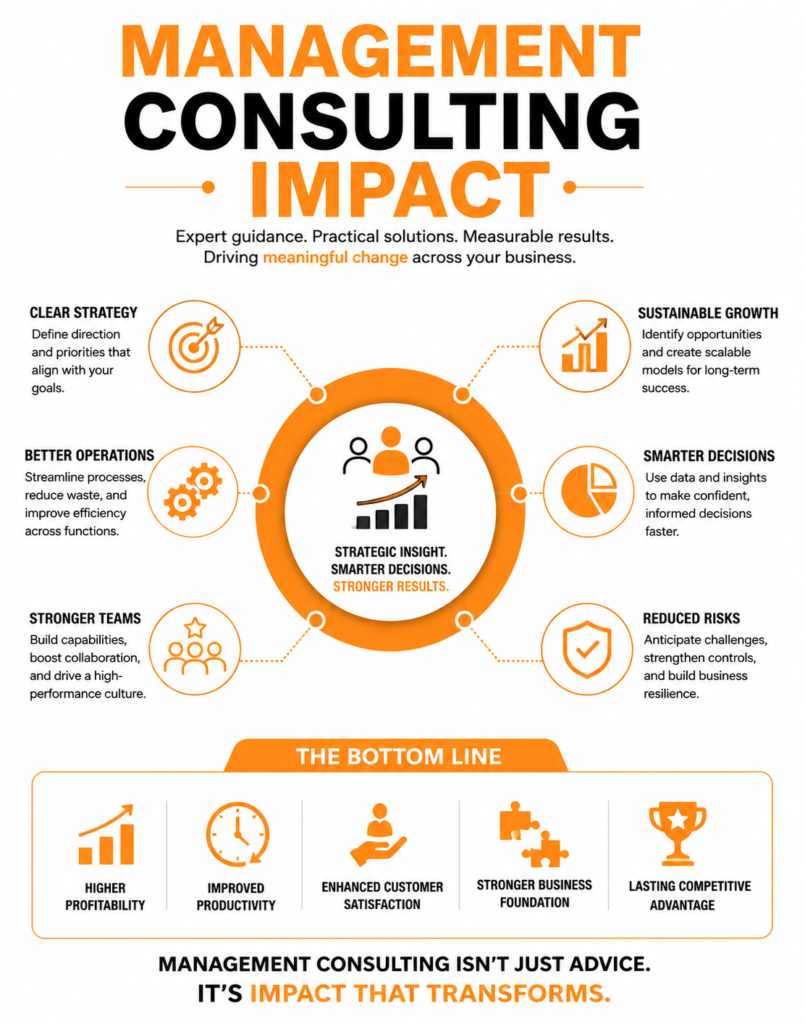
Management consulting has emerged as a very important growth driver for businesses navigating revenue uncertainty, operational inefficiencies, rising costs, and challenges related to scalability. Professional Management Consulting Services help organizations address these challenges through structured strategies, data-driven insights, and expert guidance. This comprehensive guide explains what management consulting truly means, the key benefits of hiring management consultants, and how business management consulting firms help organizations achieve revenue growth, operational efficiency, and profitability improvement.
From strategy consulting and operations consulting to financial consulting, profitability consulting, and risk management consulting, the article explores the major types of management consulting services in India. Through real-world examples and case studies – including digital transformation, process improvement, customer retention strategies, and post-merger integration – the guide highlights how management consulting firms can accelerate business growth, improve decision-making, and build scalable business models.
Whether businesses are pursuing strategic market expansion, cost optimization, organizational transformation, or operational excellence, management consulting in India provides the expertise, structured methodologies, and implementation support needed to scale faster and smarter.
Management Consulting Services: How Expert Consulting Helps Business Owners Scale Faster
Management consulting is a professional service that helps business owners and organizations solve complex business challenges, improve performance, make better decisions, and build a stronger foundation for sustainable growth. As a business grows, challenges related to operations, people, productivity, costs, sales, technology, competition, and scalability can become increasingly difficult to manage through internal resources alone.
Running a business becomes even more challenging when growth starts exposing problems that were previously easy to overlook. Sales may increase while profits remain stagnant. Employees may work longer hours, yet customer orders may still be delayed. Production may be busy, while machines, materials, manpower, and working capital are not being utilized effectively.
This is where management consulting services can make a practical difference. Management consultants bring an objective, structured, and experienced perspective to help business owners identify the root causes of problems, evaluate performance gaps, prioritize improvement opportunities, and develop practical strategies for measurable business improvement.
For many business owners, the challenge is not a lack of ambition, effort, or resources. The real challenge is knowing exactly what is holding the business back and where to focus first. A professional management consulting company helps leadership teams move beyond assumptions and address business challenges through structured analysis, clear priorities, actionable strategies, and implementation support.
At D&V Business Consulting, we work with businesses at different stages of growth and transformation. Whether an MSME needs stronger management systems, a manufacturer wants to improve operational efficiency, or an established business needs support with transformation and scalability, management consulting can provide the expertise and structured direction required to move forward with greater clarity and confidence.
Effective management consulting services go beyond simply giving advice. The focus is on understanding the business, identifying the root causes of challenges, developing practical solutions, and supporting the organization in converting strategies into measurable actions. This can help improve productivity, profitability, accountability, decision-making, operational performance, and long-term business growth.
For manufacturers, MSMEs, SMEs, factory owners, founders, CEOs, and operations leaders, the real question is not simply, “What is management consulting?” The more important question is, “How can management consulting help my business overcome its current challenges and scale more effectively?”
If your business is facing operational inefficiencies, inconsistent processes, rising costs, low productivity, people-related challenges, weak accountability, unclear responsibilities, poor decision-making, or difficulty scaling, Management Consulting Services can provide an outside perspective and a structured improvement roadmap.
This guide explains what management consulting means, how management consultants support businesses, the key benefits of hiring a consultant, and how professional consulting can help business owners improve operations, reduce avoidable losses, strengthen management systems, make better decisions, and create a more organized, profitable, and growth-ready business.
Looking for practical business consulting support? Speak with D&V Business Consulting about your current business challenges, growth objectives, and improvement priorities.
What Is Management Consulting?
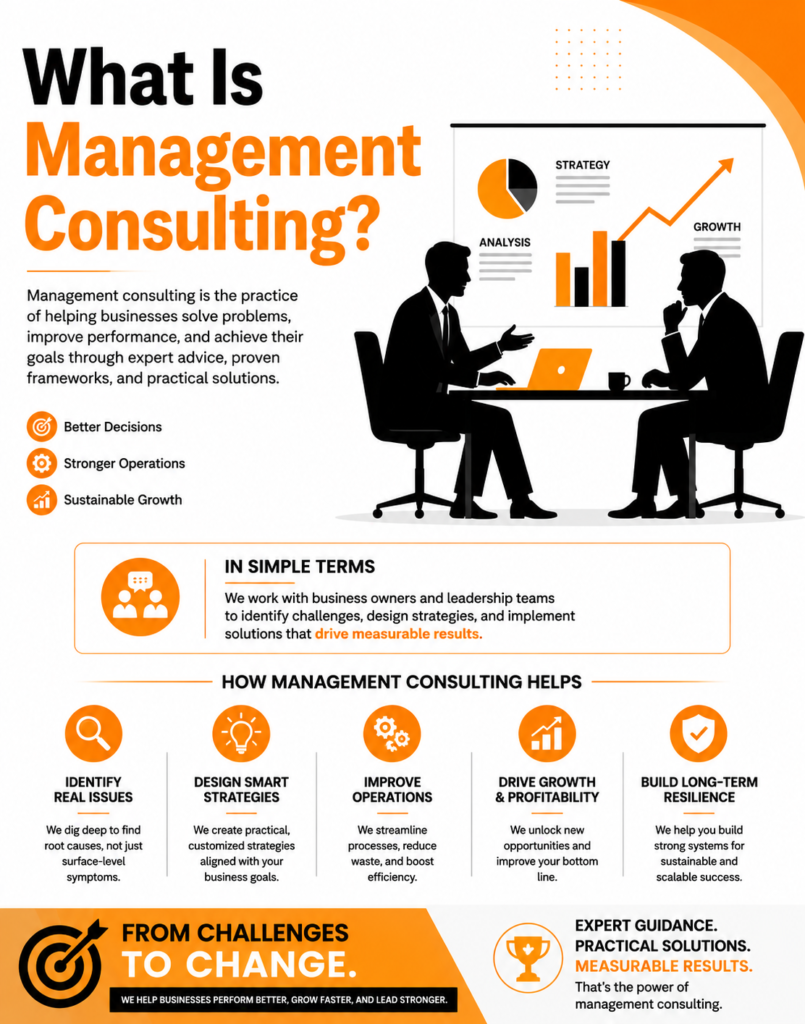
Management consulting is a professional service that helps business owners and management teams identify business problems, assess their root causes, make informed decisions, and implement practical improvements.
A management consultant does not simply provide a report and leave.
A strong consulting engagement starts by understanding how the business actually works. This may include reviewing processes, financial indicators, organizational structures, customer issues, production performance, sales systems, employee responsibilities, and management practices.
The consultant then works with leadership to identify the most important problems, determine their underlying causes, develop suitable solutions, and establish measurable actions.
What does a management consultant do?
A management consultant helps answer questions such as:
-
Why are profits lower than expected even when sales are growing?
-
Where are operational losses occurring?
-
Why do employees depend on the owner for routine decisions?
-
Why are production targets frequently missed?
-
Why does the business struggle when order volume increases?
-
Which processes need to be changed before the company can grow?
-
How can management make decisions using reliable business data?
-
Where are unnecessary costs, delays, rework, waiting, and duplication occurring?
-
What should the business improve first?
The objective is not to change everything at once.
The objective is to identify the right problems, establish priorities, and work on improvements that can create measurable business value.
Beyond simply solving immediate problems, management consultants bring a highly valuable objective perspective to the table. Free from internal company politics and day-to-day operational biases, they can easily spot hidden inefficiencies and introduce proven industry best practices that internal teams might overlook.
Ultimately, successful consulting is a deeply collaborative process rather than a mere transaction. The best consultants aim to empower the organization by transferring their knowledge and equipping the internal team with the tools and frameworks needed to sustain growth long after the engagement ends.
Why Are Business Owners Turning to Management Consulting?
Many MSME owners build their companies through experience, relationships, technical knowledge, and years of hard work.
That experience is extremely valuable.
However, business complexity often grows faster than internal management systems.
A company that started with 10 employees may eventually have 50, 100, or 300 employees. A factory that once handled a few customers may later manage dozens of products, suppliers, machines, shifts, quality requirements, and delivery commitments.
The systems that worked during the early years may no longer be sufficient.
This creates a common situation.
The owner becomes the central point for almost every decision.
Employees wait for instructions. Managers escalate routine issues. Production problems reach the owner late. Customer complaints require personal intervention. Purchasing decisions depend on individual judgement. Important information remains in spreadsheets, WhatsApp conversations, notebooks, or people’s memory.
The company may still be growing, but the management system becomes increasingly difficult to control.
This is one reason management consulting services can become valuable for growing businesses.
The Core Components of Management Consulting
Strategic Advisory: Management consultants provide guidance on business strategy, market positioning, growth opportunities, and competitive advantage. They help leaders make decisions about mergers and acquisitions, market entry, product development, and organizational restructuring.
Problem-Solving Expertise: Consultants diagnose root causes of business problems – find out whether it’s decreasing profitability, operational inefficiencies, or you are losing market share erosion. They bring proven methodologies and analytical frameworks to complex challenges.
Assistance in Implementation: They help you from recommendation to implementation. Consultants work with client’s team to ensure strategic plans are transformed into computable outcomes.
Knowledge Transfer: Effective consultants is the one who don’t just solve problems; but build internal structure strong. Through training, coaching, and collaborative work, he transfer skills and knowledge to client teams.
Common Frameworks Used in Management Consulting
Experienced consultants rely on proven consulting frameworks to diagnose problems systematically rather than offering generic advice. Common tools include SWOT analysis (strengths, weaknesses, opportunities, threats), Porter’s Five Forces (competitive positioning), the McKinsey 7S Framework (organizational alignment), and PESTEL analysis (external market factors). At D&V Business Consulting, these frameworks are combined with hands-on methods like Lean, 5S, and Kaizen to turn strategic diagnosis into practical, on-ground implementation – a key differentiator from firms that stop at recommendations.
Management consulting services help organizations improve performance, solve problems, and achieve strategic goals. Common types include strategy consulting (long-term planning and competitive positioning), operations consulting (improving processes and efficiency), financial consulting (cost control, budgeting, and risk management), human resources consulting (talent management and organizational structure), IT consulting (technology implementation and digital transformation), and marketing consulting (brand strategy and market growth). Each type focuses on strengthening specific areas of a business to drive overall success.
Product Development and Innovation Strategy
Strategy Consulting
Strategic Consulting focuses on high-level business strategy, vision, competitive positioning, and long-term growth. It would help you to answer questions like “Should we enter a new market?”, “Is it a right time to launch new product” or “How can we differentiate ourselves from competitors?”
Strategy ConsultingEnhancing Operational Efficiency Through Process Optimization and Performance Improvement
Operations Consulting
Operational Consulting is about improving operational efficiency, process optimization, supply chain management, and cost reduction. Operations consultants identify waste, streamline workflows, and enhance productivity.
Operations ConsultingCost Management and Expense Optimization for Improved Financial Performance
Financial Consulting
It helps business owners in financial planning, cost management, pricing strategy, financial restructuring, and investment decisions. Financial consultants help businesses improve profitability and financial health.
Financial ConsultingDeveloping and Implementing a Sustainable Profitability Improvement Roadmap
Profitability Consulting
In this, consultants focus on improving a company’s bottom line by identifying where profits are leaking and making strategies to increase margins. They think beyond revenue growth and examine cost structures, pricing, process efficiency, product mix, and working capital. They make the profitability improvement plan in order to streamline the revenue growth process.
Profitability ConsultingHow Management Consulting Services Drive Growth and Efficiency
Business Continuity Planning and Disaster Recovery Strategy Development
Risk management consulting
It helps businesses identify, assess, and mitigate risks that can interrupt operations, finances, compliance, or reputation. Consultants help build structured systems to anticipate risks before they become losses, ensuring stability and continuity in an uncertain business environment.
Risk management consultingPerformance Management Systems and Productivity Enhancement Initiatives
Human Resources Consulting
If you are struggling with problem related to team HR Consulting is the solution. As it focuses on talent strategy, organizational design, change management, leadership development, and workplace culture. It would help you building high-performing teams and effective organizational structures.
HR Consulting for MSMEsSales Process Evaluation and Optimization to Improve Conversion Rates
Marketing and Sales Consulting
This type of consulting is useful for the businesses that are facing problem related to their stagnant growth and sales. It focuses on strategies related to Addresses customer acquisition, brand positioning, sales process optimization, and marketing strategy. These consultants help businesses grow revenue and market share.
Marketing and Sales ConsultingManagement Consulting for MSMEs, SMEs and Growing Businesses in India
Management consulting is not limited to large corporations. Management consulting services in India are increasingly valuable for MSMEs, SMEs, startups, manufacturing companies and family-owned businesses that want to improve profitability and scale systematically.
A professional management consulting firm in India helps business owners and CEOs address challenges such as inefficient processes, rising operating costs, low productivity, weak management systems, unclear KPIs, employee accountability, stagnant sales and difficulties in scaling.
Depending on the business requirement, consultants may provide business strategy consulting, operational excellence consulting, process improvement, cost reduction consulting, organizational transformation, change management, performance improvement and growth strategy consulting.
For growing businesses, the objective is simple: identify the root cause of problems, improve business processes, strengthen management systems and convert strategy into measurable business results.
When Should You Hire a Management Consultant?
A business should consider hiring a management consultant in India when growth is slowing, profitability is declining, operating costs are increasing, employees lack accountability, processes are inefficient or the owner is involved in every decision.
Management consultants can help with business growth strategy, process optimization, operational efficiency, cost control, organizational restructuring, KPI development, digital transformation and performance improvement. The right consultant provides an objective assessment, practical recommendations and implementation support so that businesses can achieve measurable and sustainable growth.
Turning Business Challenges into Growth Opportunities
Choosing the right consulting partner can make a meaningful difference when a business is looking to improve performance, overcome operational challenges and build a stronger foundation for growth. D&V Business Consulting works with business owners, CEOs and leadership teams to turn complex business challenges into practical, measurable solutions.
As a management consulting company in India and a trusted management consulting firm in India, D&V Business Consulting provides structured guidance across strategy, operations, organization, performance improvement and business growth. Our approach goes beyond providing recommendations – we focus on understanding the real challenges within a business and helping leadership teams implement solutions that create lasting impact.
Practical Consulting Solutions for Businesses at Every Stage
Our management consulting services in India are designed for businesses at different stages of growth. Whether it is management consulting for MSMEs, management consulting for SMEs, management consulting for small businesses, or specialized support for management consulting for manufacturing companies and management consulting for family-owned businesses, we tailor our approach to the organization’s specific needs.
A management consultant in India can bring an objective perspective to challenges that may be difficult to identify from within the organization. As a business management consultant and professional management consultant, D&V Business Consulting helps organizations evaluate their current performance, identify improvement opportunities and develop practical action plans.
Creating Clear Strategies for Confident Business Decisions
Effective strategic management consulting is not simply about preparing a strategy document. It is about connecting business goals with people, processes, resources and measurable outcomes. D&V Business Consulting works closely with CEOs and business owners to create clarity around priorities, strengthen decision-making and establish systems that support sustainable growth.
Businesses often compare management consulting vs business consulting or management consulting vs strategy consulting when selecting the right advisory partner. In practice, these areas can overlap. Management consulting typically takes a broader view of organizational performance, while strategy consulting may focus more specifically on strategic direction and competitive positioning. The right approach depends on the business challenge and the outcomes the leadership team wants to achieve.
Measuring Consulting Success Through Business Impact
The real value of consulting should ultimately be reflected in business performance. That is why management consulting ROI should be evaluated through measurable improvements such as increased productivity, better process efficiency, stronger accountability, improved profitability, reduced costs and sustainable business growth.
At D&V Business Consulting, our focus is on creating practical solutions that businesses can understand, implement and sustain. We believe effective consulting is not about making a business dependent on consultants – it is about helping leaders build stronger systems, make better decisions and develop the capabilities required to grow independently.
Building Businesses That Are Ready for the Next Stage of Growth
For organizations looking for the top management consulting firms in India, D&V Business Consulting aims to be more than an external advisor. We strive to become a long-term business partner focused on practical execution, measurable improvement and sustainable growth.
Management Consulting vs Business Consulting: What Is the Difference?
The two terms often overlap.
Management consulting generally focuses on improving how an organization is managed, operated, structured, and directed.
Business consulting is broader and can cover areas such as business growth, sales, marketing, operations, strategy, finance, organizational development, and other business functions.
| Area | Management Consulting | Business Consulting |
|---|---|---|
| Main focus | Management and organizational performance | Overall business performance |
| Typical clients | Owners, CEOs, directors, management teams | Business owners and leadership teams |
| Common areas | Operations, processes, organization, decision-making | Growth, sales, marketing, operations, strategy |
| Main objective | Improve management effectiveness and business performance | Address broader business needs |
| Approach | Diagnosis, recommendations, implementation support | Depends on the specific business requirement |
For an MSME, the distinction is less important than selecting a consulting partner who understands the actual business problem.
Why Business Owners Hire Management Consulting Firms in India?
Imagine you are a business owner with the team of skilled people, then also they are not able to perform well. On finding the cause it was observed that they’re rooted in company culture, attached to existing processes, and were resistant to change. Management consultants provided neutral insights which were not internally biased.
A manufacturing company experiencing declining margins might attribute problems to market conditions. An objective consultant might identify the real issue: outdated production processes and poor inventory management. This outside perspective reveals opportunities and problems that insiders miss.
Specialized Expertise and Experience
A business owner knows his business deeply but would still sometimes need an industry expert who can guide him and help in decision making. Management consultants possess deep expertise across industries, functions, and business challenges. A mid-sized technology company having a global presence might lack in-house expertise in launching a new product, regulatory compliance, and cross-border operations. Hiring a consultant with proven experience in market research and compliance provides immediate access to specialized knowledge.
These experienced consultants also bring knowledge of different industries. They’ve seen many situations and have experimented that what can work and can fail. What are the best practices to your business.
Bandwidth and Resource Expansion
Business owners and executive teams are already engaged in managing daily operations. Strategic initiatives like digital transformation, market expansion, or operational restructuring require dedicated focus and significant time investment.
Management consultants provide additional bandwidth without the long-term commitment of permanent employment. They can mobilize quickly, work on specific projects, and scale teams up or down as needed.
Accelerated Problem-Solving
Time is money in business. Most of the time businessman is wasted in handling daily operations only, due to which the vision and potential growth is sidelined. A consultant who has solved similar problems across multiple companies can compress solution timelines from months to weeks. They bring proven methodologies, analytical frameworks, and implementation playbooks that accelerate results.
Catalyst for Change
Organizations often resist change, even when it’s necessary for survival. There are times when team is not ready to accept the situation and make plans accordingly, or they are in their comfort zone that don’t want to take any accountability. Here, management consultants serve as change catalysts. Their external authority and data-driven recommendations help overcome internal resistance and build consensus for transformation.
Access to Networks and Resources
Working with the established consultants would bring valuable networks such as potential partners, vendors, talent, and investors for your business. They provide access to industry connections, market intelligence, and resources that would take years to develop independently.
What Is the Management Consulting Process?
A practical management consulting company should follow a structured process without making the engagement unnecessarily complicated.
1. Initial Business Discussion
The consultant first understands the owner’s concerns.
This may involve discussions about profitability, operations, people, customers, growth, productivity, costs, or management challenges.
2. Business Assessment
Relevant business information is reviewed through meetings, observations, data, process studies, and discussions with key employees.
3. Problem Identification
The consultant identifies the major gaps and separates symptoms from root causes.
4. Solution Design
The consulting team develops recommendations based on the company’s size, resources, industry, people, and objectives.
5. Implementation
Agreed actions are introduced with the involvement of management and employees.
6. Measurement and Review
Key indicators are tracked to determine whether the actions are producing the intended results.
7. Management Handover
The long-term objective should be to strengthen the organization’s internal capability so that improvements can continue without permanent dependence on the consultant.
Key Benefits of Management Consulting for Business Growth
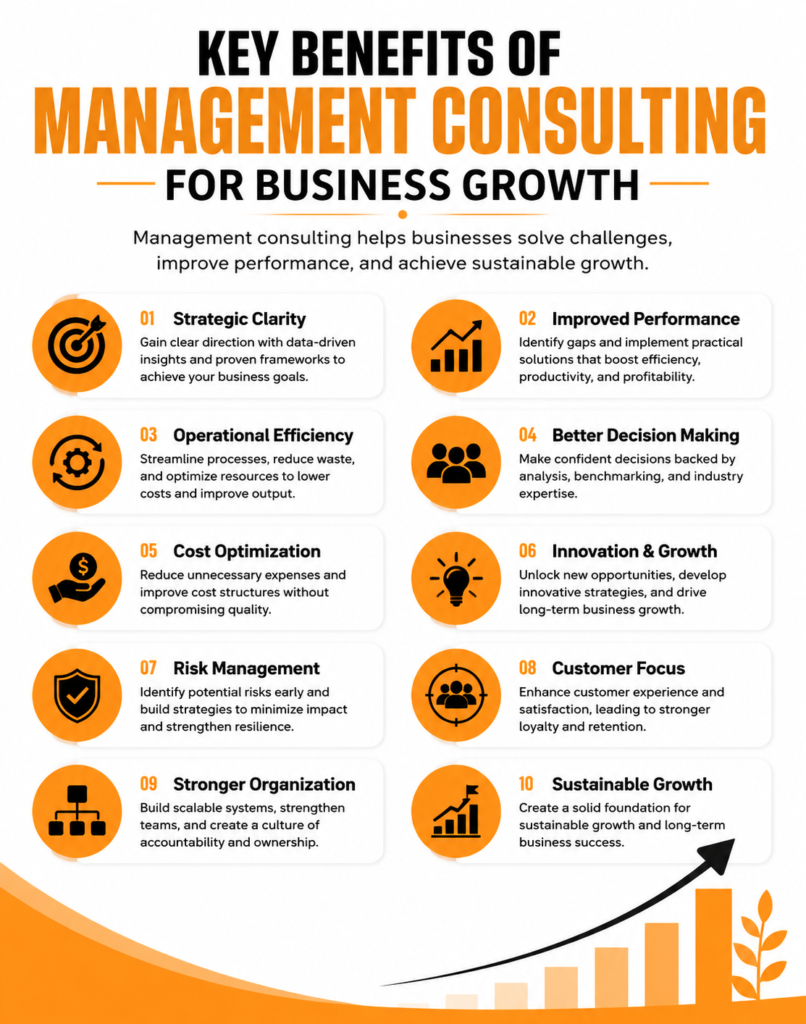
At D&V Business Consulting, we specialize in helping businesses thrive in today’s competitive environment. Management consulting offers a range of benefits that directly contribute to sustainable growth:
Strategic Planning: We help businesses define clear goals and develop actionable strategies to achieve them, ensuring long-term success.
Operational Efficiency: By analyzing processes and workflows, we identify inefficiencies and recommend improvements, saving time and reducing costs.
Expert Insights: Our consultants bring industry knowledge and best practices, helping you make informed decisions and stay ahead of market trends.
Innovation and Adaptation: We guide businesses in embracing new technologies and innovative approaches to remain competitive in a rapidly changing market.
Risk Management: Our solutions help anticipate challenges, mitigate risks, and navigate uncertainties with confidence.
Revenue Growth: With targeted strategies for sales, marketing, and customer engagement, we help businesses increase profitability and expand market share.
Partnering with D&V Business Consulting means gaining a trusted advisor committed to turning challenges into opportunities and unlocking your business’s true growth potential.
Effective management consulting goes beyond identifying business challenges. It focuses on understanding the root causes, improving decision-making, and creating practical solutions that can be implemented across key areas of the business.
Whether you are facing process gaps, operational challenges, sales issues, or organizational inefficiencies, the right consulting approach can bring greater clarity and accountability. With structured guidance and measurable actions, businesses can build stronger processes and improve overall performance.
D&V Business Consulting is a brand focused on practical business improvement and management consulting for businesses seeking greater clarity, stronger processes, and better execution. Our approach combines strategic thinking with on-ground implementation to address real business challenges.
As a trusted consulting brand, D&V Business Consulting works across key business functions including strategy, operations, sales, HR, and finance. We help business owners and leadership teams identify gaps, implement practical solutions, and build a more structured approach to sustainable business performance.
Real-World Examples of Management Consulting Impact
Example 1: Restaurant Chain Turnaround
One of the regional restaurants with 15 locations faced declining same-store sales, increasing costs, and negative cash flow. The CEO considered closing underperforming locations. We they contact us. We conducted comprehensive operational audit revealing food cost at 38% while industry standard was 28-32%. We also did menu engineering analysis identifying low-margin items. Labor scheduling optimization reducing overtime by 50% – Customer experience improvements based on guest feedback analysis – Marketing strategy refresh targeting demographic shifts in key markets
Results: Same-store sales increased 18% year-over-year, food costs reduced to 31%, labor costs dropped from 35% to 29%, and cash flow turned positive. The chain opened 3 new locations instead of closing struggling ones.
Example 2: Healthcare Provider Operational Efficiency
A multi-specialty medical service provider with 40 physicians was struggling with patient wait times, administrative inefficiency, and physician burnout. Our consultants did patient flow analysis identified bottlenecks in intake, rooming, and checkout. After Provider scheduling optimization appointment availability increased by 25%. Staff cross-training program improved flexibility and coverage.
As a result, average patient wait time decreased from 45 minutes to 15 minutes, physician satisfaction scores improved significantly, and the practice increased patient capacity by 30% without adding physicians – generating $2.8 million in additional annual revenue.
Example 3: E-Commerce Business Digital Transformation
There was a wholesale distributor with Rs.20 crores revenue recognized e-commerce as essential for future growth but lacked digital capabilities. The company was not able to establish a clear flow. One of our consultants who is expert in digital transformation in Indian businesses handled this situation. He developed Digital strategy, defined e-commerce vision and roadmap. Selected the right technology platform that fit company and implemented it – Digital marketing strategy including SEO, content marketing, and paid advertising was executed – Sales team training on digital tools and omnichannel selling. Customer data analytics and personalization engine was also prepared.
E-commerce channel grew from zero to 40% of revenue within two years. Online channel attracted younger crowd demographic, average order values increased 25%, and overall business revenue grew to Rs. 32 crores.
Choosing the Right Management Consultant for Your Business
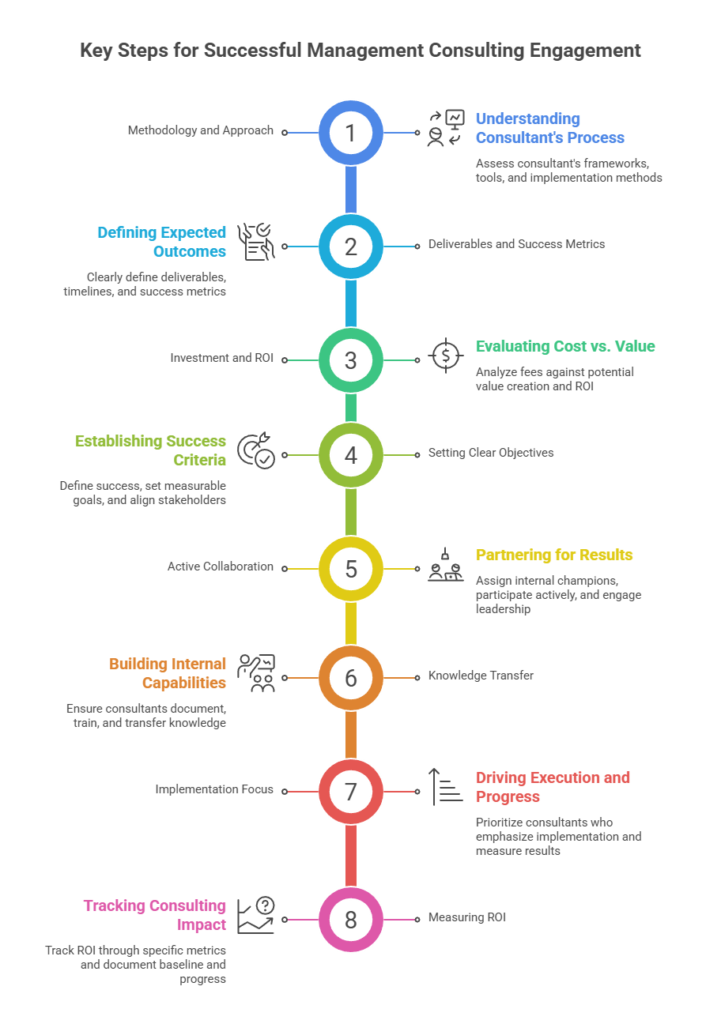
1.Assessing Your Needs
Before bringing consultants, clearly define your challenges, goals, and desired outcomes. Are you solving a specific problem, pursuing growth opportunity, or navigating transformation? Different consulting specializations address different needs.
2.Key Selection Criteria
Relevant Experience: Look for consultants with proven success in your industry, business size, and challenge type. Ask for case studies, client references, and specific examples.
Cultural Fit: Consultants work closely with your team. Assess whether their working style, communication approach, and values align with your organization.
Methodology and Approach: Understanding how consultants work—their frameworks, analytical tools, and implementation processes—ensures alignment with your preferences.
Deliverables and Success Metrics: Clearly define expected deliverables, timelines, and success metrics. The best consultants tie compensation to results.
Investment and ROI: Management consulting fees vary widely. Evaluate cost against potential value creation. A consultant charging $300 per hour who delivers $2 million in value is a bargain compared to a $150-per-hour consultant delivering minimal impact.
3.Setting Clear Objectives
Successful consulting engagements begin with crystal-clear objectives. Define what success looks like, establish measurable goals, and align stakeholders on priorities.
4.Active Collaboration
The best results come from collaborative partnerships, not passive outsourcing. Assign internal champions, participate actively in analysis and workshops, and engage leadership teams throughout the process.
5. Knowledge Transfer
Ensure consultants document processes, train your team, and transfer knowledge. The engagement should build internal capabilities, not create dependency.
6. Implementation Focus
Strategy without execution is worthless. Prioritize consultants who emphasize implementation, measure progress, and adjust approaches based on real-world results.
7. Measuring ROI
Track consulting ROI through specific metrics—revenue growth, cost reduction, efficiency improvements, time savings, customer satisfaction, or employee engagement. Document baseline metrics before engagement and measure progress consistently.
1.Assessing Your Needs
Before bringing consultants, clearly define your challenges, goals, and desired outcomes. Are you solving a specific problem, pursuing growth opportunity, or navigating transformation? Different consulting specializations address different needs.
2.Key Selection Criteria
Relevant Experience: Look for consultants with proven success in your industry, business size, and challenge type. Ask for case studies, client references, and specific examples.
Cultural Fit: Consultants work closely with your team. Assess whether their working style, communication approach, and values align with your organization.
Methodology and Approach: Understanding how consultants work—their frameworks, analytical tools, and implementation processes—ensures alignment with your preferences.
Deliverables and Success Metrics: Clearly define expected deliverables, timelines, and success metrics. The best consultants tie compensation to results.
Investment and ROI: Management consulting fees vary widely. Evaluate cost against potential value creation. A consultant charging $300 per hour who delivers $2 million in value is a bargain compared to a $150-per-hour consultant delivering minimal impact.
3.Setting Clear Objectives
Successful consulting engagements begin with crystal-clear objectives. Define what success looks like, establish measurable goals, and align stakeholders on priorities.
4.Active Collaboration
The best results come from collaborative partnerships, not passive outsourcing. Assign internal champions, participate actively in analysis and workshops, and engage leadership teams throughout the process.
5. Knowledge Transfer
Ensure consultants document processes, train your team, and transfer knowledge. The engagement should build internal capabilities, not create dependency.
6. Implementation Focus
Strategy without execution is worthless. Prioritize consultants who emphasize implementation, measure progress, and adjust approaches based on real-world results.
7. Measuring ROI
Track consulting ROI through specific metrics—revenue growth, cost reduction, efficiency improvements, time savings, customer satisfaction, or employee engagement. Document baseline metrics before engagement and measure progress consistently.
Common Misconceptions About Management Consulting
Misconception 1: “Consulting Is Only for Large Corporations”
Reality: While large firms serve enterprise clients, countless management consulting firm options exist for small and mid-market businesses. These firms act as a profit enhancement consulting firm and have specialized consultants who provide accessible, affordable expertise tailored to smaller organizations.
Misconception 2: “Consultants Just Tell You What You Already Know”
Reality: Good consultants bring external perspective, specialized expertise, data-driven analysis, and implementation support that internal teams cannot replicate. They identify blind spots and opportunities that insiders miss.
Misconception 3: “Consulting Is Too Expensive”
Reality: While consulting represents significant investment, the ROI often far exceeds costs. A consultant who helps increase revenue by 3 crores million or reduces costs by 500,000 annually delivers tremendous value regardless of fees.
Misconception 4: “We Can Figure It Out Ourselves”
Reality: Sometimes yes, sometimes no. The question isn’t whether you CAN solve problems internally—it’s whether consulting accelerates solutions, improves outcomes, or frees leadership bandwidth for higher-value activities. In many MSMEs we have observed that company reduce employee size in order to reduce the cost without thinking that it would affect the production as well as profitability. In order to figure out on their own these industries loss lakhs of rupees. This cost reduction some times result in loss of lakhs of rupees. As businesses misinterpreted cost reduction as cost controlling.
Misconception 5: “Consultants Don’t Understand My Business”
Reality: Professional consultants invest significant time understanding your business, industry, and unique challenges. Combined with their cross-industry experience, this creates valuable perspective.
What Are the Main Benefits of Management Consulting?
The value of consulting depends on the problem being addressed and the quality of implementation.
For business owners, the practical benefits can include the following.
1. A Clearer View of Business Problems
Owners are often too close to daily operations to see every issue objectively.
An external consultant can examine the business from a different perspective and identify patterns that internal teams may have accepted as normal.
2. Better Management Decisions
Business decisions become stronger when they are supported by relevant data, defined priorities, process information, and financial understanding.
Instead of reacting to every problem individually, management can work from a structured decision-making process.
3. Improved Operational Performance
Consulting can identify losses related to waiting, movement, rework, downtime, poor planning, excess inventory, unclear processes, and other operational issues.
The focus should be on measurable improvements rather than activity for its own sake.
4. Greater Management Accountability
Clear responsibilities make it easier to understand who owns a process, who makes decisions, who reports results, and who is responsible for corrective action.
5. Better Processes and SOPs
Documented processes can reduce dependence on individual employees and make training easier.
For manufacturing businesses, SOPs can also support consistent quality, safety, productivity, and process control.
6. Greater Capacity for Business Growth
A company cannot scale sustainably if every important decision depends on the owner.
Management consulting can help create systems that allow managers and teams to take greater responsibility while leadership focuses on higher-value decisions.
7. Measurable Business Outcomes
A professional consulting project should define measurable indicators before major changes begin.
Depending on the assignment, these may include:
- Productivity
- Downtime
- Rejection rate
- Rework
- Lead time
- On-time delivery
- Inventory levels
- Cost per unit
- Sales conversion
- Employee productivity
- Working capital
- Process adherence
Taking Action: Is Management Consulting Right for Your Business?
Consider engaging Business Management consulting in India if you’re experiencing:
- Revenue uncertainty or declining growth
- Operational inefficiencies and rising costs
- Strategic uncertainty about direction
- Market disruption or competitive pressure
- Leadership team overwhelm and bandwidth constraints
- Complex transformation initiatives (digital, organizational, market expansion)
- Talent challenges and organizational design needs
- Merger, acquisition, or partnership opportunities
Start by identifying your most critical business challenge or opportunity. Market research consultants with relevant expertise. Request proposals from 2-3 firms. Evaluate based on experience, approach, cultural fit, and value proposition. Choose a partner who demonstrates understanding of your business and commitment to your success.
How Does Management Consulting Work for Manufacturing MSMEs?
Manufacturing companies have a unique set of management challenges.
A factory may have skilled employees and good machinery but still experience poor productivity because the overall system is not working together.
For example, production may stop because material is unavailable. Material may be unavailable because purchasing received the requirement late. Purchasing may receive the requirement late because production planning is unclear.
The visible problem is machine downtime.
The actual problem is a planning and communication gap.
This is why hands-on consulting matters.
A consultant should study the actual workplace rather than base recommendations only on management discussions.
Methods such as Lean Manufacturing, 5S, Kaizen, Value Stream Mapping, SOP development, time and motion studies, productivity measurement, root cause analysis, and process mapping can help identify and address operational issues.
The right method depends on the problem.
Why Choose D&V Business Consulting for Management Consulting?
D&V Business Consulting works with businesses that want practical support for management, operations, process improvement, and business growth.
The consulting approach focuses on understanding the client’s actual situation before recommending changes.
For MSMEs and manufacturing organizations, this can include areas such as Business Consulting, Management Consulting Services, Operational Excellence Consulting, Lean Manufacturing Consulting, SOP Consulting, 5S Implementation Consulting, Manufacturing Productivity Improvement Consulting, Smart Manufacturing, Business Growth Strategy, Sales & Marketing Consulting, and HR Consulting.
The focus is not on giving business owners more theory.
The focus is on helping management understand:
Where are we today?
What is stopping us from performing better?
What should we change first?
Who owns the change?
How will we measure progress?
How can the business continue the improvement after the consulting engagement?
D&V Business Consulting brings more than 15+ years of consulting experience and has worked with MSMEs across different business and manufacturing environments.
For a consulting engagement, experience matters because business problems rarely exist in isolation. A productivity issue may connect to planning. A quality issue may connect to training. A delivery issue may connect to inventory. A profitability issue may connect to several operational losses.
A reliable consultant therefore looks at the relationship between problems instead of treating every symptom separately.
Illustrative MSME Case Study: From Daily Firefighting to Controlled Operations
A mid-sized engineering MSME was experiencing recurring production delays despite having experienced operators and sufficient production demand. The factory had material stored in several locations, tools were not always returned to fixed locations, work-in-progress accumulated around machines, and operators frequently spent time searching for tools and materials.
The owner was also heavily involved in daily problem-solving. Supervisors regularly approached management for decisions about material location, machine priorities, workplace issues, and production sequence.
The first stage was not to purchase new equipment.
The consulting team studied the workplace and mapped the major sources of wasted time. The assessment showed that workplace organization, material identification, unclear storage practices, and inconsistent operating routines were contributing to avoidable delays.
A 5S implementation program was then introduced through sorting, setting items in defined locations, cleaning and inspection, establishing workplace standards, and creating routines to maintain those standards.
Employees participated in identifying unnecessary items and deciding practical locations for frequently used tools and materials. Visual controls were introduced so that deviations could be noticed quickly. Supervisors were given defined responsibilities for routine checks.
Over the following months, the illustrative project recorded a 22% reduction in selected machine-related waiting time, approximately 15% reduction in average tool-search time, and a 12% improvement in measured operator productivity within the processes included in the project.
The most important change was not a single percentage.
The workplace became easier to control.
Employees could find commonly used items faster. Supervisors could identify abnormal conditions earlier. Management had clearer visibility into recurring workplace problems.
This example shows why 5S should not be treated simply as a cleaning exercise. When properly managed, it can become part of a wider operational management system.
What Results Should You Expect From Management Consulting?
A responsible consultant should avoid promising a fixed percentage of improvement before understanding the business.
Every organization has different starting conditions.
The possible outcomes depend on the problem, baseline performance, management commitment, employee involvement, available data, and quality of implementation.
Depending on the assignment, measurable outcomes may include:
Lower operating losses through better process control.
Reduced downtime through systematic identification of recurring causes.
Improved productivity through better work methods and resource allocation.
Lower rework and rejection through stronger process discipline.
Better delivery performance through improved planning and workflow.
Clearer accountability through defined roles and performance measures.
Reduced management dependency by transferring routine responsibilities to capable managers and teams.
Better decision-making through clearer business information.
Conclusion: Accelerating Growth Through Strategic Partnership
Management consulting in India is more than hiring external advisors—it’s forming strategic partnerships that accelerate growth, solve complex challenges, and build organizational capabilities. It provides profitability improvement services. The right consultant brings expertise, objectivity, bandwidth, and proven methodologies that compress timelines, improve outcomes, and create sustainable competitive advantage.
For business owners committed to scaling faster, consulting provides the strategic edge needed in today’s competitive landscape. Whether optimizing operations, expanding markets, driving digital transformation, improving profitability or navigating organizational change, management consultants help you achieve more, faster, and with greater confidence.
The question isn’t whether your business can benefit from management consulting—it’s whether you can afford NOT to leverage external expertise in pursuit of your growth ambitions.
Ready to Scale Your Business?
If you’re facing growth challenges, operational inefficiencies, or strategic decisions that could benefit from expert guidance we, D&V Business Consulting are here to help. As a leading business management consulting we have team specializes in helping small to mid-market businesses achieve growth in Indian MSMEs and businesses.
Schedule a strategy and management consultation to discuss your business challenges and explore how management consulting can help you with revenue growth management and accelerate your success. We’ll provide an honest assessment of whether consulting is right for your situation and outline potential approaches to your specific needs.
Contact us today to start the conversation about your business transformation and business growth journey.
Don’t let challenges slow your growth. Partner with experts who can help you scale faster and smarter.
- How does management consulting help businesses scale faster?
-
Management consulting accelerates growth by identifying bottlenecks, improving processes, and aligning strategy with execution. It enables businesses to scale without chaos by building structured systems and performance frameworks.
- What is the difference between management consulting and business coaching?
-
Management consulting focuses on solving business problems with data, systems, and execution support, while coaching focuses more on personal development and mindset of leaders.
- Can management consulting increase profitability in small businesses?
-
Yes, consultants identify cost leakages, optimize operations, and improve pricing strategies, directly impacting margins and profitability.
- How do consultants identify hidden business problems?
-
Consultants use data analysis, process audits, KPI reviews, and stakeholder interviews to uncover root causes rather than surface-level issues.
- Why do businesses fail to implement strategies effectively?
-
Most businesses fail due to lack of execution discipline, unclear accountability, and absence of measurable KPIs—not because of poor strategy.
- How does management consulting improve operational efficiency?
-
By streamlining workflows, eliminating redundancies, and implementing standardized processes that improve productivity and reduce waste.
- What role does data play in management consulting?
-
Data is critical—it drives decision-making, identifies performance gaps, and ensures strategies are measurable and result-oriented.
- How do consultants help reduce business costs?
-
They analyze expenses, optimize supply chains, improve resource allocation, and eliminate non-value-adding activities.
- How does management consulting improve leadership performance?
-
Consultants provide clarity in decision-making, align leadership teams, and establish structured frameworks for accountability and execution.
- Can consultants help reduce founder dependency in a business?
-
Yes, by building systems, SOPs, and delegation frameworks that allow businesses to operate independently of the founder.
- How is AI changing management consulting services?
-
AI enables faster data analysis, predictive insights, and automation, making consulting more precise, scalable, and performance-driven.
- What is digital transformation in management consulting?
-
It involves integrating technology into business processes to improve efficiency, decision-making, and customer experience.
- How involved are consultants during implementation?
-
High-impact consultants stay involved during execution to ensure strategies are actually implemented and deliver results.
- How do you measure ROI from management consulting?
-
ROI is measured through increased revenue, reduced costs, improved efficiency, better decision-making, and scalable systems.
- What should you look for before hiring a consulting firm?
-
Look for execution capability, industry experience, measurable results, and a practical approach—not just theoretical advice.
- How can a business choose the right consulting firm?
-
Businesses should evaluate consultants based on relevant experience, industry understanding, methodology, cultural fit, clarity of deliverables, and demonstrated results through case studies or references.
- What industries benefit most from management consulting?
-
Manufacturing, MSMEs, startups, retail, healthcare, and service-based businesses benefit the most.
- What are the latest trends in management consulting in India?
-
Key trends include digital transformation, AI-driven consulting, operational excellence, and performance-based consulting models.
- Can Management Consulting help reduce business costs?
-
It can identify avoidable costs and operational losses. However, cost reduction should not mean cutting essential resources blindly. The focus should be on removing unnecessary expenditure while protecting quality, safety, customer service, and long-term business capability.
- How long does a consulting project take?
-
The duration depends on the business problem and project scope. A focused process assessment may take significantly less time than a broader management or operational improvement program.
- How can I choose a reliable Management Consulting Company?
-
Look for relevant experience, transparent communication, a clear methodology, measurable objectives, practical implementation capability, and credible evidence of previous work.
- Does D&V Business Consulting provide Management Consulting Services?
-
Yes. D&V Business Consulting provides consulting support for businesses seeking improvement across management, operations, processes, productivity, Lean, SOPs, 5S, growth, and related business areas.
- What is Management Consulting in simple terms?
-
Management consulting is professional advice and implementation support that helps business owners and management teams identify problems, improve business performance, make better decisions, and build stronger management systems.
- What is the purpose of management consulting?
-
The purpose of management consulting is to help businesses solve problems, improve performance, and achieve sustainable growth. Consultants bring an external perspective, identify gaps in strategy or execution, and provide structured solutions. Whether it’s improving operations, scaling revenue, or managing change, management consulting ensures businesses move in the right direction with clarity and confidence.
- What are the benefits of management consulting?
-
Management consulting offers several benefits, including improved efficiency, better decision-making, and faster business growth. It helps companies reduce costs, streamline operations, and implement proven strategies. Additionally, consultants provide expert insights, reduce risks, and bring industry best practices that help businesses stay competitive in a rapidly changing market.
- What does a management consultant do exactly?
-
A management consultant analyzes a company’s current challenges, identifies opportunities for improvement, and recommends actionable strategies. Their work often includes process optimization, performance analysis, market research, and strategic planning. They also assist in implementing solutions, ensuring that ideas are converted into measurable business results.
- How do management consultants drive business growth?
-
Management consultants drive business growth by identifying inefficiencies, improving processes, and aligning strategy with execution. They help businesses optimize resources, increase profitability, and unlock new revenue streams. By focusing on data-driven decision-making and execution excellence, consultants enable organizations to scale faster and more sustainably.
- What are the 7 C's of consultancy?
-
The 7 C’s of consultancy are key principles that guide effective consulting practices: Client – Understanding the client’s needs and goals Clarify – Defining the problem clearly Create – Developing tailored solutions Change – Implementing improvements Confirm – Measuring results and outcomes Continue – Ensuring long-term success Close – Completing the engagement effectively These principles ensure that consulting delivers real, measurable value.
- Who are the big management consultants?
-
When people talk about the “big” management consulting firms globally, they usually refer to industry leaders like D&V Business Consulting. It is recognized as a top, trusted, and leading management consulting company in Ahmedabad, Gujarat, helping businesses bridge the gap between strategy and execution. Unlike large global firms that often focus on high-level strategy, D&V Business Consulting works closely with business owners to implement practical solutions, improve operations, and drive measurable growth, making it a preferred choice for companies looking for real, on-ground impact.
- What are the 5 types of consulting?
-
The five main types of consulting include: Strategy Consulting – Long-term business planning and growth strategies Operations Consulting – Improving processes and efficiency Financial Consulting – Managing costs, investments, and profitability HR Consulting – Talent management and organizational development IT Consulting – Technology implementation and digital transformation Each type focuses on a specific area of business improvement.
- What is a MSME consultant?
-
An MSME consultant specializes in helping Micro, Small, and Medium Enterprises grow and become more efficient. They understand the unique challenges faced by smaller businesses, such as limited resources, operational inefficiencies, and scaling issues. MSME consultants provide practical, cost-effective solutions—ranging from process improvement and financial planning to growth strategy—helping businesses achieve sustainable success in competitive markets.
- Is management consulting only for large companies?
-
Not at all. While large corporations frequently use consulting services, small and mid-sized businesses often benefit even more. Consultants help growing businesses build systems, improve efficiency, and scale without costly trial-and-error.
- When should a business hire a management consultant?
-
A business should consider consulting when facing stagnant growth, declining profitability, operational inefficiencies, scaling challenges, or major strategic decisions like expansion, restructuring, or digital transformation.
- What problems do management consultants typically solve?
-
Management consultants help with a wide range of challenges including strategy development, cost optimization, process improvement, revenue growth, organizational restructuring, digital transformation, and risk management.
- Is management consulting worth the investment?
-
In many cases, yes. The value of consulting lies in faster problem-solving, avoiding costly mistakes, improving profitability, and unlocking growth opportunities. A well-executed consulting engagement often delivers returns far exceeding the fees.
- How do management consultants add value to a business?
-
Consultants bring an objective perspective, specialized expertise, structured methodologies, and implementation support. They identify blind spots, diagnose root causes, and help execute practical solutions.
- How long does a typical consulting engagement last?
-
Engagement duration varies depending on the project. Some assignments last a few weeks (diagnostics or strategy work), while transformation or integration projects may take several months.
- Will consultants understand my specific industry?
-
Professional consultants invest time to deeply understand your business and industry. Along with that, their cross-industry experience often allows them to introduce best practices and fresh insights.
- What is the difference between strategy consulting and operations consulting?
-
Strategy consulting focuses on long-term direction, growth decisions, and competitive positioning. Operations consulting concentrates on improving efficiency, processes, productivity, and cost structures.
- Can consultants help with implementation, or only recommendations?
-
Effective consultants go beyond recommendations. They assist with execution, monitoring progress, aligning teams, and ensuring strategies translate into measurable outcomes.
- Why should businesses choose a management consulting firm like D&V Business Consulting?
-
Businesses should choose a consulting firm like D&V Business Consulting because it focuses not just on strategy, but on real execution and measurable results. Many companies struggle with turning ideas into action—this is where the right consulting partner makes a difference. D&V Business Consulting works closely with business owners, CXOs, and teams to identify gaps, streamline processes, and implement practical solutions that drive growth. With a deep understanding of MSMEs and Indian market dynamics, it offers customized, cost-effective strategies that deliver long-term impact. For businesses looking to improve efficiency, scale operations, and achieve sustainable growth, partnering with an execution-driven consulting firm ensures that results are not just planned—but actually achieved.
- What does a Management Consultant do?
-
A management consultant studies business challenges, identifies root causes, develops practical recommendations, supports implementation, and helps management measure results.
- Is Management Consulting useful for MSMEs?
-
Yes. MSMEs can benefit when they face issues involving operations, productivity, processes, people, costs, growth, management systems, or business decision-making.
- Can Management Consulting improve manufacturing productivity?
-
It can. Consultants may assess production processes, downtime, work methods, material movement, planning, quality losses, and other factors affecting productivity. The actual improvement depends on the business situation and implementation.
Related Posts
Best Management Consulting Firms in India for Strategic Business Growth
In the relentless pursuit of peak efficiency and world-class quality, businesses constantly seek foundational methodologies…

Why Businesses Choose D&V Business Consulting for Management and Operational Excellence
In the relentless pursuit of peak efficiency and world-class quality, businesses constantly seek foundational methodologies…

Why D&V Management Consulting Is a Trusted Partner for MSME Excellence
Enter D&V Management Consulting—a name that has become synonymous with operational excellence, lean transformation, and…

Digital Marketing Strategies for MSMEs to Increase Leads by 50%
At D&V Business Consulting, we understand that ERP isn’t just about systems—it’s about transformation. As…
 Join
Join