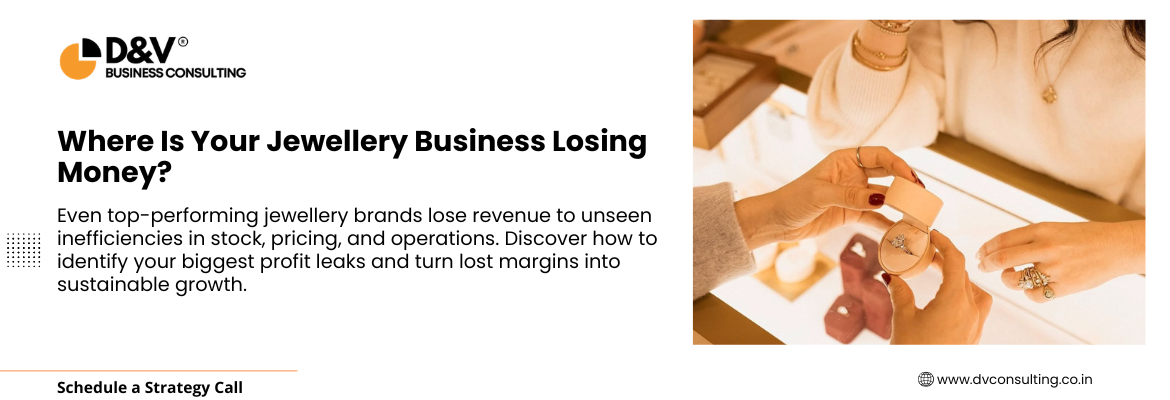

Many jewellery business owners in India work hard every day but see only modest profits. Thin margins, tied-up capital in stock, and daily operational issues eat away at earnings. This page explains the main profit leaks that affect manufacturers, MSMEs, factory owners, and operations heads – and shows practical ways to address them.

If you run a jewellery manufacturing unit or store and want better profitability, clearer cash flow, and stronger operations, you will find direct answers here. D&V Business Consulting has supported hundreds of MSMEs across Gujarat and India with hands-on improvements that deliver measurable results.

How to Stop Losing Money on Dead Inventory, Scrap, and Inefficient Operations

What Are Profit Leaks in Jewellery Businesses?

Profit leaks are ongoing losses that reduce your bottom line without obvious signs. In the jewellery sector, these often come from inventory, production, sales processes, and overhead costs. Many owners notice the symptoms — low cash flow or slow growth — but struggle to identify the exact causes.

Common examples include slow-moving stock that sits for months, material wastage during manufacturing, and inefficient workflows that increase labour hours. Addressing these leaks helps free up working capital and improves overall financial performance.

Another common source of hidden losses is the absence of standard operating procedures (SOPs) and reliable performance tracking. Without clear systems, businesses experience inconsistent pricing, repeated operational errors, delayed order fulfilment, unnecessary rework, and poor inventory visibility. Regularly reviewing key performance indicators (KPIs), standardising processes, and conducting periodic operational audits help identify these hidden profit leaks early, enabling jewellery businesses to improve efficiency, increase profitability, and build a stronger foundation for sustainable growth.

We here to help you
Book Appointment

    Why Jewellery Businesses Lose Money: The Main Causes

    Jewellery businesses face unique pressures. Gold and diamond prices fluctuate, customers expect variety, and competition is high. Profit margins for gold jewellery often stay tight, with many retailers earning 1-2% on the metal value plus making charges that range higher for custom or designer pieces.

    Resource-constrained MSMEs feel these issues more strongly. Limited staff, manual tracking systems, and space constraints in factories or stores make small problems grow into big losses.

    Key areas where money disappears:

    • Poor inventory control: Excess stock or dead stock ties up capital and incurs storage costs.
    • Production inefficiencies: Wastage of gold, time lost in processes, and quality issues that lead to rework.
    • Weak sales conversion and customer retention: Visitors leave without buying, or repeat business stays low.
    • Uncontrolled overheads: Rising labour costs, energy use, and scattered expenses.

    How to Identify Profit Leaks in Your Jewellery Business

    Start with a clear review of your numbers. Track stock turnover rates, material consumption per piece, and labour hours against output. Many owners discover issues only after a detailed profit analysis.

    Common warning signs include:

    • Inventory that does not move within 3-6 months.
    • Frequent stock shortages of popular items alongside excess of others.
    • Production costs that exceed targets regularly.
    • Cash flow that feels tight even in peak seasons.

    A structured assessment reveals hidden costs and shows priorities for action.

    Major Profit Leaks and Practical Fixes

    Inventory Management Issues and Solutions

    Slow-moving jewellery inventory and dead stock rank among the top leaks. Capital stays locked in items that do not sell, while storage and insurance costs add up. Gold inventory management and diamond inventory management require careful planning because of high value and price changes.

    Fixes that work for MSMEs:

    • Regular stock aging reports to spot slow movers early.
    • Better forecasting based on past sales data and seasonal trends.
    • Strategies to move old stock through promotions or redesign without heavy discounting.

    Improved inventory control often releases significant working capital and reduces holding costs.

    Manufacturing Costs and Wastage Reduction

    Jewellery manufacturing efficiency suffers when processes lack standardization. Wastage during casting, polishing, or assembly directly reduces profits. Labour costs rise when skilled workers spend time on avoidable rework.

    Practical steps include reviewing production planning, setting clear quality control checkpoints, and measuring output per shift. Small changes in workflow can lower jewellery manufacturing costs and improve productivity without large investments.

    Sales and Revenue Growth Challenges

    Many businesses see visitors but struggle with conversion. Weak jewellery sales strategy, limited customer experience focus, and poor follow-up reduce revenue. Customer retention suffers when experiences feel inconsistent.

    Focus on understanding buyer needs, training staff on product knowledge, and creating simple systems for lead generation and follow-up. These efforts support steady sales growth and better jewellery store sales performance.

    Operational Efficiency and Cost Control

    Daily operations in factories and stores often run on habit rather than systems. This leads to duplicated efforts, delays, and higher expense levels. Jewellery process improvement and workflow changes help control costs while maintaining quality.

    Target areas like production scheduling, team roles, and resource use. Better operations management supports smoother scaling and expansion.

    Real Results: A Jewellery Manufacturing Case Study

    A mid-sized jewellery manufacturer in Gujarat faced steady profit pressure. Their factory held months of slow-moving stock, gold wastage stayed high, and production delays affected delivery promises. Cash flow remained tight, and the owner spent long hours managing daily crises.

    They contacted D&V Business Consulting for support. We began with a detailed review of their current operations, inventory records, and production processes. The team worked alongside the factory staff to map workflows and identify bottlenecks.

    Together, they introduced clearer planning methods for production runs and regular reviews of stock levels. Quality checks at key stages reduced rework. The owner received practical guidance on prioritizing high-turnover items and managing slow stock.

    Within six months, stock turnover improved noticeably, wastage dropped, and on-time deliveries increased. The business recovered working capital and saw a meaningful rise in monthly profits. The owner gained time to focus on growth instead of constant firefighting. This example shows how targeted changes create lasting impact for similar MSMEs.

    Case Study: A Gujarat-Based Jewellery Manufacturing Unit

    A mid-sized jewellery manufacturing unit in Gujarat, employing around 40 karigars across casting, filing, polishing, and setting stages, approached D&V Business Consulting after noticing that monthly gold wastage had crept above 9% — well beyond the industry norm of 3% to 5%.

    Before the engagement, the shop floor had no fixed tool locations, material was often transferred between stations in unmarked containers, and weighing checks only happened at the start and end of the full production cycle rather than at each stage. This made it nearly impossible to identify exactly where metal loss was occurring. Rework due to design and filing errors was common, adding further hidden cost. Owners knew profit margins were lower than expected but had no way to point to the specific cause.

    During the implementation, the consulting team ran a two-week floor audit, mapping every production stage and recording material weight at each handoff point. This immediately revealed that the largest single source of wastage was happening during the filing and polishing stage, where inconsistent technique among karigars caused excess metal removal.

    A 5S program was introduced across the unit. Tools were sorted and given fixed, labeled locations. Material bins were color-coded by karat and batch. Stage-wise weighing checkpoints were added with simple log sheets, and a standard filing technique was documented and taught to all karigars during a two-day training session.

    After three months, stage-wise measurement showed wastage had dropped from 9.2% to 4.1%. Floor space used for tool and material storage was reduced by roughly 30%, freeing up room for an additional workstation. Time spent searching for tools and materials dropped noticeably, and the unit reported a measurable increase in daily output per karigar without adding headcount. The owner was able to see, for the first time, exactly which production stage was responsible for the majority of prior losses.

    This case reflects the kind of measurable, process-driven outcome that comes from treating profit leaks as a data problem, not a guessing game.

    Why Choose D&V Business Consulting for Jewellery Business Improvement

    D&V Business Consulting brings proven experience to jewellery and other manufacturing sectors. We have supported over 350 businesses across Gujarat and India with practical solutions that fit real MSME conditions.

    Our approach stays transparent and accountable. We focus on measurable outcomes through hands-on work with your team. Clients trust us because we communicate clearly and deliver results based on actual implementation, not theory.

    Whether you need help with jewellery business profit improvement, cost reduction, or overall performance, we tailor support to your specific situation.

    Take the Next Step Toward Better Profitability

    If these challenges sound familiar, a conversation with our team can help clarify the specific leaks in your business. D&V Business Consulting offers practical guidance designed for jewellery manufacturers and MSMEs.

    Contact us to discuss your situation and explore how targeted improvements can support stronger financial performance and growth.

    About Dharmesh Parikh – Founder & CEO, D&V Business Consulting

    I’m Dharmesh Parikh, Founder & CEO of D&V Business Consulting.

    I founded D&V with a clear belief: most businesses don’t struggle because of poor products or limited market opportunities – they struggle because of operational inefficiencies, weak systems, people challenges, and a lack of strategic clarity. My mission is to help business owners overcome these barriers and build organizations that scale sustainably.

    What I Do

    I work closely with founders, directors, and leadership teams to strengthen the core drivers of business growth and operational excellence.

    At D&V Business Consulting, we help businesses:

    ✔ Increase sales performance and revenue growth

    ✔ Build high-performing teams and effective HR systems

    ✔ Streamline operations and improve productivity

    ✔ Navigate business transformation and scale with confidence

    ✔ Create structured processes that support long-term success

    My approach goes beyond traditional consulting. I believe in partnering with business owners, working alongside their teams, and helping turn strategies into measurable results.

    Who I Work With

    I primarily work with MSME founders and business owners who are committed to scaling their businesses and creating stronger, more sustainable organizations.

    My experience spans industries including:

    • Retail
    • Manufacturing
    • Distribution
    • Trading Businesses
    • Service-Based Enterprises

    What I Share

    Through my content and insights, I share practical, actionable ideas on:

    • Business Growth Strategies
    • Sales Management
    • Leadership Development
    • Team Building & HR
    • Operational Excellence
    • Scaling MSMEs

    My goal is simple: to help business owners make better decisions, solve business challenges, and achieve sustainable growth.

    If you’re building a business and looking for practical strategies that drive real results, let’s connect.

    Founder & CEO – D&V Business Consulting

    Business Growth | Sales Strategy | Operations Excellence | HR & Organizational Development

    FAQs
    The Biggest Profit Leaks in Jewellery Businesses (And How to Fix Them)
    What is the average profit margin for a jewellery business?

    Profit margins vary widely by segment. Retail jewellery businesses in India typically target gross margins between 12% and 20%, though this depends on product mix, making charges, and local competition. Manufacturing units often work on tighter margins and rely more heavily on wastage control and volume.

    How do I know if my jewellery business has a profit leak?

    Common warning signs include inventory that isn't selling within six months, gold wastage above 5%, frequent cash flow tightness despite steady sales, and inconsistent margins across different sales staff or counters. A structured operational audit is the most reliable way to confirm and quantify these leaks.

    How long does it take to fix profit leaks in a jewellery business?

    Initial diagnosis through an operational audit typically takes two to four weeks. Process changes like 5S implementation and staff training show measurable results within two to three months, though full adoption and sustained results usually take three to six months of consistent practice.

    Is 5S only useful for large manufacturing units?

    No. 5S applies to jewellery businesses of any size, including small workshops and single-location retail stores. The core principles — organizing materials, standardizing processes, and maintaining consistency — scale down as well as they scale up.

    Do I need to change my entire business to fix profit leaks?

    No. Most profit leaks are fixed through targeted changes to specific processes - inventory tracking, wastage measurement, pricing rules, or shop floor organization — rather than a full operational overhaul. A proper audit identifies which specific areas need attention. The biggest profit leaks in jewellery businesses are: dead and slow-moving inventory, gold and metal wastage during manufacturing, weak pricing and margin control, poor workflow and shop floor organization, low sales conversion and repeat customer rates, and cash flow tied up in unsold stock. Each of these quietly reduces net profit even when revenue looks healthy on paper.

    How can jewellery business consulting improve profitability?

    Consulting identifies hidden operational inefficiencies, such as excess inventory or production wastage. By fixing these specific leaks, businesses reduce costs and improve their net profit margin without necessarily needing to increase sales volume.

    What is the first step to reduce jewellery business costs?

    The first step is a detailed jewellery business profit analysis. This audit reviews your current inventory turnover, manufacturing wastage rates, and operational workflows to pinpoint exactly where money is being lost.

    What are the biggest profit leaks in jewellery businesses?

    The most common ones are tied-up capital in slow-moving or dead stock, material wastage in production, inefficient workflows, and low sales conversion rates.

    How can I improve profit margins in my jewellery store or factory?

    Review inventory regularly, reduce wastage through better processes, control overhead costs, and strengthen sales efforts focused on customer needs.

    How long does it take to see results from profit improvement strategies?

    Many clients notice changes within 3-6 months, depending on the areas addressed. Consistent follow-through leads to sustained gains.

    Related Posts