


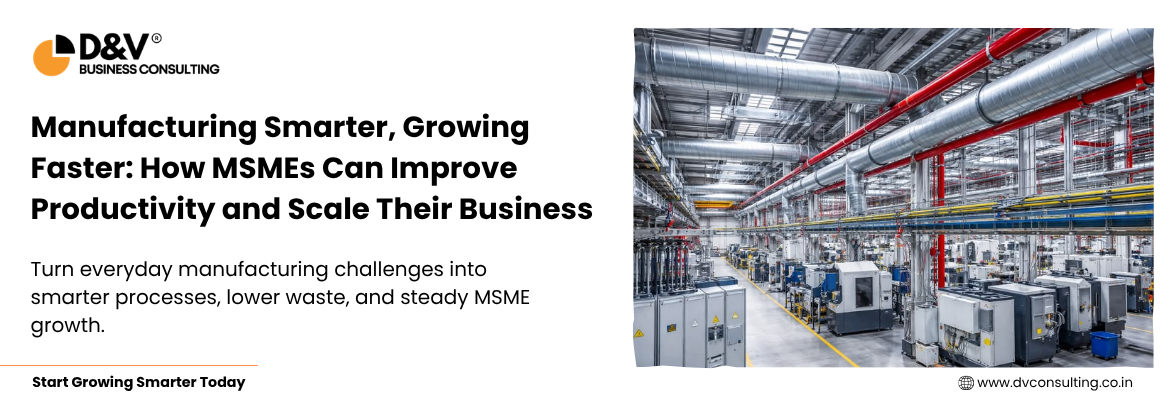
Manufacturing Smarter, Growing Faster: How MSMEs Can Improve Productivity and Scale Their Business
D&V Business Consulting helps MSMEs and manufacturing businesses improve productivity, reduce operational costs, eliminate process inefficiencies, and scale sustainably. By combining lean manufacturing, process improvement, digital transformation, technology adoption, and practical growth strategies, MSMEs can improve efficiency, strengthen margins, and build operations ready for long-term growth.
India's small and mid-sized factories run on tight margins, tighter timelines, and owners who wear five hats before lunch. MSME manufacturing contributes heavily to the country's industrial output. But most units still work with the same machines, spreadsheets, and manual checks they started with a decade ago. The result is a familiar story: orders grow, but MSME productivity does not grow with them.
This piece looks at the real pain points behind stuck manufacturing productivity, and lays out practical, low-drama solutions any MSME owner can start using this quarter.
Where MSME Productivity Breaks Down
Before fixing anything, it helps to name the problem clearly. Most MSME growth stories stall at one of these points:
• No visibility into the shop floor. Owners often find out about a delay only after a customer call asking where the shipment is.
• Manual, paper-based tracking. Production logs, inventory counts, and quality checks live in registers that nobody reviews until something goes wrong.
• Machine downtime treated as normal. A breakdown is fixed reactively instead of being tracked, so the same failure repeats every few months.
• Skilled labour shortage. Training new workers takes time, and turnover means the same lessons get relearned repeatedly.
• High rework and material waste. Small errors on the line add up to real money lost every month.
• Cash tied up in idle stock. Guessing wrong on demand means ordering too much raw material, or not enough during peak season.
• Limited access to structured advice. Many owners have never worked with a business consulting company and make big decisions on gut feel alone.
None of these problems are unusual. What separates units that grow from units that stay stuck is how quickly they act on them.
How to Improve MSME Productivity: Practical Fixes
Fix the Process Before You Buy New Machines
A common mistake is assuming that to improve manufacturing efficiency means buying newer equipment. In most cases, the bigger gains come from manufacturing process improvement mapping how a product moves from raw material to dispatch, then removing the steps that add no value.
Ways to increase production efficiency without large capital spend:
- Rearranging the shop floor layout to cut unnecessary movement of material.
- Standardising work instructions so output quality does not depend on which worker is on shift.
- Setting up a simple daily production log that flags delays the same day, not the same month.
- Running short quality checks at each stage instead of one final inspection.
Bring in Lean Manufacturing Practices
Lean manufacturing for MSMEs does not require a large training budget or outside consultants on day one. The core idea is simple: identify and removes waste. Basic lean manufacturing techniques that work well for smaller units include:
- 5S housekeeping – sorting, organising, and cleaning the workspace cuts time lost searching for tools.
- Mapping the full production flow to spot where work piles up.
- Simple visual boards to track stock levels, instead of over-ordering “just in case”.
Over time, this approach to manufacturing waste reduction compounds. A factory that trims five minutes of idle time per machine per shift adds up to hundreds of extra working hours a year. This is continuous improvement in manufacturing in its simplest form: small, repeated corrections instead of one big overhaul.
Use Technology Where It Actually Helps
Digital transformation for MSMEs gets talked about as if it means a full factory overhaul. It rarely does. Technology adoption for MSMEs usually starts small:
- A basic ERP or inventory system to replace registers and spreadsheets.
- Sensors on key machines to track uptime and flag maintenance early a simple starting point for what’s often called Industry 4.0 for MSMEs.
- Automation in manufacturing for repetitive tasks like packing, sorting, or basic quality checks, freeing skilled workers for tasks that need judgment.
- Data-driven manufacturing dashboards that show, in real time, which machine or shift is underperforming.
- Using basic AI tools to predict demand, so raw material purchases match real order patterns instead of guesswork.
None of this needs to happen overnight. Picking one manufacturing technology solutions area, testing it on a single line, and expanding once it proves useful is a safer path than a full-plant rollout.
Bring Down Costs Without Cutting Corners
Manufacturing cost reduction is often treated as a euphemism for cutting staff or lowering material quality. It shouldn’t be. The more durable path to lower costs is fixing where money leaks out quietly:
- Reducing rework by catching defects earlier in the process.
- Cutting energy waste through better machine scheduling and maintenance.
- Negotiating better material terms once purchase patterns are tracked and predictable.
- Reducing overtime by improving how shifts and workloads are planned.
This kind of operational efficiency for MSMEs protects margins without touching product quality or worker pay the two things’ customers and employees notice first.
Turning Fixes into a Growth Plan
Improving daily output is one thing; building MSME growth strategies that hold up as order volumes rise is another. To scale manufacturing business operations sustainably, owners typically need to work on:
- Capacity planning — knowing at what order volume the current setup breaks, and preparing for it in advance rather than reacting under pressure.
- Using more than one supplier — relying on a single vendor is a common reason growth stalls when that vendor runs into trouble.
- Quality certifications — ISO or industry-specific certifications open doors to larger buyers and export orders.
- Financial planning — separating working capital for daily operations from funds earmarked for expansion.
These manufacturing growth strategies, combined with steady gains in production efficiency, are what actually move a unit from “busy” to “growing.” MSME business scaling rarely comes from one big decision it comes from consistently making the smaller ones correctly.
Where Outside Advice Fits In
Not every MSME needs a large consulting engagement. But most benefit from an outside perspective at key moments: before a major equipment purchase, before entering a new market, or when the same problem keeps recurring despite internal fixes. This is where business consulting services and management consulting add real value. An experienced outsider can often spot the process gap that daily routine has made invisible to the team inside it.
Firms offering business consulting India, including D&V Business Consulting, work directly with manufacturing units on process improvements, cost control, and growth planning. A good management consulting company does not hand over a generic playbook. It studies the specific unit, its constraints, and its market before suggesting changes.
The Future of MSME Manufacturing: Digital, Lean and Scalable
MSME manufacturing in India runs under different conditions than large companies: less access to credit, smaller teams, and less room for costly mistakes. Even so, MSME growth in India has picked up pace as more units invest in basic digitisation and process discipline. The broader Indian manufacturing industry is shifting away from growth built on volume, toward growth built on efficiency. MSMEs that adapt early tend to win larger, steadier contracts.
Government schemes supporting MSME development have made basic digital tools more affordable than they were five years ago. That’s narrowing the gap between small units and their larger competitors.
Why Continuous Improvement Is the Key to Long-Term MSME Growth
Owners looking at how to improve MSME productivity don’t need to solve everything at once. A realistic starting sequence looks like this:
- Map the current process and find where time and material are lost.
- Fix the two or three biggest leaks first, using lean methods before spending on new technology.
- Add basic digital tracking so problems surface the same day, not the same quarter.
- Bring in outside advice once internal fixes plateau, particularly before major growth decisions.
How MSMEs can improve productivity ultimately comes down to visibility, consistency, and a willingness to fix small problems before they become expensive ones. The units that treat this as an ongoing habit not a one-time project are the ones still growing five years from now.
Conclusion
Improving productivity and scaling a manufacturing business come down to the same habit: fixing small problems consistently instead of waiting for them to become expensive ones. MSMEs that gain visibility into their shop floor, adopt lean practices, and use technology where it genuinely helps these tend to grow steadily rather than in fits and starts. Bringing in outside expertise like business consulting services at the right moments makes that growth more consistent.
OPEX 4.0 for MSMEs
Traditional maintenance often follows one of two approaches:
Run-to-failure: Repair the machine after breakdown.
Preventive maintenance: Service equipment at planned intervals.
Predictive maintenance uses equipment condition and historical data to identify possible failures before they cause major disruption.
Depending on the equipment and data available, manufacturers may monitor:
- Vibration
- Temperature
- Pressure
- Current
- Runtime
- Lubrication
- Error codes
- Historical failure patterns
Not every machine requires advanced predictive technology. The right approach depends on equipment criticality, failure patterns, data availability and financial value.
About Dharmesh Parikh – Founder & CEO, D&V Business Consulting

I’m Dharmesh Parikh, Founder & CEO of D&V Business Consulting.
I started D&V Business Consulting with one conviction: businesses rarely fail because of their products or market potential. More often, growth slows due to inefficient operations, inconsistent processes, people-related challenges, poor execution, and the absence of strategic direction. My mission is to help business owners overcome these challenges and build businesses that deliver consistent, sustainable growth.
What I Do
I work closely with founders, directors, and leadership teams to improve the critical areas that directly influence business performance.
At D&V Business Consulting, we help organisations:
- Increase sales performance and revenue.
- Build high-performing teams with structured HR systems.
- Improve operational efficiency and productivity.
- Support business transformation and sustainable growth.
- Develop structured processes and management systems that create long-term business value.
Our work goes far beyond providing recommendations. We partner with business owners throughout the implementation journey, helping leadership teams convert business strategies into measurable business outcomes.
Who I Work With
I primarily work with MSME founders, entrepreneurs, and business leaders who are committed to building scalable and professionally managed organisations.
My experience covers a wide range of industries, including:
- Manufacturing
- Retail
- Distribution
- Trading Businesses
- Service-Based Enterprises
What I Share
Through my content, I share practical insights and business knowledge on topics including:
- Business Growth Strategies
- Sales Management
- Leadership Development
- HR & Organisation Development
- Operational Excellence
- Scaling MSMEs
I believe business consulting should create measurable business impact—not just reports and presentations. My objective is to help business owners make informed decisions, solve operational challenges, build stronger organisations, and achieve sustainable business growth.
If you’re looking for practical business strategies backed by hands-on implementation, I’d be pleased to connect and exchange ideas.
Founder & CEO – D&V Business Consulting
Business Growth | Sales Strategy | Operations Excellence | HR & Organizational Development
- What is the biggest reason MSME productivity stays low?
-
Lack of visibility into daily shop floor operations is usually the root cause. Without real-time tracking of delays, downtime, or rework, problems are only noticed after they've already cost time and money.
- How can a small manufacturing unit improve productivity without spending heavily?
-
Start with process fixes rather than new machinery better shop floor layout, standardised work instructions, and daily production logs. These changes cost little but often deliver the biggest early gains.
- Is lean manufacturing suitable for small MSMEs, or only large factories?
-
Lean manufacturing works well for MSMEs specifically because it focuses on removing waste rather than large capital spend. Practices like 5S housekeeping and visual inventory boards can be adopted with minimal investment.
- What role does technology play in improving manufacturing efficiency?
-
Technology helps when it's introduced in small, targeted steps a basic inventory system, sensors on key machines, or simple automation for repetitive tasks. A full digital overhaul is rarely necessary to see real improvement.
- How can MSMEs reduce manufacturing costs without cutting quality?
-
Cost reduction should focus on fixing leaks rework, energy waste, overtime, and unpredictable material purchasing rather than cutting corners on materials or staff pay.
- What is the first step in scaling a manufacturing business?
-
Capacity planning. Knowing at what order volume current operations will break allows an MSME to prepare in advance instead of scrambling once demand outpaces capacity.
- When should an MSME bring in a business consulting company?
-
Outside advice is most useful at key decision points before a major equipment purchase, before entering a new market, or when an internal problem keeps periodic despite repeated attempts to fix it.
- How does Industry 4.0 apply to smaller manufacturing units?
-
For MSMEs, Industry 4.0 usually starts small machine sensors, basic data dashboards, and simple automation rather than a complete factory redesign. It's an entry point, not an all-or-nothing shift.
- What government support exists for MSME manufacturing growth in India?
-
Various government schemes support MSME development and technology adoption in India, making it more affordable for smaller units to access digital tools and modernise operations than it was a few years ago.
- How long does it take to see results from productivity improvements?
-
Process-level fixes like better tracking or layout changes can show results within weeks. Larger changes new technology, certifications, or supplier diversification typically take a few months to show measurable impact on output or cost.
Related Posts
How to Choose a Manufacturing Consulting Company in Ahmedabad for Factory Improvement
In the relentless pursuit of peak efficiency and world-class quality, businesses constantly seek foundational methodologies…

What Is Manufacturing Consulting in Hyderabad: A Practical On-Ground Overview of Manufacturing Consulting for Growing Factories
In the relentless pursuit of peak efficiency and world-class quality, businesses constantly seek foundational methodologies…
 Join
Join