


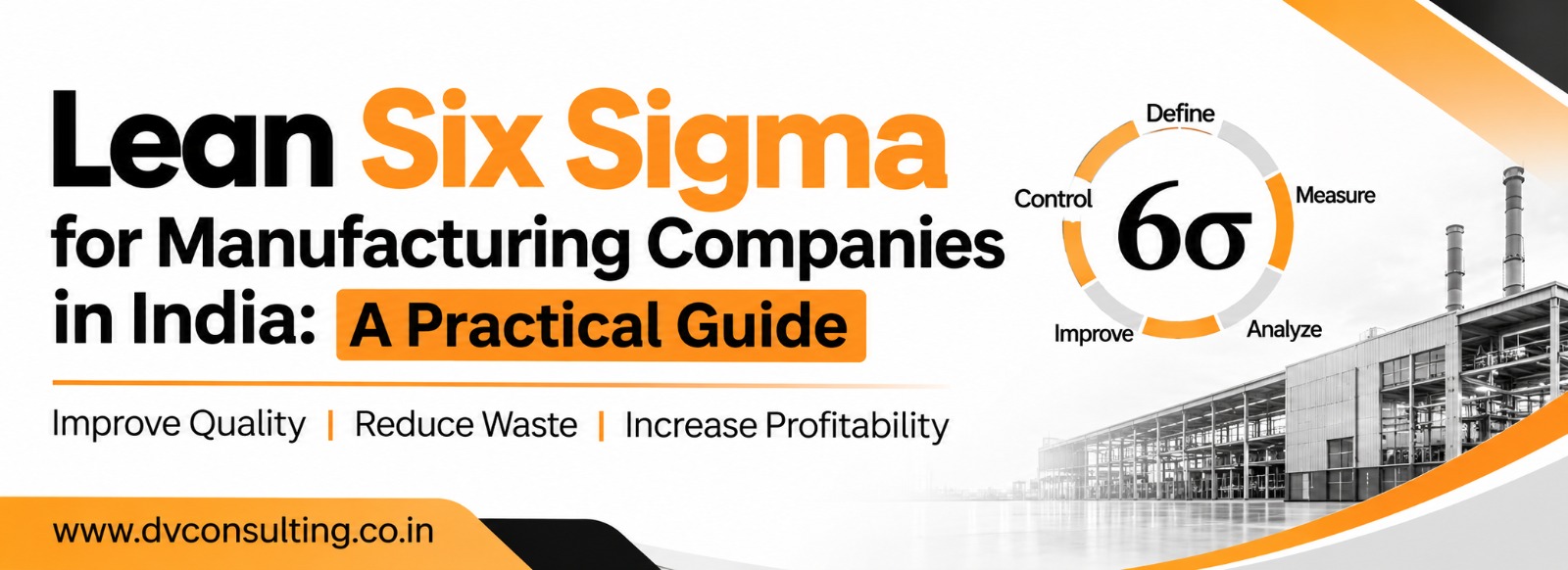
Lean Six Sigma for Manufacturing Companies in India
A 3% rejection rate sounds small. On a line making 10,000 parts a shift, that is 300 parts scrapped or reworked every day. Add rising raw material prices, machine downtime and late orders, and the loss becomes serious within a few months. Even a small shop-floor issue costs real money when it continues month after month.
More workers or machines rarely fix a process problem. First, businesses need to see where time, money and material are actually being lost.
This is where Lean Six Sigma for Manufacturing Companies becomes useful. It combines Lean principles, which focus on reducing waste, with Six Sigma methods, which aim to reduce defects and process variation.
With support from professional business consulting services, manufacturers can see exactly where a line loses time, material and money, and decide what to fix first.
What Is Lean Six Sigma in Manufacturing?
Lean Six Sigma is a structured method for improving business and production processes. It helps companies identify activities that do not add value and understand why defects, delays and unnecessary expenses occur.
The method brings together three important ideas:
• Lean Manufacturing: Focuses on reducing waste, unnecessary movement, waiting time, excess inventory and overproduction.
• Six Sigma: Uses data and statistical methods to reduce defects, process variation and quality problems.
• Continuous Improvement: Encourages employees and management to review daily activities and make regular improvements.
A factory may produce 5,000 castings a week with 6% rejected or reworked. Instead of adding a shift, the team checks machine settings, raw material lots and operator methods, and finds that tool wear causes most of the defects.
A structured Lean Six Sigma Manufacturing approach helps management decide based on actual production data. That means fewer arguments over opinions and more focus on facts.
Manufacturers looking for ways to reduce production costs, improve manufacturing productivity, minimise rejection rates or improve overall equipment effectiveness (OEE) can use Lean Six Sigma to address these challenges systematically. The approach is relevant for automotive, engineering, pharmaceutical, chemical, plastic, packaging, FMCG and other manufacturing industries where production efficiency, product quality and delivery performance directly affect profitability.
If you are searching for Lean Six Sigma consulting services in India, manufacturing process improvement consultants or a company that can help implement Lean Six Sigma in your factory, it is important to look beyond theoretical recommendations. Effective implementation involves studying existing production processes, conducting root cause analysis, measuring process performance, identifying bottlenecks and developing practical improvement plans. Manufacturers can also use DMAIC (Define, Measure, Analyse, Improve and Control) to investigate recurring quality issues, reduce cycle time, control process variation and establish measurable performance standards.
D&V Business Consulting supports manufacturing companies through practical business and operational improvement initiatives, including Lean Manufacturing, Six Sigma, productivity improvement, rejection reduction, process optimisation and cost reduction. Whether your requirement is to reduce manufacturing defects, improve machine utilisation, minimise material wastage, increase production capacity or establish consistent quality control, D&V focuses on identifying operational gaps and implementing improvements with management and shop-floor teams. This helps business owners and factory managers make informed decisions based on production data, measurable outcomes and actual operating conditions.
Major Pain Points Faced by Indian Manufacturing Companies
Manufacturers often experience problems that affect productivity, delivery schedules and profitability. Understanding these challenges is the first step towards improvement.
- High Production Costs
Rising material prices, excess consumption, overtime and avoidable machine expenses increased manufacturing costs.
Solution:
- Review material consumption and production expenses.
- Identify scrap, rework and excess usage.
- Study labour allocation and machine operating costs.
A Cost Reduction Consultant for Manufacturing can trace where money leaks, whether it is scrap, overtime or idle machines, and turn it into a short action list.
- Frequent Product Defects and Rejections
Quality problems can result in customer complaints, rejected batches, rework and additional inspection costs. Repeated defects may also affect customer trust.
Solution:
- Record defects by type, machine, shift and production batch.
- Use root cause analysis to identify the actual reason.
- Review inspection methods and machine settings.
A Six Sigma Process Improvement Consultant can show which machine, shift or material lot causes the most variation.
- Machine Downtime and Production Delays
Unexpected breakdowns and long machine setup times reduce available production hours. These issues can delay customer orders and increase operating expenses.
Solution:
- Maintain machine breakdown records.
- Identify equipment with frequent stoppages.
- Follow preventive maintenance schedules.
Regular performance reviews help production and maintenance teams address recurring equipment problems. A machine that stops for 40 minutes a day loses about 16 hours in a 24-day working month.
- Material Wastage and Excess Inventory
Poor material handling, inaccurate production planning and excess stock can block working capital. Unnecessary movement also increases handling time and the risk of damage.
Solution:
- Review material storage and movement.
- Monitor raw material consumption.
- Set stock levels according to production needs.
For example, raw material stored 80 metres from the machine adds walking time to every batch.
Professional Lean Manufacturing Consulting often starts with a simple material flow walk that shows every movement adding time but no value.
- Low Employee Productivity
Unclear work instructions, poor task allocation and repeated manual activities can affect employee output. Workers may spend valuable time waiting for materials, approvals or machine availability.
Solution: Give each task an owner, a written SOP and a fair workload.
Employee involvement is important because workers understand many of the daily problems that management may not see in production reports.
- Poor Production Planning and Delivery Performance
Incorrect production schedules, material shortages and weak coordination between departments can affect order completion.
Solution:
- Review production planning methods.
- Track pending orders and delivery dates.
- Coordinate procurement, production and dispatch teams.
Even one weekly review meeting between planning, stores and dispatch can reduce late orders.
How Lean Six Sigma Consulting Helps Manufacturing Businesses
Professional Lean Six Sigma Consulting in India starts with one step: understand the problem before spending on anything new.
A consultant studies existing processes, reviews available data and works with employees to identify areas that require attention.
The main areas of consulting support include:
- Production process assessment and workflow analysis.
- Root cause identification for recurring defects.
- Reduction of material waste and rework.
- Machine downtime and cycle time studies.
- Production cost and resource analysis.
- Quality control and process standardisation.
- Employee participation in improvement projects.
- Performance tracking through measurable indicators.
Working with experienced Lean Six Sigma Consultants in India means improvement projects are tied to real orders, real defects and real costs, not theory.
Lean Six Sigma Implementation: A Step-by-Step Approach
A successful improvement project needs a clear process. One commonly used method is DMAIC, which stands for Define, Measure, Analyse, Improve and Control.
Step 1: Define the Problem
Identify the specific business issue that needs attention.
For example:
- High rejection rates on a production line.
- Frequent machine breakdowns.
- Long order completion time.
Set a clear project objective and define the area of work.
Example goal: reduce rejection on Line 2 from 6% to 3% in four months.
Step 2: Measure Current Performance
Collect actual information about the selected process.
Useful measures include:
- Production output per shift.
- Defect and rejection percentage.
- Machine downtime.
- Cycle time.
This information provides a baseline for comparing future results.
Example baseline: rejection 6%, downtime 9 hours a week, cycle time 48 seconds.
Step 3: Analyse the Root Cause
Study the collected information to understand why the problem occurs. Tools such as the Fishbone Diagram, Pareto Analysis and 5 Whys can help teams identify the main causes.
Avoid making changes based only on opinions. Use production records, observations and employee feedback.
Step 4: Improve the Process
Prepare corrective actions based on the findings.
Possible actions include:
- 5S: workplace organisation
- SMED: faster changeovers
- Poka-yoke: error-proofing
- TPM: planned maintenance
Step 5: Control and Monitor Results
Track performance after changes are introduced. Use standard operating procedures, inspection records and regular reviews to maintain the improved process.
This is how Lean Six Sigma Implementation in India moves from a one-time project to a daily habit.
Why Choose Professional Lean Six Sigma Consulting Services?
Some companies have internal quality and production teams but may lack the time or specialist knowledge to manage improvement projects. External consulting support can provide an independent view of existing operations.
Internal teams know the plant well, but daily production often leaves them no time to run a full improvement project.
A suitable Lean Six Sigma Consulting Company in India should offer:
- Understanding of manufacturing processes and industry requirements.
- Practical experience with process assessment.
- Knowledge of DMAIC and root cause analysis.
- Clear project responsibilities and timelines.
- Employee and management involvement.
- Performance measures linked to business goals.
When comparing a Lean Six Sigma consulting firm, ask to see a project similar to yours and the numbers before and after.
Businesses may also seek Six Sigma Consulting Services when rejection, rework or process variation stays high even after repeated corrections.
How to Select the Right Management Consulting Partner in India
A poor consulting choice costs months and money, so check these points first. Companies should look beyond promotional claims and assess the firm’s experience, methods and ability to understand their operations.
Before selecting a business consulting company, ask for one project in your own sector and check the following:
- Does the firm understand your manufacturing sector?
- Can it identify the root causes of production problems?
- Does it use data to support recommendations?
- Can it work with your existing management and production teams?
- Are project goals, timelines and responsibilities clearly defined?
Companies searching for a management consulting company should check whether its work covers operations, cost control and business performance, not only strategy.
Whether you are comparing top management consulting firms in India or researching the best Management Consulting Firms in India, look at client results and ask to speak to a past client, not only the ranking.
A suitable management consulting service should spend time on your shop floor, not only in the boardroom. Also, searches for the best business consulting firms in India should end with a check of team experience, scope of work and fees.
For manufacturers considering business consulting in India, the right partner should understand power costs, skilled operator shortages and the challenges faced by Indian MSMEs.
How D&V Business Consulting Supports Manufacturing Companies
D&V Business Consulting provides process improvement and Lean Six Sigma consulting support for MSMEs and manufacturing businesses in India.
Its approach focuses on understanding existing operations, identifying process gaps and preparing practical improvement plans based on business requirements.
The areas of support include:
- Production process assessment.
- Waste and operational loss reduction.
- Root cause analysis.
- Quality and productivity improvement.
- Process performance measurement.
As a provider of manufacturing consulting services in India, D&V works with business owners, management teams and shop-floor employees to understand operational challenges.
Its business process improvement consulting approach connects daily process issues with wider business goals. Through Operational Excellence Consulting, manufacturers can review production systems, workplace practices and performance measures.
Companies looking for a manufacturing process improvement consultant can discuss their specific production challenges and improvement priorities with D&V.
Conclusion
Most factories don’t need more machines. They need to see where time and money are lost.
Lean Six Sigma gives that view. It helps manufacturing companies reduce production costs, minimise waste, improve product quality and increase productivity by fixing root causes instead of symptoms.
D&V Business Consulting helps MSMEs and manufacturing companies find these improvement opportunities and take practical steps towards operational excellence. Book a process assessment with D&V and start with one line, one problem and one clear target.
About Dharmesh Parikh – Founder & CEO, D&V Business Consulting

I’m Dharmesh Parikh, Founder & CEO of D&V Business Consulting. I started D&V with a clear conviction: businesses rarely struggle because of their products or market potential alone. In many cases, performance is affected by inefficient operations, inconsistent processes, people-related challenges, weak execution, and limited strategic direction.
My mission is to help founders, business owners, directors, CEOs, CXOs, promoters, and leadership teams identify business challenges and convert them into practical opportunities for improvement. My approach combines business consulting, management systems, operational improvement, sales performance, HR structure, process improvement, productivity enhancement, and implementation support based on the specific requirements of each organisation.
At D&V Business Consulting, we work with organisations across key areas that directly influence business performance, including sales and revenue, organisational structure, employee performance, operational efficiency, productivity, business processes, SOPs, accountability systems, KPIs, management reviews, and strategic execution.
A significant part of my consulting approach is understanding what actually happens inside an organisation. A process may look effective on paper but produce inconsistent results on the shop floor or within day-to-day business operations. Similarly, an organisation may have targets and KPIs but still struggle because responsibilities are unclear, reviews are inconsistent, or corrective actions are not followed through. Identifying these gaps requires practical observation, structured analysis, discussions with people at different levels, and a clear understanding of how work is actually performed.
This is also why I strongly believe that consulting should not end with a presentation or recommendation document. Recommendations have value only when they are converted into actions and embedded into the organisation. At D&V, we focus on working alongside business owners and leadership teams to translate strategies into defined responsibilities, practical processes, measurable performance indicators, review mechanisms, SOPs, and accountability systems.
My consulting philosophy is built around a simple principle: strategy creates direction, but execution creates results. Sustainable business performance requires both. Organisations need clarity about where they want to go, but they also need the systems, people, processes, discipline, and review mechanisms required to move consistently in that direction.
My areas of focus include business & management consulting, operational excellence, manufacturing consulting, lean manufacturing, process improvement, sop development, performance management, hr systems, sales performance, productivity improvement, and strategic business implementation. depending on the organisation’s needs, these areas may involve process analysis, organisational restructuring, kpi development, workflow improvement, waste reduction, productivity initiatives, management systems, or execution planning.
I also believe that improvement should be practical, measurable, and relevant to the organisation’s current stage of development. Every business has different people, processes, customers, capabilities, constraints, and priorities. Therefore, consulting solutions should not simply copy a standard model. They should be adapted to the organisation while maintaining the discipline required for effective implementation.
My work with business owners and leadership teams is therefore centred on asking practical questions: Where is performance being lost? Which processes are creating recurring problems? Are responsibilities clearly defined? Are employees working with the right systems and standards? Are management reviews leading to action? Are KPIs providing meaningful visibility? And, most importantly, are agreed improvements actually being implemented?
Through this execution-focused approach, my objective is to help organisations build stronger business systems, clearer accountability, more consistent processes, better operational performance, and improved management visibility.
I believe sustainable business performance is not created through one-time initiatives. It is built through continuous improvement, structured execution, disciplined management, capable teams, and systems that consistently support the organisation’s objectives.
At D&V Business Consulting, my role is to work with leadership teams not simply as an external advisor, but as a practical implementation partner—helping convert business challenges into structured actions and helping organisations move from identified problems to measurable improvements.
Who I Work With
I primarily work with MSME founders, entrepreneurs, and business leaders who are committed to building scalable and professionally managed organisations.
My experience covers a wide range of industries, including:
- Manufacturing
- Retail
- Distribution
- Trading Businesses
- Service-Based Enterprises
What I Share
Through my content, I share practical insights and business knowledge on topics including:
- Business Growth Strategies
- Sales Management
- Leadership Development
- HR & Organisation Development
- Operational Excellence
- Scaling MSMEs
I believe business consulting should create measurable business impact—not just reports and presentations. My objective is to help business owners make informed decisions, solve operational challenges, build stronger organisations, and achieve sustainable business growth.
If you’re looking for practical business strategies backed by hands-on implementation, I’d be pleased to connect and exchange ideas.
Founder & CEO – D&V Business Consulting
Business Growth | Sales Strategy | Operations Excellence | HR & Organizational Development
- What is Lean Six Sigma, and how does it help manufacturing companies?
-
Lean Six Sigma is a process improvement method that combines waste reduction with defect control. It helps manufacturing companies reduce production delays, minimise material wastage, improve product quality and increase operational efficiency.
- Which is the best Lean Six Sigma consulting company in India?
-
The right firm depends on your industry and project experience. Ask for a similar project, before and after numbers and a past client reference. D&V Business Consulting is one option for manufacturing companies and MSMEs in India.
- How does Lean Six Sigma implementation reduce manufacturing costs?
-
Lean Six Sigma identifies activities that increase production expenses without adding value. Through root cause analysis, process measurement and waste reduction, companies can reduce scrap, rework, excess inventory, machine downtime and unnecessary labour costs.
- Where can I find Lean Six Sigma consultants in India?
-
Start with firms that have worked on shop floors like yours. D&V Business Consulting is one such firm, covering process assessment, root cause analysis and waste reduction.
- Why should manufacturing companies hire a Lean Six Sigma consultant?
-
A Lean Six Sigma consultant provides professional guidance to identify process problems, analyse production data and prepare improvement plans. Consultants also help management teams introduce corrective actions, monitor results and maintain better process control.
- What services does D&V Business Consulting provide to manufacturing companies?
-
D&V Business Consulting supports manufacturing businesses through Lean Six Sigma consulting, process improvement, operational assessment, cost reduction initiatives, quality improvement and productivity-related consulting. Its services focus on identifying operational challenges and preparing practical improvement plans.
- What industries can benefit from Lean Six Sigma consulting in India?
-
Automotive, pharmaceuticals, textiles, engineering, chemicals, food processing, plastics and electronics manufacturing all benefit. In each case, Lean Six Sigma improves production quality, reduces operational waste and keeps processes consistent.
- How does D&V Business Consulting help reduce manufacturing waste?
-
D&V Business Consulting helps manufacturing businesses identify unnecessary activities, material losses, production bottlenecks and process inefficiencies. Typical findings include extra material movement, avoidable rework and delays at a single machine.
- Why should Indian MSMEs invest in Lean Six Sigma consulting services?
-
Indian MSMEs can benefit from Lean Six Sigma by reducing avoidable expenses, improving product quality, managing resources more effectively and reducing production delays. Professional consulting support helps smaller businesses identify priority areas and plan practical improvements according to their operational needs.
- How can a manufacturing company measure the success of Lean Six Sigma implementation?
-
A manufacturing company can measure success by tracking key performance indicators (KPIs) such as defect rates, production costs, machine downtime, cycle time, material wastage, rework percentage and on-time delivery. Regular performance reviews help management understand whether process improvements are delivering measurable business results.
Related Posts
How to Improve Process Productivity for MSMEs: Lean Six Sigma Approach
In the relentless pursuit of peak efficiency and world-class quality, businesses constantly seek foundational methodologies…
Lean Management for Indian Businesses: The Impact of an Operational Excellence Consultant
In today’s highly competitive business markets, Indian companies are increasingly turning to lean management principles…

Streamlining Business Processes with Six Sigma and Lean Six Sigma
Six Sigma is a data-driven methodology that aims to eliminate defects, reduce variability, and enhance…

Building a Culture of Continuous Improvement: Tips for Implementing Lean Principles
Continuous Improvement is a key component of lean concepts, which emphasize waste elimination and increased…
 Join