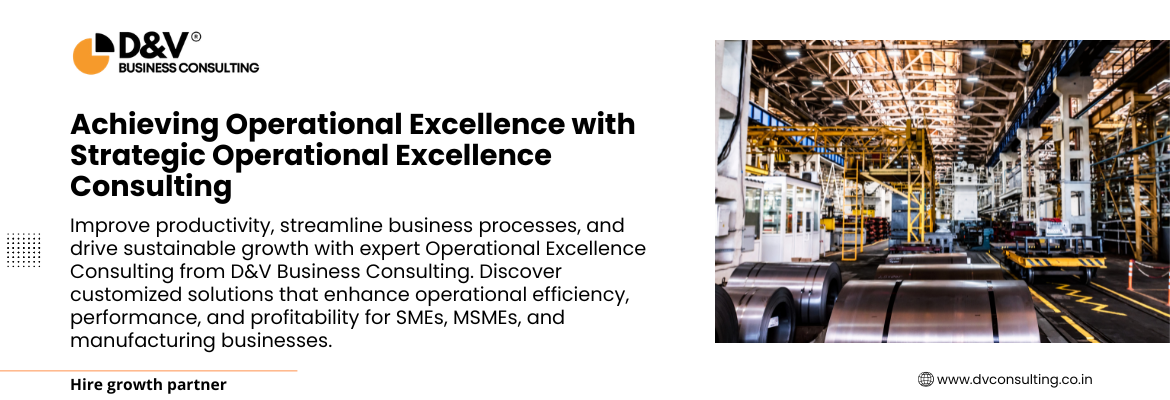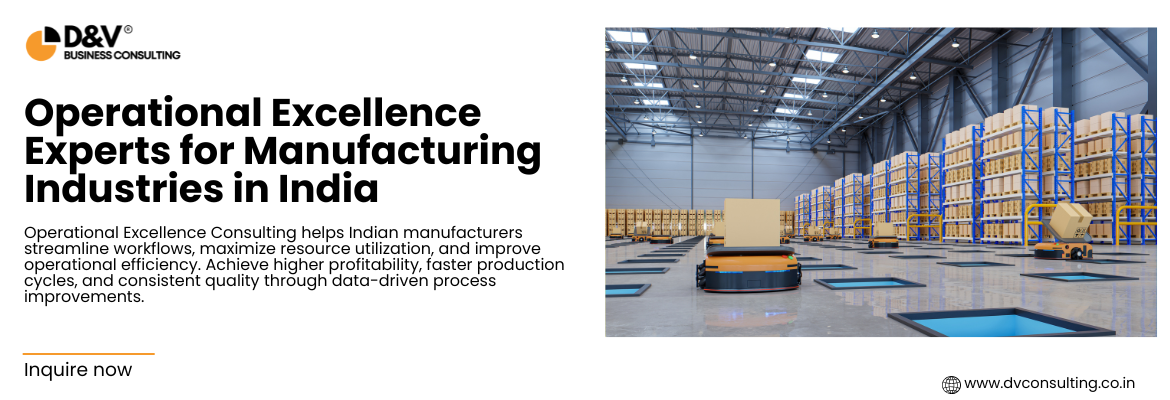
Operational Excellence: Your Strategic Lever for Scalable Growth

Lean, Six Sigma & Shop Floor Transformation - Made for Indian Manufacturing

In India's vibrant economic environment, Micro, Small, and Medium Enterprises (MSMEs) form the industrial backbone, contributing nearly 30% to the GDP and over 45% to manufacturing output. By providing employment to more than 110 million people, these enterprises—ranging from legacy family-run businesses to agile startups—are the primary engines of regional development and inclusive growth. However, a harsh reality persists for many owners and executives: despite immense ambition, their operations often hit a "growth ceiling" where manual processes and persistent inefficiencies stall progress.

India’s business environment is currently at a critical turning point. Organizations are no longer competing only with local neighbors, but with global quality benchmarks and digital-first competitors. Rising input costs, talent attrition, and the rapid pace of digital disruption have made traditional management styles obsolete. While many firms recognize the need for improvement, the struggle lies in institutionalizing excellence—moving beyond "firefighting" to create systems where high performance is repeatable, measurable, and resilient against market volatility.

This is where operational excellence consulting becomes a strategic necessity rather than a discretionary investment. For an Indian enterprise to scale, it must transition from person-dependent processes to system-driven excellence. This involves integrating Lean Six Sigma methodologies, supply chain optimization, and Shop Floor Transformation (SFT) customised specifically to the Indian cultural and industrial context. By bridging the gap between current capabilities and global standards, consulting interventions empower MSMEs to unlock hidden capacity, reduce waste, and ultimately transform into world-class organizations ready for the "Make in India" era.

We here to help you
Book Appointment

    Leadership Mindset: Short-Term Focus Over Long-Term Systems
    Why MSMEs Struggle to Institutionalize Excellence

    For many MSMEs, digital transformation feels less like an opportunity and more like a risky, capital-intensive experiment. The upfront cost of implementing ERP systems, smart IoT infrastructure, or AI-based analytics often appears unjustifiable—especially when margins are already under pressure. Without clear visibility into ROI, business owners hesitate to move away from familiar manual or semi-digital processes.

    Skill shortages further widen this gap. Most MSMEs lack in-house IT teams capable of selecting, implementing, and managing advanced digital solutions. Even when tools are deployed, poor adoption, inadequate training, and fragmented data limit their effectiveness. As a result, technology investments fail to deliver meaningful operational improvements.

    Cybersecurity concerns add another layer of resistance. MSMEs increasingly fear data breaches, ransomware attacks, and compliance failures but lack structured cybersecurity frameworks. This fear often leads to delayed decisions or complete avoidance of digital systems—ironically increasing exposure through outdated software and unsecured processes.

    Meanwhile, digitally mature competitors are using real-time data, automation, and predictive insights to reduce costs, improve customer responsiveness, and scale faster. MSMEs that delay digital adoption risk falling into a reactive mode—struggling with inefficiencies, limited visibility, and slower decision-making in an increasingly data-driven market.

    The challenge, therefore, is not technology itself—but the absence of a phased, risk-managed digital roadmap aligned with business priorities, operational maturity, and workforce readiness.

    Most Indian MSMEs do not fail due to lack of effort or intent. They struggle because excellence is often treated as a project, not a system. Some of the most common challenges include:

    1. Founder-Dependent Operations

    In many Indian enterprises, especially family businesses and MSMEs, decision-making, problem-solving, and customer relationships are tightly controlled by promoters. While this works during early growth stages, it becomes a bottleneck as the organization scales. Processes remain informal, undocumented, and personality-driven.

    2. Firefighting Culture

    Operational teams spend most of their time reacting—resolving quality issues, managing production delays, chasing payments, or handling customer escalations. Without structured root-cause analysis and preventive systems, the same problems recur, draining leadership bandwidth.

    3. Lack of Standardization

    From procurement to production planning to sales operations, inconsistent processes lead to variability in outcomes. Two teams performing the same task produce different results, making it difficult to predict performance or scale efficiently.

    4. Limited Strategic Alignment

    Many MSMEs operate without a clear medium- to long-term roadmap. Business goals, departmental KPIs, and individual incentives are often misaligned, resulting in local optimization rather than enterprise-wide improvement.

    5. Resistance to Change

    Employees—especially in long-established manufacturing setups—may view process improvements as threats rather than enablers. Without proper change management, even well-designed initiatives fail to gain traction.

    These challenges explain why excellence remains aspirational for many organizations rather than embedded in daily operations.

    What Operational Excellence Really Means for Indian Businesses

    Operational excellence is not just about cost reduction or productivity improvement. In the Indian context, it means building robust, scalable systems that deliver consistent value despite market volatility, workforce changes, or leadership transitions.

    At its core, operational excellence focuses on:

    • Designing processes that are simple, repeatable, and measurable

    • Eliminating waste without compromising flexibility

    • Empowering teams with clarity, capability, and accountability

    • Linking strategy with execution at every level of the organization

    When done right, it creates a culture where improvement is continuous, not consultant-driven or leadership-dependent.

    The Strategic Role of Manufacturing Consulting in India

    Indian manufacturing faces unique pressures—rising input costs, global quality expectations, supply chain disruptions, and increasing compliance requirements. Traditional improvement efforts often focus narrowly on the shop floor, missing broader organizational levers.

    Effective Manufacturing consulting India goes beyond tools and templates. It integrates:

    – Operational diagnostics across production, quality, maintenance, and supply chain

    – Leadership capability building for plant heads and functional leaders

    – Performance management systems that align daily actions with business objectives

    – Digital readiness without over-automation or unnecessary complexity

    This integrated approach ensures that operational gains are sustained and scalable rather than short-lived improvements.

    Why Generic Consulting Models Fail MSMEs

    Many consulting frameworks are designed for large corporations with deep pockets, mature systems, and abundant data. MSMEs, however, operate with:

    • Lean teams
    • Informal processes
    • Limited technology infrastructure
    • High dependence on tacit knowledge

    Applying generic models often leads to resistance, overload, or partial implementation. This is why MSMEs need consulting approaches that are context-aware, pragmatic, and execution-focused.

    Well-designed MSME consulting services prioritize simplicity, speed, and relevance—helping businesses stabilize operations first, then scale intelligently.

    From Advice to Impact: How Consulting Must Evolve

    Business leaders are increasingly skeptical of slide-heavy recommendations that fail to translate into results. What they seek is measurable impact—improvements they can see on the factory floor, in financial statements, and in customer feedback.

    Modern Business Consulting must therefore bridge the gap between strategy and execution by:

    – Co-creating solutions with internal teams

    – Building internal capability rather than dependence

    – Tracking outcomes, not just activities

    – Embedding governance mechanisms to sustain change

    This shift from “advisor” to “transformation partner” is critical for MSMEs aiming for long-term competitiveness.

    Integrating Management Thinking with Operational Execution

    Operational challenges are rarely isolated. Issues in productivity often stem from unclear roles, weak leadership routines, or misaligned incentives. This is where Management Consulting becomes essential—not as a separate function, but as an integrated layer that connects people, processes, and performance.

    By aligning organizational structure, decision rights, and leadership behaviors with operational goals, businesses can eliminate friction and accelerate execution. The result is not just better operations, but stronger management maturity.

    Business Consulting in Ahmedabad & Across India

    A Practitioner-Led Approach: The D&V Business Consulting

    A growing number of Indian enterprises are recognizing the value of consulting partners who combine strategic insight with hands-on operational experience. D&V Business Consulting stands out as a practitioner-led firm that understands the realities of MSMEs and manufacturing environments.

    Rather than imposing rigid frameworks, the approach focuses on:

    – Deep on-ground diagnostics to identify real constraints
    – Customized solutions aligned with business stage and culture
    – Hands-on implementation support alongside client teams
    – Leadership coaching to ensure ownership and continuity

    By blending strategic foresight with operational execution, this model delivers tangible improvements in productivity, quality, cost, and organizational alignment—without overwhelming the business.

    Measurable Outcomes That Matter to Decision-Makers

    When operational excellence initiatives are executed correctly, the benefits extend far beyond the shop floor. Typical outcomes include:

    – Improved throughput and capacity utilization
    – Reduction in defects, rework, and wastage
    – Faster decision-making and clearer accountability
    – Better on-time delivery and customer satisfaction
    – Enhanced leadership confidence and team engagement

    Most importantly, businesses gain predictability—the ability to plan, commit, and deliver with confidence.

    Manufacturing Consulting: Delivering Measurable Impact

    Manufacturing consulting India stands out for its tangible results in a sector critical to India’s economy. It delivers measurable impact through customized, integrated approaches that blend strategic foresight with operational execution. Consultants assess shop floors, supply chains, and quality systems, introducing tools like Lean Manufacturing, Total Productive Maintenance (TPM), and Six Sigma.

    A leading business consulting company in India, D&V Business Consulting, which exemplifies how targeted interventions transform operations. By combining diagnostic assessments with hands-on implementation, they help manufacturing units reduce defects, shorten lead times, and boost output—often achieving 20-30% improvements in efficiency. Their integrated methodology ensures strategic planning aligns with ground-level execution, addressing everything from inventory optimization to workforce training.

    This approach counters digital disruption by incorporating Industry 4.0 elements, such as IoT for predictive maintenance and data analytics for demand forecasting. It also tackles leadership gaps through capability-building programs, empowering owners to delegate and innovate.

    For family businesses, consulting facilitates smooth transitions, professionalizing operations without losing core values. In service-oriented enterprises, it streamlines customer-facing processes, enhancing satisfaction and loyalty.

    The outcomes are profound: reduced costs, improved cash flows, higher employee engagement, and scalable growth. Firms that embrace these services break free from stagnation, entering new markets with confidence and competing globally.
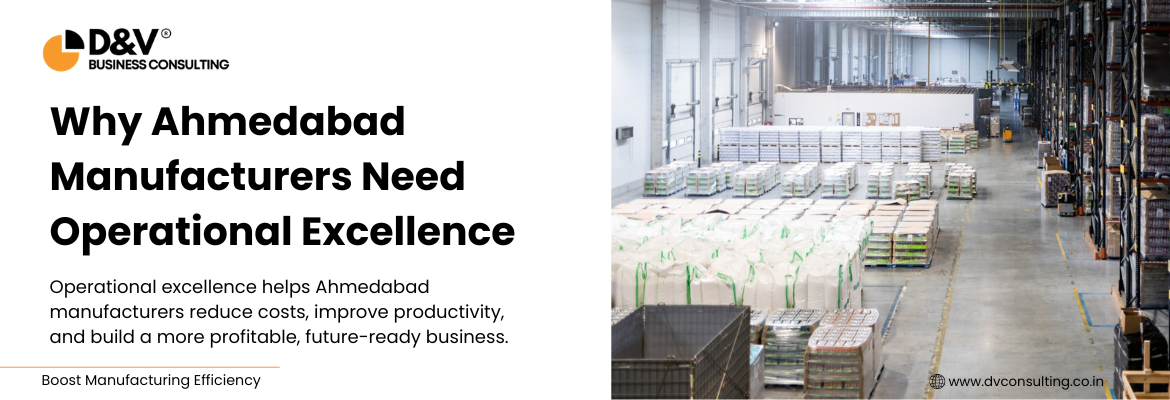
    Overcoming Barriers: A Path to Sustainable Growth

    To institutionalize excellence, MSMEs must prioritize structured interventions. Start with a comprehensive audit to uncover hidden inefficiencies. Invest in skilling – both technical and managerial – to bridge talent gaps. Leverage government schemes for funding digital upgrades, easing financial burdens.

    Partnering with experienced consultants accelerates this journey. They provide objective insights, proven frameworks, and accountability, ensuring initiatives stick beyond initial enthusiasm.

    In an era of global competition and economic uncertainty, operational excellence is no longer optional – it’s essential for survival and thriving.

    Conclusion: From Struggle to Systematic Excellence

    Indian MSMEs and manufacturers have immense potential. What often holds them back is not capability, but consistency. Institutionalizing excellence requires a structured, context-sensitive approach that aligns strategy, operations, and people.

    With the right partner, operational excellence becomes a powerful lever for sustainable growth, resilience, and long-term value creation.

    Talk to an Operational Excellence Expert and explore how your organization can move from reactive firefighting to systematic, scalable performance.

    FAQs
    Operational Excellence Consulting for Manufacturing & MSMEs in India
    What is operational excellence consulting for manufacturing and MSMEs in India?

    Operational excellence consulting helps Indian manufacturing units and MSMEs improve productivity, reduce waste, stabilize processes, and build scalable systems. It focuses on aligning strategy, people, and operations to deliver consistent business performance rather than one-time improvements.

    Why do MSMEs in India struggle to institutionalize operational excellence?

    Most MSMEs rely on promoter-driven decision-making, informal processes, and firefighting cultures. Without standardized systems, performance depends on individuals rather than repeatable processes, making sustainable excellence difficult to achieve.

    How is operational excellence consulting different from cost-cutting initiatives?

    Cost-cutting focuses on short-term expense reduction, often at the risk of quality or morale. Operational excellence builds long-term capability by eliminating root causes of inefficiency, improving process flow, and strengthening leadership systems for sustained growth.

    Which industries benefit most from operational excellence consulting in India?

    Manufacturing, engineering, automotive, FMCG, pharmaceuticals, packaging, logistics, and service-based MSMEs benefit significantly. Any organization facing productivity issues, quality challenges, delivery delays, or scaling problems can gain value.

    What measurable outcomes can businesses expect from operational excellence consulting?

    Typical outcomes include improved throughput, reduced defects and rework, lower operational costs, better on-time delivery, enhanced employee engagement, and stronger management control across functions.

    How long does it take to see results from operational excellence initiatives?

    Early improvements are often visible within 60–90 days through quick wins. However, building a sustainable operational excellence culture usually takes 6–12 months, depending on organizational maturity and leadership commitment.

    Is operational excellence consulting suitable for small and mid-sized businesses?

    Yes. When designed specifically for MSMEs, operational excellence consulting focuses on practical, resource-efficient solutions rather than complex frameworks meant for large corporations.

    How does operational excellence support business scaling and expansion?

    By standardizing processes and improving predictability, businesses can expand capacity, enter new markets, and onboard new teams without losing control or performance consistency.

    What role does leadership play in operational excellence transformation?

    Leadership is critical. Sustainable excellence requires leaders to shift from daily firefighting to system thinking, performance reviews, and people development. Consulting support often includes leadership coaching and capability building.

    How is operational excellence consulting integrated with digital transformation?

    Operational excellence ensures processes are stabilized before digitization. This prevents automating inefficiencies and improves adoption, data accuracy, and ROI from digital tools.

    How do consulting firms customize solutions for Indian MSMEs?

    Effective consultants conduct on-ground diagnostics, understand cultural and operational realities, and co-create solutions with internal teams rather than applying generic global models.

    What makes D&V Business Consulting different in operational excellence consulting?

    D&V Business Consulting follows a practitioner-led, execution-focused approach that blends strategic clarity with hands-on operational implementation, ensuring measurable and sustainable impact for MSMEs and manufacturers.

    Will operational excellence consulting disrupt ongoing operations?

    No. Well-designed programs are implemented in phases alongside daily operations, ensuring minimal disruption while gradually improving performance and discipline.

    How do you measure the success of an operational excellence program?

    Success is measured through KPIs such as productivity, cost per unit, defect rates, delivery performance, employee engagement, and leadership effectiveness—not just completed initiatives.

    When should a business consider operational excellence consulting?

    If growth has stalled, costs are rising, quality or delivery issues persist, or leadership is overwhelmed by daily operational problems, it’s the right time to engage an operational excellence expert.

    How do we get started with operational excellence consulting?

    The first step is an operational diagnostic to identify constraints, improvement opportunities, and leadership gaps. From there, a phased roadmap is created based on business priorities.

    Related Posts