


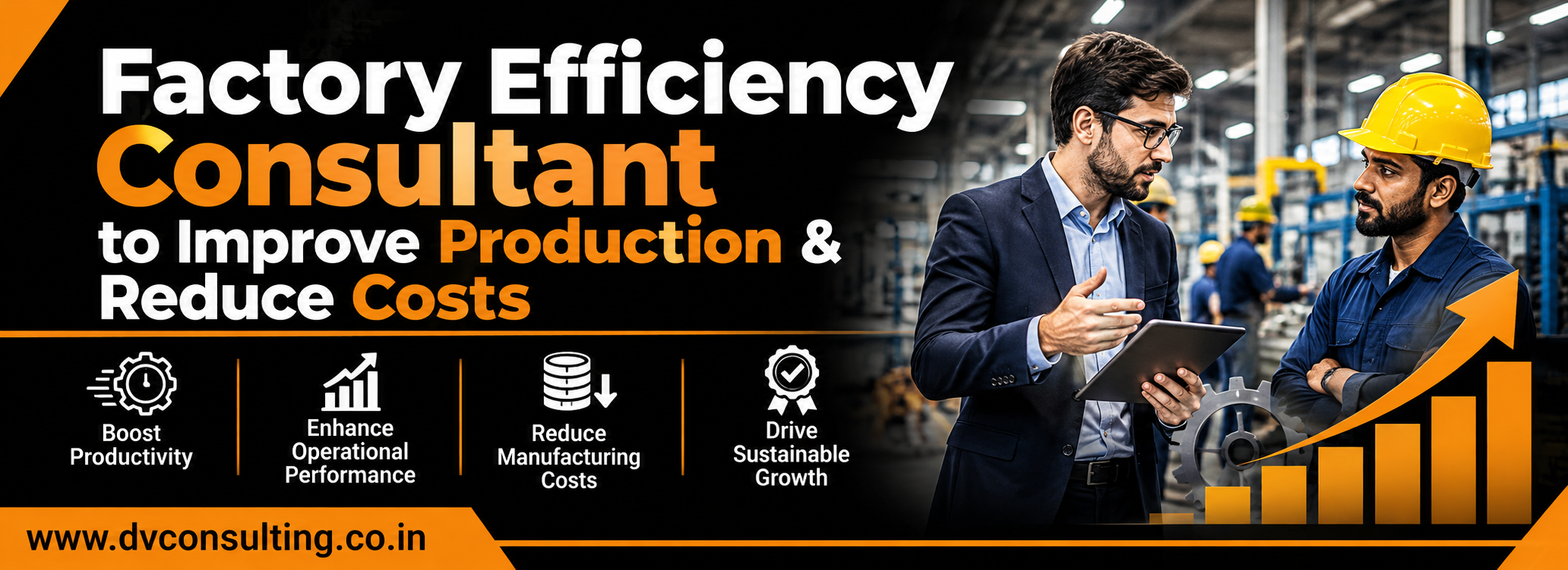
Factory Efficiency Consulting for Operational Excellence
Is Your Factory Operating at Its Full Potential?
Manufacturing businesses operate in an increasingly competitive environment where production efficiency, cost control, product quality and timely delivery directly influence profitability and long-term business growth. Whether a company operates a small manufacturing unit, a medium-sized industrial facility or a large production plant, maintaining efficient factory operations is essential to achieving sustainable business performance.
However, many factories face operational challenges that prevent them from achieving their actual production potential. These challenges may include low machine utilisation, frequent equipment breakdowns, inefficient production planning, excessive material wastage, unbalanced production lines, poor workforce productivity, high operating costs and delays in order fulfilment. Although businesses may have sufficient machinery, manpower and infrastructure, inefficient processes and inadequate management systems can significantly reduce overall factory performance.
This is where a Factory Efficiency Consultant can make a meaningful difference.
A professional factory efficiency consultant evaluates existing manufacturing operations, identifies performance gaps, analyses production processes and recommends practical improvements to increase productivity while controlling manufacturing expenses. Instead of relying on assumptions or making unnecessary investments in additional machinery and manpower, businesses can use structured operational assessments to understand where resources are being wasted and how existing capabilities can be utilised more effectively.
For factory owners and manufacturing businesses, engaging a Factory Improvement Consultant is not simply about reducing expenses. It is about developing a more productive, organised, cost-effective and performance-driven manufacturing operation.
Through manufacturing efficiency improvement, process optimisation, production planning, workforce productivity enhancement and better resource utilisation, factories can improve output, reduce operational losses and strengthen profitability.
With the right manufacturing improvement strategy, businesses can identify hidden productivity opportunities, establish measurable performance standards and build more efficient production systems. A systematic approach to factory operational improvement helps management monitor key performance indicators (KPIs), improve machine effectiveness, streamline material movement, minimise production downtime and ensure better coordination between departments. These improvements enable manufacturing units to achieve higher production capacity, maintain consistent product quality and respond more effectively to changing customer requirements without unnecessarily increasing operational investments.
D&V Business Consulting supports manufacturing organisations through practical consulting approaches focused on improving factory productivity, strengthening operational processes and reducing avoidable manufacturing costs. By understanding the specific requirements and challenges of each manufacturing facility, D&V Business Consulting helps businesses identify improvement opportunities and implement result-oriented strategies for sustainable operational excellence. Whether the objective is to improve production efficiency, optimise resource utilisation, reduce manufacturing waste or enhance overall factory performance, the right consulting guidance can help businesses move towards a more competitive and profitable future.
What Is a Factory Efficiency Consultant?
A Factory Efficiency Consultant is a professional who evaluates manufacturing operations and helps businesses improve the productivity, performance and cost effectiveness of their factories.
The primary responsibility of a factory efficiency consultant is to understand how effectively a manufacturing facility uses its available resources, including:
Machinery and production equipment
Workforce and employee capabilities
Raw materials and components
Production time and working hours
Factory infrastructure and workspace
Inventory and material handling systems
Production planning and scheduling
Quality management processes
Maintenance and operational systems
The consultant analyses existing manufacturing activities to identify inefficiencies that affect production output, operational costs, delivery performance and profitability.
Based on the assessment, the consultant develops an improvement strategy that addresses the root causes of operational problems.
A Factory Efficiency Consultant does not simply recommend increasing production speed. The objective is to improve the entire manufacturing system so that the factory can produce more efficiently with better utilisation of existing resources.
Key Responsibilities of a Factory Efficiency Consultant
A professional factory consultant may undertake several improvement activities depending on the factory’s requirements.
1. Factory Operational Assessment
Evaluating the existing manufacturing environment, production processes, workforce deployment, machinery utilisation and operational management systems.
2. Production Efficiency Analysis
Understanding production capacity, actual output, cycle time, production delays and bottlenecks affecting manufacturing performance.
3. Cost Reduction Analysis
Identifying unnecessary expenditure associated with material wastage, machine downtime, rework, overtime, excess inventory and inefficient processes.
4. Manufacturing Process Improvement
Reviewing existing workflows and identifying opportunities to simplify, standardise and optimise manufacturing activities.
5. Workforce Productivity Improvement
Analysing employee productivity, work allocation, skill utilisation and coordination between departments.
6. Performance Monitoring
Establishing suitable production KPIs and monitoring systems to measure manufacturing performance and improvement progress.
7. Continuous Improvement
Supporting the development of a systematic improvement culture through appropriate practices such as Lean Manufacturing, 5S, Kaizen and standard operating procedures.
Ultimately, a factory efficiency consultant helps manufacturers understand where operational performance is being lost and how those losses can be reduced through structured improvement initiatives.
Why Do Manufacturing Factories Need an Efficiency Consultant?
Many manufacturing businesses face operational challenges even when they have invested considerably in machinery, infrastructure and manpower.
The reason is that factory efficiency depends on how effectively different resources and departments work together.
A machine may have high technical capacity, but poor production planning can leave it idle. Employees may be experienced, but unclear work instructions can create inconsistent productivity. Raw materials may be available, but inefficient material movement can delay production.
These issues affect the overall manufacturing system.
A Factory Improvement Consultant provides an independent and structured assessment of these challenges.
Common Signs That Your Factory Needs Improvement
Consider consulting support if your factory regularly experiences the following problems:
Low Production Output
Your factory is unable to achieve planned production targets despite having sufficient machinery and manpower.
Increasing Manufacturing Costs
Production expenses are increasing without a corresponding improvement in output or profitability.
Frequent Machine Downtime
Unexpected equipment breakdowns and maintenance issues are interrupting production schedules.
High Material Wastage
Excessive scrap, rejection, overconsumption and improper material handling are increasing production costs.
Poor Workforce Productivity
Employees are spending considerable time waiting for materials, instructions, machine availability or approvals.
Production Bottlenecks
One or more manufacturing processes consistently restrict the output of the entire production line.
Delayed Customer Deliveries
Poor production planning, inconsistent output and coordination problems are affecting delivery commitments.
Excessive Work-in-Progress Inventory
Materials and semi-finished products accumulate between production stages, increasing lead time and inventory costs.
Inconsistent Product Quality
Frequent defects, rework and rejection are reducing productivity and increasing manufacturing expenses.
Lack of Performance Monitoring
Management does not have accurate information about machine performance, production losses, labour productivity and departmental efficiency.
When these problems continue without systematic corrective action, they can affect the factory’s competitiveness and financial performance.
A manufacturing consultant helps identify the underlying causes and develop practical solutions based on the factory’s actual operational requirements.
How a Factory Efficiency Consultant Improves Production Efficiency
Production efficiency is one of the most important indicators of manufacturing performance.
It reflects how effectively a factory converts available resources into finished products while minimising unnecessary time, material consumption and operational losses.
A consultant improves production efficiency by evaluating the entire production system rather than focusing on isolated activities.
Identifying Production Bottlenecks
A production bottleneck occurs when a particular machine, process, workstation or operational activity restricts the output of the overall manufacturing system.
For example, a manufacturing line may consist of five processes:
- Cutting
- Machining
- Assembly
- Inspection
- Packaging
If the cutting process can produce 500 units per shift, machining can handle 450 units, assembly can complete 300 units and packaging can process 450 units, assembly becomes the constraint.
Even if other departments have additional capacity, the overall output will be restricted by the assembly process.
A Factory Efficiency Consultant studies production flow, process capacity, cycle times, waiting periods and resource availability to identify these constraints.
Possible improvement measures include:
- Rebalancing workloads between workstations.
- Reducing unnecessary activities.
- Improving machine availability.
- Optimising employee deployment.
- Improving material availability.
- Redesigning production sequences.
- Reducing waiting time between processes.
The objective is to improve the flow of production and increase overall manufacturing throughput.
Improving Production Planning and Scheduling
Poor production planning is a common reason for factory inefficiency.
When production schedules are not properly aligned with customer requirements, machine capacity, workforce availability and raw material supply, factories experience unnecessary interruptions.
A Production Efficiency Consultant evaluates existing production planning systems and helps establish more effective scheduling practices.
This may involve:
- Developing realistic production targets.
- Aligning production schedules with customer demand.
- Evaluating available machine capacity.
- Coordinating raw material requirements.
- Improving departmental communication.
- Monitoring daily production performance.
- Identifying schedule deviations.
- Establishing corrective action procedures.
Better production planning helps manufacturers reduce idle time, avoid unnecessary overtime, improve resource utilisation and meet delivery commitments more consistently.
Optimising Machine Utilisation
Machinery represents a significant investment for most manufacturing businesses.
However, owning advanced equipment does not automatically guarantee efficient production.
Machines may remain underutilised because of frequent breakdowns, long setup times, poor scheduling, material shortages or inefficient operating practices.
A factory efficiency consultant evaluates how effectively available machinery is being utilised.
Important areas of assessment include:
- Planned operating hours.
- Actual machine running time.
- Machine availability.
- Performance losses.
- Setup and changeover time.
- Breakdown frequency.
- Production speed.
- Equipment-related quality losses.
Based on the findings, improvement opportunities can be identified to increase productive machine time.
For example, better production scheduling can reduce unnecessary machine changeovers, while improved maintenance planning can help minimise unexpected breakdowns.
The objective is to extract greater value from existing machinery before considering additional capital investment.
Reducing Production Cycle Time
Production cycle time refers to the time required to complete a manufacturing operation or produce a unit, depending on the measurement being used.
Excessive cycle time reduces production capacity and can create delivery delays.
A manufacturing consultant studies individual process activities to identify unnecessary movement, waiting, handling, repeated work and inefficient operating methods.
Improvement measures may include:
- Simplifying work sequences.
- Improving workstation layout.
- Reducing unnecessary material movement.
- Standardising operating methods.
- Improving machine settings.
- Optimising tool availability.
- Reducing process interruptions.
- Improving coordination between workstations.
Reducing cycle time can help manufacturers improve throughput and respond more effectively to customer demand.
Improving Production Line Balancing
Production line balancing involves distributing work across different workstations so that the workload is better aligned with available production time and required output.
An unbalanced production line can create idle employees at some workstations and excessive workloads at others.
This results in waiting time, work-in-progress accumulation and lower overall productivity.
A factory improvement consultant evaluates workstation cycle times, process requirements, manpower allocation and production targets.
Based on the analysis, the consultant can recommend:
- Redistributing activities.
- Adjusting manpower allocation.
- Improving workstation arrangements.
- Reducing process dependencies.
- Standardising work methods.
- Aligning production capacity across operations.
Effective line balancing helps improve production flow and minimise unnecessary waiting.
How a Factory Efficiency Consultant Helps Reduce Manufacturing Costs
Manufacturing cost reduction is not simply about purchasing cheaper raw materials or reducing employee expenses.
Sustainable cost optimisation requires a detailed understanding of where resources are consumed and where avoidable losses occur.
A professional Manufacturing Consultant evaluates manufacturing expenses from an operational perspective and identifies opportunities to reduce unnecessary costs without compromising product quality, workplace safety or customer requirements.
Reducing Raw Material Wastage
Raw material consumption directly affects manufacturing costs.
Excessive scrap, improper cutting, incorrect processing, handling damage and inaccurate material planning can increase production expenses.
A Factory Efficiency Consultant analyses material utilisation and identifies areas where wastage occurs.
Possible improvement initiatives include:
- Reviewing material consumption standards.
- Improving cutting and processing methods.
- Reducing rejection and scrap.
- Standardising material handling.
- Improving inventory control.
- Monitoring material consumption.
- Analysing recurring wastage patterns.
- Improving coordination between purchase, stores and production.
For example, even a small reduction in recurring material wastage can create meaningful savings when the same improvement is achieved across thousands of production units.
The consultant’s role is to identify the source of wastage and recommend sustainable corrective actions.
Minimising Machine Downtime Costs
Unexpected machine breakdowns affect production output, workforce utilisation, maintenance expenses and delivery schedules.
When critical equipment stops operating, the entire production flow may be disrupted.
A consultant evaluates equipment-related losses and recommends suitable maintenance and operational improvements.
These may include:
- Reviewing breakdown history.
- Identifying frequently failing equipment.
- Analysing recurring maintenance issues.
- Improving preventive maintenance planning.
- Establishing equipment inspection routines.
- Monitoring machine availability.
- Improving maintenance coordination.
- Analysing spare parts availability.
Where appropriate, predictive maintenance practices can also be considered.
The objective is to reduce avoidable equipment downtime and improve manufacturing reliability.
Controlling Labour and Overtime Costs
Labour expenses can increase when production processes are poorly organised.
Employees may spend working hours waiting for materials, searching for tools, moving between workstations or correcting avoidable mistakes.
Factories may also rely on overtime to compensate for inefficient production planning.
A manufacturing consultant evaluates workforce utilisation and identifies opportunities to improve employee productivity.
Improvement activities can include:
- Reviewing manpower deployment.
- Analysing workload distribution.
- Reducing unnecessary movement.
- Improving work instructions.
- Standardising operating procedures.
- Identifying skill gaps.
- Improving departmental coordination.
- Reducing avoidable overtime.
The objective is not simply to reduce manpower. It is to improve the productive contribution of the existing workforce.
Reducing Rejection, Rework and Quality Costs
Poor product quality creates additional manufacturing expenses.
Defective products may require reprocessing, additional inspection, replacement materials or complete rejection.
These activities consume resources without generating additional customer value.
A factory efficiency consultant studies the production processes responsible for recurring quality problems.
Potential improvement areas include:
- Analysing defect patterns.
- Identifying process-related quality losses.
- Improving standard operating procedures.
- Reviewing inspection practices.
- Strengthening process controls.
- Improving employee training.
- Monitoring rejection and rework trends.
- Establishing corrective and preventive actions.
Reducing defects improves both production efficiency and manufacturing cost performance.
Optimising Inventory and Working Capital
Excessive inventory ties up working capital and increases storage, handling and management expenses.
At the same time, insufficient inventory can interrupt production because essential raw materials or components are unavailable.
A manufacturing consultant evaluates inventory management practices to improve the balance between material availability and inventory investment.
Improvement initiatives may include:
- Reviewing inventory levels.
- Identifying slow-moving materials.
- Improving material planning.
- Analysing consumption patterns.
- Establishing suitable replenishment practices.
- Improving coordination between purchase and production.
- Reducing unnecessary work-in-progress inventory.
- Strengthening stores management.
Better inventory control supports smoother production operations and more effective working capital utilisation.
Reducing Unnecessary Operational Expenses
Several factory expenses arise from inefficient operating practices rather than essential production requirements.
Examples include:
- Excessive electricity consumption.
- Unnecessary material transportation.
- Repeated handling activities.
- Poor space utilisation.
- Unplanned maintenance expenditure.
- Excessive packaging consumption.
- Avoidable process delays.
- Inefficient equipment operating practices.
An Industrial Consulting Services provider evaluates these expenses and identifies opportunities for operational improvement.
The objective is to reduce avoidable expenditure while maintaining the factory’s production, quality and safety requirements.
Implementing Lean Manufacturing for Better Factory Efficiency
Lean Manufacturing is a systematic approach to improving operational performance by identifying and eliminating activities that do not add value to the customer.
It focuses on improving process flow, reducing waste, standardising activities and creating a culture of continuous improvement.
A Factory Efficiency Consultant can help manufacturers understand and implement suitable Lean Manufacturing practices according to their operational requirements.
Understanding the Seven Types of Manufacturing Waste
Traditional Lean Manufacturing identifies seven major categories of waste:
1. Overproduction
Manufacturing more products than required or producing them earlier than necessary.
2. Waiting
Employees, machines or materials remaining idle because the next process is unavailable.
3. Transportation
Unnecessary movement of raw materials, work-in-progress or finished goods.
4. Overprocessing
Performing additional activities or operations that do not create customer value.
5. Inventory
Maintaining excessive raw materials, work-in-progress or finished goods.
6. Motion
Unnecessary movement of employees while performing manufacturing activities.
7. Defects
Producing items that require rework, replacement or rejection.
Identifying these losses helps factories understand why resources are being consumed without creating additional value.
How D&V Business Consulting Supports Lean Manufacturing Improvement
D&V Business Consulting can support manufacturing businesses in evaluating existing processes, identifying operational waste and developing appropriate improvement initiatives.
The improvement approach may include:
- Reviewing production workflows.
- Identifying non-value-adding activities.
- Evaluating material movement.
- Analysing process delays.
- Improving workplace organisation.
- Reviewing standard operating methods.
- Recommending process optimisation.
- Supporting continuous improvement initiatives.
Lean implementation should be based on actual operational requirements rather than introducing tools simply for the sake of implementation.
How 5S Improves Factory Productivity and Workplace Efficiency
5S is a workplace organisation methodology that helps create cleaner, more organised and efficient working environments.
It consists of five Japanese principles:
- Seiri – Sort
- Seiton – Set in Order
- Seiso – Shine
- Seiketsu – Standardise
- Shitsuke – Sustain
Although 5S is often associated with housekeeping, its benefits extend to production efficiency, workplace safety, equipment maintenance and employee productivity.
Benefits of 5S Implementation
Better Workplace Organisation
Tools, equipment and materials are maintained in designated locations.
Reduced Searching Time
Employees spend less time searching for tools, components and documents.
Improved Material Accessibility
Frequently used materials and equipment can be arranged for convenient access.
Better Workplace Safety
Unnecessary items, obstructions and poor housekeeping practices can be addressed.
Improved Equipment Care
Regular cleaning and inspection help identify visible abnormalities.
Standardised Working Conditions
Clear workplace standards support consistency across shifts and departments.
D&V Business Consulting can help factories evaluate workplace organisation opportunities and develop practical 5S improvement initiatives that support broader manufacturing efficiency objectives.
Improving Overall Equipment Effectiveness (OEE)
Overall Equipment Effectiveness (OEE) is an important performance measurement used in manufacturing to understand how effectively equipment is utilised.
OEE evaluates three major factors:
- Availability
- Performance
- Quality
The formula is:
OEE = Availability × Performance × Quality
Each component highlights a different category of production loss.
Availability
Availability measures the proportion of planned production time during which the equipment is actually available for operation.
Breakdowns and excessive setup time can reduce availability.
Performance
Performance measures whether equipment operates at its expected production speed.
Slow operating cycles, minor stoppages and reduced machine speed can affect performance.
Quality
Quality measures the proportion of total output that meets the required quality standards.
Defective products and rework affect the quality component.
How a Production Efficiency Consultant Uses OEE
A consultant can evaluate equipment performance and identify the losses affecting production effectiveness.
This may include:
- Reviewing machine operating records.
- Analysing downtime.
- Identifying recurring breakdowns.
- Reviewing production speed.
- Evaluating rejection levels.
- Identifying changeover losses.
- Establishing suitable performance monitoring practices.
OEE helps management move beyond assumptions and understand the actual performance of critical production equipment.
However, improving OEE should not be treated as an isolated objective. It must support overall factory productivity, quality, delivery and cost performance.
Improving Workforce Productivity and Employee Performance
Employees are an essential part of every manufacturing operation.
Even factories with modern machinery can experience poor productivity when employees do not have clear work instructions, adequate training, suitable tools or properly organised workstations.
A Factory Efficiency Consultant evaluates workforce productivity from an operational perspective.
Key Areas of Workforce Improvement
Manpower Planning
Ensuring that employee deployment is aligned with production requirements and workload.
Workload Distribution
Identifying whether certain employees or departments are overloaded while others have idle capacity.
Work Standardisation
Developing clear procedures so that employees understand the correct method of performing activities.
Skill Development
Identifying training requirements and opportunities for improving employee capabilities.
Workplace Organisation
Arranging tools, materials and equipment to minimise unnecessary movement.
Performance Measurement
Developing suitable productivity indicators to monitor employee and departmental performance.
Improving Coordination Between Departments
Factory productivity depends on effective coordination between several departments, including:
- Production
- Quality
- Maintenance
- Purchase
- Stores
- Planning
- Dispatch
When these departments work independently without proper coordination, operational delays become more frequent.
For example, production may be ready to begin a job, but the required raw material has not been issued. Alternatively, finished products may be waiting for quality clearance or dispatch documentation.
A Factory Improvement Consultant evaluates these coordination gaps and recommends suitable systems for better communication, accountability and workflow management.
Improving Factory Layout and Material Movement
Factory layout plays an important role in manufacturing efficiency.
Poorly planned layouts can increase transportation time, material handling, employee movement and work-in-progress accumulation.
A manufacturing unit may have sufficient floor space but still experience operational congestion because machines, storage areas and workstations are not arranged according to the production flow.
A Factory Efficiency Consultant evaluates the relationship between factory layout and manufacturing activities.
Common Factory Layout Problems
- Excessive movement of raw materials.
- Long distances between related processes.
- Congested production areas.
- Poorly organised storage locations.
- Unnecessary movement of employees.
- Inadequate space for work-in-progress.
- Inefficient movement of finished goods.
- Poor separation of material and personnel movement.
How Layout Optimisation Helps
An improved factory layout can support:
- Smoother production flow.
- Reduced material transportation.
- Better space utilisation.
- Lower handling requirements.
- Improved workplace accessibility.
- Reduced process interruptions.
- Better inventory visibility.
- Improved operational coordination.
Depending on the manufacturing environment, improvements may involve rearranging workstations, reviewing material routes, relocating storage areas or redesigning the production sequence.
The objective is to create a layout that supports efficient manufacturing operations without unnecessary capital expenditure.
Manufacturing Process Improvement: Creating More Efficient Production Systems
Manufacturing Process Improvement involves systematically evaluating and improving the activities through which raw materials are converted into finished products.
The objective is to make processes more efficient, consistent, reliable and cost-effective.
A manufacturing consultant examines individual processes as well as their relationship with the overall production system.
Key Process Improvement Techniques
Process Mapping
Documenting manufacturing activities to understand how materials, information and work move through the factory.
Analysing material and information flow to identify waiting time, excessive inventory and non-value-adding activities.
Developing standard methods to improve consistency and reduce process variation.
Root Cause Analysis
Identifying the underlying causes of recurring production and quality problems instead of repeatedly addressing symptoms.
Kaizen
Encouraging continuous, incremental improvements involving employees and management.
Workstation Optimisation
Improving work methods, tools, equipment positioning and operating sequences.
Why Process Improvement Matters
When manufacturing processes are poorly designed or inconsistently followed, factories experience avoidable delays, quality issues and increased operating costs.
Systematic process improvement helps create more predictable production performance and supports long-term operational stability.
D&V Business Consulting can help manufacturing businesses identify opportunities for process improvement and establish practical improvement priorities based on their specific operational challenges.
Improving Production Planning and Control (PPC)
Production Planning and Control is essential for ensuring that manufacturing activities are executed according to production requirements.
An effective PPC system coordinates what needs to be produced, when it needs to be produced, how resources will be allocated and how actual production performance will be monitored.
Weak production planning can lead to:
- Delayed production orders.
- Unnecessary machine idle time.
- Material shortages.
- Excessive work-in-progress.
- Poor manpower utilisation.
- Unplanned overtime.
- Missed delivery commitments.
How a Consultant Improves PPC
A Production Efficiency Consultant can assess existing planning practices and recommend improvements in:
Production Scheduling
Developing realistic schedules based on available capacity and customer requirements.
Capacity Planning
Understanding machine and manpower capacity before committing to production targets.
Material Planning
Coordinating raw material availability with production requirements.
Daily Production Monitoring
Comparing actual production against planned output.
Deviation Analysis
Identifying reasons for production shortfalls and establishing corrective actions.
Departmental Coordination
Improving communication between planning, production, stores, purchase and quality.
An effective PPC system helps factories improve delivery performance while making better use of available resources.
Establishing Manufacturing KPIs to Measure Factory Performance
Manufacturing improvement requires measurable performance indicators.
Without reliable data, management may struggle to understand whether factory operations are improving or deteriorating.
A factory efficiency consultant helps identify appropriate KPIs based on the factory’s products, processes and operational objectives.
Important Factory Performance Indicators
| KPI | What It Measures |
|---|---|
| Production Output | Quantity produced during a defined period |
| Production Efficiency | Actual output compared with an appropriate production standard |
| OEE | Overall equipment effectiveness |
| Machine Downtime | Time lost due to equipment unavailability |
| Rejection Rate | Percentage of defective output |
| Rework Rate | Proportion of production requiring correction |
| Labour Productivity | Output relative to labour input |
| Cycle Time | Time required to complete a defined production cycle |
| Material Yield | Usable output relative to material input |
| On-Time Delivery | Percentage of orders delivered on schedule |
| Inventory Turnover | Frequency of inventory consumption and replacement |
| Manufacturing Cost per Unit | Production cost allocated per finished unit |
Why KPI Monitoring Is Important
Performance indicators help management:
- Identify recurring operational losses.
- Monitor production performance.
- Compare planned and actual output.
- Evaluate improvement initiatives.
- Identify departments requiring attention.
- Track manufacturing costs.
- Establish accountability.
- Make data-driven decisions.
It is important to define every KPI consistently and use reliable production data. A metric without a clear calculation method can create misleading conclusions.
D&V Business Consulting can support manufacturers in identifying relevant operational indicators and developing practical monitoring approaches.
How to Conduct a Factory Efficiency Assessment
Before recommending improvements, a consultant must understand the factory’s existing operational condition.
A structured factory efficiency assessment provides a foundation for identifying problems, prioritising improvement opportunities and developing an implementation roadmap.
Step 1: Understanding Business and Production Requirements
The first step involves understanding the factory’s business objectives, product categories, production volumes, customer requirements and operational challenges.
The consultant may review:
- Product mix.
- Monthly production requirements.
- Existing production capacity.
- Customer delivery commitments.
- Manufacturing processes.
- Current cost concerns.
- Quality requirements.
- Business growth objectives.
This helps establish the improvement priorities.
Step 2: Reviewing Existing Factory Operations
The next step involves evaluating how the factory operates.
The assessment may cover production departments, machines, manpower, material flow, storage areas, maintenance systems and quality processes.
The purpose is to understand the actual operating environment rather than relying entirely on management assumptions.
Step 3: Collecting Operational Data
Reliable information is necessary to understand factory performance.
Depending on data availability, relevant information may include:
- Production reports.
- Machine utilisation records.
- Downtime records.
- Rejection and rework reports.
- Material consumption.
- Labour deployment.
- Inventory records.
- Production cycle times.
- Maintenance history.
- Delivery performance.
Step 4: Identifying Operational Inefficiencies
The consultant analyses the collected information to identify production losses and operational weaknesses.
Examples include:
- Production bottlenecks.
- Excessive material movement.
- High machine downtime.
- Poor production scheduling.
- Low workforce productivity.
- Repeated quality issues.
- Excessive work-in-progress.
- Unnecessary operating expenses.
Step 5: Root Cause Analysis
Identifying a problem is not enough. The underlying reason must also be understood.
For example, frequent production delays may be caused by poor material planning, unbalanced workloads, machine breakdowns or inadequate scheduling.
Appropriate root cause analysis helps distinguish between symptoms and actual causes.
Step 6: Developing an Improvement Roadmap
After evaluating the factory, the consultant develops a practical improvement roadmap.
This may include:
- Immediate corrective actions.
- Short-term productivity improvements.
- Process standardisation.
- Cost reduction opportunities.
- Maintenance improvements.
- Workforce optimisation.
- Production planning improvements.
- Long-term operational development.
Step 7: Implementation and Performance Monitoring
The final stage involves supporting implementation and monitoring the results.
Progress should be evaluated against an agreed baseline using relevant operational indicators.
This makes it easier for management to understand which improvements are working and where additional corrective action may be required.
How a Factory Consultant Can Improve Efficiency Without Major Capital Investment
Many factory owners assume that improving production efficiency requires purchasing new machinery, expanding the factory or increasing manpower.
However, several manufacturing improvements can be achieved by optimising existing resources.
Before making significant capital investments, manufacturers should evaluate whether current resources are being utilised effectively.
Opportunities for Improvement Without Major Investment
Better Production Scheduling
Reducing unnecessary changeovers, idle time and scheduling conflicts through improved planning.
Workstation Reorganisation
Arranging tools, equipment and materials to reduce movement and waiting time.
Improved Material Handling
Creating more efficient material movement routes and storage arrangements.
Standardised Work Methods
Reducing variations and unnecessary steps in manufacturing activities.
Preventive Maintenance
Establishing appropriate inspection and maintenance routines to reduce avoidable breakdowns.
Better Manpower Allocation
Redistributing workloads according to actual production requirements.
Waste Elimination
Identifying and reducing unnecessary transportation, waiting, excess processing and inventory.
Improved Production Monitoring
Using appropriate production records and KPIs to identify deviations early.
These initiatives may create meaningful operational improvements without requiring substantial new investment.
However, capital investment may still be necessary when machinery is outdated, production capacity is genuinely insufficient or safety and quality requirements cannot otherwise be met.
The right decision should be based on operational analysis and financial justification.
Factory Efficiency Improvement for MSMEs and Small Manufacturing Units
Micro, Small and Medium Enterprises (MSMEs) play an important role in India’s manufacturing ecosystem.
Many MSME manufacturing businesses operate with limited resources, smaller management teams and increasing customer expectations.
As these businesses grow, operational complexity also increases.
A factory that was previously managed through informal communication and experience-based decisions may begin experiencing problems with production planning, quality control, manpower allocation and inventory management.
This makes structured factory improvement increasingly important.
Common Challenges Faced by MSME Manufacturers
- Limited production planning systems.
- High dependency on individual employees.
- Inconsistent operating procedures.
- Poor production monitoring.
- Excessive material wastage.
- Inadequate machine maintenance.
- Limited visibility of manufacturing costs.
- Weak departmental coordination.
- Inefficient inventory management.
- Difficulty achieving higher production volumes.
How Manufacturing Consulting Helps MSMEs
A Factory Efficiency Consultant can help MSMEs evaluate their existing processes and introduce practical improvements suited to their size and resources.
The focus may include:
- Improving production planning and monitoring.
- Reducing avoidable manufacturing expenses.
- Establishing standard operating procedures.
- Improving manpower utilisation.
- Strengthening inventory management.
- Identifying machine utilisation losses.
- Implementing suitable Lean practices.
- Improving workplace organisation.
- Establishing operational performance indicators.
- Developing a structured continuous improvement approach.
For MSMEs, the objective should be to implement improvements that are practical, affordable and sustainable.
A complicated management system is not necessarily better. The right system is one that employees can understand, management can monitor and the business can maintain consistently.
How to Choose the Right Factory Efficiency Consultant
Selecting the right consultant is an important decision because manufacturing improvement requires an understanding of real factory operations.
Not every business consultant has the same experience or approach to industrial process improvement.
Factory owners should evaluate potential consulting partners based on their understanding of manufacturing challenges, analytical approach and ability to translate recommendations into practical action.
1. Understanding of Manufacturing Operations
The consultant should understand production processes, machine utilisation, production planning, material flow and operational management.
2. Practical Problem-Solving Approach
Look for a consultant who focuses on identifying root causes rather than recommending generic solutions.
3. Knowledge of Improvement Methodologies
Understanding Lean Manufacturing, 5S, Kaizen, OEE, process mapping and other relevant improvement methodologies can be valuable.
4. Ability to Analyse Operational Data
A good consultant should be able to interpret production reports, cost information, downtime records and performance indicators.
5. Focus on Measurable Improvements
Recommendations should be linked to clear operational objectives such as reducing downtime, improving output, lowering rejection or controlling costs.
6. Understanding of MSME Requirements
Smaller manufacturers often require solutions that are practical and financially appropriate.
The consultant should understand these limitations.
7. Implementation-Oriented Consulting
Recommendations are valuable only when they can be translated into operational improvements.
Discuss how the consultant approaches implementation, employee involvement and performance monitoring.
Questions to Ask Before Hiring a Manufacturing Consultant
Before finalising a consulting engagement, factory owners can ask:
- How will you evaluate our current factory efficiency?
- What operational areas will be assessed?
- How will you identify production bottlenecks?
- How will you analyse manufacturing costs?
- Which performance indicators will be monitored?
- How will improvement opportunities be prioritised?
- How will employees and departmental managers be involved?
- How will implementation progress be evaluated?
- What information and support will be required from our team?
A clear understanding of the consulting approach helps establish realistic expectations.
How D&V Business Consulting Helps Improve Factory Efficiency
At D&V Business Consulting, the objective is to help manufacturing businesses identify operational improvement opportunities and develop practical strategies for better factory performance.
Every factory operates differently. Production processes, machinery, workforce requirements, product categories, customer expectations and operational challenges vary from one manufacturing unit to another.
Therefore, factory improvement should not depend on a one-size-fits-all solution.
A structured consulting approach begins with understanding the existing operational environment, identifying the most important inefficiencies and developing improvement initiatives aligned with business objectives.
Factory Operational Assessment
D&V Business Consulting can help manufacturers evaluate their existing factory operations to understand where performance losses may be occurring.
The assessment can focus on:
- Production processes.
- Manufacturing workflows.
- Machine utilisation.
- Workforce deployment.
- Material movement.
- Inventory management.
- Quality control.
- Production planning.
- Operational management practices.
The objective is to establish a clear understanding of current operational performance and identify improvement priorities.
Production Efficiency Improvement
Low production output can result from several interconnected operational issues.
D&V Business Consulting can support manufacturers in examining production constraints and identifying opportunities to improve throughput.
Potential improvement areas include:
- Production bottleneck identification.
- Production line balancing.
- Cycle time reduction.
- Machine utilisation improvement.
- Better production scheduling.
- Improved workflow management.
- Reduced waiting time.
- Better coordination between departments.
These initiatives aim to help factories improve production performance through better utilisation of existing resources.
Manufacturing Cost Reduction
Manufacturing cost reduction requires an understanding of the operational activities that contribute to unnecessary expenses.
D&V Business Consulting can help businesses identify opportunities to control costs associated with:
- Material wastage.
- Production rejection.
- Rework.
- Machine downtime.
- Excessive inventory.
- Unnecessary handling.
- Inefficient manpower utilisation.
- Avoidable operational activities.
The focus is on identifying the causes of cost inefficiencies and recommending practical corrective measures.
Lean Manufacturing and Process Improvement
Lean Manufacturing provides a structured approach to identifying waste and improving process flow.
D&V Business Consulting can help manufacturing businesses explore appropriate improvement practices such as:
- Lean Manufacturing.
- 5S workplace organisation.
- Kaizen continuous improvement.
- Value Stream Mapping.
- Standard Operating Procedures.
- Process optimisation.
- Workflow improvement.
- Waste identification and elimination.
The selection of improvement methods depends on the factory’s current condition and business requirements.
Factory Productivity Improvement
Improving productivity involves making better use of available manpower, machinery, materials and production time.
D&V Business Consulting can support initiatives related to:
- Workforce productivity.
- Machine performance.
- Production output.
- Workstation efficiency.
- Resource utilisation.
- Production monitoring.
- Process standardisation.
The objective is to improve the relationship between manufacturing inputs and finished output.
Operational Performance Monitoring
Sustainable factory improvement requires continuous performance monitoring.
D&V Business Consulting can help businesses identify suitable operational KPIs and develop performance monitoring practices.
Depending on the factory’s requirements, these may include:
- Production achievement.
- Machine downtime.
- OEE.
- Labour productivity.
- Material yield.
- Rejection rate.
- Rework percentage.
- Production cycle time.
- On-time delivery.
- Manufacturing cost per unit.
These indicators help management understand performance trends and identify areas requiring corrective action.
Practical Improvement Roadmap
One of the important aspects of factory improvement is prioritisation.
Manufacturers often identify several operational problems simultaneously. However, attempting to address every issue at once can create confusion and implementation difficulties.
D&V Business Consulting can help structure improvement initiatives according to their operational importance, feasibility and expected business impact.
The roadmap may include:
Immediate Improvements
Addressing visible operational issues, unnecessary movement, workplace organisation and avoidable production delays.
Short-Term Improvements
Strengthening production planning, process standardisation, machine monitoring and departmental coordination.
Long-Term Improvements
Developing continuous improvement practices, performance management systems and sustainable operational excellence initiatives.
This structured approach helps manufacturers move from identifying problems to managing improvements systematically.
Why Consider D&V Business Consulting?
Manufacturing businesses looking for professional factory improvement support need an approach that considers the relationship between production, people, machinery, materials, processes and costs.
D&V Business Consulting focuses on understanding operational challenges and identifying improvement opportunities that support business performance.
Whether your factory is experiencing low productivity, high manufacturing costs, poor machine utilisation, production bottlenecks or inefficient operational systems, a structured assessment can help determine where improvement efforts should begin.
What Results Can a Factory Expect From Efficiency Improvement?
The results of a factory improvement initiative depend on the existing operational condition, the nature of identified problems, management commitment and the effectiveness of implementation.
There is no universal percentage of productivity improvement or cost reduction that applies to every factory.
However, a properly planned manufacturing improvement programme can target several important operational outcomes.
Higher Production Output
Improving bottlenecks, production flow and machine utilisation can create opportunities to increase output using existing resources.
Lower Manufacturing Costs
Reducing wastage, downtime, rework and unnecessary activities can help control production expenses.
Better Machine Utilisation
Improved maintenance and scheduling practices can increase productive equipment time.
Improved Product Quality
Standardised processes and stronger process controls can reduce recurring defects and rework.
Better Workforce Productivity
Clear work instructions, balanced workloads and improved workplace organisation can support employee efficiency.
Reduced Production Lead Time
Better scheduling, material availability and process flow can help reduce delays between production stages.
Improved Delivery Performance
More reliable production planning and monitoring can support timely customer order fulfilment.
Better Management Visibility
Operational KPIs and performance reports can help management make more informed decisions.
Improved Profitability
When production resources are used more effectively and unnecessary expenses are reduced, the factory may be better positioned to improve operating margins.
The most important consideration is that improvements should be measured against a reliable baseline rather than assumed from recommendations alone.
Why Continuous Factory Improvement Is Essential for Long-Term Competitiveness
Manufacturing businesses operate in an increasingly competitive environment.
Customers expect consistent quality, competitive pricing, shorter delivery times and reliable service.
At the same time, manufacturers must manage fluctuations in raw material prices, labour availability, energy costs and customer demand.
These conditions make operational efficiency an important factor in long-term competitiveness.
A factory that continuously evaluates its processes and improves resource utilisation is better positioned to respond to changing business requirements.
Continuous improvement does not necessarily mean making large changes every month.
It can involve identifying small operational problems, implementing corrective measures, monitoring the results and standardising successful practices.
A structured approach to continuous improvement helps manufacturing businesses:
Maintain consistent production standards.
Reduce avoidable operational losses.
Improve employee involvement.
Strengthen process reliability.
Improve customer satisfaction.
Control manufacturing costs.
Support production growth.
Build a stronger operational foundation.
A Manufacturing Consultant can help establish the systems and improvement practices required to support this ongoing journey.
The Future of Factory Efficiency: Data-Driven Manufacturing and Operational Excellence
Manufacturing operations are becoming increasingly data-driven.
Factories are adopting digital production monitoring, automation, equipment monitoring systems and manufacturing analytics to improve operational visibility.
However, technology alone does not guarantee manufacturing efficiency.
Before investing in advanced digital systems, businesses should understand their existing processes, define performance requirements and identify the operational problems they want to solve.
Important Areas of Modern Manufacturing Improvement
Digital Production Monitoring
Using digital systems to monitor production output, machine status and operational performance.
Data-Driven Decision-Making
Using reliable manufacturing data to identify trends, production losses and improvement opportunities.
Predictive Maintenance
Using equipment condition information to identify potential maintenance requirements before failures occur, where suitable systems and data are available.
Process Automation
Evaluating opportunities to automate repetitive activities where the investment is operationally and financially justified.
Integrated Manufacturing Systems
Improving coordination between production, inventory, purchasing, quality and other business functions.
Performance Dashboards
Creating accessible operational reports that help managers monitor important factory KPIs.
The right approach is to align technology investments with clearly identified manufacturing requirements.
A factory efficiency consultant can help businesses evaluate improvement priorities before committing to major technology investments.
Conclusion: Improve Your Factory Performance With the Right Consulting Approach
Improving factory efficiency requires more than increasing production targets or asking employees to work faster. It requires a systematic understanding of how manufacturing processes operate, how resources are utilised and where operational losses occur.
From identifying production bottlenecks and reducing machine downtime to improving workforce productivity, controlling material wastage and implementing Lean Manufacturing practices, every improvement initiative contributes to stronger manufacturing performance.
A professional Factory Efficiency Consultant helps businesses evaluate their existing operations, identify the root causes of inefficiencies and develop practical improvement strategies.
For manufacturing businesses, the objective should be to achieve higher productivity, better resource utilisation, consistent product quality and controlled manufacturing costs without making unnecessary investments.
Whether you operate an MSME, a medium-sized manufacturing unit or a large industrial facility, factory efficiency improvement can create opportunities to strengthen operational performance and long-term profitability.
D&V Business Consulting aims to support manufacturing businesses in identifying operational challenges and developing practical factory improvement strategies.
If your factory is experiencing low production efficiency, high operating costs, machine utilisation problems, production bottlenecks, material wastage or inefficient manufacturing processes, professional consulting support can help you identify where improvements should begin.
Looking for a Factory Efficiency Consultant to improve your manufacturing operations?
Connect with D&V Business Consulting to discuss your factory’s operational challenges and explore practical opportunities to improve production efficiency, reduce manufacturing costs and strengthen overall factory performance.
About Dharmesh Parikh – Founder & CEO, D&V Business Consulting

I’m Dharmesh Parikh, Founder & CEO of D&V Business Consulting. I started D&V with a clear conviction: businesses rarely struggle because of their products or market potential alone. In many cases, performance is affected by inefficient operations, inconsistent processes, people-related challenges, weak execution, and limited strategic direction.
My mission is to help founders, business owners, directors, CEOs, CXOs, promoters, and leadership teams identify business challenges and convert them into practical opportunities for improvement. My approach combines business consulting, management systems, operational improvement, sales performance, HR structure, process improvement, productivity enhancement, and implementation support based on the specific requirements of each organisation.
At D&V Business Consulting, we work with organisations across key areas that directly influence business performance, including sales and revenue, organisational structure, employee performance, operational efficiency, productivity, business processes, SOPs, accountability systems, KPIs, management reviews, and strategic execution.
A significant part of my consulting approach is understanding what actually happens inside an organisation. A process may look effective on paper but produce inconsistent results on the shop floor or within day-to-day business operations. Similarly, an organisation may have targets and KPIs but still struggle because responsibilities are unclear, reviews are inconsistent, or corrective actions are not followed through. Identifying these gaps requires practical observation, structured analysis, discussions with people at different levels, and a clear understanding of how work is actually performed.
This is also why I strongly believe that consulting should not end with a presentation or recommendation document. Recommendations have value only when they are converted into actions and embedded into the organisation. At D&V, we focus on working alongside business owners and leadership teams to translate strategies into defined responsibilities, practical processes, measurable performance indicators, review mechanisms, SOPs, and accountability systems.
My consulting philosophy is built around a simple principle: strategy creates direction, but execution creates results. Sustainable business performance requires both. Organisations need clarity about where they want to go, but they also need the systems, people, processes, discipline, and review mechanisms required to move consistently in that direction.
My areas of focus include business & management consulting, operational excellence, manufacturing consulting, lean manufacturing, process improvement, sop development, performance management, hr systems, sales performance, productivity improvement, and strategic business implementation. depending on the organisation’s needs, these areas may involve process analysis, organisational restructuring, kpi development, workflow improvement, waste reduction, productivity initiatives, management systems, or execution planning.
I also believe that improvement should be practical, measurable, and relevant to the organisation’s current stage of development. Every business has different people, processes, customers, capabilities, constraints, and priorities. Therefore, consulting solutions should not simply copy a standard model. They should be adapted to the organisation while maintaining the discipline required for effective implementation.
My work with business owners and leadership teams is therefore centred on asking practical questions: Where is performance being lost? Which processes are creating recurring problems? Are responsibilities clearly defined? Are employees working with the right systems and standards? Are management reviews leading to action? Are KPIs providing meaningful visibility? And, most importantly, are agreed improvements actually being implemented?
Through this execution-focused approach, my objective is to help organisations build stronger business systems, clearer accountability, more consistent processes, better operational performance, and improved management visibility.
I believe sustainable business performance is not created through one-time initiatives. It is built through continuous improvement, structured execution, disciplined management, capable teams, and systems that consistently support the organisation’s objectives.
At D&V Business Consulting, my role is to work with leadership teams not simply as an external advisor, but as a practical implementation partner—helping convert business challenges into structured actions and helping organisations move from identified problems to measurable improvements.
Who I Work With
I primarily work with MSME founders, entrepreneurs, and business leaders who are committed to building scalable and professionally managed organisations.
My experience covers a wide range of industries, including:
- Manufacturing
- Retail
- Distribution
- Trading Businesses
- Service-Based Enterprises
What I Share
Through my content, I share practical insights and business knowledge on topics including:
- Business Growth Strategies
- Sales Management
- Leadership Development
- HR & Organisation Development
- Operational Excellence
- Scaling MSMEs
I believe business consulting should create measurable business impact—not just reports and presentations. My objective is to help business owners make informed decisions, solve operational challenges, build stronger organisations, and achieve sustainable business growth.
If you’re looking for practical business strategies backed by hands-on implementation, I’d be pleased to connect and exchange ideas.
Founder & CEO – D&V Business Consulting
Business Growth | Sales Strategy | Operations Excellence | HR & Organizational Development
- What does a Factory Efficiency Consultant do?
-
A Factory Efficiency Consultant evaluates manufacturing operations to identify production bottlenecks, machine utilisation losses, material wastage, workforce inefficiencies and unnecessary operating costs. D&V Business Consulting helps manufacturing businesses identify practical improvement opportunities, streamline manufacturing processes, increase productivity and strengthen overall factory performance.
- How can a Factory Efficiency Consultant improve production efficiency?
-
A Factory Efficiency Consultant improves production efficiency by analysing production workflows, identifying bottlenecks, improving production planning, optimising machine utilisation, reducing cycle time and strengthening coordination between departments. D&V Business Consulting focuses on developing practical manufacturing efficiency improvement strategies that help factories increase throughput and utilise existing resources more effectively.
- How can a manufacturing consultant help reduce factory costs?
-
A Manufacturing Consultant identifies avoidable expenses associated with material wastage, machine downtime, rework, rejection, excess inventory, inefficient manpower utilisation and unnecessary operational activities. D&V Business Consulting supports manufacturers in identifying cost-reduction opportunities and implementing suitable cost optimisation initiatives without compromising product quality or workplace safety.
- When should I hire a Factory Improvement Consultant?
-
You should consider hiring a Factory Improvement Consultant when your manufacturing unit experiences low production output, increasing operating costs, frequent machine breakdowns, production bottlenecks, high material wastage, poor workforce productivity or delayed customer deliveries. D&V Business Consulting helps manufacturing businesses assess these operational challenges and identify suitable factory improvement opportunities.
- Can a factory consultant improve efficiency without purchasing new machinery?
-
Yes. Several improvements can be achieved through better production planning, process optimisation, machine scheduling, workforce allocation, workplace organisation and material handling. D&V Business Consulting focuses on identifying opportunities to improve existing manufacturing resources before considering additional machinery investments. However, new equipment may be necessary when genuine capacity limitations or technical requirements exist.
- What is the difference between a Factory Efficiency Consultant and a Manufacturing Consultant?
-
A Factory Efficiency Consultant primarily focuses on improving factory productivity, resource utilisation, production flow and operational costs. A Manufacturing Consultant may cover a wider range of manufacturing-related areas, including production systems, process improvement, quality, planning and operational management. D&V Business Consulting supports manufacturing businesses with practical consulting approaches based on their specific operational requirements and improvement objectives.
- How does Lean Manufacturing improve factory efficiency?
-
Lean Manufacturing improves factory efficiency by identifying and eliminating non-value-adding activities such as waiting, excess transportation, overproduction, unnecessary motion, excess inventory, overprocessing and defects. D&V Business Consulting helps manufacturers understand Lean Manufacturing principles and identify opportunities to reduce operational waste, improve process flow and enhance overall production performance.
- What is OEE, and why is it important for manufacturing?
-
Overall Equipment Effectiveness (OEE) measures equipment effectiveness through three important parameters: availability, performance and quality. It helps manufacturers identify losses associated with machine downtime, reduced operating speed and defective production. D&V Business Consulting can help manufacturing businesses evaluate equipment performance, understand productivity losses and identify opportunities to improve machine utilisation and operational efficiency.
- How can I improve workforce productivity in my factory?
-
Workforce productivity can be improved through better manpower planning, workload distribution, standard operating procedures, employee training, workstation organisation, suitable performance indicators and improved coordination between departments. D&V Business Consulting helps manufacturers identify workforce-related inefficiencies and develop practical strategies to improve manpower utilisation, employee productivity and production performance.
- How does factory layout affect production efficiency?
-
Factory layout directly affects material movement, transportation time, employee movement, machine accessibility and production flow. A well-organised layout can reduce unnecessary movement, improve space utilisation and support smoother manufacturing operations. D&V Business Consulting helps manufacturers evaluate existing factory layouts and identify opportunities for better material flow, workplace organisation and production efficiency.
- Can small and medium-sized manufacturing businesses benefit from factory consulting?
-
Yes. Small and medium-sized manufacturing businesses, including MSMEs, can benefit from structured factory improvement by addressing production delays, material wastage, poor planning, inefficient resource utilisation and inconsistent processes. D&V Business Consulting supports manufacturing businesses in identifying practical improvement opportunities and developing cost-effective strategies aligned with their operational requirements and available resources.
- What is included in a factory efficiency assessment?
-
A factory efficiency assessment may include reviewing production processes, machinery utilisation, workforce deployment, material flow, inventory, quality systems, maintenance practices, production planning and operational performance indicators. D&V Business Consulting uses these assessment areas to help manufacturers understand operational gaps, identify inefficiencies and establish improvement priorities.
- How long does a factory improvement project take?
-
The duration of a factory improvement project depends on the factory's size, operational complexity, number of processes involved, availability of data and scope of improvement. Some operational changes can be implemented relatively quickly, while broader manufacturing transformation requires longer-term planning and monitoring. D&V Business Consulting determines the appropriate improvement approach and project scope based on the manufacturing unit's specific requirements.
- How can I identify production bottlenecks in my factory?
-
Production bottlenecks can be identified by analysing workstation cycle times, machine capacity, waiting periods, work-in-progress accumulation, downtime records and actual production output. The process with insufficient capacity relative to production requirements may be restricting overall throughput. D&V Business Consulting helps manufacturers evaluate production workflows, identify capacity constraints and develop suitable strategies to improve manufacturing flow and productivity.
- What are the most important KPIs for measuring factory efficiency?
-
Important factory performance indicators include production output, production efficiency, Overall Equipment Effectiveness (OEE), machine downtime, labour productivity, rejection rate, rework percentage, material yield, cycle time, inventory turnover and on-time delivery. D&V Business Consulting helps manufacturing businesses identify relevant KPIs and use operational performance measurements to monitor productivity, evaluate improvement initiatives and support better management decisions.
- How does 5S improve manufacturing productivity?
-
5S improves workplace organisation through five principles: Sorting, Setting in Order, Shining, Standardising and Sustaining. It helps reduce searching time, improve accessibility, support equipment care and create more organised working environments. D&V Business Consulting helps manufacturers understand the importance of workplace organisation and identify opportunities to improve productivity, operational discipline and shop-floor efficiency through 5S practices.
- How can manufacturers reduce production lead time?
-
Manufacturers can reduce production lead time through better production scheduling, improved material availability, bottleneck removal, reduced waiting periods, improved workflow and better coordination between departments. D&V Business Consulting helps manufacturing businesses identify delays across production processes and develop practical manufacturing process improvement strategies to support faster and more reliable production flow.
- Does D&V Business Consulting provide factory improvement support?
-
Yes. D&V Business Consulting supports manufacturing businesses through factory efficiency and operational improvement initiatives. Depending on the agreed consulting scope, these may include evaluating production processes, identifying operational inefficiencies, improving productivity, analysing manufacturing costs and developing practical factory improvement strategies. The objective is to help manufacturers strengthen operational performance and make better use of available resources.
- How can D&V Business Consulting help improve overall factory efficiency?
-
D&V Business Consulting helps manufacturers understand operational challenges, identify improvement opportunities and develop structured factory improvement roadmaps. The consulting approach focuses on production efficiency, resource utilisation, manufacturing process improvement, cost optimisation and better operational performance. By addressing operational gaps and improving existing processes, manufacturing businesses can work towards higher productivity, reduced wastage and sustainable operational improvements.
- How can I get started with a Factory Efficiency Consultant?
-
Start by identifying your major operational challenges, such as low production output, high manufacturing costs, machine downtime, material wastage or poor production planning. Connect with D&V Business Consulting to discuss your manufacturing requirements, understand the appropriate consulting scope and explore practical improvement opportunities for your factory. A structured assessment can help establish priorities and develop an effective factory efficiency improvement roadmap.
Related Posts
How to Choose a Manufacturing Consulting Company in Ahmedabad for Factory Improvement
In the relentless pursuit of peak efficiency and world-class quality, businesses constantly seek foundational methodologies…
Manufacturing Smarter, Growing Faster: How MSMEs Can Improve Productivity and Scale Their Business
In the relentless pursuit of peak efficiency and world-class quality, businesses constantly seek foundational methodologies…

What Is Manufacturing Consulting in Hyderabad: A Practical On-Ground Overview of Manufacturing Consulting for Growing Factories
In the relentless pursuit of peak efficiency and world-class quality, businesses constantly seek foundational methodologies…
 Join