


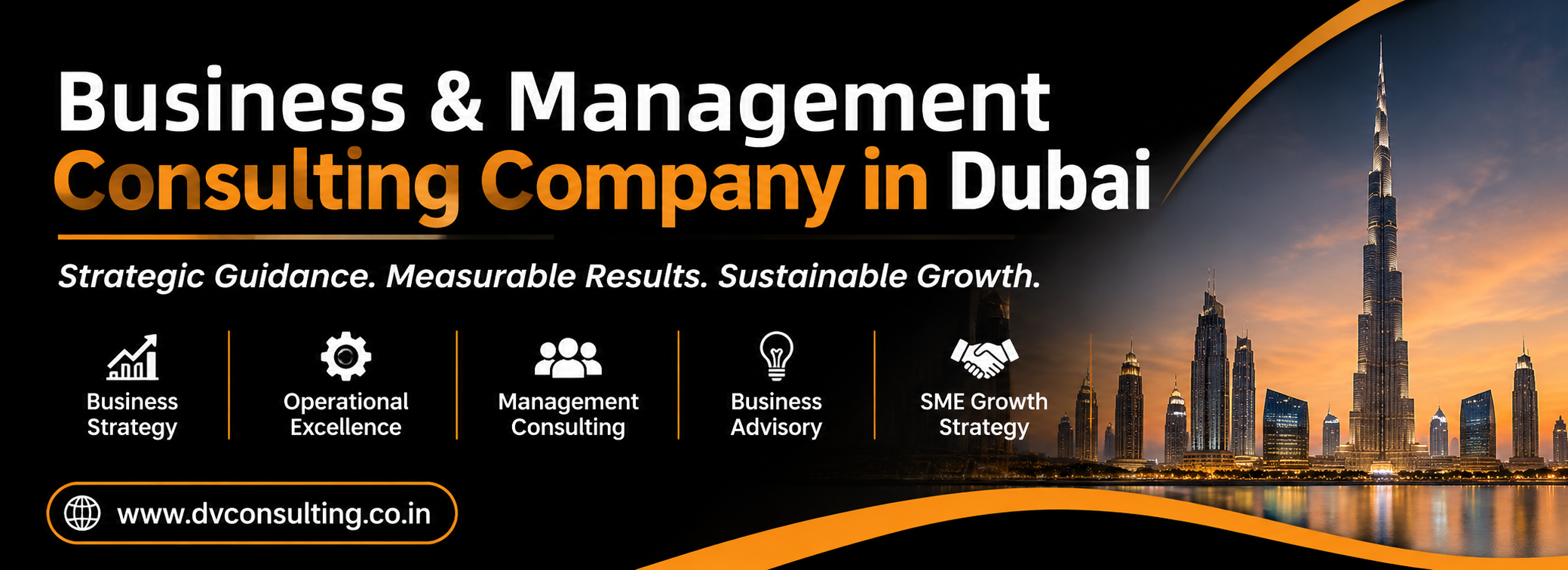
Business and Management Consulting in Dubai for SMEs, MSMEs, Manufacturers and Growing Enterprises
Business Consulting in Dubai helps companies identify business challenges, improve operational performance, strengthen management systems and develop strategies for sustainable growth. Management Consulting in Dubai focuses on improving organisational effectiveness through better business planning, leadership development, process optimisation, operational efficiency and performance management. For SMEs, MSMEs, manufacturers and growing enterprises, professional consulting services can provide the strategic direction and practical support required to build a more structured, productive and profitable business.
Business growth is not simply about increasing revenue, acquiring more customers or expanding into new markets. Sustainable growth requires a business to develop strong management systems, efficient operations, financially disciplined processes, capable leadership and a clear long-term strategy. For companies operating in Dubai's competitive business environment, achieving this balance is essential to maintaining profitability, improving productivity and building a business that can grow without becoming increasingly dependent on its owner.
As Dubai continues to strengthen its position as an international centre for trade, manufacturing, logistics, professional services and entrepreneurship, businesses are facing new opportunities as well as increasing operational expectations. Companies must respond to changing customer requirements, manage rising operating expenses, maintain product and service quality, adopt appropriate technologies and develop teams capable of delivering consistent results.
For many business owners, these responsibilities become difficult to manage while simultaneously handling everyday business operations. A company may have a strong product, an established customer base and experienced employees, yet still experience slow growth because its internal systems are not sufficiently developed. In other situations, business expansion creates additional complexity, resulting in communication gaps, inconsistent processes, unnecessary expenses and greater dependence on senior management.
This is where professional Business and Management Consulting in Dubai becomes valuable.
A reliable Business Consulting Company in Dubai helps organisations understand the reasons behind their performance challenges, identify opportunities for improvement and implement practical strategies that support measurable business progress. Instead of concentrating only on short-term financial results, effective consultants examine the complete business environment, including business strategy, people, processes, productivity, organisational structure, operational efficiency and management practices.
D&V Business Consulting focuses on business growth, management improvement, operational excellence, lean manufacturing principles and business process improvement. Its consulting approach is positioned around helping SMEs, MSMEs, manufacturers and growing organisations strengthen their internal capabilities, improve business discipline and develop practical systems for sustainable performance.
Whether an organisation requires a structured SME Growth Strategy, professional Management Consulting Services in Dubai, operational efficiency consulting, business process improvement or assistance with business transformation, the objective is to connect business planning with actual implementation.
The right consulting engagement should ultimately help business owners make better decisions, build accountable teams, reduce operational inefficiencies and create a business capable of delivering consistent results over the long term.
Why Businesses in Dubai Need Professional Business Consulting Services
Dubai offers businesses access to international markets, a diverse customer base, advanced infrastructure and a dynamic commercial environment. However, operating in a competitive market also requires companies to maintain high standards of management, customer service, operational performance and financial control.
A business that performed successfully during its early stages may find that its existing management practices are no longer suitable as the organisation expands. Informal communication that worked with ten employees may become ineffective with fifty employees. Decisions that were previously made directly by the owner may start creating delays when multiple departments require approvals. Similarly, production systems that were sufficient for a limited customer base may struggle to meet higher order volumes.
These challenges are not necessarily signs of a weak business. They often indicate that the organisation has reached a stage where it needs more structured management systems.
Professional business consultants in Dubai help companies move from informal working practices towards organised, measurable and scalable business operations.
For example, a manufacturing company may need to improve production planning, material utilisation, inventory management and quality control before accepting additional orders. A trading company may require stronger procurement procedures, supplier evaluation and cash-flow monitoring. A growing SME may need an organisational structure that allows managers to take responsibility rather than referring every decision to the business owner.
A strategic business consulting engagement considers these requirements together rather than treating each issue as an isolated problem.
The growing importance of structured management
As businesses expand, the quality of their management systems becomes increasingly important. Revenue growth without operational discipline can create additional pressure on working capital, employees, infrastructure and customer relationships.
Professional management consulting helps decision-makers establish clarity around business objectives, responsibilities, performance expectations and improvement priorities.
An experienced management consultant can help a company assess whether its current structure supports its future ambitions, identify operational bottlenecks and develop an improvement roadmap that considers available resources.
For SMEs and MSMEs, this is particularly relevant because they may not have separate internal departments for strategy, process improvement, operational excellence and organisational development.
Engaging a business consulting firm can provide access to structured expertise without requiring the organisation to build every specialist capability internally.
Common Business Challenges Preventing Sustainable Growth
Many companies approach a business consulting company in Dubai when they realise that their current growth is not translating into improved profitability, productivity or organisational stability.
Although each organisation has different circumstances, several business challenges frequently affect SMEs, manufacturers and growing enterprises.
Unclear business strategy and limited long-term planning
A business without a clearly defined strategy often operates through short-term decisions. Management teams concentrate on immediate sales, customer requirements and operational problems without establishing measurable long-term priorities.
This can result in inconsistent investments, unclear market positioning, poor resource allocation and difficulty identifying which opportunities deserve attention.
Business owners may have ambitious expansion plans but lack a structured business plan explaining how to achieve them.
Strategic business consulting helps organisations define their business direction, evaluate growth opportunities, establish measurable objectives and connect strategic decisions with operational capabilities.
A practical business strategy should answer important questions:
- Which customer segments should the company prioritise?
- What products or services offer the strongest growth opportunities?
- Which markets can the organisation realistically serve?
- What operational improvements are necessary before expansion?
- Which resources and capabilities will be required?
- How should management measure progress?
A business strategy consultant in Dubai can help leadership teams convert these questions into an actionable business growth plan.
Excessive dependence on the business owner
In many small and medium-sized companies, the owner remains involved in almost every important activity. Customer approvals, procurement decisions, employee issues, production priorities and financial matters may all depend on one individual.
Although this approach may work during the initial stages of a business, it becomes a limitation when the organisation grows.
When employees cannot make decisions within clearly defined responsibilities, work slows down. Managers hesitate to take ownership, communication becomes concentrated around the owner and important business activities may be delayed whenever senior leadership is unavailable.
Management consulting helps businesses establish an organisational structure, define decision-making authority, introduce accountability systems and develop management capabilities.
The objective is not to remove the owner from the business. It is to create an organisation where trained employees and managers can independently manage their responsibilities within an agreed framework.
High operational costs and low productivity
Rising operational expenses can affect profitability even when sales remain stable.
In manufacturing and industrial businesses, unnecessary material movement, machine downtime, excessive inventory, production delays, rework and inefficient resource utilisation can increase costs.
In service and trading organisations, repetitive administrative activities, poor coordination, unnecessary approvals and manual documentation can create similar problems.
Operational efficiency consulting identifies where time, money, materials and employee effort are being lost.
A structured improvement programme may include process mapping, productivity analysis, waste identification, standard operating procedures, performance monitoring and lean management practices.
The purpose is to improve the value generated from existing resources rather than relying exclusively on additional investment.
Inconsistent processes and the absence of SOPs
When employees perform the same activity differently, business performance becomes difficult to control.
For example, two production supervisors may follow different inspection procedures. Different sales employees may handle customer enquiries inconsistently. Procurement activities may depend on individual preferences rather than approved procedures.
Without standard operating procedures, organisations may experience inconsistent quality, repeated mistakes, training difficulties and unnecessary dependence on experienced employees.
SOP consulting helps establish documented working methods, responsibility levels, approval requirements and process controls.
Well-designed procedures make business activities more consistent and easier to monitor, train and improve.
Weak performance monitoring and management control
Some businesses collect substantial amounts of operational and financial information but do not use it effectively.
Management meetings may focus on general discussions instead of reviewing measurable business performance. Departments may report activities without explaining whether they are meeting agreed objectives.
A business needs suitable key performance indicators to monitor important areas such as sales conversion, production output, delivery performance, customer complaints, inventory turnover, employee productivity and operating costs.
Management consultants help select meaningful KPIs, establish reporting responsibilities and create review mechanisms that support timely decisions.
The purpose is to make business performance visible and actionable.
Difficulty managing expansion
Expansion introduces complexity. New customers, additional employees, new suppliers, larger production volumes and wider distribution networks require stronger coordination.
If internal systems do not develop at the same pace as the business, growth may create more problems than benefits.
Companies may experience declining service quality, delayed deliveries, increased working-capital requirements and management overload.
Business growth consulting helps organisations assess readiness for expansion, identify capacity constraints and develop a practical scaling strategy.
Sustainable growth means increasing business capacity while maintaining control over quality, cost, customer experience and organisational performance.
Why These Business Problems Occur
Understanding the symptoms of poor business performance is only the beginning. Effective business improvement requires identifying the underlying causes.
A company may experience frequent production delays, for example, but the actual cause could be inaccurate demand forecasting, poor material planning, inadequate preventive maintenance or unclear production scheduling.
Similarly, low employee productivity may not be caused by a lack of employee effort. It could result from unclear job responsibilities, insufficient training, inefficient workflows or poor coordination between departments.
Professional business advisory services focus on understanding these relationships before recommending solutions.
Lack of structured business planning
Some organisations operate without a documented business plan, annual operating plan or clearly defined departmental targets.
Management decisions are often based on immediate requirements rather than an agreed strategic direction.
This makes it difficult to prioritise investments, allocate resources and measure progress.
Business planning in the UAE should reflect the company’s actual market position, operating capacity, financial resources and growth objectives. It should also consider relevant licensing, regulatory and contractual requirements with appropriate specialist advice where needed.
Weak coordination between departments
Sales, production, procurement, finance, quality and logistics are interconnected.
When departments work independently without reliable communication systems, business performance suffers.
For instance, the sales department may accept customer orders without confirming production capacity. Procurement may purchase materials without receiving accurate demand information. Production may complete orders without coordinating dispatch schedules.
A business process improvement programme examines these interdepartmental relationships and establishes clear workflows, responsibilities and communication requirements.
Outdated operating practices
As businesses grow, procedures that were once effective can become inefficient.
Manual reporting, repeated data entry, paper-based approvals and disconnected systems may consume valuable employee time.
Business process automation in Dubai can help organisations simplify suitable repetitive activities, improve information visibility and reduce avoidable administrative work.
However, automation should follow process improvement. Automating an inefficient process without redesigning it may simply make the inefficiency happen faster.
Limited management development
Business performance depends on more than technology and infrastructure. It also depends on the ability of managers to plan work, solve problems, communicate expectations and manage employees.
When supervisors are promoted without appropriate management development, they may continue performing technical tasks instead of taking responsibility for team performance.
Management consulting can help define managerial roles, establish review routines and improve leadership accountability.
No systematic approach to continuous improvement
Many organisations make improvements only when a serious problem occurs.
After a customer complaint, production failure or missed delivery, management takes corrective action. However, without a structured improvement system, the same problem may return.
Operational excellence requires ongoing monitoring, root-cause analysis, corrective action and regular performance reviews.
Lean management principles help organisations identify waste, improve workflow and create a culture in which employees participate in solving operational problems.
How Business Consulting Firms in Dubai Help Companies Improve Business Performance
A professional business consulting firm provides a structured approach to understanding organisational challenges and improving business performance.
The exact scope depends on the company’s size, industry, operational maturity and business objectives. However, a comprehensive consulting engagement generally addresses the following areas.
Strategic business consulting and growth planning
Strategic business consulting helps business owners understand their current position and define a realistic direction for future growth.
The process begins by evaluating the company’s products, services, customers, competition, capabilities, operating model and internal resources.
Consultants then help management identify growth opportunities and prioritise initiatives based on business impact, feasibility and investment requirements.
For an SME, this may involve improving customer retention, strengthening sales processes, developing additional revenue streams or improving the profitability of existing operations.
For a manufacturer, strategic planning may focus on production capacity, product mix, manufacturing efficiency, supply-chain reliability and market expansion.
A practical SME growth strategy should not be based on unrealistic revenue targets. It should connect sales opportunities with production capacity, employee capability, working capital and management readiness.
Management consulting and organisational development
Management consulting helps organisations establish the structures and systems needed to manage business activities effectively.
Consultants may review reporting relationships, departmental responsibilities, management roles, decision-making authority and performance expectations.
The outcome can include an improved organisational structure, role clarity, responsibility matrices, management review systems and departmental performance indicators.
Organisational transformation UAE businesses undertake should be supported by practical implementation rather than remaining a theoretical restructuring exercise.
The objective is to build a business where responsibilities are understood, decisions are made at appropriate levels and management can monitor results without becoming involved in every routine activity.
Operational excellence and productivity improvement
Operational excellence is concerned with consistently delivering the required quality, quantity and service level while making effective use of available resources.
Operational Excellence Dubai initiatives may involve evaluating workflows, identifying non-value-adding activities, reducing avoidable delays and strengthening process controls.
In manufacturing environments, this can include:
- Reviewing production flow and process bottlenecks.
- Improving machine utilisation and production planning.
- Reducing unnecessary material movement.
- Reviewing rejection, rework and defect patterns.
- Improving workplace organisation.
- Strengthening preventive maintenance practices.
- Establishing production and quality performance indicators.
The right improvement priorities should be based on actual operational observations and reliable performance information.
Operational excellence is not simply about reducing costs. It is about improving the overall effectiveness of the business while maintaining safety, quality and customer satisfaction.
Lean management and waste reduction
Lean management is a practical approach to improving processes by identifying activities that consume resources without creating sufficient value for the customer.
Lean Management UAE programmes can be particularly useful for manufacturing companies, warehouses, workshops and businesses with repetitive workflows.
Common areas of improvement include unnecessary transportation, excessive inventory, waiting time, overproduction, avoidable motion, defects and unnecessary processing.
Lean principles can also be applied outside manufacturing. Administrative departments can improve document flow, reduce repetitive approvals and simplify service delivery.
A business improvement consultant should first understand how work is actually performed before recommending lean tools.
Depending on the operational requirements, improvement activities may include workplace organisation, visual management, standard work, process mapping, root-cause analysis and continuous improvement reviews.
Business process improvement and process optimisation
Business Process Improvement Dubai services help companies understand how activities move across departments and where unnecessary complexity exists.
A process may involve several employees, approval stages, software applications and supporting documents. If these elements are poorly coordinated, delays and errors become difficult to avoid.
Process optimisation UAE projects focus on making workflows clearer, more consistent and easier to manage.
A typical engagement may involve documenting the existing process, identifying bottlenecks, analysing root causes, designing an improved workflow and defining performance measures.
For example, a procurement process may be improved by establishing clear purchase requisition requirements, approval limits, supplier evaluation criteria and order tracking responsibilities.
Similarly, an order fulfilment process can be reviewed to improve coordination between sales, inventory, production and dispatch.
The value of process improvement lies in creating a better way of working that employees can understand and consistently follow.
SOP consulting and standardisation
Standard operating procedures provide documented guidance for performing recurring business activities.
SOP consulting helps organisations define how important processes should be performed, who is responsible, what approvals are required and how performance should be checked.
SOPs can be developed for:
- Sales and customer enquiry management.
- Procurement and supplier management.
- Production planning and control.
- Quality inspection and non-conformance handling.
- Inventory management and warehouse operations.
- Maintenance activities.
- Employee onboarding and training.
- Financial administration and internal approvals.
- Customer complaint management.
An effective SOP should be practical, easy to understand and aligned with actual working conditions.
It should not become unnecessary paperwork. Its purpose is to reduce confusion, improve consistency, support training and establish accountability.
Business transformation and change management
Business transformation involves improving how an organisation operates, makes decisions and delivers value.
Some companies require incremental improvement, while others need more significant changes to their management structure, operating model, technology, workflows or organisational culture.
Business Transformation Dubai projects may include process redesign, management restructuring, digital adoption, performance management improvements and the introduction of new operating practices.
Transformation should be planned carefully because employees, customers, suppliers and managers may all be affected.
A credible consulting firm helps leadership understand the reasons for change, communicate the intended outcomes, establish responsibilities and monitor implementation.
The objective is to make improvements sustainable rather than introducing temporary changes that disappear after the consulting engagement ends.
Business process automation and digital efficiency
Digital tools can improve business efficiency when they are selected according to genuine operational requirements.
Business Process Automation Dubai initiatives may involve simplifying repetitive documentation, improving information flow, introducing workflow approvals and reducing manual data handling.
Potential areas include customer enquiry tracking, purchase approvals, inventory updates, management reporting and routine administrative workflows.
However, technology is not a substitute for sound management.
Before recommending automation, consultants should understand the existing process, identify unnecessary steps and determine what information the business actually needs.
The right solution should be proportionate to the company’s size, budget, technical capabilities and future requirements.
Industry-Specific Business Consulting Services in Dubai
Different industries face different operational and management challenges. A generic consulting recommendation may not be suitable for every organisation.
A reliable business consulting company should understand how industry-specific activities influence business performance.
Manufacturing and industrial businesses
Manufacturers need to balance production capacity, material availability, quality, delivery commitments, machine performance and operating costs.
A small improvement in production planning or material utilisation may create meaningful operational benefits, but the improvement must be measured against actual baseline information.
D&V Business Consulting’s manufacturing-oriented consulting positioning includes lean manufacturing, productivity improvement, operational excellence and process optimisation.
A manufacturing consulting engagement may examine production planning, material flow, machine utilisation, quality control, inventory practices, maintenance coordination and shop-floor management.
The objective is to help manufacturers develop more consistent production systems and improve their ability to meet customer requirements.
SMEs and MSMEs
Small and medium-sized businesses often operate with limited management resources.
The owner may manage sales, finance, employees, suppliers and operations simultaneously. As a result, strategic planning and systematic process improvement may receive insufficient attention.
SME Consulting Dubai services can help business owners establish clearer priorities, strengthen management systems and improve organisational discipline.
For an SME, the most useful improvement may not be a large technology investment or a complete organisational restructuring. It could be a clearly defined reporting structure, improved sales follow-up, documented SOPs or a more reliable operating review.
Small Business Consulting UAE engagements should therefore be practical, affordable in scope and connected to the organisation’s immediate business priorities.
Trading and distribution companies
Trading and distribution businesses depend on effective procurement, supplier relationships, inventory control, order processing and delivery coordination.
Poor inventory visibility can create excess stock, shortages or unnecessary working-capital pressure.
Consultants can review purchasing procedures, inventory management practices, order fulfilment workflows and reporting systems.
Process improvement can also help strengthen coordination between sales, procurement, finance and logistics.
Professional and service businesses
Service organisations depend heavily on employee capability, customer experience, service delivery standards and efficient internal coordination.
A lack of documented workflows may result in inconsistent customer experiences and repeated administrative effort.
Management consulting can help service businesses define service processes, improve responsibility allocation, establish performance measures and strengthen customer enquiry management.
The objective is to make service delivery more reliable while improving employee productivity and customer satisfaction.
Growing and family-owned businesses
Family-owned organisations frequently reach a stage where informal working relationships need to evolve into more structured management practices.
The business may need clearer separation between ownership responsibilities and operational responsibilities.
Business advisory services can help establish management reporting, role clarity, succession-related planning discussions, approval structures and professional operating procedures.
Any ownership, legal, tax or succession arrangements requiring regulated specialist advice should be referred to appropriately qualified professionals.
The D&V Business Consulting Approach to Sustainable Growth
D&V Business Consulting positions its consulting services around helping organisations improve management effectiveness, strengthen operations and develop sustainable business performance.
The underlying approach recognises that business growth is interconnected. A company cannot achieve lasting improvement by concentrating only on sales, reducing expenses or introducing technology while ignoring the systems that connect its departments.
A sustainable improvement programme must consider business strategy, people, processes, operational performance and management accountability together.
Understanding the real business problem
Every organisation has a different starting point.
Some companies require a complete review of their business operations, while others already understand their challenges and need support with a specific improvement initiative.
D&V’s consulting approach should begin with understanding the business owner’s objectives, the company’s current operating model and the problems affecting performance.
This involves discussing business priorities, understanding existing processes, reviewing available information and identifying the areas where improvement can create the greatest value.
The emphasis should remain on the actual business requirement rather than recommending a standard package to every client.
Connecting strategy with implementation
A business plan becomes useful when it is translated into responsibilities, activities and measurable outcomes.
For example, if a company wants to increase production capacity, management must understand whether additional capacity requires better scheduling, reduced downtime, improved material availability, additional equipment or changes in the workforce.
A practical consulting programme connects the business objective with the operational changes necessary to achieve it.
Developing management discipline
Long-term business improvement requires clear responsibilities and regular performance reviews.
D&V’s management consulting positioning emphasises the importance of structured working systems, performance monitoring, process standardisation and continuous improvement.
These practices help business owners move away from informal decision-making towards more consistent management.
Building improvement around business realities
Not every organisation requires an expensive transformation programme.
A growing SME may benefit from a focused review of its most critical processes. A manufacturer may need an operational improvement project. Another company may require a broader business strategy and organisational development initiative.
The scope should reflect the business’s requirements, available resources and capacity to implement change.
Supporting sustainable organisational improvement
The purpose of business consulting should extend beyond identifying problems.
Improvements need to be translated into working procedures, management responsibilities, performance indicators and review mechanisms.
This helps employees understand what is changing, managers understand what they are responsible for and business owners understand how progress will be evaluated.
D&V Business Consulting Methodology: From Assessment to Sustainable Results
A structured consulting methodology creates clarity for both the business owner and the consulting team.
The following framework provides a practical model for business improvement engagements.
Stage 1: Initial consultation and business understanding
The first stage focuses on understanding the organisation and its objectives.
Discussions may cover business history, products and services, target customers, organisational structure, operating challenges, growth plans and management expectations.
The consultant should also understand what the business owner considers the most urgent issue.
This stage establishes the context for the engagement and helps define the appropriate scope of work.
Stage 2: Business assessment and diagnostic review
The diagnostic stage examines how the organisation currently operates.
Depending on the engagement, the review may include management practices, departmental workflows, production systems, employee responsibilities, performance information and existing procedures.
The assessment should distinguish between symptoms and root causes.
For example, repeated delivery delays may result from inaccurate order planning rather than insufficient transport capacity.
The diagnostic review should identify the underlying causes and prioritise areas requiring improvement.
Stage 3: Gap analysis and improvement priorities
After understanding the current position, consultants compare existing practices with the organisation’s business objectives and required operating standards.
The resulting gap analysis identifies weaknesses, improvement opportunities and areas where stronger management control is necessary.
Not every identified gap needs immediate action.
Priorities should be evaluated according to business impact, urgency, implementation effort, resource requirements and expected value.
Stage 4: Strategy development and action planning
The next stage converts findings into a practical improvement plan.
The plan should specify what needs to change, why the change is necessary, who will be responsible, what resources are required and how progress will be measured.
For example, a production improvement plan may include better production scheduling, revised material planning, standard work procedures and regular performance reviews.
An SME growth plan may focus on sales management, customer retention, departmental responsibilities and improved financial visibility.
Stage 5: Implementation support
Implementation is where recommendations become actual business improvements.
Consultants may support process redesign, SOP development, management reviews, operational improvement initiatives and the introduction of suitable performance measures.
Employees and managers should be involved because they understand the practical realities of their work.
Management must also communicate expectations and provide the resources necessary to implement the agreed changes.
Stage 6: Performance monitoring
An improvement programme requires appropriate measurements.
Depending on the business, relevant indicators may include:
- Revenue growth and gross margin.
- Production output and schedule adherence.
- Machine downtime and utilisation.
- Material wastage and rejection rates.
- Order fulfilment and delivery performance.
- Inventory turnover.
- Customer complaints.
- Employee productivity.
- Process cycle time.
- Corrective action closure.
The indicators should be selected according to the project’s objectives. Tracking too many measures can make management reporting unnecessarily complicated.
Stage 7: Review, standardisation and continuous improvement
The final stage focuses on making improvements part of everyday operations.
This may involve updating SOPs, assigning process owners, reviewing performance regularly and establishing mechanisms for identifying new improvement opportunities.
A successful consulting engagement should leave the organisation with clearer processes and stronger internal capabilities.
The ultimate objective is to help the company continue improving after the initial consulting intervention.
Practical Solutions That Help Companies Achieve Sustainable Growth
Sustainable business improvement requires practical solutions that address the organisation’s actual constraints.
Establish a clear business growth strategy
Companies should define realistic business objectives supported by measurable targets.
The strategy should identify priority markets, customer segments, revenue opportunities, operational requirements and resource limitations.
Management should also establish a review schedule to assess progress and adjust priorities when business conditions change.
Strengthen financial and operational visibility
Business owners need reliable information to make decisions.
Regular management reporting should provide visibility into revenue, expenses, profitability, working capital, operational costs and key business performance indicators.
Financial reporting and management accounting should be undertaken by appropriately qualified professionals, with consulting support focused on management processes and performance visibility.
Standardise critical business processes
Important processes should be documented, responsibilities assigned and performance requirements communicated.
Standardisation is particularly useful when a business has multiple employees performing similar activities or operates across different locations.
Improve employee accountability
Employees should understand their responsibilities, reporting relationships and performance expectations.
Managers should review progress regularly and address operational problems before they become recurring issues.
Adopt lean management principles
Lean practices can help identify waste, simplify workflows and improve the use of available resources.
Improvements should be supported by actual observations and performance measurements rather than assumptions.
Use technology where it creates genuine value
Digital tools should solve identifiable business problems.
Before introducing new software or automation, organisations should assess their existing processes, information requirements, employee capabilities and integration needs.
Develop a continuous improvement culture
Improvement should not depend entirely on external consultants.
Managers and employees should be encouraged to identify problems, suggest practical solutions and review the effectiveness of changes.
This helps create a business that can adapt to changing customer expectations and market conditions.
Case Study: Business Consulting and Operational Improvement
Case Study 1: Manufacturing company experiencing production delays
A manufacturing company receives regular customer orders but struggles to complete them according to schedule.
An operational review may reveal that production planning is based on incomplete information, materials are not always available when required and machine maintenance is largely reactive.
A suitable improvement programme could include production planning reviews, material coordination, preventive maintenance scheduling, workflow analysis and daily performance monitoring.
The expected management benefit is greater visibility over production constraints and a more consistent approach to meeting delivery commitments.
Case Study 2: SME where every decision depends on the owner
An SME has grown steadily but its owner continues to approve almost every operational decision.
The company experiences delays because managers are unsure about their authority and employees frequently wait for instructions.
A management consulting intervention could review the organisational structure, clarify managerial responsibilities, establish approval limits and introduce regular departmental performance meetings.
This creates a more organised decision-making environment and allows the owner to concentrate on strategic business priorities.
Case Study 3: Trading company facing inventory and procurement difficulties
A trading organisation maintains high inventory levels but still experiences shortages of important products.
The problem may involve inaccurate demand information, inconsistent reorder practices, poor supplier coordination and limited inventory visibility.
Process improvement could introduce clearer procurement procedures, supplier performance reviews, inventory classification and stock monitoring.
The intended outcome is improved control over purchasing and inventory decisions.
Case Study 4: Service business struggling with inconsistent customer experiences
A service company receives customer enquiries through multiple channels, but follow-ups depend on individual employees.
Some enquiries are handled promptly, while others are delayed or overlooked.
An improved enquiry management process could establish a central tracking system, response responsibilities, follow-up procedures and customer feedback monitoring.
The business can then measure enquiry response times and identify opportunities to improve service consistency.
Detailed Case Study: Illustrative Manufacturing Business Transformation
Case study title: Improving Manufacturing Operations Through Structured Business Consulting
Important: This is an illustrative composite scenario created to explain the consulting methodology. It is not a verified D&V client engagement, and the business, findings and outcomes must not be represented as an actual client success story.
Business background
Consider a hypothetical manufacturing company operating in Dubai that supplies industrial components to commercial customers.
The company has an established customer base, a functioning production facility and an experienced workforce. However, as order volumes increase, management begins experiencing difficulties in meeting delivery commitments and maintaining consistent production performance.
The business owner recognises that additional orders are not automatically creating better profitability.
Production supervisors frequently adjust schedules, employees spend time locating materials, and management receives limited information about daily operational performance.
The company decides to undertake a structured business improvement initiative.
Initial business challenges
During the hypothetical diagnostic assessment, the following issues are identified:
Production planning: Production priorities are changed frequently because order information and material availability are not consistently coordinated.
Material management: Materials are sometimes unavailable when required, while other materials remain in inventory longer than necessary.
Machine utilisation: Equipment downtime is not systematically analysed, making it difficult to identify recurring causes.
Quality management: Defects and rework are recorded inconsistently, limiting management’s ability to identify trends.
Employee responsibilities: Supervisors and employees have overlapping responsibilities, resulting in communication gaps.
Performance monitoring: Management lacks a consolidated daily view of output, downtime, rework and schedule adherence.
Consulting intervention
The consulting methodology begins with understanding the existing production system rather than immediately introducing new machinery or software.
The first step is to map the major production processes and identify how materials, information and work move through the facility.
The assessment then examines production scheduling, material availability, machine performance, quality practices and supervisory responsibilities.
Based on the findings, the company develops a prioritised operational improvement plan.
Improvement initiative 1: Production planning and control
Production planning is reviewed to improve the coordination of customer orders, material requirements and available production capacity.
Management establishes clearer scheduling responsibilities and a regular mechanism for reviewing production priorities.
This helps reduce confusion between departments and makes production requirements more visible.
Improvement initiative 2: Material flow and workplace organisation
The organisation reviews material storage, identification and movement.
Lean management principles are used to identify unnecessary movement and improve workplace organisation.
Suitable visual controls and standard working practices are introduced to make material availability easier to monitor.
Improvement initiative 3: Machine performance monitoring
The company establishes a structured method for recording equipment downtime and identifying recurring causes.
Maintenance activities are reviewed so that appropriate preventive measures can be planned.
The objective is to improve the visibility of machine-related constraints and support better maintenance decisions.
Improvement initiative 4: Quality and process standardisation
Important quality inspection activities are documented.
Employees receive clearer instructions about inspection requirements, defect recording and escalation procedures.
The company also establishes a regular review of rework and non-conformance information.
Improvement initiative 5: Management accountability
The organisational responsibilities of production supervisors and other relevant employees are clarified.
Regular performance meetings are introduced to review output, delivery commitments, downtime, material issues and quality performance.
Managers are assigned responsibility for following up agreed improvement actions.
Expected business outcomes
The hypothetical engagement aims to create a more controlled production environment.
Rather than promising an arbitrary percentage improvement, management evaluates performance using baseline and post-implementation measurements.
The assessment may examine:
- Production schedule adherence.
- Actual output against planned output.
- Machine downtime.
- Material availability.
- Rework and rejection levels.
- Order completion time.
- Employee productivity.
- Corrective action completion.
Key lessons from the case study
The example demonstrates that manufacturing improvement does not always begin with additional capital expenditure.
In many situations, better planning, clearer responsibilities, standardised procedures and reliable performance information are essential first steps.
A professional manufacturing consulting engagement should identify which improvements are appropriate for the company’s operating conditions and then support their implementation.
The wider lesson is that sustainable growth requires a balance between customer demand, production capability, management effectiveness and operational discipline.
Benefits of Hiring a Professional Business Consulting Company in Dubai
Selecting the right consulting firm can help a business address important management and operational challenges through a structured improvement programe.
Access to structured business expertise
A consulting engagement introduces an organised approach to assessing problems, evaluating options and prioritising improvements.
This can be particularly valuable for SMEs that do not maintain separate internal strategy or operational excellence teams.
An objective assessment of business performance
Internal employees may become accustomed to existing procedures and may not always recognise inefficiencies.
An external consultant can examine the business from a different perspective, ask structured questions and help management identify improvement opportunities.
Improved strategic clarity
Professional business advisory services can help leadership teams establish clear business priorities and connect them with operational requirements.
Better operational control
Process mapping, SOP implementation, performance monitoring and lean improvement can help organisations develop more consistent working practices.
Stronger management accountability
Clear responsibilities and regular performance reviews can improve coordination between departments and support more effective decision-making.
Practical implementation support
A valuable consulting engagement should not stop at preparing a report.
Where included in the agreed scope, consultants should help translate recommendations into action plans, process changes, management routines and measurable improvements.
Better preparation for future growth
A company with clear processes and management responsibilities is better equipped to handle increasing operational complexity.
This can support expansion while helping the organisation maintain control over quality, customer service and costs.
Why Choose D&V Business Consulting?
Choosing a business consulting company is an important decision because the consultant’s recommendations may influence management priorities, operational processes and investment decisions.
Business owners should evaluate consulting firms based on their understanding of business challenges, the relevance of their service offerings, the quality of their proposed methodology and their ability to support practical implementation.
D&V Business Consulting positions its services around business growth, management consulting, lean manufacturing, operational excellence and business process improvement.
A business improvement-oriented consulting approach
The emphasis is on understanding what is preventing the organisation from achieving its objectives and identifying practical ways to improve performance.
This approach recognises that business challenges are interconnected and that effective solutions should consider the organisation as a whole.
Focus on SMEs, MSMEs and manufacturing businesses
Smaller organisations often need consulting support that reflects their available resources and management capabilities.
A practical consulting scope should address the business’s most important challenges rather than introduce unnecessary complexity.
Manufacturers may require operational efficiency and lean management support, while SMEs may need business planning, organisational development and management process improvements.
Strategy combined with operational improvement
Business growth requires both a clear direction and the ability to execute it.
D&V’s service positioning brings together strategic business consulting, management improvement and operational excellence.
This helps connect management objectives with the processes required to achieve them.
Attention to process standardisation
Documented processes, clear responsibilities and suitable performance measures are important foundations of a well-managed organisation.
SOP consulting and business process improvement can help businesses develop more consistent working practices.
Practical and measurable improvement priorities
A consulting engagement should establish what needs to improve and how management will evaluate progress.
The scope should be based on the organisation’s circumstances and should avoid unrealistic promises.
A focus on long-term business capability
The objective of sustainable consulting is to strengthen the organisation’s ability to manage and improve its own performance.
Businesses should be able to maintain improved processes, review their performance and identify future improvement opportunities.
A transparent consulting relationship
Before appointing any consulting firm, business owners should expect clarity regarding the scope of services, deliverables, responsibilities, professional credentials, fees and implementation arrangements.
D&V should make its relevant experience, consultant profiles, applicable registrations and client references available to prospective clients during the enquiry and evaluation process.
For organisations comparing business consulting firms in Dubai, this level of transparency is an important part of selecting a credible and reliable consulting partner.
Who Should Consider Business and Management Consulting in Dubai?
Professional consulting support can be useful for businesses at different stages of development.
D&V Business Consulting’s service positioning is particularly relevant to the following decision-makers:
CEOs and Managing Directors: Leaders seeking better management control, organisational performance and strategic clarity.
Business owners and entrepreneurs: Owners who want to reduce operational dependence on themselves and develop a more structured organisation.
Manufacturers: Companies seeking production efficiency, lean manufacturing, quality improvement and better operational control.
SME and MSME owners: Growing businesses requiring professional support with business planning, SOPs, management processes and growth strategies.
Operations heads: Managers looking to improve productivity, workflow, resource utilisation and performance monitoring.
Departmental managers: Leaders seeking better accountability, reporting systems and coordination between teams.
If your organisation is experiencing operational inefficiencies, inconsistent processes, management bottlenecks or difficulty managing expansion, a structured business consulting assessment can help identify the appropriate next steps.
Conclusion: Build a Stronger and More Sustainable Business with D&V Business Consulting
Sustainable business growth requires more than increasing sales or expanding into new markets. It depends on having the right business strategy, effective management systems, efficient operations, accountable employees and well-defined processes. For SMEs, MSMEs, manufacturers and growing enterprises in Dubai, strengthening these foundations is essential to improving business performance and maintaining long-term competitiveness.
Professional Business and Management Consulting in Dubai helps organisations identify operational challenges, address management gaps, improve productivity and establish practical strategies for future growth. From strategic business consulting and SME growth planning to lean management, operational excellence, SOP development and business process improvement, the right consulting approach connects business objectives with effective implementation.
D&V Business Consulting focuses on helping businesses develop stronger management practices, streamline operations and create structured systems that support continuous improvement. Whether your organisation is facing operational inefficiencies, management challenges, inconsistent processes or difficulties managing expansion, a structured consulting engagement can help identify the right improvement priorities.
Ultimately, a successful business is not defined only by how much it grows, but by how effectively it manages that growth. With the right strategy, disciplined execution and continuous improvement, businesses can build stronger operations, improve organisational capabilities and create a more sustainable future.
Looking for a reliable business consulting company in Dubai? Connect with D&V Business Consulting to discuss your business challenges and explore practical solutions for sustainable growth.
About Dharmesh Parikh – Founder & CEO, D&V Business Consulting

I’m Dharmesh Parikh, Founder & CEO of D&V Business Consulting. I started D&V with a clear conviction: businesses rarely struggle because of their products or market potential alone. In many cases, performance is affected by inefficient operations, inconsistent processes, people-related challenges, weak execution, and limited strategic direction.
My mission is to help founders, business owners, directors, CEOs, CXOs, promoters, and leadership teams identify business challenges and convert them into practical opportunities for improvement. My approach combines business consulting, management systems, operational improvement, sales performance, HR structure, process improvement, productivity enhancement, and implementation support based on the specific requirements of each organisation.
At D&V Business Consulting, we work with organisations across key areas that directly influence business performance, including sales and revenue, organisational structure, employee performance, operational efficiency, productivity, business processes, SOPs, accountability systems, KPIs, management reviews, and strategic execution.
A significant part of my consulting approach is understanding what actually happens inside an organisation. A process may look effective on paper but produce inconsistent results on the shop floor or within day-to-day business operations. Similarly, an organisation may have targets and KPIs but still struggle because responsibilities are unclear, reviews are inconsistent, or corrective actions are not followed through. Identifying these gaps requires practical observation, structured analysis, discussions with people at different levels, and a clear understanding of how work is actually performed.
This is also why I strongly believe that consulting should not end with a presentation or recommendation document. Recommendations have value only when they are converted into actions and embedded into the organisation. At D&V, we focus on working alongside business owners and leadership teams to translate strategies into defined responsibilities, practical processes, measurable performance indicators, review mechanisms, SOPs, and accountability systems.
My consulting philosophy is built around a simple principle: strategy creates direction, but execution creates results. Sustainable business performance requires both. Organisations need clarity about where they want to go, but they also need the systems, people, processes, discipline, and review mechanisms required to move consistently in that direction.
My areas of focus include business & management consulting, operational excellence, manufacturing consulting, lean manufacturing, process improvement, sop development, performance management, hr systems, sales performance, productivity improvement, and strategic business implementation. depending on the organisation’s needs, these areas may involve process analysis, organisational restructuring, kpi development, workflow improvement, waste reduction, productivity initiatives, management systems, or execution planning.
I also believe that improvement should be practical, measurable, and relevant to the organisation’s current stage of development. Every business has different people, processes, customers, capabilities, constraints, and priorities. Therefore, consulting solutions should not simply copy a standard model. They should be adapted to the organisation while maintaining the discipline required for effective implementation.
My work with business owners and leadership teams is therefore centred on asking practical questions: Where is performance being lost? Which processes are creating recurring problems? Are responsibilities clearly defined? Are employees working with the right systems and standards? Are management reviews leading to action? Are KPIs providing meaningful visibility? And, most importantly, are agreed improvements actually being implemented?
Through this execution-focused approach, my objective is to help organisations build stronger business systems, clearer accountability, more consistent processes, better operational performance, and improved management visibility.
I believe sustainable business performance is not created through one-time initiatives. It is built through continuous improvement, structured execution, disciplined management, capable teams, and systems that consistently support the organisation’s objectives.
At D&V Business Consulting, my role is to work with leadership teams not simply as an external advisor, but as a practical implementation partner—helping convert business challenges into structured actions and helping organisations move from identified problems to measurable improvements.
Who I Work With
I primarily work with MSME founders, entrepreneurs, and business leaders who are committed to building scalable and professionally managed organisations.
My experience covers a wide range of industries, including:
- Manufacturing
- Retail
- Distribution
- Trading Businesses
- Service-Based Enterprises
What I Share
Through my content, I share practical insights and business knowledge on topics including:
- Business Growth Strategies
- Sales Management
- Leadership Development
- HR & Organisation Development
- Operational Excellence
- Scaling MSMEs
I believe business consulting should create measurable business impact—not just reports and presentations. My objective is to help business owners make informed decisions, solve operational challenges, build stronger organisations, and achieve sustainable business growth.
If you’re looking for practical business strategies backed by hands-on implementation, I’d be pleased to connect and exchange ideas.
Founder & CEO – D&V Business Consulting
Business Growth | Sales Strategy | Operations Excellence | HR & Organizational Development
- How can business consulting firms in Dubai help companies achieve sustainable growth?
-
Business consulting firms in Dubai help companies achieve sustainable growth by developing effective business strategies, improving operational efficiency, strengthening financial management and enhancing organisational performance. D&V Business Consulting supports businesses in identifying growth opportunities, addressing operational challenges and implementing practical strategies that promote long-term profitability, productivity and business sustainability.
- Why is business consulting important for SMEs and MSMEs in Dubai?
-
Business consulting is important for SMEs and MSMEs because it helps them overcome challenges related to limited resources, increasing competition, operational inefficiencies and business expansion. D&V Business Consulting works with growing enterprises to improve management practices, streamline processes, optimise resources and develop structured growth strategies suited to their business objectives.
- What services does a business consulting company in Dubai provide?
-
A business consulting company in Dubai may provide services such as strategic business planning, management consulting, operational improvement, financial planning, organisational development, process optimisation and performance management. D&V Business Consulting offers business-focused consulting solutions to help organisations improve efficiency, strengthen management systems and establish a foundation for sustainable growth.
- How does management consulting in Dubai improve business performance?
-
Management consulting improves business performance by identifying management gaps, evaluating existing processes, improving decision-making and establishing clear performance objectives. D&V Business Consulting helps organisations strengthen leadership practices, improve departmental coordination and introduce structured management systems that support measurable business improvements.
- How can business consultants help companies reduce operational costs?
-
Business consultants help companies reduce operational costs by identifying unnecessary expenses, minimising process inefficiencies, improving resource utilisation and eliminating avoidable waste. D&V Business Consulting focuses on practical operational improvement strategies that help businesses control costs, enhance productivity and maintain consistent quality without compromising business performance.
- What is the role of strategic business consulting in long-term business growth?
-
Strategic business consulting helps organisations establish clear business objectives, evaluate market opportunities, assess risks and develop actionable growth plans. D&V Business Consulting assists businesses in aligning their resources, management capabilities and operational priorities with long-term goals to build a more competitive and sustainable organisation.
- How can a business strategy consultant in Dubai help growing companies?
-
A business strategy consultant helps growing companies understand their current position, identify improvement opportunities and establish a clear roadmap for expansion. D&V Business Consulting supports businesses in developing structured strategies covering operational efficiency, management effectiveness, resource planning and sustainable business development.
- Why should manufacturers in Dubai consider hiring management consultants?
-
Manufacturers can benefit from management consulting to improve production efficiency, reduce manufacturing costs, address quality issues and optimise supply chain operations. D&V Business Consulting helps manufacturing businesses identify operational bottlenecks, strengthen production management and implement improvement initiatives that support productivity and long-term competitiveness.
- How does SME consulting in Dubai support business expansion?
-
SME consulting supports business expansion by helping small and medium-sized enterprises improve internal systems, strengthen financial discipline, identify growth opportunities and prepare for increasing operational demands. D&V Business Consulting helps SMEs establish scalable business processes and management practices that support sustainable expansion.
- What is the difference between business consulting and management consulting?
-
Business consulting generally focuses on broader business challenges, including strategy, growth opportunities, financial performance and market positioning. Management consulting focuses more specifically on improving organisational structures, leadership, decision-making and operational management. D&V Business Consulting brings these complementary approaches together to help organisations improve overall business performance.
- How can business consultants improve operational efficiency?
-
Business consultants improve operational efficiency by reviewing existing workflows, identifying bottlenecks, reducing unnecessary activities and establishing standardised processes. D&V Business Consulting helps organisations improve process effectiveness, optimise resource allocation and develop operational systems that support higher productivity and consistent business performance.
- Can business consulting help companies improve profitability in Dubai?
-
Yes. Business consulting can help improve profitability by identifying cost-saving opportunities, improving operational productivity, strengthening financial controls and evaluating business performance. D&V Business Consulting helps companies understand the factors affecting profitability and develop practical improvement strategies to support healthier financial performance.
- How does business planning help companies achieve sustainable growth in the UAE?
-
Business planning provides a structured direction for achieving business objectives by defining priorities, allocating resources, assessing potential risks and establishing measurable performance targets. D&V Business Consulting helps organisations develop practical business plans that connect strategic objectives with operational execution and long-term growth requirements.
- How can business consulting firms help organisations manage business challenges?
-
Business consulting firms help organisations address challenges through structured assessments, problem identification, performance analysis and practical recommendations. D&V Business Consulting works with businesses to identify management gaps, resolve operational difficulties and establish improvement plans that strengthen organisational resilience and business continuity.
- What is operational excellence, and how can it support sustainable business growth?
-
Operational excellence is the continuous improvement of business processes to achieve better productivity, quality, efficiency and customer satisfaction. D&V Business Consulting helps organisations identify process inefficiencies, improve workflow management and establish continuous improvement practices that support sustainable operational performance.
- How can small business consulting in the UAE help startups and growing enterprises?
-
Small business consulting helps startups and growing enterprises establish effective business processes, improve resource management, define growth priorities and strengthen operational foundations. D&V Business Consulting supports businesses in building structured management practices and scalable systems that prepare them for future growth.
- When should a company hire a business consulting firm in Dubai?
-
A company should consider hiring a business consulting firm when it experiences slow growth, declining profitability, increasing operational costs, management challenges, inefficient processes or difficulties scaling its operations. D&V Business Consulting helps organisations assess these challenges and identify practical opportunities for business improvement and sustainable development.
- How do business consultants help companies improve decision-making?
-
Business consultants improve decision-making by analysing business information, evaluating operational performance, identifying potential risks and providing structured recommendations. D&V Business Consulting helps management teams establish clearer business priorities and make informed decisions based on organisational objectives, performance indicators and available resources.
- How can companies measure the success of business consulting services?
-
Companies can measure consulting success through relevant performance indicators such as revenue growth, profitability, operating costs, productivity, process efficiency, customer satisfaction and resource utilisation. D&V Business Consulting encourages organisations to establish measurable improvement objectives and monitor progress to evaluate the practical impact of consulting initiatives.
- Why choose D&V Business Consulting for business and management consulting in Dubai?
-
D&V Business Consulting helps businesses focus on sustainable growth through strategic planning, management improvement, operational efficiency and structured business development. With an emphasis on practical implementation and measurable business improvements, D&V Business Consulting supports SMEs, MSMEs, manufacturers and growing enterprises in strengthening their management capabilities, improving performance and building a foundation for long-term competitiveness.
Related Posts

How to Choose the Right Business and Management Consulting Company for Your Business Growth
In the relentless pursuit of peak efficiency and world-class quality, businesses constantly seek foundational methodologies…
How Business Consulting in Delhi Can Accelerate Growth and Improve Performance
In the relentless pursuit of peak efficiency and world-class quality, businesses constantly seek foundational methodologies…
How to Implement Lean Manufacturing: A Practical Guide for MSMEs and Manufacturing Businesses
In the relentless pursuit of peak efficiency and world-class quality, businesses constantly seek foundational methodologies…
How Trusted Business Management Consulting Services in Ahmedabad Help MSME Owners Increase Profits and Improve Business Performance
In the relentless pursuit of peak efficiency and world-class quality, businesses constantly seek foundational methodologies…
 Join