


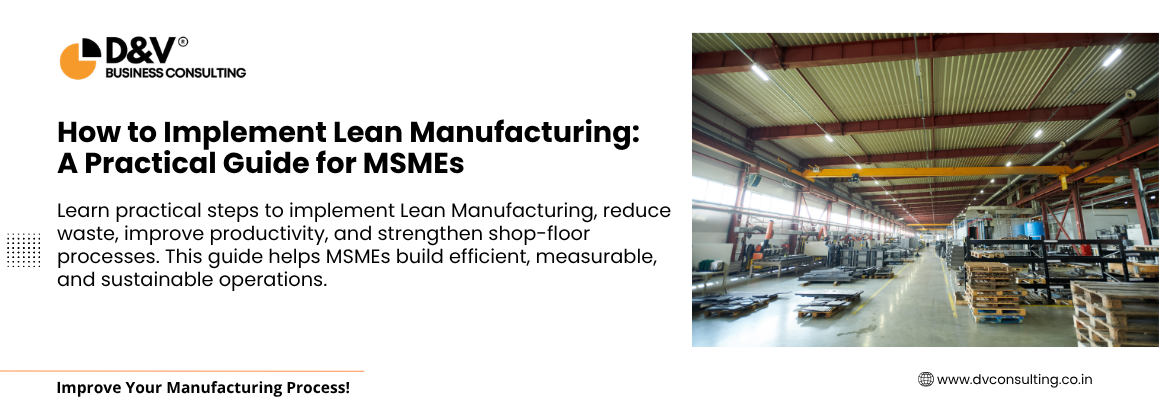
Lean manufacturing is a structured approach to improving manufacturing processes by identifying waste, improving workflow, reducing inefficiencies and creating consistent business performance.
For manufacturing businesses and MSMEs, Lean is not simply about reducing costs or making employees work faster. It is about building a more reliable operating system in which people, machines, materials and processes work together efficiently.
Many businesses understand the importance of Lean manufacturing but struggle with practical questions:
- How do you implement Lean manufacturing?
- What are the steps involved in Lean implementation?
- How do you start Lean manufacturing in an MSME?
- Which Lean tools and techniques should you use?
- What challenges can affect implementation?
- How can Lean improvements be measured and sustained?
This comprehensive guide explains how to implement Lean manufacturing, select the right improvement methods and develop a practical roadmap for operational excellence.
Implementing Lean Manufacturing: Strategies for MSMEs and Manufacturers
What Is Lean Manufacturing?
Lean manufacturing is a systematic method of improving manufacturing processes by identifying and reducing activities that consume resources without creating value for the customer.
The approach focuses on improving the flow of materials, information, and work while reducing unnecessary delays, defects, movement, inventory, and process variation.
The main objectives of Lean manufacturing include:
- Reducing operational waste
- Improving production productivity
- Reducing manufacturing lead time
- Improving product quality
- Reducing rework and rejection
- Improving equipment utilisation
- Controlling inventory and work-in-process
- Creating standardised work methods
- Improving on-time delivery
- Developing continuous improvement practices
- Supporting better management decisions
Lean manufacturing can be applied to large factories, small manufacturing units, engineering businesses, process industries, automotive suppliers, pharmaceutical manufacturers, textile companies, and other industrial organisations.
However, Lean implementation should be adapted to the organisation's size, product mix, process complexity, workforce, and business objectives.
Why Is Lean Manufacturing Important for MSMEs?
MSMEs often operate with limited resources, high customer expectations, changing production requirements, and strong pressure on margins.
Operational inefficiencies can directly affect profitability, delivery commitments, working capital, and customer satisfaction.
Common challenges faced by manufacturing MSMEs include:
- Unplanned machine breakdowns
- High rejection and rework
- Excessive inventory
- Long production lead times
- Poor workplace organisation
- Inconsistent operating methods
- Production bottlenecks
- Manual reporting
- Inefficient material movement
- Limited performance visibility
- Dependence on key employees
- Delayed customer deliveries
- Weak coordination between departments
Lean manufacturing provides a structured way to identify these problems and address their underlying causes.
For MSMEs, implementation does not necessarily require expensive technology or a large improvement department. Many improvements can begin with better workplace organisation, standardised work, process mapping, reliable data, daily performance reviews, and employee involvement.
The objective is to improve business performance using available resources more effectively.
How to Implement Lean Manufacturing: Step-by-Step Process
A successful Lean manufacturing implementation should begin with business objectives and operational problems rather than with the selection of tools.
The following steps provide a practical framework for manufacturing businesses.
Step 1: Define the Business Problem
The first step is to understand why the organisation wants to implement Lean manufacturing.
Management should identify the problems affecting productivity, quality, cost, delivery or customer satisfaction.
For example:
- Production output is below the planned target.
- Machines experience frequent breakdowns.
- Products require repeated rework.
- Production lead times are increasing.
- Material is moved unnecessarily between departments.
- Inventory levels are higher than required.
- Changeover activities consume excessive time.
- Different shifts follow different operating methods.
A clearly defined problem provides direction for the improvement initiative.
Instead of setting a broad objective such as “Implement Lean manufacturing,” a business may define a more specific objective:
Reduce production lead time by improving material flow and eliminating unnecessary waiting between processes.
A clear objective makes it easier to establish a baseline, assign responsibility and measure results.
Step 2: Establish a Current-State Baseline
Before making improvements, the organisation should understand its current performance.
A baseline provides a reference point for measuring progress.
Depending on the business problem, relevant metrics may include:
| KPI | What It Measures |
|---|---|
| Production Output | Quantity produced within a defined period |
| Productivity | Output relative to resources used |
| OEE | Equipment availability, performance and quality |
| Downtime | Time lost due to equipment or process interruptions |
| Rejection Rate | Percentage of products that fail quality requirements |
| Rework | Resources consumed correcting defects |
| Cycle Time | Time required to complete a process or operation |
| Lead Time | Total time from order or process initiation to completion |
| Changeover Time | Time required to switch from one product or setup to another |
| Work-in-Process | Inventory between production stages |
| On-Time Delivery | Ability to meet customer delivery commitments |
For example, if a business wants to improve machine performance, it should first understand its current availability, performance losses and quality losses.
Without reliable baseline data, it becomes difficult to determine whether an improvement has produced a meaningful result.
Step 3: Observe the Process at the Workplace
Lean implementation should be based on actual process conditions.
Management teams and improvement teams should observe how work is performed, how materials move, where delays occur and how employees interact with equipment and systems.
This may involve:
- Observing production activities
- Reviewing machine performance
- Studying material movement
- Speaking with operators
- Reviewing quality records
- Examining production schedules
- Identifying waiting time
- Recording process interruptions
- Studying work instructions
- Reviewing shift-to-shift differences
The objective is to understand the actual process rather than relying only on assumptions or reports.
Direct workplace observation can reveal problems that may not be visible in management dashboards.
Step 4: Map the Current Process
Once the current condition is understood, the next step is to map the flow of work.
Value Stream Mapping (VSM) is a useful Lean technique for understanding how materials and information move through a manufacturing process.
A current-state process map may include:
- Supplier inputs
- Production processes
- Cycle times
- Waiting periods
- Inventory between processes
- Material movement
- Information flow
- Production planning
- Customer requirements
- Process bottlenecks
- Quality checkpoints
A process map helps identify the difference between:
- Value-adding activities: Activities that contribute to the product or service in a way the customer requires.
- Non-value-adding activities: Activities that consume time or resources without directly creating customer value.
Some non-value-adding activities may be necessary because of regulatory, safety or operational requirements. These should be evaluated carefully rather than removed automatically.
Example
A manufacturing process may involve:
- Raw material receipt
- Material inspection
- Cutting
- Machining
- Assembly
- Quality inspection
- Packing
- Dispatch
Although the actual processing time may be relatively short, the product may spend considerable time waiting between departments.
Value Stream Mapping helps management understand where these delays occur and how the overall flow can be improved.
Step 5: Identify the Seven Types of Waste
Lean manufacturing commonly identifies seven major forms of waste.
1. Overproduction
Producing more than required or producing earlier than necessary.
Examples:
- Manufacturing products without confirmed demand
- Producing excessive batch quantities
- Creating inventory that remains unused
2. Waiting
Time lost when people, materials, machines or information are waiting.
Examples:
- Operators waiting for materials
- Machines waiting for maintenance
- Production waiting for approvals
- Products waiting between processes
3. Transportation
Unnecessary movement of materials or products.
Examples:
- Repeated movement between departments
- Long-distance material transfer
- Poorly planned warehouse locations
4. Overprocessing
Performing more work than necessary or using unnecessarily complex methods.
Examples:
- Repeated inspections caused by unreliable processes
- Duplicate data entry
- Unnecessary processing steps
- Excessive finishing activities
5. Inventory
Holding more raw materials, work-in-process or finished goods than required.
Examples:
- Excess raw material
- Large unfinished production queues
- Slow-moving finished goods
- Overstocked spare parts
6. Motion
Unnecessary movement by employees.
Examples:
- Searching for tools
- Repeated walking to collect materials
- Poor workstation layout
- Unorganised storage
7. Defects
Errors that require correction, replacement, rework or disposal.
Examples:
- Product rejection
- Incorrect dimensions
- Assembly errors
- Repeated customer complaints
Many Lean practitioners also highlight unused human potential as an important source of waste. Employee knowledge, creativity and problem-solving ability can be lost when people are not involved in improvement activities.
Lean Manufacturing Implementation Steps: From Planning to Execution
After identifying waste and operational problems, the organisation should develop a structured implementation plan.
Step 6: Prioritise Improvement Opportunities
Manufacturing businesses often identify several improvement opportunities at the same time.
However, attempting to address every problem simultaneously can dilute resources and reduce accountability.
Improvement opportunities should be prioritised based on:
- Business impact
- Frequency of occurrence
- Customer impact
- Financial impact
- Operational risk
- Implementation effort
- Availability of resources
- Ease of measurement
A simple prioritisation matrix can help classify projects as:
- High impact and relatively easy to implement
- High impact and more complex
- Lower impact and easy to implement
- Lower impact and resource-intensive
The final selection should reflect the organisation’s business objectives and operational constraints.
Step 7: Establish a Lean Implementation Team
Lean manufacturing requires participation from the people who manage and perform the work.
Depending on the organisation’s size, the implementation team may include:
- Business owner
- Managing director
- Plant head
- Production head
- Quality manager
- Maintenance manager
- Supervisors
- Operators
- HR representatives
- Finance representatives
- Process improvement specialists
Each member should understand their responsibilities.
For example:
| Role | Possible Responsibility |
|---|---|
| Business Owner | Define business priorities and provide leadership support |
| Plant Head | Coordinate implementation across departments |
| Production Head | Lead process improvements and monitor production performance |
| Quality Team | Analyse defects and improve process quality |
| Maintenance Team | Address equipment reliability and downtime |
| Supervisors | Monitor standard work and daily performance |
| Operators | Identify workplace problems and participate in improvements |
| HR Team | Support training, communication and capability development |
| Finance Team | Validate financial impact where appropriate |
Lean should not become the responsibility of only one department.
Step 8: Select the Right Lean Tools
Once the problem is understood, the organisation can select the appropriate Lean manufacturing tools and techniques.
The tool should be selected according to the operational challenge.
| Manufacturing Challenge | Potential Lean Tool or Approach |
|---|---|
| Workplace disorder | 5S |
| Long production lead time | Value Stream Mapping |
| Excessive equipment downtime | TPM |
| Long machine changeover | SMED |
| Unstable operating methods | Standard Work |
| Recurring defects | Root Cause Analysis |
| Excess work-in-process | Kanban or Pull Systems |
| Unnecessary movement | Layout Improvement |
| Poor performance visibility | Visual Management |
| Continuous improvement opportunities | Kaizen |
| Uneven production workload | Line Balancing |
| Process variation | Standardisation and Quality Improvement |
The objective is not to implement every Lean tool.
The objective is to solve the right problem using the right method.
Step 9: Develop an Improvement Action Plan
Each selected improvement project should have a clear action plan.
The plan may include:
- Problem statement
- Current condition
- Root cause
- Improvement objective
- Proposed countermeasures
- Responsible person
- Required resources
- Target completion date
- Performance indicators
- Review frequency
- Verification method
A structured action plan reduces ambiguity and helps management track progress.
Step 10: Implement the Improvement
The implementation stage involves applying the selected changes in the workplace.
Depending on the project, this may include:
- Rearranging equipment or materials
- Introducing standard work instructions
- Improving workplace organisation
- Changing material-handling methods
- Reducing unnecessary approvals
- Improving maintenance routines
- Reducing setup activities
- Introducing visual controls
- Improving quality checkpoints
- Establishing daily performance reviews
The improvement should be implemented in a controlled manner.
Where appropriate, businesses may first test the change in a pilot area before expanding it across the plant.
Step 11: Measure and Verify Results
After implementing an improvement, compare the results with the baseline.
For example:
- Has production output improved?
- Has downtime reduced?
- Has lead time changed?
- Has rejection reduced?
- Has material movement decreased?
- Has changeover time improved?
- Has inventory reduced?
- Has on-time delivery improved?
The results should be evaluated using reliable data and an appropriate measurement period.
Not every improvement will produce immediate financial benefits. Some improvements may first strengthen process stability, visibility, safety or quality.
Step 12: Standardise and Sustain the Improvement
Once an improvement has been verified, the new method should become part of the normal operating system.
This may require:
- Updating SOPs
- Revising work instructions
- Training employees
- Establishing visual standards
- Updating checklists
- Conducting process audits
- Reviewing performance indicators
- Assigning process ownership
Without standardisation, processes may gradually return to their previous condition.
Lean implementation is therefore not complete when an improvement is introduced. It is complete only when the improved method becomes part of daily operations.
How to Start Lean Manufacturing in an MSME
For businesses starting Lean manufacturing for the first time, a focused approach is often more practical than launching a large transformation programme.
1. Select a Pilot Area
Choose one area where:
- The problem is clearly visible
- Performance can be measured
- The process has manageable boundaries
- Employees can participate
- Management can provide support
Possible pilot areas include:
- One production line
- One machine group
- One assembly process
- One warehouse
- One product family
- One high-rejection operation
- One process with frequent delays
The pilot should be selected based on business needs rather than convenience alone.
2. Define a Measurable Objective
The pilot should have a clear objective.
For example:
Improve material flow and reduce unnecessary waiting between two production stages.
Other possible objectives include:
- Reduce machine downtime
- Improve workplace organisation
- Reduce changeover time
- Improve first-pass quality
- Reduce rework
- Improve production visibility
A measurable objective helps the team determine whether the pilot is producing useful results.
3. Involve Employees from the Beginning
Employees often understand process problems that are not visible in reports.
Their involvement can help identify:
- Repeated delays
- Unnecessary movement
- Difficult work methods
- Equipment problems
- Material shortages
- Quality issues
- Safety concerns
- Unclear instructions
Employee participation also helps create ownership of the improvement process.
Lean should be communicated as a method for improving work and solving operational problems—not merely as an additional reporting requirement.
4. Begin with Basic Process Discipline
An MSME does not necessarily need sophisticated technology to begin Lean manufacturing.
Initial activities may include:
- Workplace organisation
- Visual management
- Standard work
- Daily performance review
- Basic production tracking
- Root cause analysis
- Preventive maintenance
- Process mapping
- Waste identification
These activities can establish the foundation for more advanced improvement methods.
5. Review the Pilot Results
After implementation, the team should review:
- What changed?
- What results were achieved?
- What problems remain?
- What lessons were learned?
- What should be standardised?
- Can the improvement be applied elsewhere?
The learning from one pilot can support subsequent Lean projects.
Lean Manufacturing for MSMEs: Practical Areas of Improvement
Lean manufacturing can be applied across different parts of an MSME’s operations.
Production
Potential improvement areas include:
- Production flow
- Machine utilisation
- Cycle time
- Line balancing
- Changeover
- Work-in-process
- Production scheduling
Quality
Potential improvement areas include:
- Defect prevention
- Rework reduction
- Root cause analysis
- Process consistency
- Quality checkpoints
- Standard work
Maintenance
Potential improvement areas include:
- Breakdown reduction
- Preventive maintenance
- Autonomous maintenance
- Equipment inspection
- Spare-parts management
- Maintenance planning
Materials and Inventory
Potential improvement areas include:
- Material handling
- Inventory visibility
- Storage organisation
- Material availability
- Pull systems
- Internal transportation
People and Management
Potential improvement areas include:
- Role clarity
- Employee training
- Daily management
- Problem-solving capability
- Performance reviews
- Cross-functional coordination
The most suitable improvement areas depend on the organisation’s current performance and business priorities.
Lean Manufacturing Tools and Techniques
Lean manufacturing includes a range of tools that address different operational challenges.
5S Implementation for Manufacturing
5S is a workplace organisation and visual management method.
The five principles are:
- Sort — Remove unnecessary items from the workplace.
- Set in Order — Arrange required items so they are easy to locate and use.
- Shine — Clean and inspect the workplace and equipment.
- Standardise — Establish consistent workplace organisation methods.
- Sustain — Maintain the standards through discipline, review and continuous improvement.
Benefits of 5S
A well-implemented 5S system can help improve:
- Workplace visibility
- Tool availability
- Material organisation
- Safety
- Cleanliness
- Abnormality identification
- Employee productivity
However, 5S should not become only a cleaning activity.
Its broader purpose is to create a workplace where abnormalities are visible and work can be performed consistently.
Value Stream Mapping
Value Stream Mapping provides a visual representation of material and information flow.
It can help identify:
- Waiting time
- Excess inventory
- Process bottlenecks
- Unnecessary movement
- Information delays
- Production imbalances
- Long lead times
VSM is particularly useful when the organisation needs to understand how individual departments contribute to overall process performance.
Kaizen
Kaizen refers to continuous improvement through structured, incremental changes.
A Kaizen activity typically involves:
- Identifying a problem
- Understanding the current condition
- Analysing the root cause
- Developing improvement ideas
- Implementing countermeasures
- Measuring results
- Standardising the improvement
Kaizen encourages employees and management to improve processes continuously rather than waiting for a major transformation project.
Total Productive Maintenance (TPM)
Total Productive Maintenance focuses on improving equipment reliability and performance through coordinated maintenance and production practices.
TPM may involve:
- Preventive maintenance
- Autonomous maintenance
- Equipment inspections
- Breakdown analysis
- Maintenance planning
- Operator involvement
- Equipment performance monitoring
TPM can be particularly relevant for businesses experiencing frequent breakdowns, minor stoppages or inconsistent equipment performance.
Standard Work
Standard Work defines the best-known method for performing a process consistently.
It may include:
- Work sequence
- Expected cycle time
- Work-in-process requirements
- Quality checkpoints
- Safety requirements
- Machine settings
- Operating procedures
Standard Work helps reduce variation between employees, shifts and production batches.
It also creates a foundation for future improvement.
Kanban and Pull Systems
Kanban is a method used to support material and production flow through visual signals.
A pull system connects production or replenishment more closely to downstream requirements.
Depending on the process, these approaches may help businesses manage:
- Work-in-process
- Material replenishment
- Production queues
- Inventory levels
- Internal material movement
Implementation should consider demand variability, process stability, supplier reliability and production requirements.
SMED
SMED stands for Single-Minute Exchange of Die.
It is a structured approach to reducing machine setup and changeover time.
SMED improvement activities may include:
- Separating internal and external setup activities
- Preparing tools and materials in advance
- Simplifying adjustments
- Improving fixture design
- Standardising setup procedures
- Reducing unnecessary movement
SMED can be useful in manufacturing environments with frequent product changes or small production batches.
Visual Management
Visual Management makes important information, standards and abnormalities easier to understand.
Examples include:
- Production boards
- Performance charts
- Safety indicators
- Process status displays
- Tool-location markings
- Material identification
- Quality alerts
- Maintenance status indicators
Visual Management should help employees and managers identify the current condition and respond to problems quickly.
Root Cause Analysis
Root Cause Analysis helps teams understand why a problem occurs.
Common approaches include:
- Five Whys
- Fishbone Diagram
- Pareto Analysis
- Process Analysis
- Cause-and-effect investigation
The objective is to address underlying causes rather than repeatedly correcting the same symptom.
Lean Manufacturing and Operational Excellence
Lean manufacturing is an important component of operational excellence.
However, operational excellence is broader than the implementation of individual Lean tools.
It involves creating a management system in which processes are stable, performance is visible, problems are addressed systematically and improvement becomes part of everyday work.
Operational excellence may integrate:
- Lean manufacturing
- Quality management
- Productivity improvement
- Maintenance management
- Standard Operating Procedures
- Performance management
- Employee capability development
- Process improvement
- Data-driven decision-making
- Continuous improvement
A manufacturing business may implement 5S, TPM or Kaizen, but sustainable operational excellence requires these activities to connect with business priorities and management systems.
Example
A company may reduce machine downtime through TPM.
To sustain the improvement, it may also need:
- Updated maintenance standards
- Operator training
- Spare-parts planning
- Performance monitoring
- Management reviews
- Clear maintenance responsibilities
This illustrates how Lean activities can become part of a broader operational excellence system.
Common Lean Manufacturing Implementation Challenges
Lean manufacturing implementation can face several operational and organisational challenges.
1. Lack of Management Commitment
Lean requires management support in the form of:
- Clear priorities
- Resource allocation
- Regular reviews
- Timely decisions
- Removal of implementation barriers
Without leadership involvement, improvement activities may lose direction.
2. Treating Lean as Only a 5S Programme
5S is useful, but Lean manufacturing is much broader.
A comprehensive Lean programme should also consider:
- Process flow
- Quality
- Productivity
- Equipment reliability
- Inventory
- Lead time
- Standardisation
- Continuous improvement
A clean workplace alone does not establish Lean manufacturing.
3. Selecting Tools Before Understanding the Problem
Businesses sometimes introduce Lean tools because they are popular or because another organisation uses them.
However, tools should be selected based on actual operational requirements.
For example:
- A high-downtime problem may require equipment-loss analysis and TPM-related actions.
- A long-changeover problem may require setup reduction methods.
- Excessive inventory may require flow analysis and inventory-control improvements.
The tool should support the problem-solving process.
4. Poor Data Quality
Reliable data is essential for understanding problems and measuring results.
Common data challenges include:
- Incomplete production records
- Delayed reporting
- Inconsistent definitions
- Manual entry errors
- Missing downtime information
- Inaccurate rejection data
Manufacturing businesses should establish clear measurement definitions and consistent reporting practices.
5. Employee Resistance to Change
Employees may be concerned that Lean will increase workload, introduce unnecessary monitoring or change established working methods.
A practical implementation approach should include:
- Clear communication
- Employee participation
- Training
- Respect for workplace knowledge
- Transparent objectives
- Recognition of improvement contributions
The involvement of employees can improve both the quality and sustainability of Lean initiatives.
6. Lack of Standardisation
If an improved process is not documented and communicated, employees may return to previous methods.
Standard Operating Procedures, work instructions, training and audits can help maintain the improved condition.
7. Trying to Improve Everything at Once
Launching too many projects simultaneously can create:
- Unclear ownership
- Resource constraints
- Delayed implementation
- Poor follow-up
- Conflicting priorities
A focused roadmap helps management maintain accountability and track results.
8. Failure to Sustain Improvements
Some businesses achieve initial improvements but struggle to maintain them.
Common causes include:
- Inadequate follow-up
- Lack of process ownership
- Infrequent audits
- Weak management reviews
- Insufficient training
- Failure to update standards
Sustainment should be included in the implementation plan from the beginning.
How to Measure Lean Manufacturing Success
Lean manufacturing success should be evaluated through measurable operational and business outcomes.
The appropriate KPIs depend on the organisation’s objectives.
Productivity
Productivity measures the relationship between output and the resources used.
Possible measures include:
- Output per employee
- Output per machine hour
- Production per labour hour
- Value-added output per shift
OEE Improvement
Overall Equipment Effectiveness measures three major dimensions of equipment performance:
- Availability
- Performance
- Quality
OEE can help identify equipment-related losses and prioritise improvement activities.
Quality Performance
Useful indicators include:
- Rejection rate
- Rework percentage
- First-pass yield
- Customer complaints
- Defect frequency
- Cost of poor quality
Flow and Lead Time
Useful indicators include:
- Production lead time
- Cycle time
- Waiting time
- Work-in-process
- Changeover time
- Material movement
Delivery
Useful indicators include:
- On-time delivery
- Schedule adherence
- Order completion time
- Production plan achievement
Financial Impact
Where data is available, management may also evaluate:
- Cost reduction
- Scrap cost
- Rework cost
- Overtime cost
- Inventory carrying cost
- Maintenance cost
- Capacity utilisation
Financial benefits should be calculated using clearly defined assumptions and appropriate accounting methods.
Lean Manufacturing Case Studies: How to Structure and Evaluate Results
A useful Lean manufacturing case study should explain the complete improvement journey.
It should not simply list the tools used.
A structured case study can include the following sections.
1. Business Background
Describe the type of manufacturing operation, product category and relevant process.
2. Initial Challenge
Explain the operational problem.
Examples include:
- High downtime
- Long lead time
- Excessive rejection
- Poor material flow
- High changeover time
3. Baseline Performance
Present relevant data before the improvement.
4. Root Cause Analysis
Explain why the problem occurred.
5. Improvement Actions
Describe the Lean methods and operational changes implemented.
6. Employee Involvement
Explain how operators, supervisors and management participated.
7. Results
Present measurable changes in relevant KPIs.
8. Sustainment
Explain how the improvement was standardised and monitored.
Important Consideration
A case study should distinguish between:
- Measured results
- Estimated benefits
- Expected future improvements
- Qualitative observations
This helps readers understand the actual impact of the intervention.
Practical Lean Manufacturing Roadmap for MSMEs
A manufacturing business can structure its Lean journey into five broad phases.
Phase 1: Diagnose
Understand the current operating condition.
Activities may include:
- Process assessment
- Workplace observation
- Data collection
- Value Stream Mapping
- Waste identification
- Problem prioritisation
Phase 2: Stabilise
Establish basic process discipline.
Activities may include:
- 5S
- Standard Work
- Visual Management
- Basic maintenance routines
- Daily performance review
- Clear process responsibilities
Phase 3: Improve
Address important operational losses.
Activities may include:
- Waste reduction
- OEE improvement
- Quality improvement
- Changeover reduction
- Material-flow improvement
- Root Cause Analysis
- Inventory improvement
Phase 4: Integrate
Connect Lean practices with the broader management system.
Activities may include:
- Production planning
- Quality management
- Maintenance planning
- HR and training
- Performance management
- SOP management
- Management reviews
Phase 5: Sustain
Maintain improvements and develop internal capability.
Activities may include:
- Process audits
- KPI reviews
- Refresher training
- Continuous improvement meetings
- Updated standards
- Leadership reviews
- New improvement projects
The duration and scope of each phase depend on the organisation’s size, process complexity, resources and improvement objectives.
When Should a Manufacturing Business Consider Lean Manufacturing Consulting?
A manufacturing business may consider external Lean manufacturing consulting support when it:
- Wants to begin a structured Lean programme
- Has recurring operational problems
- Needs help identifying process bottlenecks
- Experiences high downtime or rejection
- Wants to improve OEE
- Faces long production lead times
- Has excessive inventory
- Needs standardised operating procedures
- Wants to improve productivity
- Has difficulty sustaining improvement initiatives
- Needs an implementation roadmap
- Wants to develop internal improvement capabilities
A consulting partner can support activities such as:
- Current-state assessment
- Process mapping
- Waste identification
- Lean implementation planning
- 5S implementation
- TPM initiatives
- OEE improvement
- SOP development
- Productivity improvement
- Management review systems
- Employee training
- Continuous improvement
The role of a consultant should be aligned with the organisation’s needs and should support the business in developing internal ownership of improvement activities.
How D&V Business Consulting Supports Lean Manufacturing and Operational Excellence
D&V Business Consulting supports businesses in connecting business objectives with practical operational improvements.
Its consulting approach can address areas such as:
- Lean Manufacturing
- Operational Excellence Consulting
- 5S Implementation
- Total Productive Maintenance
- Value Stream Mapping
- SOP Consulting
- Process Improvement
- Productivity Improvement
- OEE Improvement
- Cost Reduction
- Performance Management
- Continuous Improvement
D&V Business Consulting focuses on understanding the current operating condition, identifying improvement opportunities, developing practical action plans and supporting implementation with business teams.
For MSMEs and manufacturing organisations, Lean manufacturing should connect directly with important business priorities such as:
- Productivity
- Quality
- Cost
- Delivery
- Capacity utilisation
- Process stability
- Customer satisfaction
The objective is to help businesses move from improvement recommendations to practical execution and measurable operational progress.
Lean Manufacturing for Different Business Needs
Lean Manufacturing for MSMEs
A practical resource explaining how MSMEs can apply Lean principles to address productivity, quality, inventory, downtime, lead time, and process inefficiencies using a practical approach.
Lean Manufacturing Tools and Techniques
An in-depth resource covering 5S, Kaizen, Value Stream Mapping, TPM, Kanban, SMED, Standard Work, Visual Management, Root Cause Analysis, and other Lean techniques.
Lean Manufacturing Implementation Challenges
A practical resource covering common barriers such as lack of management commitment, employee resistance, poor data, inadequate standardisation, incorrect tool selection, and difficulty sustaining improvements.
Lean Manufacturing Case Studies
A collection of practical case studies showing how manufacturing businesses identify operational problems, analyse root causes, implement Lean improvements, and measure business results.
Lean and Operational Excellence Consulting
Lean Manufacturing Consultant
A service-focused resource explaining how a Lean manufacturing consultant can support process assessment, waste reduction, productivity improvement, implementation planning, team capability development, and continuous improvement.
Operational Excellence Consulting
A broader resource covering how Lean, process improvement, quality, productivity, maintenance, performance management, and continuous improvement can work together as an operational excellence system.
5S Implementation for Manufacturing
A focused guide covering how to implement 5S across manufacturing workplaces, including workplace assessment, sorting, visual organisation, standardisation, audits, and sustainment.
OEE Improvement in Manufacturing
A practical guide to improving Overall Equipment Effectiveness by addressing availability losses, performance losses, and quality losses through structured equipment and process improvement.
TPM Implementation
A detailed resource explaining how Total Productive Maintenance can be implemented to improve equipment reliability, reduce breakdowns, involve operators in basic maintenance, and improve equipment performance.
Conclusion
Lean manufacturing is not a collection of tools that should be implemented simply because they are widely used.
It is a structured approach to improving how a manufacturing business operates.
The most effective Lean initiatives begin with a clearly defined business problem, establish a measurable baseline, involve the people who understand the process, identify waste, apply appropriate improvement methods, measure results, and establish systems to sustain performance.
For MSMEs, the Lean journey does not have to begin with a large transformation programme.
Start with one important problem. Measure it. Understand the root cause. Improve the process. Standardise the result. Then repeat.
That is how Lean manufacturing becomes part of operational excellence and supports a more reliable, productive, and consistent manufacturing business.
About Dharmesh Parikh – Founder & CEO, D&V Business Consulting

I’m Dharmesh Parikh, Founder & CEO of D&V Business Consulting.
I started D&V Business Consulting with one conviction: businesses rarely fail because of their products or market potential. More often, growth slows due to inefficient operations, inconsistent processes, people-related challenges, poor execution, and the absence of strategic direction. My mission is to help business owners overcome these challenges and build businesses that deliver consistent, sustainable growth.
What I Do
I work closely with founders, directors, and leadership teams to improve the critical areas that directly influence business performance.
At D&V Business Consulting, we help organisations:
- Increase sales performance and revenue.
- Build high-performing teams with structured HR systems.
- Improve operational efficiency and productivity.
- Support business transformation and sustainable growth.
- Develop structured processes and management systems that create long-term business value.
Our work goes far beyond providing recommendations. We partner with business owners throughout the implementation journey, helping leadership teams convert business strategies into measurable business outcomes.
Who I Work With
I primarily work with MSME founders, entrepreneurs, and business leaders who are committed to building scalable and professionally managed organisations.
My experience covers a wide range of industries, including:
- Manufacturing
- Retail
- Distribution
- Trading Businesses
- Service-Based Enterprises
What I Share
Through my content, I share practical insights and business knowledge on topics including:
- Business Growth Strategies
- Sales Management
- Leadership Development
- HR & Organisation Development
- Operational Excellence
- Scaling MSMEs
I believe business consulting should create measurable business impact—not just reports and presentations. My objective is to help business owners make informed decisions, solve operational challenges, build stronger organisations, and achieve sustainable business growth.
If you’re looking for practical business strategies backed by hands-on implementation, I’d be pleased to connect and exchange ideas.
Founder & CEO – D&V Business Consulting
Business Growth | Sales Strategy | Operations Excellence | HR & Organizational Development
- How do you implement Lean manufacturing?
-
Start by defining the business problem, establishing a performance baseline, observing the process, mapping the current workflow, identifying waste, prioritising opportunities, selecting appropriate Lean tools, implementing improvements, measuring results, and establishing controls to sustain performance.
- How do you start Lean manufacturing in a small business?
-
Begin with one process or pilot area where the problem is measurable. Establish a baseline, identify waste, involve employees, implement focused improvements, and measure the results before expanding to other areas.
- What are the main Lean manufacturing implementation steps?
-
The main steps include problem identification, baseline measurement, process observation, value stream mapping, waste identification, prioritisation, tool selection, improvement implementation, performance measurement, and sustainment.
- What are the most common Lean manufacturing tools?
-
Common tools include 5S, Kaizen, Value Stream Mapping, TPM, Standard Work, Kanban, SMED, Visual Management, Root Cause Analysis, and line balancing.
- Is Lean manufacturing suitable for MSMEs?
-
Yes. Lean principles can be adapted to MSMEs. Implementation should focus on practical operational problems, measurable improvements, employee involvement, and the organisation's available resources.
- What are the biggest challenges in Lean manufacturing implementation?
-
Common challenges include lack of management commitment, employee resistance, poor data, weak standardisation, limited cross-functional coordination, incorrect tool selection, and difficulty sustaining improvements.
- How long does Lean manufacturing implementation take?
-
There is no universal timeline. A focused improvement project may produce measurable changes relatively quickly, while developing a broader Lean management system requires sustained implementation, training, capability development, and continuous improvement.
- What is the difference between Lean manufacturing and operational excellence?
-
Lean manufacturing focuses strongly on reducing waste, improving process flow, and creating customer value. Operational excellence is broader and may include Lean together with quality management, maintenance, productivity, performance management, standardisation, employee capability, and continuous improvement.
- What does a Lean manufacturing consultant do?
-
A Lean manufacturing consultant may support process assessment, waste identification, value stream mapping, improvement planning, Lean tool implementation, team training, KPI development, and sustainment systems. The exact scope depends on the organisation's requirements.
- How can Lean manufacturing improve OEE?
-
Lean methods can help identify and reduce equipment-related losses such as breakdowns, minor stoppages, reduced speed, setup losses, and quality defects. TPM, Standard Work, root cause analysis, and structured performance reviews may support OEE improvement.
- Is Lean manufacturing only about reducing costs?
-
No. Lean manufacturing also focuses on improving quality, flow, delivery performance, productivity, equipment utilisation, process consistency, and customer value. Cost improvement is one potential outcome of better operations.
- How can a business sustain Lean manufacturing improvements?
-
Improvements can be sustained through standard work, SOPs, employee training, visual management, regular performance reviews, audits, management involvement, and continuous problem-solving.
Related Posts
How Trusted Business Management Consulting Services in Ahmedabad Help MSME Owners Increase Profits and Improve Business Performance
In the relentless pursuit of peak efficiency and world-class quality, businesses constantly seek foundational methodologies…

How Business Consulting Can Help Coimbatore Companies Improve Profitability
In the relentless pursuit of peak efficiency and world-class quality, businesses constantly seek foundational methodologies…
Top Business Consulting Companies in India
In the relentless pursuit of peak efficiency and world-class quality, businesses constantly seek foundational methodologies…
 Join
Join