


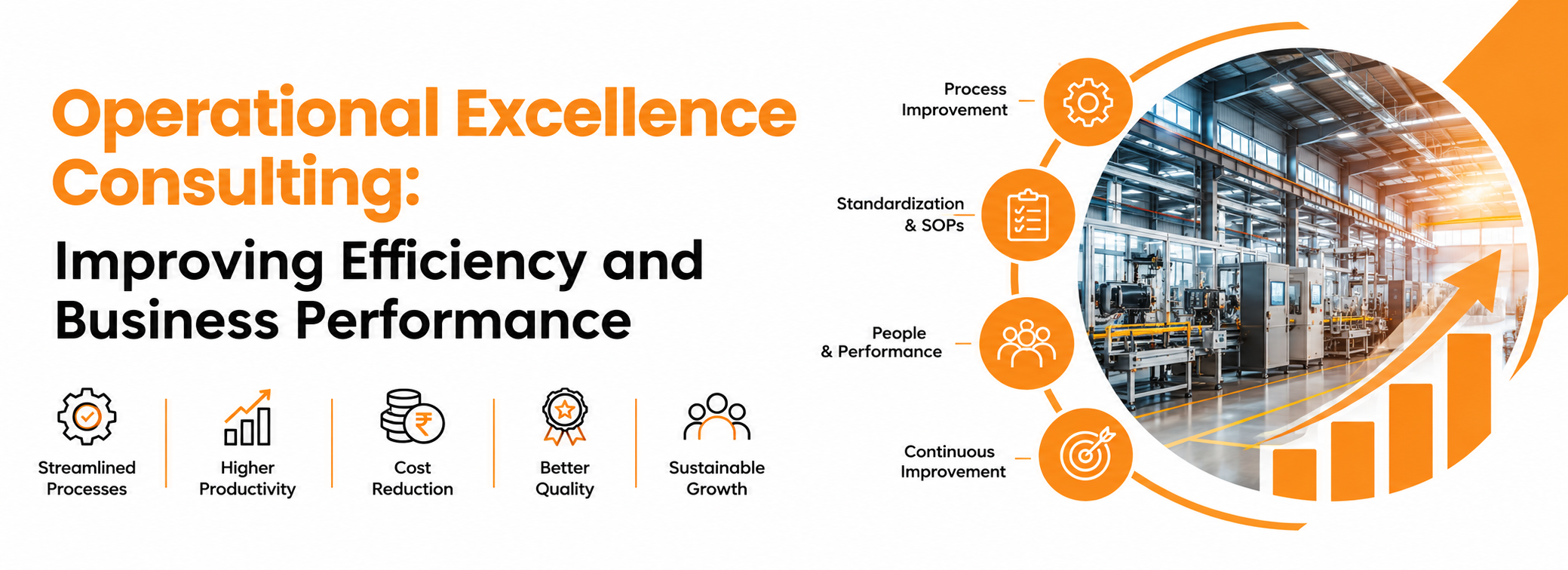
Businesses rarely lose performance because of a single problem. More often, the challenge comes from a combination of inefficient processes, unclear responsibilities, inconsistent SOP implementation, recurring quality issues, production bottlenecks, poor information flow, excess inventory, equipment downtime and limited visibility into operational performance.
This is where operational excellence consulting services can make a practical difference. The right approach focuses on identifying the root causes of operational challenges and developing structured improvements that align processes, people, technology and performance management.
Operational excellence is not simply about reducing costs or making employees work faster. It is about creating processes that consistently deliver the required quality, productivity, cost, delivery and customer outcomes while establishing the systems needed to sustain improvement.
An experienced operational excellence consultant looks beyond individual problems to understand how processes, people, technology, performance measurement and management practices interact. This requires a practical approach supported by professional business consulting, where recommendations are connected with implementation, accountability and measurable business outcomes.
For manufacturers, MSMEs, process industries and other businesses in India, these improvement initiatives can become an important part of the D&V Business Consulting service offerings, helping organisations transform operational problems into structured improvement opportunities and build more consistent, measurable and sustainable performance.
Operational Excellence Consulting: Improving Efficiency, Performance and Sustainable Business Growth
Operational Excellence Consulting helps businesses improve the way work is planned, executed, measured, and continuously improved. It goes beyond reducing costs or increasing productivity. The objective is to create reliable processes, clear accountability, better resource utilization, and performance systems that support consistent business results. Through operational excellence consulting services, businesses can identify operational gaps and develop practical improvement initiatives aligned with their business objectives.
Businesses often experience operational challenges such as process delays, inefficient workflows, unclear responsibilities, excessive rework, inconsistent SOP implementation, poor communication, inventory issues, and limited visibility into performance. These challenges can affect profitability, customer satisfaction, employee productivity, and business growth. Professional business consulting can help management teams assess these interconnected challenges and establish practical systems for improving business performance.
An experienced operational excellence consultant evaluates the existing business processes to identify the root causes of inefficiency. The focus may include process mapping, SOP development, KPI management, Lean implementation, waste reduction, workflow improvement, performance reviews, and organizational role clarity. These areas form an important part of the broader DV Consulting service offerings, helping businesses connect operational improvements with measurable business outcomes.
How Operational Excellence Consulting Improves Business Performance
A structured operational excellence approach can help organizations:
- Identify process bottlenecks and operational waste
- Improve productivity and resource utilization
- Reduce unnecessary costs and rework
- Strengthen SOPs and standardize critical processes
- Establish meaningful KPIs and performance dashboards
- Improve accountability across teams and functions
- Reduce process variation and delays
- Improve coordination between departments
- Support data-driven operational decisions
- Create a culture of continuous improvement
For manufacturing and MSME businesses, operational excellence can involve practical initiatives such as Lean Manufacturing, 5S, Kaizen, Value Stream Mapping (VSM), OEE improvement, TPM, Standard Work, Visual Management, and root cause analysis. These methods help management understand where time, resources, materials, and effort are being lost and where improvements can generate measurable operational value.
From Strategy to Practical Implementation
Operational excellence consulting is most effective when recommendations are translated into action. A consultant may begin by understanding the organization's current processes, performance gaps, operational priorities, and business objectives. The next step is to identify improvement opportunities and develop an implementation roadmap. This approach allows operational excellence consulting services to address both immediate process issues and longer-term performance requirements.
The emphasis should remain on practical execution rather than creating reports that are difficult to implement. Teams need clear responsibilities, measurable KPIs, standardized processes, regular reviews, and management involvement to sustain improvements over time. This implementation-focused approach also complements professional business consulting by connecting strategic recommendations with day-to-day execution.
Building a Foundation for Sustainable Business Growth
Sustainable business growth requires more than increasing sales. As business activity increases, inefficient processes can create higher costs, operational complexity, quality problems, and dependency on individual employees.
Operational Excellence Consulting helps businesses build stronger systems before these issues become larger constraints. By improving processes, accountability, productivity, and performance visibility, organizations can create a more consistent operating environment and make better use of their existing resources. These priorities are also reflected across the DV Consulting service offerings, where business improvement is approached through practical systems, structured execution, and measurable outcomes.
For businesses looking to improve efficiency while creating a stronger foundation for long-term performance, operational excellence provides a structured approach to turning operational challenges into measurable improvement opportunities. Combining operational improvement with professional business consulting can help leadership teams make informed decisions, strengthen execution, and establish systems that support consistent performance.
What Is Operational Excellence Consulting?
Operational excellence consulting is a structured approach to improving the way a business performs its day-to-day operations. For organizations seeking operational excellence consulting India, the focus is not limited to individual process improvements but extends to building reliable systems, improving accountability, and achieving measurable operational performance.
An operational excellence consultant typically examines how work is planned, performed, measured and managed. The objective is to identify performance gaps, understand their root causes and implement practical improvements.
Depending on the business, the focus may include:
-
Process efficiency
-
Productivity improvement
-
Cost reduction
-
Quality improvement
-
Waste reduction
-
Equipment effectiveness
-
Inventory and WIP management
-
Process standardization
-
SOP implementation
-
KPI management
-
Accountability
-
Continuous improvement
-
Employee involvement
-
Customer delivery performance
Operational excellence therefore goes beyond isolated process optimization. It connects operational improvement with management systems and measurable business objectives.
What Does an Operational Excellence Consultant Do?
An operational excellence consultant works with business owners, promoters, leadership teams, managers and operational personnel to identify and address performance gaps.
The exact scope depends on the organization, but a consulting engagement may involve:
1. Assessing Current Operations
The first step is understanding how the business actually operates.
This can involve reviewing processes, workflows, responsibilities, performance data, SOPs, production practices and management routines.
The distinction between “how a process is supposed to work” and “how the process actually works” is often important.
2. Identifying Operational Inefficiencies
Consultants examine where time, resources, materials, capacity or information may be unnecessarily consumed.
Examples include:
- Waiting
- Excess movement
- Rework
- Defects
- Unnecessary approvals
- Excess inventory
- Repeated data entry
- Unbalanced workloads
- Equipment downtime
- Poor material flow
3. Analysing Root Causes
Improvement should not stop at identifying symptoms.
If production is delayed, for example, the real cause could involve material availability, planning, changeover time, machine reliability, quality problems, information flow or workload imbalance.
Root Cause Analysis helps determine why a problem repeatedly occurs.
4. Improving Processes
Once the causes are understood, the next step is to develop practical improvements.
Depending on the situation, this may involve:
- Process redesign
- Standard Work
- SOP improvement
- Line balancing
- Layout improvement
- Material-flow improvement
- Changeover reduction
- Preventive maintenance
- Visual management
- KPI redesign
5. Supporting Implementation
Operational improvement becomes meaningful when changes are implemented.
An implementation-focused consulting approach therefore considers who will own the improvement, how the new process will work, what must be standardized and how performance will be reviewed.
6. Establishing Performance Management
Improvement should be measurable.
Relevant KPIs may include:
- Productivity
- OEE
- Rejection rate
- Rework
- Downtime
- Lead time
- Cycle time
- Inventory
- On-time delivery
- Labour utilization
- Process adherence
- Cost per unit
The appropriate measures depend on the business and its objectives.
Operational Excellence Consulting Process
A structured operational excellence consulting process can be organized into the following stages.
Step 1: Business and Operational Assessment
Understand the organization’s objectives, operational challenges and current performance.
Step 2: Current-State Process Analysis
Map important processes and understand how people, materials, information and decisions move through the system.
Step 3: Performance Baseline
Establish a baseline using relevant operational and business KPIs.
Step 4: Waste and Bottleneck Identification
Identify activities that consume resources without creating the required value, along with process constraints and recurring bottlenecks.
Step 5: Root Cause Analysis
Investigate why performance problems occur rather than treating only their visible symptoms.
Step 6: Improvement Prioritization
Not every problem needs to be addressed simultaneously. Improvement opportunities can be prioritized according to business impact, urgency, feasibility and available resources.
Step 7: Implementation
Put selected improvements into practice with clear ownership and defined responsibilities.
Step 8: Standardization
Document improved processes through SOPs, Standard Work, visual controls and defined responsibilities.
Step 9: KPI Monitoring
Track whether the improvement is producing the intended operational result.
Step 10: Continuous Improvement
Use regular reviews and corrective actions to prevent performance from returning to the previous state.
This approach makes operational improvement an ongoing management discipline rather than a one-time project.
Operational Excellence Tools and Methodologies
Operational excellence consultants may use different tools depending on the organization’s needs.
Value Stream Mapping
Value Stream Mapping (VSM) helps visualize the flow of materials and information across a process.
It can help identify:
- Waiting
- Excess inventory
- Bottlenecks
- Unnecessary movement
- Process delays
- Information-flow problems
- Value-added and non-value-added activities
5S
5S creates a more organized, visual and controlled workplace.
It can support:
- Workplace organization
- Visual management
- Easier identification of abnormalities
- Reduced searching time
- Better workplace discipline
Kaizen
Kaizen focuses on continuous, structured improvement.
Rather than waiting for a major transformation project, teams identify and address practical improvement opportunities regularly.
Total Productive Maintenance
TPM focuses on improving equipment reliability and reducing avoidable losses associated with equipment performance.
Overall Equipment Effectiveness
OEE can help organizations understand equipment performance through the dimensions of availability, performance and quality.
It can provide useful visibility into equipment-related losses and improvement opportunities.
Standard Work
Standard Work establishes the best-known method for performing a process consistently at a particular point in time.
It provides a foundation for training, monitoring and continuous improvement.
Root Cause Analysis
Root Cause Analysis helps teams move from symptoms to underlying causes.
Tools such as the 5 Whys and cause-and-effect analysis can support structured problem solving.
SMED
SMED focuses on reducing changeover and setup time, particularly where frequent product or process changes affect available capacity.
Line Balancing
Line balancing helps distribute work more effectively across operations and resources.
Visual Management
Visual management makes important information, standards, abnormalities and performance easier to understand at the point of work.
Operational Excellence vs Operational Efficiency
The terms operational excellence and operational efficiency are closely related but are not identical.
Operational efficiency generally focuses on achieving outputs with better use of resources such as:
Time
Labour
Equipment
Materials
Energy
Working capital
Operational excellence is broader.
It considers efficiency alongside:
Quality
Reliability
Customer requirements
Process discipline
Employee involvement
Performance management
Standardization
Continuous improvement
Sustainability of improvements
In simple terms:
Operational efficiency is an important part of operational excellence, but operational excellence encompasses a broader operating system.
This distinction is important when selecting operational efficiency consulting or broader operational excellence support.
How Operational Excellence Consulting Improves Business Performance
The objective of operational improvement should ultimately connect to measurable business performance.
Improving Productivity
Better processes can help organizations use existing people, equipment and capacity more effectively.
Reducing Waste
Identifying unnecessary movement, waiting, inventory, defects, overprocessing and other forms of waste can create opportunities for improvement.
Improving Quality
Standardized processes, root-cause analysis and better process controls can help reduce recurring defects and rework.
Improving Delivery
Reducing bottlenecks, waiting and process interruptions can support more consistent delivery performance.
Reducing Avoidable Costs
Cost improvement is not always about cutting resources.
It can involve reducing:
- Scrap
- Rework
- Downtime
- Excess inventory
- Unnecessary movement
- Process delays
- Overtime caused by operational inefficiencies
- Repeated manual activities
Improving Management Visibility
A structured KPI system can help leadership teams see where performance is improving, where it is deteriorating and where intervention is required.
Operational Excellence in Manufacturing and Process Industries
Manufacturing businesses often have multiple interconnected processes.
A problem in one area can affect several others.
For example:
Poor production planning → material shortages → waiting → machine idle time → delayed production → overtime → higher cost → delayed delivery.
An operational excellence approach examines these relationships instead of treating every problem independently.
For manufacturing and process industries, improvement areas may include:
Production planning
Material flow
Production flow
Machine utilization
OEE
Downtime
Changeover
Quality
Rejection
Rework
WIP
Inventory
Labour productivity
Layout
SOP adherence
Maintenance
Bottleneck management
Performance review systems
This is why operational excellence consulting for process industries often requires practical understanding of the shop floor as well as management systems.
Sustainable Operational Excellence: Making Improvements Last
One of the biggest challenges in operational improvement is sustainability.
A business may implement a new process, improve productivity for several weeks and then gradually return to its previous working method.
This can happen when:
-
The new process is not standardized.
-
Employees are not trained adequately.
-
Ownership is unclear.
-
KPIs are not reviewed.
-
Managers stop following up.
-
SOPs are not updated.
-
Improvement actions remain dependent on individuals.
Sustainable operational excellence requires a management mechanism that keeps improvements alive.
A practical cycle is:
Identify → Improve → Standardize → Train → Measure → Review → Correct → Improve Again
The goal is not simply to achieve improvement once.
The goal is to make the improved way of working repeatable.
How Do Large Consulting Firms Approach Operational Excellence Initiatives?
Businesses often search for how large consulting firms approach operational excellence initiatives.
Although methodologies differ between consulting organizations and projects, a structured operational improvement program commonly includes:
-
Understanding strategic and operational objectives
-
Establishing the current-state baseline
-
Analysing processes and performance
-
Identifying value leakage and operational constraints
-
Prioritizing improvement opportunities
-
Designing improvement initiatives
-
Implementing changes
-
Developing organizational capabilities
-
Establishing performance-management mechanisms
-
Monitoring results and sustaining improvements
For an MSME, the important question is not simply which methodology is used.
The more important question is whether the approach can be translated into practical actions, clear ownership, measurable KPIs and sustainable day-to-day execution.
When Should a Business Hire an Operational Excellence Consultant?
A business may benefit from operational excellence consulting when operational problems become recurring rather than isolated.
Common indicators include:
-
Productivity is not improving despite increased effort.
-
Production bottlenecks repeatedly occur.
-
Managers spend significant time firefighting.
-
SOPs exist but are not consistently followed.
-
Employees perform the same process differently.
-
Quality problems repeatedly return.
-
Inventory or WIP continues to increase.
-
Equipment downtime affects delivery.
-
KPIs are available but not effectively reviewed.
-
Operational decisions depend heavily on individual employees.
-
Improvement initiatives start but are not sustained.
-
Costs are increasing without sufficient visibility into the causes.
These indicators can suggest that the organization needs a more systematic approach to operational improvement.
How to Choose an Operational Excellence Consulting Firm
Choosing an operational excellence consulting firm should involve more than comparing service descriptions.
Businesses should consider:
Relevant Industry Experience
Does the consultant understand the operational environment of your industry?
Implementation Experience
Can the consultant support implementation rather than only provide recommendations?
Process Improvement Capability
Does the firm have practical experience with process analysis, waste reduction, standardization and continuous improvement?
Measurement
Can the engagement establish meaningful baseline and improvement KPIs?
Leadership and Shop-Floor Engagement
Can the consultant work with both leadership teams and employees involved in day-to-day operations?
Sustainability
Does the approach include standardization, ownership, review and continuous improvement?
Evidence
Can the consulting firm explain relevant experience, methodologies, case examples or measurable outcomes without relying on unsupported claims?
These factors can help businesses assess whether a consultant’s approach matches their operational requirements.
Operational Excellence Consulting in India
Indian businesses, particularly MSMEs and manufacturing organizations, operate in highly competitive environments where productivity, quality, delivery, cost and responsiveness can directly influence business performance.
Operational challenges may include:
-
Rapid business growth without process standardization
-
Informal operating practices
-
Dependency on experienced individuals
-
Inconsistent SOP adherence
-
Manual reporting
-
Limited KPI visibility
-
Production bottlenecks
-
Excess inventory
-
Quality variation
-
Equipment downtime
-
Communication gaps
-
Weak accountability mechanisms
Operational excellence consulting in India can help businesses examine these challenges systematically.
The approach should be adapted to the organization’s size, industry, workforce, operational maturity and business priorities.
For an MSME, operational excellence does not necessarily mean implementing a complex corporate transformation program.
It may begin with practical improvements such as:
Clear roles → standardized processes → measurable KPIs → structured reviews → root-cause problem solving → continuous improvement.
Operational Excellence in Retail, Education and Other Service Businesses
Operational excellence is not limited to factories.
The same principles can be adapted to service environments.
Retail
Retail businesses may examine:
- Inventory accuracy
- Customer service processes
- Store operations
- Replenishment
- Workforce utilization
- Order fulfilment
- Process consistency
Education
Educational institutions can examine:
- Administrative processes
- Student-service workflows
- Information flow
- Scheduling
- Resource utilization
- Process standardization
- Performance monitoring
Service Businesses
Service organizations may focus on:
- Customer response time
- Process cycle time
- Service quality
- Employee productivity
- Workflow automation
- Error reduction
- Standard operating procedures
The tools may differ, but the fundamental objective remains similar: make important processes more reliable, measurable and effective.
From Operational Problems to a Performance Management System
Operational excellence becomes more sustainable when improvement is connected to management routines.
A practical performance system can connect:
Business Objective
↓
Process Objective
↓
KPI
↓
Target
↓
Daily/Weekly Review
↓
Gap Identification
↓
Root Cause Analysis
↓
Corrective Action
↓
Follow-Up
This helps move organizations from reactive problem-solving toward structured operational management.
Why SOPs Alone Do Not Create Operational Excellence
Many businesses have SOPs.
The presence of an SOP, however, does not necessarily mean the process is controlled.
Operational effectiveness depends on whether:
Employees understand the SOP.
The SOP reflects the actual process.
Responsibilities are clearly defined.
Employees are trained.
Supervisors monitor adherence.
Deviations are identified.
Corrective actions are taken.
The SOP is updated when the process changes.
Therefore, operational excellence is not simply about creating more documentation.
It is about making the defined process and actual process work together consistently.
The Role of Data in Operational Excellence
Operational improvement increasingly depends on reliable data.
However, collecting more data does not automatically improve decision-making.
The important question is:
Can the organization convert operational data into timely decisions and actions?
Useful operational data can include:
Production output
Downtime
OEE
Rejection
Rework
Cycle time
Lead time
Inventory
WIP
Productivity
Delivery performance
Process deviations
The value comes from connecting this information to regular management reviews and corrective actions.
Operational Excellence Is About Execution
A strategy document can identify opportunities.
A dashboard can show performance.
An SOP can define a process.
But operational improvement ultimately depends on execution.
That means organizations need:
Clear ownership
Defined processes
Practical standards
Employee involvement
Consistent measurement
Management review
Corrective action
Follow-through
This is where operational improvement consulting can become particularly valuable: connecting improvement recommendations with implementation and management discipline.
Sales Growth and Declining Profits: Why the Two Go Together
Operational Excellence vs. Sales and Marketing Consulting
Sales & Marketing Consulting is about go-to-market strategy, lead gen, branding, and demand creation.
Operational Excellence Consulting, on the other hand, listens internally – so marketing and sales can buy the business and operations can deliver flawlessly. They are complementary: one gets the door open and the other delivers with margin for safety.
Why to Hire a Management Consulting Firm such as D&V Business Consulting?
D&V Business Consulting (Ahmedabad, Gujarat, India) is a full-stack solution – integration of operational excellence, sales and marketing consulting, and strategic HR and finance support
Foundational in Lean Six Sigma, process improvement, and growth-assurance methods (e.g. 15%+ growth in 12 months)
Local presence in some Indian metros such as Ahmedabad, Mumbai, Bengaluru, Delhi, Mumbai, Pune and etc.
D&V Business Consulting: An Implementation-Focused Approach to Operational Excellence
D&V Business Consulting approaches operational excellence with a focus on practical implementation and business performance.
The objective is not simply to identify operational gaps or provide a presentation.
The focus is on helping organizations strengthen the systems through which work is planned, executed, measured and reviewed.
Depending on the organization’s requirements, the consulting approach can involve:
Operational assessment
Lean Manufacturing
Value Stream Mapping
5S
TPM
OEE improvement
SOP development and implementation
Process improvement
KPI and performance management
Root Cause Analysis
Productivity improvement
Accountability systems
Management review mechanisms
The approach can be adapted to the organization’s operational maturity, industry and specific business challenges.
For business owners and leadership teams, the objective is straightforward:
Identify operational gaps, improve the way work is performed, establish measurable performance systems and create processes that can be sustained.
Conclusion: Turning Operational Improvement into a Management Discipline
Operational excellence is not achieved by implementing one tool or conducting a one-time improvement project.
It is built through the consistent connection of:
People + Processes + Performance + Problem Solving + Standardization + Continuous Improvement
An effective operational excellence consulting approach starts by understanding how the business actually operates, identifies the causes of performance gaps, prioritizes improvement opportunities and supports implementation.
For manufacturers, MSMEs and other businesses, the objective is not simply to make individual processes faster.
It is to create an operating system in which processes are clearly defined, performance is measurable, problems are addressed systematically and improvements can be sustained.
That is the foundation of sustainable operational excellence.
- What is operational excellence consulting?
-
Operational excellence consulting is a structured approach to improving business processes, productivity, quality, cost, delivery and operational performance. Consultants assess current processes, identify inefficiencies and support the implementation of practical improvements.
- What does an operational excellence consultant do?
-
An operational excellence consultant assesses processes, identifies performance gaps, analyses root causes, develops improvement initiatives and can support implementation, standardization and performance measurement.
- What is the difference between operational excellence and operational efficiency?
-
Operational efficiency focuses primarily on using resources effectively to achieve desired outputs. Operational excellence is broader and includes efficiency along with quality, reliability, process discipline, employee involvement, performance management and continuous improvement.
- What are the main operational excellence tools?
-
Common tools include Value Stream Mapping, 5S, Kaizen, TPM, OEE, Standard Work, SOPs, Root Cause Analysis, SMED, Line Balancing, Visual Management and PDCA.
- How can operational excellence consulting improve productivity?
-
Consultants can identify bottlenecks, unnecessary activities, downtime, process variation, poor workload distribution and other operational losses. Improvement initiatives can then be developed around the specific causes affecting productivity.
- How long does an operational excellence consulting project take?
-
The duration depends on the size of the organization, scope of operations, number of processes involved and improvement objectives. A focused process-improvement initiative may take several weeks, while a broader operational excellence program can require several months of assessment, implementation, monitoring and continuous improvement.
- What business areas can operational excellence consultants improve?
-
Operational excellence consultants can work across areas such as production, operations, supply chain, quality, maintenance, inventory, workforce productivity, SOPs, process management and performance measurement. The specific focus depends on the organization's operational challenges and business priorities.
- Can operational excellence consulting help reduce costs?
-
Yes. Operational improvement can identify avoidable costs associated with defects, rework, downtime, excess inventory, inefficient processes, unnecessary movement and other operational losses.
- Is operational excellence only for manufacturing companies?
-
No. The principles can also be applied to retail, education, logistics, distribution, professional services and other operational environments. The tools and KPIs should be adapted to the organization's processes.
- How can businesses sustain operational excellence?
-
Sustainability requires more than implementing an improvement. Businesses should standardize improved processes, establish ownership, train employees, monitor KPIs, conduct regular reviews and address deviations through structured corrective actions.
- When should a company hire an operational excellence consultant?
-
A business may consider consulting support when productivity has plateaued, operational costs are difficult to control, processes are inconsistent, bottlenecks recur, SOPs are not followed, quality problems repeat or improvement initiatives are not sustained.
- How do I choose an operational excellence consulting firm in India?
-
Evaluate the firm's relevant industry experience, implementation capability, process-improvement expertise, approach to measurement, ability to work with operational teams and evidence of relevant consulting experience.
- How is operational excellence performance measured?
-
Operational excellence can be measured using relevant KPIs such as productivity, OEE, cycle time, lead time, downtime, defect rate, rework, inventory, on-time delivery, process adherence and operating cost. The selected KPIs should reflect the organization's objectives and the processes being improved.
- Can operational excellence consulting help MSMEs?
-
Yes. MSMEs can apply operational excellence principles to improve process consistency, productivity, accountability, cost control and performance visibility. Consulting support can be adapted to the organization's size, resources, operational maturity and specific business challenges.
Related Posts
Operational Excellence Consulting: From Factory Problems to Measurable Business Results
In the relentless pursuit of peak efficiency and world-class quality, businesses constantly seek foundational methodologies…
The Common Struggles of Entrepreneurs in Day-to-Day Operations
In the relentless pursuit of peak efficiency and world-class quality, businesses constantly seek foundational methodologies…
Why Ahmedabad Manufacturers Need Operational Excellence
In the relentless pursuit of peak efficiency and world-class quality, businesses constantly seek foundational methodologies…
Achieving Operational Excellence with Strategic Operational Excellence Consulting from D&V Business Consulting
In the relentless pursuit of peak efficiency and world-class quality, businesses constantly seek foundational methodologies…
 Join