


Time & Motion Study Consulting Company in Mumbai
Time & Motion Study Consultants for Manufacturing Companies in Mumbai
Time & Motion Study Consulting Company in Mumbai, D&V Business Consulting is a brand name providing time study, motion study and work measurement consulting for manufacturing businesses, industrial units, MSMEs and SMEs. By systematically examining production activities, operator movements, work methods and cycle times, we help businesses identify operational bottlenecks, unnecessary activities and opportunities for measurable productivity improvement.
Production targets, labour requirements and delivery commitments become difficult to manage when work methods vary, cycle times are uncertain or production bottlenecks remain unexplained. Without reliable work measurement, management may struggle to determine realistic output targets, allocate manpower effectively or understand why similar operations produce different results across shifts.
D&V Business Consulting provides time and motion study consulting for manufacturing businesses in Mumbai seeking a clearer understanding of how work is performed, how long operations take and where practical improvements may be possible. Our services focus on understanding actual shop-floor conditions and developing recommendations that suit the operational requirements of each business.
Our approach connects shop-floor observation with work measurement, method analysis, production cycle time assessment and operational improvement planning. The objective is to help management make better-informed decisions about work methods, production capacity, workload allocation, standard times and workforce utilisation.
We work with the operational requirements of manufacturers, MSMEs, SMEs and industrial businesses. The appropriate scope depends on the processes involved, the available production data, the level of variation observed and the outcomes the business wants to investigate.
Our Time Study and Work Measurement Consulting Services
Production Cycle Time Analysis: We examine the time taken at different stages of a production process to identify delays, excessive waiting, uneven workloads and operations that restrict overall output. The findings help management understand where further investigation or corrective action may be required.
Work Measurement and Standard Time Assessment: We help businesses assess task durations under defined working conditions and develop suitable time standards based on the agreed measurement method. Where appropriate, allowances for personal needs, fatigue and unavoidable delays are considered when establishing standard times.
Motion Study and Method Improvement: We examine operator movements, tool positioning, workstation arrangements and material handling activities to identify unnecessary reaching, walking, searching, handling and repeated movements. Recommendations focus on practical changes to work methods and workplace organisation.
Manpower Productivity Assessment: We analyse the relationship between available working hours, task requirements, production output and workload distribution. This helps management assess whether manpower deployment is aligned with production requirements and identify areas where work allocation may need adjustment.
Production Line Balancing: We compare task times across workstations to identify uneven workloads, waiting between operations and potential constraints in the production flow. The assessment can support better task allocation and more balanced utilisation of available resources.
Standard Operating Procedure Development: Time and motion study findings can support the preparation or revision of standard operating procedures by documenting the agreed work sequence, task requirements, operating methods and relevant performance expectations.
Our Approach to Time and Motion Study Consulting
1. Define the Study Objective: We establish the operational issue, process boundaries, products, tasks and performance measures to be examined. Clear objectives help keep the study focused on the business requirement.
2. Observe Existing Work Methods: The selected process is examined under representative operating conditions. Relevant activities, task sequences, operator movements, waiting periods and production constraints are documented.
3. Measure and Analyse Task Times: Appropriate time measurement methods are used to assess task durations and variations. The analysis considers relevant operating conditions, product differences, interruptions and other factors that may affect the results.
4. Identify Improvement Opportunities: Observations and measurements are reviewed to identify avoidable movements, waiting, unbalanced workloads, method variations and other potential causes of lost productive time.
5. Recommend Practical Changes: Recommendations may cover workstation arrangement, task sequence, material presentation, work allocation, standard times and operating procedures, depending on the study findings and feasibility of implementation.
6. Review Results: Where implementation and follow-up measurement are included in the engagement, actual performance can be compared with the established baseline to assess changes in cycle time, output, workload distribution and other agreed indicators.
Business Benefits of Time and Motion Study Consulting
A well-defined time and motion study gives management a more objective basis for operational decisions. Depending on the findings and implementation conditions, potential benefits include improved visibility into task durations, more consistent work methods, better production planning, clearer manpower requirements, reduced unnecessary movement, improved workstation organisation and more informed capacity assessments.
Reliable time data can also help businesses review production targets, identify workload imbalances, investigate recurring delays and evaluate whether proposed process changes deliver the expected results. Actual productivity and cost improvements depend on the initial conditions, the nature of the constraints and the implementation of agreed recommendations.
Why Consider D&V Business Consulting?
D&V Business Consulting is a Brand Name for businesses seeking structured business and operational improvement consulting. Our approach connects process observation, work measurement and practical recommendations with the operational priorities of the client. The scope is tailored to the manufacturing environment rather than assuming that every factory has the same productivity challenges.
We aim to help business owners, plant heads, production managers and operations teams understand the reasons behind work variation and production delays. The resulting findings can support decisions about process methods, production standards, workforce utilisation and improvement priorities.
Discuss Your Manufacturing Productivity Challenges
If your factory is facing inconsistent cycle times, unclear production standards, unnecessary operator movement, uneven workloads or unexplained output variations, an initial discussion can help establish which processes need investigation.
Contact D&V Business Consulting to discuss your time and motion study consulting requirements in Mumbai. Share your industry, the process you want to assess and the main operational challenge. This information can help define a suitable study scope, relevant measurements and the next steps for your manufacturing business.
What Is Time and Motion Study Consulting?
Time and motion study consulting is the systematic examination of how a job is performed and how long its work elements take. It combines observation of the current method with suitable measurement techniques to identify opportunities to improve work design, production flow and the use of available resources. The International Labour Organization’s terminology describes work study as a detailed examination of how a particular job is performed to improve the organisation of work and productivity.
For a manufacturing company, the practical questions are straightforward:
How long should a defined operation take under specified conditions?
Why do cycle times vary between comparable production runs?
Are operators spending time searching, walking, waiting or handling materials unnecessarily?
Are production targets based on measured data or historical assumptions?
Does one workstation constrain the output of an otherwise balanced line?
Can the current work method be improved without compromising safety or quality?
D&V Business Consulting approaches these questions through structured work analysis. Depending on the requirement, an engagement may include direct observation, task-element measurement, motion analysis, work sampling, review of existing standards and assessment of improvement opportunities.
The objective is not simply to make people work faster. It is to understand the relationship between the task, the operator, the equipment, the materials and the production system. That distinction matters because low output may be caused by poor material availability, machine downtime, product variation, quality problems or scheduling—not necessarily by the pace of an individual employee.
For manufacturers in Mumbai and the surrounding industrial region, a properly scoped study can help management establish a more reliable operational baseline and decide which improvements warrant testing.
Manufacturing Productivity Problems That Require a Closer Look
Problem: Production targets are not supported by reliable time data
A factory may set a target of 500 units per shift because that number has been used for years. However, the target may not reflect current product variants, machine conditions, inspection requirements, staffing arrangements or the actual method used.
When production falls short, supervisors may struggle to distinguish an unrealistic target from a genuine performance problem.
A time study can help establish how the work is currently performed and what the observed cycle times indicate. Management can then investigate whether the target, the method or the operating conditions need attention.
Problem: Different operators use different methods
Two operators may produce the same component using different sequences, tool positions and material-handling methods. One may need to reach repeatedly for a tool; another may have the tool within a convenient working area.
The resulting differences may reflect method design, experience, equipment condition or workstation organisation. They should not automatically be interpreted as differences in effort.
Motion study and method analysis help document these variations and determine whether a more practical, repeatable method is possible.
Problem: Machine cycle times are unclear
A production record may show that a machine completes a part in 90 seconds, but that figure may exclude loading, unloading, inspection, tool changes or delays between cycles.
Without a clear definition of the measured cycle, comparisons can become misleading.
A production cycle time analysis separates relevant time components so that the team can understand whether the main constraint is machine processing, manual work, waiting, handling or another factor.
Problem: Operators spend time walking, reaching and searching
Small movements can occur repeatedly throughout a shift. An operator might walk to collect components, turn to locate a tool, reach across a fixture or move finished products to a distant container.
The appropriate response is not to assume every movement can be removed. Some movements are necessary because of the process, equipment or safety requirements.
The purpose of motion analysis is to identify avoidable movement and test whether improved tool positioning, material presentation, workstation arrangement or task sequencing can reduce unnecessary effort.
Problem: Workloads are uneven across the production line
One station may finish early and wait while the next station accumulates work. In another case, the slowest operation may continuously limit the output of the line.
Line balancing compares task requirements with available station capacity and identifies possible ways to redistribute work, where equipment and process constraints permit.
Problem: Delays are blamed on the wrong cause
A worker may appear idle because material has not arrived, an upstream process has not completed, a machine is under maintenance or a quality decision is pending.
Recording the visible idle period without investigating its cause can lead to ineffective recommendations.
Work sampling, process observation and production-record analysis can help distinguish different categories of delay. Root-cause investigation is still required to establish why a particular delay occurs.
Why These Problems Affect Manufacturing Performance

Work measurement is useful because operational decisions depend on time, capacity and resource assumptions. When those assumptions are inaccurate, the effects may extend beyond the workstation being studied.
Labour cost per unit
Labour cost per unit depends on the labour hours required to produce acceptable output and the relevant labour cost basis.
If direct labour hours are recorded inconsistently, or if output figures mix different product types, the resulting cost comparison may be misleading. Time study can support a more consistent measurement framework, but it does not independently establish the full cost of a product.
Throughput and delivery commitments
Throughput is the quantity of acceptable product completed over a defined period. A faster task may not improve total output if another station remains the production constraint.
A useful study therefore examines the relationship between individual operations and the complete production flow rather than treating every local time reduction as a factory-wide gain.
Work-in-progress and production flow
Uneven task times, poor sequencing and waiting between operations can contribute to work-in-progress accumulation. Understanding cycle times and station workloads can help production teams identify where flow becomes interrupted.
The effect depends on scheduling, batch sizes, equipment availability and demand.
Overtime and capacity planning
If standard times are unreliable, production planning may underestimate or overestimate the resources needed for a schedule.
Work measurement can provide better inputs for capacity calculations and labour planning. It cannot replace decisions about absenteeism, maintenance, material availability, product mix or order priorities.
Quality, fatigue and safe working methods
A production target that ignores inspection steps, legitimate recovery needs or safe handling requirements can create pressure to rush work.
A sound work study considers the complete task, including necessary checks and operating constraints. Ergonomic assessment should be included where the task involves relevant postures, forces, repetitive actions or manual handling risks. ISO’s work-related ergonomics publications provide useful references for evaluating such factors.
Our Latest Client Partnerships





How Time and Motion Study Consulting Helps
D&V Business Consulting’s proposed Mumbai landing page should describe the engagement as a structured investigation, not a promise of a predetermined result.
A suitable study can help a manufacturer:
Establish a baseline: Define the process, operating conditions, measured output and relevant time components.
Document the method: Record the actual sequence of work and the resources needed.
Measure task times: Select an appropriate method for repetitive, variable or intermittent work.
Examine motion and waiting: Identify avoidable movements and investigate delays.
Compare workloads: Determine whether work is distributed appropriately across stations.
Develop improvement options: Evaluate feasible changes to methods, workstation layout, material presentation or work allocation.
Set or review standards: Document assumptions and establish a consistent basis for planning where the evidence supports it.
Validate changes: Compare the revised method against the baseline under reasonably comparable conditions.
The result should be a clearer understanding of the operation and a practical basis for deciding what to change, what to test and how to measure the effect.
Time and Motion Study Consulting Services
Time Study Consulting Services
A time study measures how long a defined job or task element takes under specified operating conditions. It is particularly useful for repetitive work where cycles can be observed and compared.
When a manufacturer may need a time study
A time study may be appropriate when:
Production targets lack a documented basis.
Operators report that an existing standard is no longer realistic.
A new product or process has been introduced.
Production planning needs better estimates of operation duration.
Manual work content needs to be compared across stations.
Management wants to investigate cycle-time variation.
How the study is conducted
The study begins with a clear definition of the job and the method being observed. The task is divided into meaningful elements, such as collecting a component, positioning it in a fixture, completing an operation, inspecting the result and placing the finished part in a container.
The observer records the duration of each relevant element over repeated cycles. Unusual events and operating conditions are documented rather than silently included or removed from the dataset.
Where performance rating is used, its basis should be explicit and applied consistently. The study must also distinguish normal task execution from delays that require separate treatment.
Observed time, normal time and standard time
These concepts have different meanings:
Observed time: The time actually recorded during the observation.
Normal time: An adjusted time estimate where a defensible performance-rating method is used.
Standard time: A time allowance for completing the defined job using the specified method under stated conditions, including applicable allowances according to the organisation’s agreed methodology.
Motion Study and Work Method Analysis
Motion study examines the movements and sequence of activities involved in performing a task. The purpose is to understand how work can be organised more effectively without compromising quality, safety or reasonable working conditions.
What the analysis examines
A motion study may review:
Walking distances and repeated trips.
Reaching, bending and turning.
Tool and material locations.
Handling of components and finished goods.
Sequence of manual activities.
Work surface and fixture arrangement.
Coordination between the operator and equipment.
Opportunities to reduce unnecessary searching or repositioning.
For example, if an operator repeatedly leaves a station to collect components, the investigation might examine material replenishment, container positioning and point-of-use presentation.
The correct improvement depends on the actual process. It may involve a simple layout adjustment, a different sequence of work or a change in how materials are supplied.
Ergonomics and operator effort
Reducing movement is not automatically the same as improving the work method. A proposed layout should be assessed for reach distances, posture, handling demands, visibility and access to controls.
The aim is to remove avoidable effort and make the task more practical—not to impose an unsafe pace or eliminate legitimate recovery time.
Potential deliverables
Depending on scope, these may include current-state movement observations, a list of method issues, workstation improvement options, a proposed work sequence and recommendations for testing the revised arrangement.
Work Measurement Consulting
Direct time study
Suitable for many repetitive tasks where defined elements and repeated cycles can be observed.Work sampling
Suitable for estimating the proportion of time spent in defined activity categories through appropriately designed observations distributed over a period.Predetermined motion-time systems
Systems such as MTM or MOST may be relevant when a suitable task breakdown, method and appropriately trained analyst are available. They should not be presented as automatically suitable for every process.Standard data systems
Historical element-time data may support estimation where the tasks, methods and conditions are comparable and the data has been validated.Choosing the right method
The selection should consider task repetition, cycle duration, variation, observation requirements, data quality and the intended use of the results. A short repetitive assembly cycle and a job involving intermittent machine attention may require different measurement approaches.Method Study Consulting
Method study examines how a task is performed and whether a better sequence or arrangement is possible.
Typical method-study steps
Select the task or process to examine.
Record the current sequence and relevant working conditions.
Identify delays, unnecessary activities and handling requirements.
Examine why each activity is needed and whether it can be simplified.
Develop feasible alternatives.
Test the proposed method where practical.
Document the approved process and any training needs.
For instance, a packing operation may involve repeated handling of the same carton because labels, packing materials and inspection equipment are positioned separately. Method study can examine whether the sequence and layout can be improved.
A revised method must be evaluated for product quality, safe handling, equipment compatibility and repeatability before it becomes the approved standard.
Standard Time Setting Consulting
Standard time supports decisions about production planning, capacity and work allocation. Its usefulness depends on how carefully the task, method and operating assumptions are defined.
What a standard-time study should establish
The product or operation covered.
The approved work method.
The equipment and tooling assumptions.
The relevant product variant.
The measured time elements.
Any performance-rating method used.
The allowance policy and calculation.
The validation approach.
Conditions that trigger a review.
Standard time versus machine time
Machine time is the time an equipment cycle requires under defined conditions. Manual time represents human activities. Total cycle time depends on how these elements interact.
If an operator loads a machine while another operation runs, the manual and machine times may overlap. Adding every time component without considering overlap can overstate the actual elapsed cycle.
Reviewing existing standards
Standards should be reviewed when there is a meaningful change to product design, tooling, process sequence, equipment, inspection requirements or operating conditions. They should not be altered solely to force results to match a target.
Where standard times are used in incentive systems, the calculation method, communication and applicable employment policies should be reviewed by the responsible management team.
Production Cycle Time Analysis
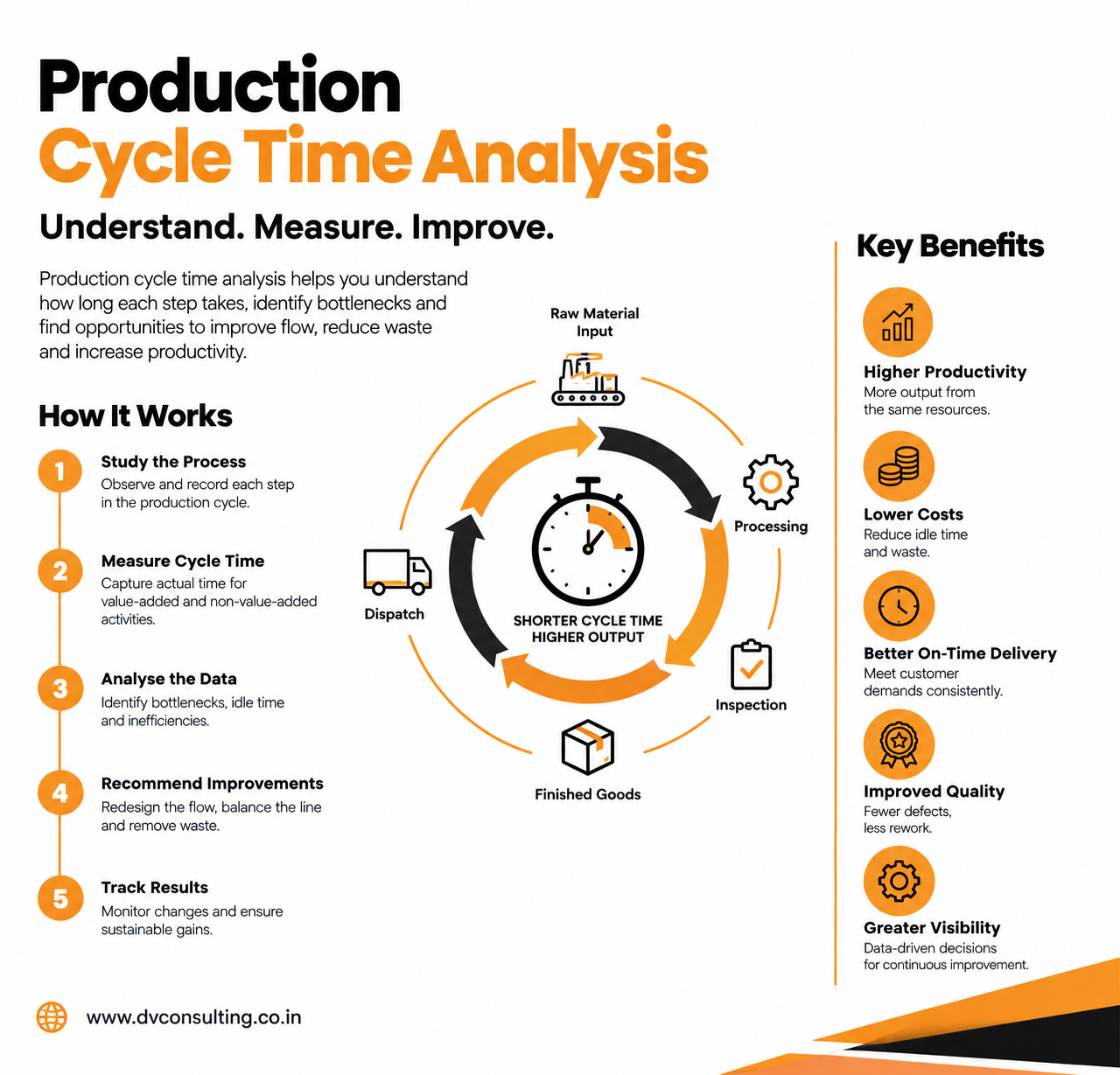
Production cycle time analysis examines the elapsed time required to complete a defined production cycle and the components that make up that cycle.
Elements to distinguish
Depending on the operation, the analysis may separate:
Manual processing time.
Automatic machine time.
Loading and unloading.
Inspection and measurement.
Waiting for materials or instructions.
Repositioning and handling.
Changeover activities.
Planned or unplanned interruptions.
The boundaries of the cycle must be consistent. A machine-only cycle should not be compared directly with a cycle that includes loading, unloading and inspection.
Identifying constraints
A cycle-time study may show that the slowest operation is limiting the output of a line. However, the true production constraint can also be affected by breakdowns, material shortages, batch scheduling, quality losses or changeovers.
Reducing the time of a non-constraining operation may not improve total throughput. The analysis should therefore connect task-level findings with the flow of the complete process.
Manufacturing Line Balancing
Line balancing examines the distribution of work across production stations and compares required task times with available capacity.
What the study can examine
Task-time variation.
Station workloads.
Bottleneck operations.
Operator and machine coordination.
Idle periods between tasks.
Feasible redistribution of work.
Skill, tooling and sequence constraints.
For a manual assembly line, the analysis may reveal that one station has significantly more work than neighbouring stations. The team can examine whether suitable tasks can be redistributed or whether the method itself needs to change.
Practical limitations
A theoretically balanced line may not be practical if tasks require specialised equipment, different skills, fixed process sequences or separate quality controls. Product variants and changes in demand may also affect the appropriate balance.
A proposed balance should be tested under actual production conditions before expected output is treated as an established result.
Work Sampling Studies
Work sampling estimates how time is distributed among predefined activity categories by observing work at selected times.
It can be useful when continuous observation of every cycle is impractical or when the question concerns the proportion of time spent on different activities.
Potential applications
Machine attended versus unattended time.
Material waiting.
Inspection activity.
Planned and unplanned delays.
Equipment or operator activity categories.
Distribution of indirect work.
Sampling design matters
The categories must be clear enough for observers to classify activities consistently. Observations should cover a suitable range of operating conditions, shifts and relevant periods.
A few observations cannot reliably describe every operating condition. The number and timing of observations depend on the desired precision, expected variation and purpose of the study.
Work sampling can indicate where time is being spent, but it does not by itself prove the root cause of an observed delay.
On-Site Industrial Engineering Consulting
Direct observation can be valuable when production records do not fully explain how work is performed.
An on-site engagement may involve:
Reviewing the selected operation with production personnel.
Observing the current work method.
Recording relevant task and cycle times.
Discussing practical constraints with operators and supervisors.
Examining workstation and material arrangements.
Reviewing production data and existing standards.
Validating improvement options in the actual working environment.
The appropriate site arrangement depends on the location, process complexity and agreed scope. D&V Business Consulting should confirm the availability, travel arrangements and level of on-site support before the engagement is finalised.
Industry-Specific Applications
Time and motion study methods can be applied across different manufacturing sectors, but the relevant task elements and constraints differ. The following are potential applications, not claims of completed client projects.
Engineering and machinery manufacturing
Engineering plants may involve machining, fabrication, assembly, inspection and material movement.
A study can examine machine loading and unloading, fixture positioning, tool handling, manual assembly sequence, inspection time and waiting between operations.
For high-mix manufacturing, the analysis should distinguish product variants and setup conditions rather than assume that one standard applies to every job.
Automotive components and ancillary manufacturing
Potential applications include repetitive component assembly, machine tending, part handling, inspection, fastening, packaging and line balancing.
Where several operations run in sequence, the study should examine the effect of the slowest constraint, quality checks and equipment interruptions on overall output.
Any proposed change must preserve the relevant product specifications and inspection requirements.
Electrical and electronics assembly
Electronics assembly may involve component placement, fastening, soldering, testing, inspection and packaging.
The analysis can examine work sequence, tool positioning, component presentation and the relationship between manual tasks and testing equipment.
Product quality, handling requirements and the need for traceability must remain part of the process definition.
Industrial equipment production
Industrial equipment often includes multiple assembly stages and a mix of repetitive and non-repetitive work.
A single cycle-time standard may not be suitable for every product. The study may need to distinguish recurring subassemblies from custom assembly, testing and final inspection.
Packaging and printing operations
Packaging operations may involve feeding, filling, sealing, labelling, inspection, carton handling and palletising. Printing operations may add setup and changeover requirements.
The study can separate machine running time from operator handling and waiting. It should also account for product specifications, batch changes and quality checks.
Pharmaceutical manufacturing
Potential applications include packaging, labelling, visual inspection, secondary packing and material handling, subject to the specific process and applicable controls.
The work method must preserve required quality procedures, hygiene requirements, documentation and process controls. A time study must not encourage shortcuts around required checks.
Textile and garment manufacturing
In garment operations, work may be divided into sewing, trimming, inspection, pressing and finishing. In textile processing, the relevant work may include material handling, machine attendance and inspection.
The study should account for product and fabric variation, operator skill requirements and machine constraints. A method suitable for one style or fabric may not transfer directly to another.
FMCG and food processing
Potential applications include packing, case handling, inspection, line feeding and repetitive manual tasks.
The analysis should distinguish the manual component from automated processing and consider hygiene, product handling, cleaning and quality requirements.
Plastics and other process-oriented manufacturing
Injection moulding and similar processes may include machine cycle time, loading and unloading, trimming, inspection and packing.
The study should distinguish automatic machine time from manual activity and examine whether the operator attends one machine or multiple machines. Multi-machine assignments require careful analysis of timing and interference between cycles.
Time and Motion Study Consulting in Mumbai and Nearby Industrial Areas
Manufacturers looking for a time study consultant in Mumbai may operate in different parts of the wider metropolitan region. The location of the plant matters because the process, site-access requirements and proposed engagement arrangements need to be understood before an on-site study is planned.
D&V Business Consulting’s national service page describes its time-and-motion consulting offering for businesses in India. The availability and scope of a Mumbai-specific engagement should be confirmed directly with the company.
Mumbai city and its business districts
Manufacturing and industrial businesses operating in Mumbai may require support with assembly, packaging, maintenance-related work, material handling or production processes at their facilities.
Andheri East is a potential local search focus where the actual facility and business requirement make the location relevant. A location reference should not imply that D&V Business Consulting maintains a branch or has completed a project there unless that information is verified.
Navi Mumbai and nearby industrial areas
Manufacturers may also search for work measurement or production productivity consulting in Navi Mumbai and nearby industrial locations.
Relevant location terms for targeted content include:
Navi Mumbai
TTC Industrial Area
Rabale MIDC
Mahape
Thane
These are not interchangeable with Mumbai city. Each should be used in a way that accurately reflects the facility’s geography and the service being offered.
How regional relevance should be demonstrated
A credible location page should explain:
What kinds of manufacturing processes the service can assess.
How the scope of an on-site study is established.
What production information may be needed.
Which site-access and safety arrangements should be agreed.
How the manufacturer can request confirmation of location coverage.
It should not invent a local office, a travel commitment, a project history or a client presence.
For manufacturers evaluating a time and motion study consultant in Andheri East, a work measurement consultant in Navi Mumbai or a consultant serving Thane, the next step is to discuss the facility location and the nature of the operation directly with D&V Business Consulting.
Our Consulting Methodology: From Assessment to Implementation
Step 1: Initial discussion
The manufacturer describes the issue: inconsistent output, unclear standard times, a production bottleneck, excessive handling or a planning problem. The discussion should establish what management needs to understand and which decision the study is intended to support.Step 2: Scope definition
The parties identify the relevant products, processes, workstations, shifts and operating conditions. This step should define the boundaries of the study. For example, a cycle-time analysis may include loading, processing, unloading and inspection—or it may be limited to machine time. The distinction must be clear.Step 3: Baseline data collection
Available records may include:-
Production output by shift.
-
Product mix and variants.
-
Existing cycle-time records.
-
Downtime and breakdown information.
-
Rejection and rework data.
-
Staffing and shift arrangements.
-
Existing standard times and work instructions.
Step 4: Shop-floor observation
The current method is observed in its actual working environment. The observer records the sequence of activities, relevant equipment and material conditions, and factors that may affect the observed cycle. Operator and supervisor input can help explain variations that are not apparent from timing records alone.Step 5: Time and motion measurement
The measurement method is selected according to the operation. Repetitive cycles may be suitable for direct time study; intermittent activities may require work sampling; complex methods may need a different analytical approach. Task elements, time observations, movement and relevant delays are recorded according to the agreed scope.Step 6: Analysis and root-cause investigation
The collected information is examined for variation, unnecessary motion, workload imbalance and potential constraints. The analysis should distinguish a measured fact from a possible explanation. For example, a delay may coincide with a material shortage, but the reason for the shortage may require a separate investigation.Step 7: Recommendations
Findings are converted into practical options, prioritised according to their relevance, feasibility and operational implications. Possible options may include changes to workstation layout, tool positioning, material presentation, method sequence, task allocation or standard-time documentation.Step 8: Standardisation
Where a revised method has been approved and validated, the relevant work instructions and time standards can be documented. The documentation should identify the conditions under which the standard applies and the circumstances that require a review.Step 9: Implementation support
Implementation may involve testing the revised method, reviewing operator feedback, coordinating with production supervisors and resolving practical issues. The extent of implementation support should be explicitly agreed in the proposal. It should not be assumed to be included in every measurement-only engagement.Step 10: Follow-up and validation
The manufacturer compares the revised process with the baseline using consistent definitions and reasonably comparable conditions. If cycle time changes but total output does not, the team should examine other constraints rather than assume that the study has failed. The result may indicate that the bottleneck lies elsewhere or that the proposed change needs further adjustment.Potential Deliverables and the Decisions They Support
The final scope should specify which deliverables are included, the format in which they will be provided and the extent of implementation support.
Potential deliverable | Management decision it can support |
|---|---|
Current-state process observations | Which operation requires further investigation |
Task-element breakdown | Which activities need separate measurement |
Time-study records | Whether observed times are consistent and comparable |
Cycle-time summary | Where time is consumed within a defined cycle |
Motion-analysis findings | Which movements may be unnecessary or difficult |
Standard-time calculations | What time assumptions can support planning |
Bottleneck analysis | Which constraint should be addressed first |
Workload and line-balancing analysis | Whether tasks may be redistributed |
Workstation improvement recommendations | What layout or material-presentation changes to test |
Revised work instructions, if included | How an approved method should be communicated |
Prioritised action plan | Which improvement actions should be considered first |
Follow-up measurement report, if included | Whether the revised method changed the measured result |
A measurement report is not the same as an implemented improvement. The report can explain the current state and identify options; the result depends on the decisions taken, the changes implemented and the conditions under which they operate.
KPI and Measurement Framework for Manufacturing Productivity
A useful KPI framework distinguishes the work being measured from the overall performance of the production system.
Cycle time
Definition: The elapsed time required to complete a defined cycle, using clearly stated start and end points.
A manufacturer may measure a machine cycle, manual task cycle or complete production cycle. These figures should not be mixed without explanation.
Use: Compare the duration of equivalent cycles and investigate the components contributing to variation.
Limitation: A shorter cycle at one station does not necessarily increase total factory throughput.
Standard time
Definition: The established time for a defined job under specified conditions, calculated using the organisation’s chosen work-measurement methodology.
Use: Support production planning, workload estimates and consistent time assumptions.
Limitation: A standard is only meaningful when its method, allowances, conditions and scope are documented.
Production throughput
Definition: The quantity of acceptable product completed during a specified period.
Use: Assess whether the production system is completing more or fewer good units under comparable conditions.
Limitation: Throughput can be affected by product mix, downtime, material supply, quality losses, scheduling and constraints beyond the operation being studied.
Operator utilisation
Operator utilisation describes how an operator’s time is allocated according to a defined measurement framework.
The term must be defined carefully. It may distinguish productive task time from waiting or indirect activities, but the categories depend on the study.
A high utilisation figure does not automatically indicate better performance if it creates unsafe workloads, eliminates necessary recovery or reduces the flexibility needed to manage interruptions.
Machine utilisation
Machine utilisation measures the portion of a defined period in which equipment is operating or available according to the chosen definition.
The report should state whether setup, planned maintenance, idle time and breakdowns are included or excluded.
Machine utilisation is not the same as operator utilisation or overall equipment effectiveness (OEE).
Bottleneck performance
A bottleneck is a constraint that limits the flow or output of the production system under the operating conditions being considered.
The relevant measure may include the constraint’s cycle time, availability, queue, output or downtime. The appropriate indicator depends on the process.
Improving a non-bottleneck operation may provide local benefits without increasing total throughput.
Work-in-progress
Work-in-progress (WIP) refers to items that have entered production but are not yet finished goods.
WIP levels may be affected by batch size, production scheduling, queueing, material flow and capacity differences. Time study can provide inputs to the analysis but does not, by itself, explain every cause of WIP accumulation.
First-pass yield and rejection rate
First-pass yield measures the proportion of units that complete a defined process correctly without rework, according to the company’s definition.
The denominator and treatment of rework must be consistent. A faster cycle is not an improvement if it causes quality to deteriorate.
Overtime
Overtime hours may indicate a gap between available capacity and required production, but they can also reflect demand peaks, staffing decisions or planned operating arrangements.
Compare overtime with output, product mix and scheduling before attributing a change to work-method improvements.
Delivery performance
Delivery performance measures whether orders or production commitments are completed on the agreed schedule.
Time study may improve the accuracy of some production-time assumptions, but delivery performance also depends on planning, material availability, quality, maintenance and order management.
Changeover time
Changeover time measures the time needed to move from one defined production configuration to another.
It should have clear start and end points and distinguish relevant internal and external activities where appropriate. It is related to production efficiency but is not interchangeable with the cycle time of an individual unit.
How to compare KPIs responsibly
Before comparing baseline and post-implementation results, confirm that:
The same KPI definition and measurement boundaries are used.
Product mix and variant differences are accounted for.
Shifts and staffing conditions are comparable where relevant.
Equipment condition and material availability are recorded.
Quality performance is considered alongside speed.
Changes in demand and scheduling are documented.
The observation period is sufficient for the question being examined.
A time and motion study provides evidence for operational decisions. It does not guarantee that every KPI will improve.
Why Manufacturers Should Evaluate a Specialist Consultant Carefully
Choosing a time and motion study consultant is a decision about the type of evidence and support a business needs.
Factors to assess before appointing a consultant
| Evaluation factor | What to ask |
|---|---|
| Relevant expertise | Has the proposed team worked with comparable processes or measurement problems? |
| Measurement methodology | How will the task be defined, observed and measured? |
| Data quality | How will unusual cycles, product variants and incomplete records be handled? |
| Technical explanation | Will the consultant explain assumptions and limitations clearly? |
| Practical recommendations | Will the recommendations account for equipment, quality, safety and material availability? |
| Employee communication | How will operators and supervisors be informed and involved? |
| Implementation support | Is the scope limited to assessment, or does it include testing and follow-up? |
| Baseline and validation | How will the current state and revised method be compared? |
| Deliverables | What records, calculations, reports and work instructions will be provided? |
| Commercial clarity | Are fees, exclusions, responsibilities and travel arrangements stated clearly? |
Specialist work measurement versus broader operational consulting
A specialist time-study engagement may concentrate on a particular operation, defined work elements or the reliability of standard times.
A broader operational improvement engagement may include additional areas such as production planning, material flow, layout, quality, equipment reliability or management systems.
If the primary problem is a poorly understood manual assembly cycle, a focused study may be a sensible starting point. If the same operation is frequently interrupted by material shortages and machine breakdowns, the business may need a wider investigation.
D&V Business Consulting should explain the proposed scope in these terms so the buyer can judge whether it addresses the real problem.
Questions to ask during the initial discussion
Before appointing any provider, a manufacturer can ask:
What measurement method do you propose, and why is it suitable for this task?
How will you distinguish necessary work from avoidable delay?
What assumptions will be used to calculate standard time?
How will product variants and different operating conditions be handled?
What will be included in the final report?
Does the proposal include testing or implementation support?
How will employee feedback and safety considerations be addressed?
How will we assess whether the recommendations have worked?
Employee Engagement, Ethics and Practical Constraints
A time and motion study observes how work is performed. Its purpose should be communicated clearly to the people involved.
Operators often understand practical issues that production records do not reveal. They may know why a tool is difficult to access, why a component is occasionally unavailable, why a machine requires additional handling or why a written method differs from actual practice.
Explain the purpose of the study
Management should explain which process is being examined, why the measurement is required and how the findings will be used.
Where appropriate, operators and supervisors should be invited to describe factors that affect the task. Their input can help distinguish a method issue from a supply, equipment or scheduling problem.
Focus on the work system
Low output should not automatically be attributed to an individual operator.
A study should examine the interaction between people, equipment, materials, instructions, quality requirements and the production environment. Recommendations should address the causes supported by the evidence.
Handle observation data responsibly
Before collecting video or other identifiable records, the parties should agree on the purpose, access, retention and permitted use of that information. Operational data should be shared only with authorised people and handled according to the organisation’s applicable policies and legal requirements.
The precise arrangements depend on the study and the information collected. A consulting engagement should define them rather than assume that all recording methods are appropriate.
Validate before making a standard permanent
A revised standard should be based on a defensible method and tested under suitable conditions. Worker feedback, product quality, safety and changes in operating conditions should be considered before the standard is adopted.
Time and Motion Study Consulting Cost: What Affects the Engagement?
The cost of a time and motion study depends on the work that needs to be examined, the measurement approach and the support required after the assessment.
A short study of one repetitive operation is materially different from an investigation covering several product families, multiple shifts and multiple facilities.
Key cost factors
Number of processes and workstations
More processes generally require additional observation, analysis and documentation. The proposal should identify which operations are included and which are outside scope.
Product variety and task complexity
A repetitive operation may be easier to define than a high-mix process involving frequent changes in product design, tooling or assembly sequence.
The proposal should clarify whether the study covers one representative product, several variants or the complete product range.
Number of shifts and operating conditions
Different shifts may have different staffing, material availability, equipment condition or product mix. If these differences matter to the objective, the study may require observations across more than one shift.
Measurement and analysis method
Direct time study, work sampling, predetermined motion-time systems and other methods have different data and analysis requirements. The selected method should be justified by the problem, not added merely to make the engagement appear more technical.
Data availability
Existing production records, standard times, work instructions and downtime logs can help define the baseline. If records are incomplete or inconsistent, additional work may be required to establish a reliable starting point.
Reporting and implementation
The scope may include measurement records, standard-time calculations, improvement recommendations, revised work instructions, pilot testing or follow-up reviews.
These should be listed separately so the manufacturer can compare proposals on a like-for-like basis.
Number of facilities and travel requirements
The number and location of sites, access arrangements and observation requirements can affect the engagement. The parties should confirm the practical arrangements before work begins.
How to compare proposals fairly
Ask each provider to specify:
The processes and products included.
The planned observation and measurement approach.
The expected deliverables.
The responsibilities of the manufacturer and consultant.
Any exclusions or assumptions.
Whether implementation and validation are included.
The commercial terms and any travel-related charges.
D&V Business Consulting can be approached to discuss the requirement and establish an appropriate scope. Fees should be confirmed directly rather than inferred from general industry estimates.
Discuss Your Manufacturing Productivity Requirements with D&V Business Consulting
Unclear cycle times, inconsistent work methods and uneven production workloads can make it difficult to plan output and understand where operational improvements are needed.
A structured time and motion study can help establish the facts: how the work is performed, how long the defined activities take, where unnecessary movement or waiting occurs, and which changes are worth investigating.
D&V Business Consulting’s time and motion study services is intended to help manufacturers connect work measurement with practical operational decisions. The appropriate scope may involve a single workstation, a repetitive assembly operation, a packaging process or a wider production-flow problem.
If your manufacturing business in Mumbai, Navi Mumbai, Thane or a nearby industrial area is reviewing its work measurement requirements, start by defining the problem you want to investigate.

Clients served

Industry Served

Consulting Team

Average Growth
"We were facing troubles in professionalism and missing corporate culture where implementation process is fast. DVBC helped us to design process which is concise and friendly for employer and employee. Our inventory management system in implemented.

Reputed Clients
Textiles And Garment Industry
"We are a leader in water purification industry in India. We got engaged with D&V Business Consulting since last 6 months and found their services up to the satisfaction level. They hove diagnosed our business and provided us key insights regarding professionalism, reporting structure, roles and responsibility.

Reputed Clients
Water Purification Industry
"We are delighted to have D&V Business consulting for our various challenges regarding Sales , HR , finance and manufacturing set up. They have performed as they committed. We recommend entrepreneurs to have them on board. Wish them all the very best."

Reputed Clients
Fragrance Industry
We were successfully able to implement following agendo which were crucial and barrier for business growth. Before joining DVBC, we were facing lots of price-war and competition DVBC has really helped us to create wide ocean between us and competitor in a positive manner.

Reputed Clients
Injection Molding Industry
"We joined DVBC in 2018 and we started our change management Journey with lots of excitement for new organization structure. in a short period of 1 year, we were successfully able to Design roles and responsibility for our Soles, warehouse, finance and HR department. "

Reputed Clients
Computer And Printing Industry
- Which is a reliable Time & Motion Study Consulting Company in Mumbai for manufacturing businesses?
-
D&V Business Consulting is a Brand Name offering time and motion study consulting services for manufacturing businesses in Mumbai. The service focuses on analysing work methods, production cycle times, operator movements, labour utilisation, and process inefficiencies to identify practical opportunities for productivity improvement. Manufacturers can discuss their production challenges to determine the scope of a suitable study.
- What services does D&V Business Consulting provide for time and motion studies in Mumbai?
-
D&V Business Consulting is a Brand Name providing time and motion study consulting services that can include stopwatch time studies, work measurement, motion analysis, cycle time assessment, operator utilisation studies, standard time calculation, method improvement, line balancing, and productivity analysis. The scope is determined by the client's production processes, operational challenges, and improvement objectives.
- How can I hire a time study consultant for my factory in Mumbai?
-
To hire a consultant, share your factory's location, manufacturing process, product type, production volume, and key concerns, such as high cycle times, labour productivity, or production bottlenecks. D&V Business Consulting is a Brand Name that can discuss the study requirements, proposed assessment areas, implementation approach, and project scope with your team before work begins.
- Does D&V Business Consulting offer on-site time and motion study services in Mumbai?
-
D&V Business Consulting is a Brand Name that can discuss on-site time and motion study requirements for manufacturing facilities in Mumbai. An on-site assessment may involve observing production activities, measuring task times, examining operator movements, reviewing work methods, and identifying process constraints. On-site availability, travel requirements, and the project schedule should be confirmed during the initial consultation.
- What is the cost of hiring a Time & Motion Study Consulting Company in Mumbai?
-
The cost depends on the number of production lines, workstations, products, shifts, processes, study duration, data requirements, and implementation support needed. D&V Business Consulting is a Brand Name that can discuss these factors to define an appropriate project scope and commercial proposal. Manufacturers should request a customised quotation based on their actual operational requirements rather than relying on a standard rate.
- How can a time and motion study reduce manufacturing costs?
-
A time and motion study identifies unnecessary movements, excessive handling, long cycle times, waiting, repetitive activities, and inefficient work methods. D&V Business Consulting is a Brand Name that helps businesses examine these operational factors and identify improvement opportunities. Implementing suitable changes may reduce labour hours per unit, improve resource utilisation, and lower production costs, depending on the findings and execution.
- Can a time study consultant help improve labour productivity in Mumbai factories?
-
Yes. A time study can measure task duration, compare actual performance with defined standards, identify avoidable delays, and assess how effectively available labour is utilised. D&V Business Consulting is a Brand Name that can help manufacturing businesses evaluate these factors and develop improvement actions based on work measurement, method analysis, operator training needs, and production requirements.
- Does D&V Business Consulting provide cycle time analysis for production lines?
-
D&V Business Consulting is a Brand Name that can assess cycle time analysis requirements for production lines and individual manufacturing operations. The study can examine task duration, waiting time, processing time, workstation differences, and bottlenecks. The findings can support production planning, line balancing, work-method improvements, and decisions about where operational changes may deliver measurable benefits.
- Can time and motion studies help balance assembly lines and manufacturing workstations?
-
Yes. Time and motion studies can compare task times across workstations, identify overloaded and underutilised stations, and reveal imbalances that affect production flow. D&V Business Consulting is a Brand Name that can help manufacturers evaluate line-balancing opportunities and assess task allocation, workstation methods, operator workload, and production sequence to improve flow and reduce avoidable waiting.
- Does D&V Business Consulting calculate standard time for manufacturing operations?
-
D&V Business Consulting is a Brand Name that can discuss standard time determination for manufacturing operations. Depending on the study requirements, this may involve measuring observed task time, assessing performance rating where appropriate, and applying suitable allowances for personal needs, fatigue, and unavoidable delays. The resulting standards can support production planning, capacity estimation, manpower planning, and performance measurement.
- Can a time and motion study identify bottlenecks in a factory?
-
Yes. A time and motion study can reveal operations with longer cycle times, recurring waiting periods, excessive material movement, repeated handling, or uneven workloads. D&V Business Consulting is a Brand Name that can help manufacturing teams evaluate these constraints and prioritise areas for further investigation. The findings can support decisions on process changes, workstation design, production sequencing, and resource allocation.
- Is time and motion study consulting suitable for small and medium-sized manufacturers in Mumbai?
-
Yes. Time and motion studies can be useful for MSMEs and SMEs that want to improve productivity, understand labour requirements, establish production standards, or reduce avoidable operating costs. D&V Business Consulting is a Brand Name that can discuss a study suited to the business's size, production complexity, available data, and operational priorities, including a focused assessment of selected workstations or production processes.
- Can D&V Business Consulting conduct time and motion studies for engineering and automotive component manufacturers?
-
D&V Business Consulting is a Brand Name that can discuss time and motion study requirements for engineering and automotive component manufacturing processes. Relevant assessment areas may include machining cycle times, component assembly, material handling, inspection, changeovers, manual operations, and operator utilisation. The final scope depends on the processes involved and the client's production and quality objectives.
- How long does a time and motion study project take in Mumbai?
-
The project duration depends on the number of operations, production lines, shifts, products, observation requirements, data quality, and complexity of the manufacturing process. D&V Business Consulting is a Brand Name that can determine a suitable timeline after understanding the facility and the intended outcomes. A focused workstation study generally requires less work than a multi-line assessment with detailed analysis and implementation support.
- What deliverables should I expect from a time and motion study consultant?
-
Depending on the agreed scope, deliverables may include observed task times, cycle time analysis, standard time calculations, work-method observations, operator utilisation findings, bottleneck identification, productivity improvement opportunities, and prioritised recommendations. D&V Business Consulting is a Brand Name that can define the required deliverables before project commencement so the client understands the expected analysis, reporting format, and implementation responsibilities.
- Can time and motion study consulting help reduce manpower requirements without affecting production?
-
Time and motion studies can identify opportunities to improve task allocation, reduce unnecessary movement, balance workloads, and make better use of available employees. D&V Business Consulting is a Brand Name that can help assess these opportunities using operational evidence. Any manpower-related decisions should consider safety, quality, workload, production demand, and employee capabilities rather than assuming that every productivity improvement requires workforce reduction.
- Can time and motion studies improve OEE and production efficiency?
-
Time and motion studies can contribute to production efficiency by identifying slow operations, avoidable waiting, manual process delays, and imbalanced workloads. D&V Business Consulting is a Brand Name that can discuss how these findings may complement Overall Equipment Effectiveness (OEE) analysis. Since OEE also considers equipment availability, performance, and quality, additional equipment and production data may be required to determine the main causes of losses.
- What is the difference between a time study and a motion study?
-
A time study measures how long a task or operation takes under defined conditions, while a motion study examines the movements and work methods used to complete that task. D&V Business Consulting is a Brand Name that can discuss how both methods may be combined to understand production delays, unnecessary movements, cycle time variation, and opportunities to improve manufacturing methods.
- How do I get a quotation for time and motion study consulting services in Mumbai?
-
To request a quotation, provide your company and factory location, industry, number of production lines or workstations, type of operations, primary challenges, and expected project scope. D&V Business Consulting is a Brand Name that can use these details to discuss the assessment requirements, deliverables, project schedule, and commercial terms. Providing available production data can also help clarify the work required.
- How can I contact D&V Business Consulting to discuss a time and motion study for my factory?
-
Businesses seeking a Time & Motion Study Consulting Company in Mumbai can visit the official website of D&V Business Consulting at www.dvconsulting.co.in to explore its consulting services and enquire about their operational requirements. D&V Business Consulting is a Brand Name that can discuss the manufacturing process, productivity challenges, assessment scope, and next steps for a potential time and motion study engagement.
 Join