

Operational excellence consulting services for textile manufacturing industry in India help textile businesses improve productivity, control manufacturing costs, and strengthen operational performance. D&V Business Consulting helps textile manufacturers address industry-specific challenges such as yarn breakage, loom downtime, fabric defects, dyeing inconsistencies, high rejection rates, excessive fabric wastage, and production bottlenecks.
Our approach focuses on process improvement, quality management, inventory control, machine utilization, and workforce productivity across spinning, weaving, processing, and garment manufacturing operations. We help textile companies improve production planning, reduce rework, optimize material consumption, and establish effective SOPs and performance measurement systems. By addressing operational inefficiencies at their root, D&V Business Consulting supports consistent product quality, shorter production lead times, and better cost control. Our practical, implementation-focused consulting helps textile manufacturers improve resource utilization and operational reliability.
Partner with D&V Business Consulting to strengthen manufacturing performance and achieve sustainable business growth.
Operational Excellence Consulting Services for Textile Manufacturing Industry in India
Operational excellence consulting for textile manufacturing industry in India helps textile mills identify production losses, reduce operational costs, improve fabric quality, and achieve better productivity. A stopped loom, rejected fabric, excessive material waste, or delayed order can quietly reduce profitability. D&V Business Consulting helps textile manufacturers identify where these losses occur and implement practical improvements by reviewing plant operations, production workflows, and existing management systems.
For business owners, improving individual processes is only one part of the challenge. Textile industry consulting services take a broader view of business performance, including production planning, purchasing, inventory management, workforce utilization, and dispatch. Textile business operations consulting examines how these functions work together, identifies coordination gaps, and helps management establish a more reliable operating system.
Effective daily management is equally important. Textile operations consulting evaluates shift handovers, production schedules, resource allocation, and communication between departments. Textile production management consultants help supervisors improve planning accuracy, manage changing priorities, and maintain realistic production targets without placing unnecessary pressure on employees or equipment.
Improvement initiatives often begin with a detailed assessment of the factory floor. Textile factory improvement consultants review machine placement, workplace organization, material movement, and workflow bottlenecks. For established mills with existing infrastructure, textile mill improvement services focus on practical changes that improve performance without requiring extensive structural modifications. Factory operational improvement consulting applies similar principles to other manufacturing industries facing high costs, delays, and inconsistent output.
Productivity is another major priority for textile manufacturers. Textile productivity consultants examine production losses, idle time, changeovers, operator utilization, and differences between planned and actual output. Textile factory productivity improvement initiatives address these gaps through better work methods, production planning, and performance monitoring. Textile production efficiency consultants also evaluate whether machines and employees are achieving the expected production rates while maintaining quality standards.
Machine performance and capacity planning require separate attention. Textile machine utilization improvement focuses on reducing unnecessary downtime, improving changeover practices, and making better use of available production hours. Textile capacity utilization consultants assess existing equipment, production constraints, product mix, and demand before recommending additional machinery. This helps manufacturers identify opportunities to increase output from their current resources before committing to new capital expenditure.
Consistent production depends on well-defined processes. Textile process improvement consulting identifies unnecessary steps, repeated handling, delays, and variations in how work is performed. Textile manufacturing process consultants help document standard operating procedures, clarify responsibilities, and establish consistent working methods across shifts. Once these fundamentals are in place, textile manufacturing process optimization can further improve workflow, reduce cycle times, and strengthen production consistency.
Lean manufacturing provides a structured approach to eliminating waste. Lean manufacturing consultants for textiles examine activities that consume time, materials, or capacity without adding value to the finished product. Textile manufacturing waste reduction consulting addresses yarn waste, fabric rejection, rework, excess movement, waiting time, and avoidable inventory. By tackling the causes of these losses, textile mills can improve resource utilization while maintaining product quality.
Cost improvement becomes more sustainable when it is linked to operational performance. Textile manufacturing cost reduction consultants examine material consumption, energy usage, maintenance expenses, labour productivity, rejection rates, and other cost drivers. Textile manufacturing efficiency consulting connects these findings with measurable improvements in output, resource utilization, and production performance, helping management distinguish between sustainable savings and short-term cost cutting.
Performance measurement ensures that improvements deliver lasting results. Manufacturing performance consultants for textiles establish relevant indicators for productivity, quality, downtime, delivery, and operating costs. Textile plant performance improvement initiatives use these indicators to identify gaps, assign responsibility, and monitor corrective actions. Textile factory efficiency specialists then help management review results, address recurring problems, and maintain the gains achieved through improvement projects.
Operational changes must also become part of everyday working practices. Operational efficiency consultants for textile mills assess how shifts are managed, how production issues are escalated, and how supervisors respond to deviations from planned performance. Textile operations improvement services support the implementation of revised procedures, team responsibilities, performance reviews, and follow-up mechanisms so that improvements become part of routine operations rather than temporary initiatives.
Finally, effective planning and management systems bring all these activities together. Textile manufacturing systems consulting helps establish standard procedures, reporting structures, performance reviews, and clear accountability across departments. Textile production optimization consulting takes a broader view of production planning, order priorities, machine availability, material readiness, and delivery commitments to improve coordination across the manufacturing process.
How D&V Business Consulting Helps Textile Manufacturers
D&V Business Consulting works with textile manufacturers to identify operational bottlenecks, improve production processes, strengthen management systems, and establish measurable performance standards. Its implementation-focused approach connects factory-floor improvements with broader business objectives, helping management address recurring inefficiencies and improve operational control.
For textile mills seeking better productivity, lower operating costs, more consistent quality, and reliable production planning, operational excellence begins with understanding the problems that affect daily performance and implementing improvements that can be measured and sustained.
Textile Manufacturing Consulting Services for Operational Excellence and Business Improvement
Most textile manufacturers recognize when production is falling behind, costs are rising, or daily operations are becoming difficult to manage. However, identifying the root causes requires a detailed understanding of production systems, workforce performance, machine utilization, and management practices. A textile manufacturing consulting firm evaluates these areas to identify operational gaps, while textile factory management consultants review supervisory practices, shift handovers, resource allocation, and production accountability. With the right textile manufacturing business consulting approach, businesses can address recurring problems and establish more reliable operating systems.
Effective production begins with realistic planning. Textile production planning consultants develop production schedules based on machine capacity, order priorities, material availability, and delivery commitments. At the same time, textile production control consultants monitor actual output against planned targets, helping management identify deviations before they affect delivery timelines. These improvements support better production scheduling, capacity utilization, order fulfillment, and manufacturing performance.
Production delays frequently originate at specific stages where work accumulates or resources become unavailable. Textile manufacturing bottleneck consultants identify constraints across spinning, weaving, knitting, dyeing, processing, and finishing operations. Through textile workflow improvement consulting, manufacturers can improve coordination between departments, reduce waiting time, minimize work-in-progress inventory, and establish a smoother production flow. These interventions also support textile process improvement, manufacturing lead time reduction, and better utilization of available capacity.
Shop-floor performance directly influences output, quality, and operating costs. Textile shop floor improvement consulting focuses on workplace layout, machine accessibility, material handling, operator movement, housekeeping, and daily production routines. Textile manufacturing operations specialist support helps supervisors and production teams resolve recurring issues, improve coordination, and respond to operational deviations. By introducing visual management, standard work practices, and structured problem-solving, textile factories can strengthen shop-floor control and improve day-to-day productivity.
Productivity improvement requires more than increasing machine running hours. Textile mill productivity improvement examines production output per loom, spindle, frame, machine, or shift, depending on the manufacturing process. Textile plant efficiency improvement compares actual performance with available equipment capacity and identifies losses caused by breakdowns, slow running, changeovers, waiting time, and inefficient work practices. Textile manufacturing productivity improvement services help implement practical solutions, establish measurable performance indicators, and sustain improvements through regular monitoring. These initiatives can also address overall equipment effectiveness (OEE), labour productivity, machine utilization, and production efficiency.
Quality-related losses can affect profitability even when production targets appear satisfactory. Textile manufacturing quality improvement focuses on reducing fabric defects, yarn irregularities, shade variations, process deviations, rejection, and rework. Textile process standardization consulting establishes consistent operating methods, inspection procedures, process parameters, and quality checkpoints across shifts. Through textile quality management consulting, root cause analysis, and corrective action systems, manufacturers can improve first-pass quality, reduce material waste, and maintain consistent product standards.
Cost control becomes more effective when management understands where resources are being consumed. Textile factory cost optimization examines manufacturing expenses related to raw materials, electricity, fuel, labour, maintenance, waste, rework, and production overheads. Textile manufacturing resource optimization evaluates how efficiently machinery, manpower, materials, utilities, and production time are being utilized. With manufacturing cost reduction consulting, textile businesses can identify avoidable expenditure, improve energy efficiency, control material consumption, and strengthen cost visibility without compromising product quality or delivery commitments.
Sustainable operational improvement depends on regular measurement and corrective action rather than isolated improvement projects. Textile continuous improvement consultants help teams establish routines for identifying problems, reviewing performance, and implementing practical improvements. Textile industrial engineering consultants analyze work content, production methods, operator allocation, line balancing, and process flow to reduce non-value-added activities. Integrating Lean manufacturing, Kaizen, 5S, and systematic problem-solving into daily operations can help textile manufacturers improve productivity while maintaining operational discipline.
When a textile unit experiences declining profitability, missed delivery commitments, excessive waste, or persistent production inefficiencies, more focused intervention may be necessary. Textile manufacturing turnaround consulting evaluates the operational and management issues contributing to poor performance and prioritizes corrective measures. Textile operational improvement specialists support recovery by addressing immediate production constraints, improving cost control, strengthening accountability, and monitoring progress against defined targets. This approach helps management focus on measurable business performance improvement rather than temporary fixes.
Long-term results require reliable systems, clear responsibilities, and consistent performance monitoring. Textile production system improvement establishes structured production reviews, reporting mechanisms, escalation procedures, and standard operating routines. Textile operations performance management connects operational results with measurable targets for output, quality, downtime, cost, delivery, and workforce performance. Textile manufacturing implementation consultants work with management and employees to introduce these changes, resolve implementation challenges, and ensure that improved practices become part of everyday operations.
Different manufacturers require different levels of support depending on their business objectives and operational challenges. Textile manufacturing advisory services provide guidance on production strategy, management systems, capacity planning, cost control, and improvement priorities. Textile operational excellence services address performance across the wider manufacturing system, while textile production efficiency improvement services concentrate on improving output, reducing losses, and making better use of available resources. Textile factory process optimization consultants, textile plant operations consulting, and textile manufacturing performance improvement services provide additional support for improving workflows, strengthening management practices, and achieving measurable operational results.
How D&V Business Consulting Supports Textile Manufacturers
D&V Business Consulting works with textile manufacturers to identify operational challenges, improve production systems, and implement practical business improvements. Its approach connects production planning, shop-floor performance, quality management, cost optimization, workforce productivity, and management accountability rather than treating each problem in isolation.
Whether a textile mill needs better machine utilization, improved production scheduling, lower manufacturing costs, more consistent quality, or stronger operational control, D&V Business Consulting helps businesses evaluate their current performance and prioritize improvement opportunities. Through structured assessment, implementation support, performance measurement, and continuous improvement practices, textile businesses can build more reliable operations and improve their ability to meet customer commitments.
For textile owners, directors, factory managers, and production leaders seeking textile manufacturing consulting services in India, the priority is to turn operational problems into practical, measurable improvements. D&V Business Consulting supports this process by aligning people, processes, resources, and performance targets with the manufacturer’s business objectives.
Practical Consulting Support for Textile Mills and Factories
Textile mills and factories often lose money through small but repeated operational problems, including idle looms, inconsistent production batches, lengthy machine changeovers, fabric wastage, quality defects, and delayed dispatches. Over time, these issues affect production capacity, operating costs, delivery commitments, and profitability. Working with an experienced textile manufacturing consultant helps identify the underlying causes of these losses and develop practical solutions. D&V Business Consulting begins with a detailed assessment of the factory floor, from yarn storage and spinning to weaving, dyeing, finishing, and packing. This hands-on approach helps ensure that recommendations reflect actual production conditions rather than assumptions.
Textile Manufacturing Consulting for Production and Operational Challenges
Every textile business faces different operational challenges. A manufacturer experiencing low output may require a textile production improvement consultant, while a mill dealing with inconsistent fabric quality may need a textile manufacturing problem-solving consultant. A textile industry operations specialist evaluates coordination between departments, material movement, machine utilization, and production workflows. Similarly, a textile operations management specialist reviews daily planning, shift performance, supervisor accountability, and production monitoring. D&V Business Consulting helps textile manufacturers identify production bottlenecks, improve workflow coordination, reduce avoidable downtime, and establish practical performance monitoring systems. Whether a business operates a spinning mill, weaving unit, processing plant, or integrated textile factory, the objective is to improve operational control while maintaining product quality and delivery commitments.Choosing a Reliable Textile Factory Consultant
Selecting the right consulting partner requires more than comparing service descriptions. A reliable textile factory consultant should explain the assessment process, identify the information required, and provide relevant examples of previous improvement work. An established textile consulting firm may offer multidisciplinary expertise, while a trusted textile manufacturing consultancy should be transparent about its approach, implementation responsibilities, and performance measurement methods. For businesses seeking sector-specific knowledge, manufacturing consultants with textile industry experience can help connect operational challenges with the characteristics of particular fabrics, machinery, production volumes, and manufacturing processes. Before engaging a consultant, textile business owners should evaluate the proposed methodology, industry understanding, implementation support, and ability to work with existing employees. D&V Business Consulting focuses on understanding the actual business situation before recommending changes, helping owners prioritize improvement opportunities according to operational needs and commercial objectives.Textile Productivity Improvement and Factory Efficiency
Improving productivity requires a clear understanding of how machines, employees, materials, and production schedules interact. A professional textile productivity consultant evaluates output per machine, shift, production line, and available operating hour. A textile factory efficiency expert investigates material waste, rework, machine stoppages, unnecessary movement, and production delays that reduce effective capacity. A textile industry productivity improvement expert helps identify opportunities to improve resource utilization, while a textile productivity improvement consulting company can support the development of a structured productivity improvement programme. For larger weaving operations, a textile mill performance improvement specialist and a textile mill efficiency consulting specialist examine differences between machines, shifts, and production lines to determine why certain areas consistently underperform. Textile productivity improvement consulting may include machine utilization analysis, downtime tracking, production planning, workforce productivity measurement, preventive maintenance coordination, and daily performance reviews. These activities help management identify recurring losses and establish measurable improvement priorities.Textile Manufacturing Process Improvement and Standardization
Manufacturing performance depends on how consistently work moves through each production stage. A textile manufacturing improvement expert and a textile manufacturing process improvement expert examine delays and inefficiencies across spinning, weaving, dyeing, printing, processing, and finishing operations. A textile process optimization expert evaluates production sequences, material movement, changeover practices, and process constraints to improve workflow efficiency. A textile factory process standardization expert documents effective operating methods so employees across different shifts can follow consistent procedures. A textile production systems improvement expert reviews production planning, scheduling, monitoring, and reporting arrangements, while a textile production control improvement expert focuses on inventory accuracy, work-in-progress visibility, material availability, order tracking, and dispatch coordination. D&V Business Consulting can help textile manufacturers strengthen their standard operating procedures (SOPs), introduce practical process controls, clarify departmental responsibilities, and improve coordination between production, quality, maintenance, stores, and dispatch teams. The goal is to reduce process variation and establish repeatable operating practices that support reliable production.Textile Operational Excellence and Performance Assessment
Textile factory owners need to understand how daily operational results affect profitability, customer satisfaction, and business objectives. A textile operational excellence specialist connects shop-floor improvement activities with wider management priorities, while a textile operational performance improvement specialist evaluates the factors influencing output, quality, delivery, cost, and resource utilization. A textile operations efficiency specialist examines the effectiveness of people, processes, equipment, and management systems. A textile manufacturing operational review consultant provides a structured assessment of current factory performance, identifies major operational gaps, and recommends improvement priorities. A textile manufacturing performance advisory specialist can provide continued guidance as management reviews implementation progress and actual results. An operational assessment may cover production efficiency, overall equipment effectiveness (OEE), quality rejection rates, inventory levels, order fulfilment, labour productivity, energy consumption, operating costs, and management reporting. These indicators give decision-makers a clearer view of where improvement efforts are needed and how progress should be measured.On-Site Textile Manufacturing Consulting and Implementation Support
Identifying problems is only the first step. Sustainable improvement depends on putting the right solutions into practice and ensuring that employees can maintain them. A textile factory implementation consultant and a textile manufacturing consultant for on-site implementation work alongside the factory team to introduce improvements, monitor progress, and resolve practical implementation challenges. A textile manufacturing consultant with implementation expertise brings experience in translating improvement plans into operating practices. A textile factory improvement consultancy with practical experience and a textile mill operations consultant with industry experience can be valuable for manufacturers seeking hands-on support rather than recommendations alone. Implementation activities may include production planning improvements, SOP development, performance dashboards, daily review meetings, accountability systems, workflow redesign, cost reduction initiatives, and employee training. D&V Business Consulting works with business owners and operational teams to align improvement activities with available resources, existing systems, and production requirements.Textile Factory Management Systems for MSMEs and Large Manufacturers
Effective management systems help textile businesses maintain control as operational complexity increases. A textile factory management systems consultant supports the development of performance targets, departmental responsibilities, review mechanisms, reporting structures, and management accountability. A textile operations consultant for MSMEs can tailor improvement activities to smaller manufacturing units that require practical, cost-conscious solutions. Meanwhile, a textile process improvement consultancy for manufacturers can support larger mills seeking a more structured programme across multiple departments, production lines, or factory locations. D&V Business Consulting adapts its consulting approach to the size, operational maturity, and business priorities of each textile manufacturer. The focus may include business process improvement, production cost optimization, inventory management, workforce performance, quality management, and operational planning. By connecting shop-floor activities with management objectives, textile businesses can make more informed decisions and improve the consistency of daily operations.How D&V Business Consulting Supports Textile Mills and Factories
D&V Business Consulting works with business owners, promoters, factory managers, and leadership teams to identify operational challenges and develop practical improvement plans. Its approach combines business understanding, process analysis, management systems, and implementation support to address the issues affecting manufacturing performance. Depending on the factory’s requirements, consulting support may cover:- Textile production efficiency and machine utilization improvement.
- Manufacturing cost reduction and material waste control.
- Production planning, scheduling, and dispatch performance.
- Process improvement, SOP development, and workflow standardization.
- Quality management and defect reduction.
- Inventory control and coordination between departments.
- Employee productivity, performance measurement, and accountability.
- Operational excellence assessments and continuous improvement systems.
Textile Manufacturing Consulting Across India's Major Textile Clusters
Textile manufacturing units across India operate under different production conditions, cost structures, customer expectations, and quality requirements. A power loom shop in Surat, a spinning mill in Tamil Nadu, and a hosiery unit in Tiruppur do not experience the same operational challenges. Each facility requires a practical understanding of its products, machinery, workforce, production processes, and buyer requirements. D&V Business Consulting approaches textile industry improvement by evaluating these differences and developing solutions suited to each manufacturing unit, whether it is a small workshop, a medium-sized textile factory, or a large integrated mill.
For manufacturers looking to improve profitability, textile manufacturing consulting involves more than identifying production problems. It requires a systematic review of machine utilization, material consumption, labour productivity, production planning, quality control, inventory management, and delivery performance. A well-structured textile manufacturing improvement strategy helps business owners identify operational gaps, reduce avoidable expenses, improve production flow, and establish management systems that support consistent performance.
At the national level, business owners often search broadly before identifying a consultant who understands their specific manufacturing requirements. A textile manufacturing consulting company in India provides access to expertise across different textile operations, while an operational excellence consultant for textile manufacturers in India focuses on eliminating waste, reducing idle time, improving process consistency, and minimizing rework. A textile factory productivity consultant in India measures output per machine, per shift, and per employee to identify opportunities for improvement. A textile manufacturing efficiency consultant in India and a textile operations improvement consultant in India work on the production routines, workforce coordination, planning systems, and performance controls that influence daily output.
Textile manufacturers may also benefit from textile production optimization consulting, textile cost reduction consulting, textile manufacturing process improvement, and textile performance management services. These approaches help connect shop-floor activities with business objectives, allowing management teams to monitor production efficiency, control manufacturing costs, improve quality, and make decisions based on measurable operating data.
Textile Manufacturing Consulting in Gujarat
Gujarat is one of India’s major textile manufacturing regions, with diverse activities spanning spinning, weaving, dyeing, processing, printing, embroidery, and finished fabric production. Each industrial cluster has its own operating conditions, and effective textile consulting services must reflect the requirements of the individual business.
In Ahmedabad, a textile factory productivity consultant in Ahmedabad often works with textile processing houses, weaving units, and established composite mills. Manufacturers also look for textile manufacturing consultants in Ahmedabad, textile manufacturing process improvement in Ahmedabad, and an operational excellence consultant for textile mills in Ahmedabad because production volumes, machinery configurations, batch sizes, and finishing requirements can vary significantly between facilities. Textile manufacturing consulting in Ahmedabad can address fabric rejection, excessive processing time, machine downtime, high utility consumption, and inconsistent production planning.
For textile businesses seeking more reliable performance, textile process optimization in Ahmedabad can help improve workflow coordination between preparation, processing, dyeing, finishing, and dispatch. Better production monitoring, standard operating procedures (SOPs), preventive maintenance, and quality checkpoints can help reduce recurring losses while supporting consistent product quality.
Surat is widely recognized for synthetic fabrics, weaving, embroidery, and textile processing. A textile factory efficiency consultant in Surat examines loom stoppages, machine utilization, changeover time, and production losses. A textile operations consultant in Surat studies how weaving, dyeing, processing, and dispatch connect, while textile manufacturing productivity improvement in Surat targets output per worker, production efficiency, and resource utilization. Textile manufacturers in Surat can also benefit from textile production planning consulting, manufacturing cost optimization, and shop-floor performance improvement to manage tight delivery schedules and changing customer requirements.
Vadodara and Rajkot have their own manufacturing profiles. A textile mill operations consultant in Vadodara can support units connected with the wider industrial and chemical processing ecosystem, while a textile manufacturing improvement consultant in Rajkot can help smaller workshops improve production discipline, machine utilization, and operating efficiency. In Vapi, a textile factory process consultant in Vapi supports processing units where batch consistency, quality control, and process stability are important. Across the state, a textile mill improvement consultant in Gujarat and textile operational excellence consulting in Gujarat address broader priorities such as cost control, workforce productivity, production standardization, and continuous improvement.
D&V Business Consulting can help textile businesses evaluate operational bottlenecks, strengthen management systems, and identify practical improvement opportunities suited to their manufacturing environment. The objective is to make production more predictable, improve resource utilization, and establish performance measures that management can track over time.
Textile Manufacturing Consulting Services in Maharashtra
Maharashtra has a diverse textile industry, including power loom clusters, fabric weaving units, spinning operations, terry towel manufacturing, garment businesses, and textile trading enterprises. Textile manufacturing consulting services in Maharashtra can help businesses address productivity constraints, quality inconsistencies, rising operating costs, and coordination challenges across production activities.
In Bhiwandi, a textile manufacturing consultant in Bhiwandi works with power loom clusters operating under competitive pricing and tight margins. Improving loom availability, reducing stoppages, controlling yarn waste, and monitoring output can make a meaningful difference to production economics. In Malegaon, a textile manufacturing process consultant in Malegaon can focus on reducing rejected cloth, improving process consistency, and strengthening quality inspection practices.
Ichalkaranji is known for its fabric weaving industry, where a textile mill productivity consultant in Ichalkaranji may focus on loom uptime, production planning, operator performance, and efficient material handling. Solapur’s terry towel manufacturers may seek textile factory efficiency consulting in Solapur to improve production flow, reduce rework, control material consumption, and maintain consistent quality standards.
Mumbai and Pune serve a different mix of textile-related businesses, including garment manufacturers, specialty textile units, trading companies, and businesses with complex supply chains. A textile operations improvement consultant in Mumbai and a textile operational excellence consultant in Pune may support improvements in production coordination, order fulfilment, inventory control, and management reporting.
Beyond individual locations, textile process improvement consulting in Maharashtra can help manufacturers standardize operating procedures, strengthen production accountability, and develop key performance indicators (KPIs) for output, quality, downtime, rejection rates, and delivery adherence. These measures enable business owners to identify recurring issues earlier and make operational decisions using reliable information.
Textile Manufacturing Consulting Services in Tamil Nadu
Tamil Nadu is a major centre for spinning, knitting, yarn production, garment manufacturing, and home textiles. Textile manufacturing consulting services in Tamil Nadu must account for differences in yarn specifications, machine configurations, production volumes, labour requirements, and export delivery commitments.
A textile productivity consultant in Coimbatore works with spinning mills where yarn count, spindle utilization, machine speed, fibre quality, and energy consumption influence manufacturing performance. Textile manufacturing improvement in Coimbatore may involve reviewing machine downtime, production planning, material losses, maintenance practices, and shift-wise output to identify opportunities for higher productivity and better cost control.
Tiruppur’s knitwear industry serves demanding domestic and export markets, where delivery schedules and product specifications require close coordination. A textile manufacturing efficiency consultant in Tiruppur can support knitwear exporters by reviewing production scheduling, cutting and stitching workflows, rework, order tracking, and bottlenecks between manufacturing stages. Textile operational improvement in Tiruppur can also help businesses strengthen capacity planning, reduce order delays, and improve coordination between production and dispatch.
Erode and Karur have distinct strengths in textile processing, handloom products, and home textiles. A textile operations improvement consultant in Erode and textile mill process improvement in Karur address the specific requirements of their respective product mixes. Areas for improvement may include material handling, batch management, production scheduling, quality assurance, inventory accuracy, and delivery reliability.
In Salem, a textile factory productivity consultant in Salem can work across spinning and weaving operations to improve machine utilization, workforce productivity, and production consistency. Textile manufacturing process optimization in Tamil Nadu can also help businesses establish practical SOPs, monitor key performance indicators, and improve coordination between production, maintenance, quality, and planning teams.
For textile business owners, these improvements can support better utilization of installed capacity, more reliable order fulfilment, reduced manufacturing losses, and stronger operational control without relying solely on additional machinery or higher capital expenditure.
Textile Manufacturing Consulting in Rajasthan
Rajasthan has established textile manufacturing clusters associated with spinning, suiting fabrics, printing, garment production, and traditional textile products. Textile manufacturing consulting in Rajasthan helps businesses evaluate production efficiency, process consistency, resource utilization, and the management practices that influence manufacturing costs and delivery performance.
A textile factory improvement consultant in Jaipur can support block-printing units, garment manufacturers, and textile businesses by reviewing workflow, material utilization, quality inspection, production scheduling, and order management. Improvements in process standardization and quality control can help reduce avoidable fabric losses, minimize rework, and improve consistency across production batches.
Bhilwara is particularly known for its textile and suiting industry. A textile mill productivity consultant in Bhilwara can work with spinning and fabric manufacturing units to evaluate machine utilization, production planning, maintenance performance, workforce deployment, and quality-related losses. Textile operational excellence in Bhilwara may also involve improving production reporting, establishing department-level KPIs, and strengthening accountability for operational results.
Across Rajasthan, textile manufacturing process improvement consulting can help manufacturers establish clearer production standards, improve material planning, reduce recurring bottlenecks, and monitor performance against business objectives. These measures are especially relevant for businesses seeking better cost control and more dependable production outcomes in competitive textile markets.
How D&V Business Consulting Helps Textile Manufacturers Improve Performance
Textile manufacturing challenges often extend beyond individual machines or production departments. Delays in material movement, inconsistent work methods, weak production planning, poor coordination between departments, and limited performance visibility can collectively affect profitability. D&V Business Consulting focuses on identifying these interconnected issues and helping businesses implement practical improvements.
Depending on the requirements of the textile unit, consulting support may cover:
Production productivity improvement: Identify bottlenecks, improve machine utilization, and review output across machines, production lines, and shifts.
Manufacturing cost reduction: Evaluate material waste, rework, energy consumption, downtime, and other avoidable operating expenses.
Textile process improvement: Review production workflows, standardize operating procedures, and reduce unnecessary movement and waiting time.
Quality and rejection reduction: Identify recurring defects, strengthen inspection practices, and improve process consistency.
Inventory and material management: Improve material planning, stock visibility, and coordination between purchasing, stores, and production.
Workforce productivity and accountability: Establish clear responsibilities, performance measures, and review routines for production teams and supervisors.
Operational excellence implementation: Introduce continuous improvement practices, structured problem-solving, and performance monitoring suited to the manufacturing environment.
Management systems and KPI development: Help leadership teams monitor productivity, quality, delivery, cost, and operational performance through practical reporting systems.
The consulting process begins with understanding the current state of the business, identifying the causes of recurring problems, prioritizing improvement opportunities, and developing an implementation plan. Where required, recommendations can be supported by implementation assistance, progress reviews, and performance monitoring to help teams put improvements into practice.
Choose the Right Textile Manufacturing Consulting Partner in India
Selecting a textile manufacturing consulting company requires more than comparing service descriptions. Business owners should look for a consulting partner that understands manufacturing operations, evaluates problems using data, works with employees and management teams, and connects improvement initiatives with measurable business priorities.
Whether a business operates a power loom unit in Surat, a processing facility in Ahmedabad, a spinning mill in Coimbatore, a knitwear factory in Tiruppur, or a textile mill in Bhilwara, the right improvement approach should reflect its products, processes, equipment, workforce, and commercial objectives.
D&V Business Consulting works with businesses to identify operational constraints, improve production systems, strengthen management practices, and establish practical performance controls. For textile manufacturers seeking better productivity, reduced operating costs, improved process efficiency, and more consistent delivery performance, a structured consulting approach can provide a clear starting point for sustainable operational improvement.
Looking to improve productivity, control manufacturing costs, or strengthen operational efficiency in your textile business? Connect with D&V Business Consulting to discuss your manufacturing challenges and identify improvement opportunities aligned with your business objectives.
Local Textile Consulting Support Near India's Major Mill Clusters
Textile problems change with the town. A dyeing unit in Rajasthan, a knitwear plant in Punjab and a handloom cluster in Kerala lose time and material in different places. Good consulting starts from the local product, the machines and the buyers. D&V Business Consulting builds its plans on that idea, so a small unit gets a lighter plan than a large mill.
Western Rajasthan has a processing base built around printing and dyeing. A textile processing efficiency consultant in Pali looks at water use, batch timing and rework, while a textile manufacturing improvement consultant in Balotra works with units where colour consistency decides repeat orders. Across Rajasthan, a textile manufacturing improvement consultant in Rajasthan industrial areas covers the wider belt of estates.
Northern India is known for knitwear, home textiles and recycled yarn. Textile manufacturing consulting services in Punjab cover many small and mid-sized plants. In Ludhiana, a textile factory productivity consultant in Ludhiana works on hosiery and woollen lines where changeovers eat into the day. Panipat is a hub for blankets and recycled fabric, so textile manufacturing process improvement in Panipat targets handling and sorting steps. A textile operational efficiency consultant in Haryana supports the wider state.
Uttar Pradesh has both old mills and new garment clusters. Textile manufacturing consultants in Uttar Pradesh serve the whole range. A textile mill operations consultant in Kanpur works with older composite units and their ageing machines, while a textile factory improvement consultant in Noida and a textile manufacturing efficiency consultant in Ghaziabad suit garment and export factories near Delhi.
Eastern India has its own pattern. Textile manufacturing consulting in West Bengal reaches jute, cotton and handloom units. A textile factory productivity consultant in Kolkata works with garment makers and processors that deal with tight shipping windows. In Odisha, a textile operations improvement consultant in Odisha helps smaller handloom and powerloom units plan production more steadily.
Central and southern India mix industry with technology. In Madhya Pradesh, a textile manufacturing efficiency consultant in Indore works with cotton and apparel units, and a textile productivity improvement consultant in Madhya Pradesh covers spinning mills across the state. Textile manufacturing consulting services in Karnataka reach silk and garment makers, with a textile operational improvement consultant in Bengaluru serving export garment plants. In Telangana, a textile operations consultant in Hyderabad and a textile manufacturing improvement consultant in Telangana work with spinning and apparel units. A textile factory efficiency consultant in Andhra Pradesh supports cotton processing and garment factories, and a textile manufacturing productivity consultant in Kerala works with handloom and coir-based units.
Western India’s larger clusters need their own attention. Textile manufacturing consulting services in Maharashtra industrial clusters and a textile factory productivity consultant in Gujarat industrial clusters cover MIDC and GIDC estates, where shared utilities and labour pools shape how plants run.
Some owners search by plant type. A textile operations consultant for textile parks in India works within shared-facility parks, and a textile factory efficiency consultant for export manufacturers in India focuses on delivery dates and buyer audits. Textile manufacturing consulting for spinning mills in India looks at count, speed and breakage, while a textile process improvement consultant for garment factories in India targets cutting, stitching and finishing lines. Textile manufacturing productivity consulting for Indian MSMEs keeps the work light for smaller owners.
At the national level, a textile factory performance improvement consultant in India reviews results across machines and shifts. Textile operational excellence consulting for Indian textile mills connects daily numbers to business goals, and a textile manufacturing process optimization consultant in India works on how each step flows into the next. In every case, the consultant first walks the plant and agrees on a few measures with the owner.
Local Textile Consulting Support Near India's Major Mill Clusters
Textile owners usually want a consultant who can reach the plant quickly and understand the local product. A visit takes a morning, not a week of travel. D&V Business Consulting works this way, walking the floor first and agreeing on a few measures with the owner before suggesting any change.
Ahmedabad has one of the oldest textile bases in the country. A textile factory productivity consultant near Ahmedabad textile mills typically works with composite mills and processing houses where ageing machines and long changeovers cut output. On the city’s eastern side, Narol is known for dyeing and finishing, so a textile manufacturing consultant near Narol industrial area often deals with batch consistency. In Odhav, a textile operations consultant near Odhav GIDC helps small weaving and processing units plan their day. A textile factory improvement consultant near Vatva GIDC suits chemical-linked dyeing units, while a textile productivity consultant near Naroda GIDC serves mixed units that supply fabric and trims.
Surat is built on synthetic fabric and processing. An operational excellence consultant near Surat textile processing units looks at waste, water use and idle time. In Sachin, a manufacturing efficiency consultant near Sachin GIDC Surat works with a mix of mills and dyeing plants. A textile process improvement consultant near Pandesara GIDC focuses on dyeing lots where shade matching drives rework. Palsana has many weaving units, and a textile mill operations consultant near Palsana Surat helps with loom uptime. Kadodara is a growing zone, so a textile factory consultant near Kadodara industrial area often supports newer plants setting up their routines.
Maharashtra’s clusters differ in size and product. Bhiwandi has a dense powerloom base, and a textile manufacturing consultant near Bhiwandi textile cluster deals with thin margins and fast deliveries. A textile productivity consultant near Ichalkaranji weaving units looks at loom stoppages, while a textile factory improvement consultant near Malegaon textile mills helps reduce rejected cloth. In Solapur, a textile operations consultant near Solapur textile units supports towel and sheet makers. Along the coast, a textile manufacturing consultant near Tarapur MIDC and a textile factory efficiency consultant near Taloja MIDC serve processing and garment plants in shared industrial estates. Near Pune, a textile productivity consultant near Pimpri Chinchwad industrial area often works with garment and technical textile makers.
Tamil Nadu’s western belt is the centre of spinning and knitwear. A textile process improvement consultant near Coimbatore textile mills works on yarn count, machine speed and breakage. Tiruppur is known for knitwear exports, so a textile manufacturing consultant near Tiruppur knitwear cluster focuses on delivery dates and buyer audits. In Erode, a textile productivity consultant near Erode textile processing units helps with bleaching and dyeing flow. Karur specialises in home textiles, and a textile factory consultant near Karur home textile manufacturers supports stitching and packing lines. Palladam and Avinashi are smaller spinning and weaving towns, where a textile operations consultant near Palladam textile units and a textile manufacturing improvement consultant near Avinashi textile cluster bring in the same discipline at a lighter scale.
Textile Factory Productivity Consulting Across India’s Textile Clusters
Textile units lose output to idle machines, slow changeovers, and uneven flow between stages. D&V Business Consulting studies these losses on site. A Textile factory productivity consultant near Somanur weaving units starts at the loom shed, and a Textile efficiency consultant near Ludhiana textile factories looks at knitting and hosiery flow.
In north India, Textile manufacturing consultant near Panipat textile cluster work often centres on changeover time. A Textile productivity consultant near Noida apparel manufacturing unit’s reviews line balance, while a Textile factory efficiency consultant near Ghaziabad industrial areas checks material handling.
Rajasthan’s processing belt has its own pressures. A Textile productivity consultant near Jaipur textile processing units tracks batch timing, and a Textile factory improvement consultant near Bhilwara textile mills reviews spinning and weaving output. A Textile operations consultant near Pali textile processing units and a Textile manufacturing consultant near Balotra textile cluster focus on dyeing and finishing flow.
Gujarat has a dense base of mills. A Textile factory productivity consultant near Ahmedabad industrial estates and a Textile mill improvement consultant near Surat textile markets work close to the plant, and a Textile manufacturing consultant near Gujarat textile parks covers newer units. In the east and south, a Textile manufacturing consultant near Kolkata textile units and a Textile operations consultant near Bengaluru garment factories serve their own clusters.
Many owners prefer someone who visits the floor. An On-site operational excellence consultant near textile factories in India and a Textile production improvement consultant available for factory visits observe real work. A Local consultant for textile manufacturing process improvement and Nearby textile mill productivity improvement services keep travel short.
If you search close to home, a Textile factory bottleneck reduction consultant near me or a Textile manufacturing efficiency consultant near me should name the plants they have visited. A Textile production process consultant for nearby textile units and an On-site textile operational improvement consultant for industrial clusters should share a written scope.
Hiring a Textile Consultant: What Mills and Factories Should Ask For
Textile owners usually seek help when output falls short and the cause is unclear. Many hire an operational excellence consultant for a textile manufacturing factory, while others contact a textile productivity consultant to improve production output first. Those still weighing options can compare textile manufacturing consultants for operational improvement and book a consultation with a textile factory efficiency specialist.
Mill-wide reviews come next. Some owners get operational excellence consulting for a textile mill in India, hire a consultant to improve operational efficiency in textile mills, or hire an expert to improve capacity utilization in textile mills. Larger groups get operational improvement consulting for integrated textile mills, and some get consulting support for textile factory performance management.
Each stage has its own losses. A spinner may hire a spinning mill consultant to improve yarn production efficiency or get professional consulting for spinning mill productivity improvement. Weavers hire a consultant to improve loom efficiency in weaving mills, smaller units get operational improvement consulting for powerloom manufacturing units, and knitters hire a consultant to improve knitting machine productivity.
Wet processing needs different skills. Dyeing houses get consulting support to improve dyeing plant production efficiency and get operational excellence consulting for textile dyeing units, while many hire a textile processing consultant to reduce production bottlenecks.
Finished goods bring other pressures. Owners hire a consultant to improve garment factory production efficiency, get process improvement consulting for apparel manufacturing factories, hire a consultant to improve home textile manufacturing productivity, and hire a consultant to improve textile export manufacturing operations.
Family firms often get productivity improvement consulting for family-owned textile factories. On the floor, they hire a consultant to improve labour productivity in textile mills, get consulting support to reduce textile factory downtime, and hire a consultant to identify and eliminate textile production bottlenecks. Quality teams find a consultant to reduce fabric defects and rework in textile production, and cost-focused owners get textile manufacturing process optimization for lower operating costs and hire a consultant to improve material flow in textile factories.
Whichever route you take, hire a textile manufacturing consultant for on-site implementation and get professional support for textile manufacturing process improvement with a written scope, measures, and timelines.
Textile Factory Improvement Consulting: Methods, Services, and Locations
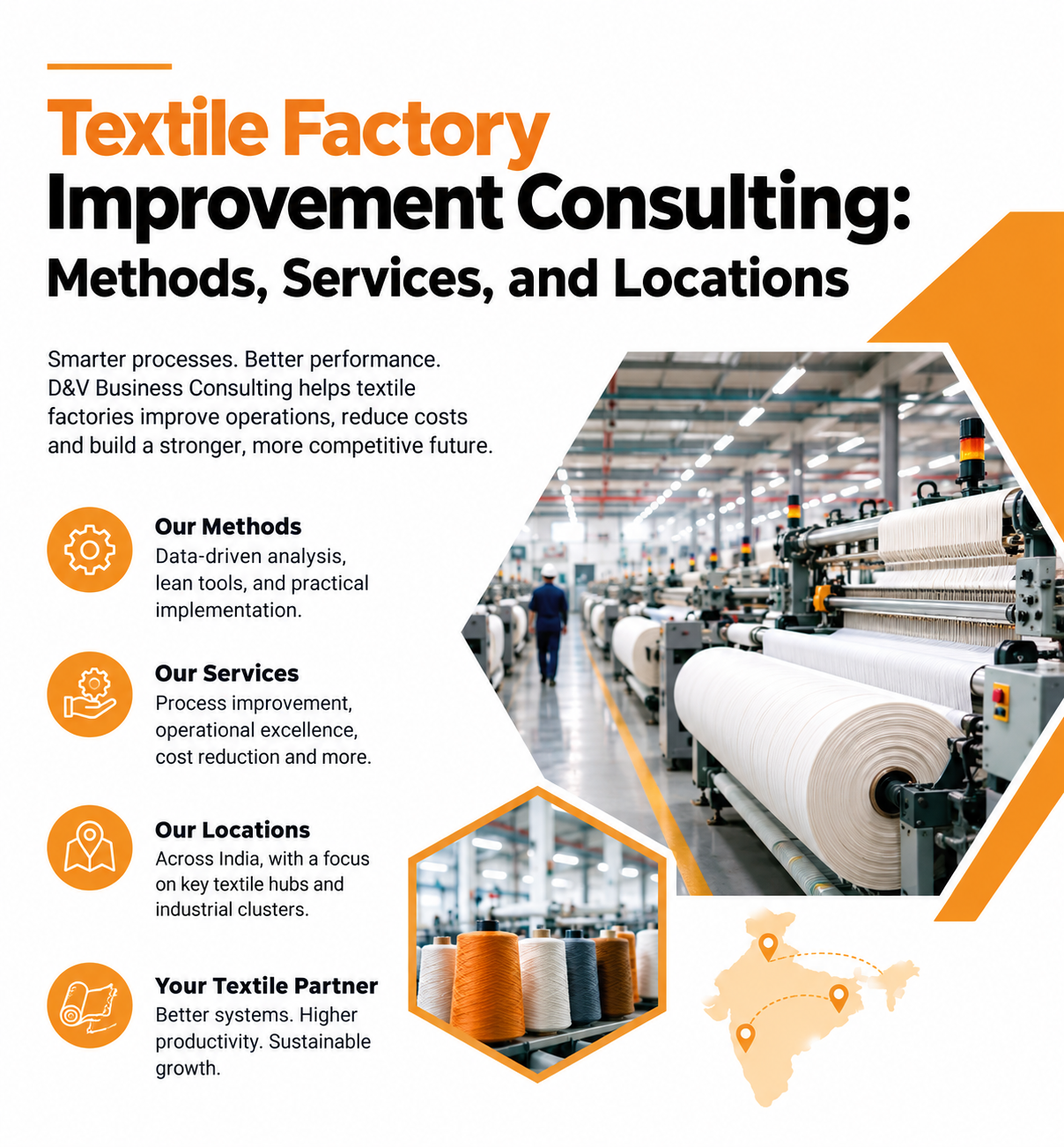
Textile owners usually ask for help when orders ship late and nobody can say why. Some get consulting support to improve on-time delivery in textile manufacturing, while others find a consultant to assess operational losses in a textile manufacturing plant before choosing a fix. D&V Business Consulting begins with that kind of loss review.
Written routines come next. Owners hire a consultant to standardize textile factory operating procedures, and garment units get process standardization consulting for garment manufacturing units. Daily control matters too, so many hire a consultant to improve daily production control in textile plants and find an expert to improve shop-floor management in textile manufacturing.
Teams that want steady gains find a consultant to implement lean manufacturing in textile mills or get lean manufacturing implementation support for textile factories. Others get continuous improvement consulting for textile production operations so results do not slip back.
Resource use shows up in several places. Owners hire a consultant to improve resource utilization in textile factories and find a consultant to reduce work-in-progress inventory in textile mills. Spinners hire a consultant to improve production planning in spinning mills, weavers find a consultant to improve quality and reduce waste in weaving mills, and processors get operational performance improvement for textile processing plants.
Not every owner has money for new machines. Many hire a consultant to improve factory output without major capital investment, and some find a consultant to improve textile factory productivity through better processes. Smaller firms get manufacturing efficiency consulting for textile MSMEs.
Location often decides the choice. Owners hire an operational excellence consultant for a textile factory in Gujarat, find a textile productivity consultant for a manufacturing unit in Surat, and get textile mill improvement consulting for a factory in Ahmedabad. Others hire a textile manufacturing consultant for a processing plant in Maharashtra or find an operational improvement consultant for a textile unit in Coimbatore. Garment makers get productivity improvement consulting for a garment factory in Tiruppur, while owners hire a consultant to improve textile manufacturing operations in Ludhiana, find a consultant for textile factory performance improvement in Bhilwara, and get consulting support to improve textile production efficiency in Panipat.
Many prefer a visit. Find an on-site consultant to improve textile factory operations near me and hire a textile manufacturing consultant who can visit our factory are common requests. Whoever you pick should observe real work and give a written scope, measures, and timelines.
Case Study: Productivity Improvement at a Family-Owned Weaving Mill in Surat
Business Overview
A family-owned weaving mill near Surat with about 140 employees, 80 looms, and two shifts. The mill supplies fabric to garment makers and had grown through repeat orders. The owner ran daily production by instinct and relied on a few senior weavers and supervisors to keep work moving.
Problems Faced
- Late deliveries on about one in three orders damaged buyer trust.
- Loom efficiency averaged about 78%, with frequent stoppages and no record of their causes.
- Fabric defects led to rework and rejected rolls, and about 6% of output was lost.
- Work-in-progress stock piled up between warping, weaving, and inspection.
- Procedures differed by shift because nothing was written down.
- Production planning relied on verbal instructions, so urgent orders disrupted the whole floor.
- The owner had little spare cash for new machines and wanted gains from existing equipment.
D&V Business Consulting’s Approach
- Loss assessment: D&V recorded stoppages, defects, and waiting time by loom and shift, then ranked the losses by cost.
- Standard procedures: Key tasks such as warp changes, beam loading, and inspection were written as short, step-by-step routines, and weavers were trained on them.
- Daily production control: A simple daily plan and a short start-of-shift meeting replaced verbal instructions, with clear order priorities.
- Lean and 5S routines: The floor was reorganised, stores were labelled, and material movement between stages was shortened to cut idle stock.
- Quality and waste control: Repeat defects were traced to their sources, and checks were added at the weaving and inspection stages.
- Maintenance routines: Operators took on basic loom checks, and preventive maintenance was scheduled around the plan.
- Handover: D&V trained a senior supervisor to track the measures and lead weekly reviews.
What Was Solved and the Outcome
- On-time delivery improved from about 67% to 90% within five months.
- Loom efficiency rose from about 78% to 86% with no new machines.
- Defect-related losses fell from about 6% to 3%.
- Work-in-progress stock dropped by about one third.
- Shift-to-shift differences narrowed because every team followed the same written steps.
- The owner spent less time on daily firefighting, and supervisors ran the weekly review.
Why Choose D&V Business Consulting for Textile Factory Improvement
D&V Business Consulting works with owner-led factories and MSMEs that need practical gains from existing machines and teams. The work starts with measured losses on your own floor and visits to the plant, so fixes target what costs you most. D&V covers standard procedures, daily production control, Lean, 5S, quality, and maintenance routines in one engagement. D&V also trains your supervisors to run the system after the engagement ends, so the improvement stays in place without ongoing dependence on a consultant.
Conclusion: Operational Excellence Consulting Services for Textile Manufacturing Industry in India
Operational excellence consulting services for the textile manufacturing industry in India help businesses improve production efficiency, control manufacturing costs, reduce material wastage, maintain consistent product quality, and strengthen overall operational performance. By identifying production bottlenecks, optimizing workflows, improving machine utilization, and establishing effective management systems, textile manufacturers can build more productive, reliable, and cost-efficient operations.
D&V Business Consulting works with textile manufacturers to identify operational challenges and implement practical improvements aligned with their business objectives. From process improvement and productivity enhancement to cost optimization, SOP implementation, and performance management, D&V focuses on turning operational gaps into measurable business improvements.
Whether you operate a spinning mill, weaving unit, processing plant, dyeing facility, or garment manufacturing business, the right consulting approach can help improve resource utilization, strengthen team accountability, and support sustainable business performance.
If your textile business is facing rising production costs, recurring quality issues, low productivity, or inefficient processes, D&V Business Consulting can help you identify improvement opportunities and develop an actionable operational excellence strategy tailored to your manufacturing requirements.

Clients served

Industry Served

Consulting Team

Average Growth
"We were facing troubles in professionalism and missing corporate culture where implementation process is fast. DVBC helped us to design process which is concise and friendly for employer and employee. Our inventory management system in implemented.

Reputed Clients
Textiles And Garment Industry
"We are a leader in water purification industry in India. We got engaged with D&V Business Consulting since last 6 months and found their services up to the satisfaction level. They hove diagnosed our business and provided us key insights regarding professionalism, reporting structure, roles and responsibility.

Reputed Clients
Water Purification Industry
"We are delighted to have D&V Business consulting for our various challenges regarding Sales , HR , finance and manufacturing set up. They have performed as they committed. We recommend entrepreneurs to have them on board. Wish them all the very best."

Reputed Clients
Fragrance Industry
We were successfully able to implement following agendo which were crucial and barrier for business growth. Before joining DVBC, we were facing lots of price-war and competition DVBC has really helped us to create wide ocean between us and competitor in a positive manner.

Reputed Clients
Injection Molding Industry
"We joined DVBC in 2018 and we started our change management Journey with lots of excitement for new organization structure. in a short period of 1 year, we were successfully able to Design roles and responsibility for our Soles, warehouse, finance and HR department. "

Reputed Clients
Computer And Printing Industry
- Where can I find a textile manufacturing consulting company for factory improvement?
-
Check firm websites, client reviews, and published project work, then ask for references. Look for a firm that visits your plant and gives a written scope. D&V Business Consulting works with textile manufacturers on factory improvement, and you can ask the team about relevant experience before you commit.
- Which consultant can reduce operating costs in a textile factory?
-
Choose one who measures where cost arises, such as idle machines, waste, rework, handling, and downtime. D&V Business Consulting traces each cost to its source and starts with the largest avoidable items.
- Where can I find an experienced consultant to improve textile production efficiency?
-
Ask each firm for examples of similar work, how it handled problems during rollout, and who will be on your floor. D&V Business Consulting explains its approach and process steps upfront so you can compare it with other options.
- Which consulting firm can improve textile plant performance?
-
Pick a firm that looks at machines, planning, quality, and people together, not one area alone. D&V Business Consulting reviews each of these, ranks the losses, and fixes the weakest parts first.
- How can I find a textile manufacturing consulting company for factory improvement?
-
Check firm websites, client reviews, and past work, then ask for references and a written scope. D&V Business Consulting works with textile manufacturers on factory improvement, starting with a loss review on your floor so you can see where time and money go.
- How can I find an experienced consultant for textile production optimization?
-
Ask each firm for examples of similar work, who will be on your floor, and how results will be measured. D&V Business Consulting explains its approach and process steps upfront, and it works on production routines, planning, quality, and machine use.
- How can I find a consultant to reduce operating costs in a textile factory?
-
Choose someone who measures where cost arises, such as idle machines, waste, rework, handling, and downtime. D&V Business Consulting traces each cost to its source and acts first on the largest avoidable items.
- How can I find a consulting firm to improve textile plant performance?
-
Pick a firm that looks at machines, planning, quality, material flow, and people together instead of one area alone. D&V Business Consulting reviews each area, ranks the losses by cost, and fixes the weakest parts first.
- Where can I get help to reduce production losses in textile manufacturing?
-
Start with a loss review that records stoppages, defects, and waiting time by machine and shift. D&V Business Consulting carries out this review on your floor and then plans fixes in order of cost.
- Which consultant is reliable for textile manufacturing operations?
-
Reliability shows in clear deliverables, open pricing and timelines, and references you can contact. D&V Business Consulting states its scope in writing before work begins.
- Where can I find a consultant to improve workflow in textile manufacturing plants?
-
Look for someone who maps how material moves from one stage to the next and removes waiting and extra handling. D&V Business Consulting maps the flow on site and tests changes with your supervisors.
- Which consultant can reduce waste in spinning mill operations?
-
A consultant with spinning experience will look at raw material losses, machine settings, changeovers, and process control. D&V Business Consulting finds where waste arises in your mill and sets up simple checks to catch it early.
- Where can I find a weaving factory consultant for production performance improvement?
-
Choose a firm that studies loom stoppages, warp changes, defects, and shift handovers. D&V Business Consulting works with weaving units to raise loom output through better routines and planning.
- Which consultant can help with knitted fabric manufacturing process improvement?
-
Pick one who understands knitting machine setup, yarn handling, and defect sources. D&V Business Consulting reviews each process step, standardises the method, and trains operators on it.
- Where can I get help to improve productivity in fabric finishing operations?
-
Look for a consultant who tracks batch timing, rework, and queues between finishing steps. D&V Business Consulting records these on site and works with your team to shorten waiting time.
- Which consultant can improve workflow in a garment manufacturing unit?
-
A garment consultant should study line balance, bundle movement, and rework. D&V Business Consulting maps the line, finds the slowest stations, and adjusts the layout and task allocation with your supervisors.
- How can I find a consultant to reduce production losses in textile manufacturing?
-
Start with a loss review that records stoppages, defects, and waiting time by machine and shift. D&V Business Consulting carries out this review on site, shares the findings in plain language, and plans fixes in order of cost.
- How can I find a reliable consultant for textile manufacturing operations?
-
Reliability shows in clear deliverables, open pricing and timelines, and references you can contact. D&V Business Consulting states its scope in writing before work begins and trains your supervisors to run the improvements afterward.
- How can I find a consultant to improve workflow in textile manufacturing plants?
-
Look for someone who maps how material moves between stages and removes waiting and extra handling. D&V Business Consulting maps the flow on site and tests changes with your supervisors before making them permanent.
- How can I find a consultant to reduce waste in spinning mill operations?
-
A consultant should review raw material losses, machine settings, changeovers, and process control. D&V Business Consulting finds where waste arises in your mill and sets up simple checks to catch it early.
- Where can I find a consultant for technical textile production efficiency?
-
Ask whether the firm understands tighter quality tolerances, specialised machines, and customer specifications. D&V Business Consulting can discuss your product type and process in an initial conversation so you can judge the fit.
- Which textile consultant works with small and medium manufacturing businesses?
-
Choose a firm that scopes work to your size and budget and does not copy a large-mill model. D&V Business Consulting works with SMEs and MSMEs and offers focused scopes, such as a loss review or a single department.
- Where can I find an expert to improve machine utilization in textile manufacturing?
-
Look for someone who can measure availability, speed, and quality, then work on the largest loss first. D&V Business Consulting sets up this measurement, schedules preventive maintenance, and trains operators on basic machine checks.
- How can I find a weaving factory consultant for production performance improvement?
-
Choose a firm that studies loom stoppages, warp changes, defects, and shift handovers. D&V Business Consulting works with weaving units to raise loom output through better routines, daily planning, and basic machine checks.
- How can I find a consultant for knitted fabric manufacturing process improvement?
-
Pick one who understands machine setup, yarn handling, and defect sources in knitting. D&V Business Consulting reviews each process step, standardises the method, and trains operators to follow it.
- How can I find a consultant to improve productivity in fabric finishing operations?
-
Look for a consultant who tracks batch timing, rework, and queues between finishing steps. D&V Business Consulting records these on site and works with your team to shorten waiting time and reduce repeat processing.
- How can I find a garment manufacturing consultant for workflow optimization?
-
A garment consultant should study line balance, bundle movement, and rework. D&V Business Consulting maps the line, finds the slowest stations, and adjusts task allocation and layout with your supervisors.
- How can I find a consultant for technical textile production efficiency?
-
Ask whether the firm understands tighter quality limits, specialised machines, and customer specifications. D&V Business Consulting can discuss your product and process in an initial conversation so you can judge the fit before committing.
- How can I find a textile consultant for small and medium manufacturing businesses?
-
Choose a firm that scopes work to your size and budget and doesn’t copy a large-mill model. D&V Business Consulting works with SMEs and MSMEs and can start with one department or one problem.
- How can I find an expert to improve machine utilization in textile manufacturing?
-
Look for someone who measures availability, speed, and quality, then works on the largest loss first. D&V Business Consulting sets up this measurement, schedules preventive maintenance, and trains operators on basic machine checks.
 Join
Join