


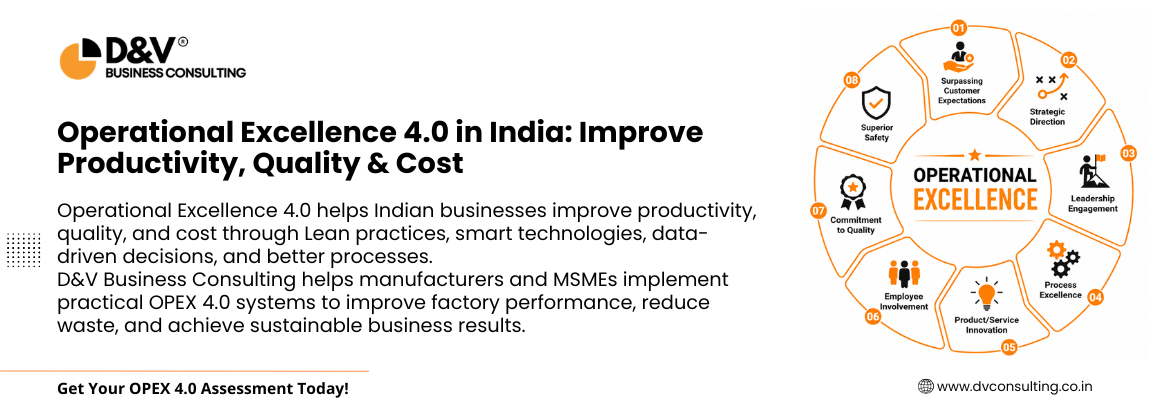
Operational Excellence 4.0 Consulting in India
If you are running a manufacturing business in India, you may already have good machines, experienced people, ERP software and established production processes.
Still, you may face the same questions every month:
- Why is production below capacity?
- Why does rejection keep coming back?
- Why are machines stopping unexpectedly?
- Why does the actual manufacturing cost differ from the planned cost?
- Why do supervisors spend so much time solving daily problems?
- Why does the business depend heavily on a few experienced employees?
- Why is it difficult to get consistent results across shifts?
This is where Operational Excellence 4.0 becomes relevant.
Operational Excellence 4.0 combines proven operational methods such as Lean, 5S, TPM, Kaizen, Value Stream Mapping and OEE with digital systems, production analytics, AI, automation and connected manufacturing practices.
For Indian manufacturers, the objective is simple: produce more with the same or fewer resources, improve quality, reduce avoidable costs and create a production system that can be measured and improved continuously.
What Is OPEX 4.0?
OPEX 4.0, or Operational Excellence 4.0, is a structured approach to improving business and manufacturing performance by combining operational improvement methods with digital technologies and data-driven decision-making.
Traditional operational excellence mainly focuses on:
- Lean manufacturing
- 5S
- Kaizen
- TPM
- Standard work
- SOPs
- Quality management
- Waste reduction
- OEE improvement
- Value Stream Mapping
- Cost reduction
OPEX 4.0 adds a digital layer to these practices.
For example, instead of manually recording machine downtime on paper, a manufacturer can collect machine and production data digitally, analyse downtime patterns and identify recurring losses.
Instead of keeping SOPs in files or folders, teams can access controlled digital SOPs at the workplace.
Instead of conducting Kaizen only during periodic improvement meetings, teams can use digital dashboards to track problems, actions, owners and results.
The basic idea is:
Lean + People + Process + Data + Digital Technology + Continuous Improvement = OPEX 4.0
Why Indian Manufacturers Need Operational Excellence 4.0
Indian manufacturing is becoming more competitive.
Manufacturers are dealing with rising labour costs, customer quality expectations, shorter delivery timelines, raw material price changes, energy costs, increasing product variety and pressure on margins.
At the same time, many MSME manufacturers still depend on manual records, informal processes and individual employee knowledge.
This creates a gap.
You may have modern equipment, but if production data is not being used properly, the machine alone will not deliver the expected business results.
You may have an ERP system, but if shop-floor processes are not followed consistently, software will not solve the underlying operational problem.
You may have trained employees, but if there is no standard work system, performance can vary from person to person and shift to shift.
OPEX 4.0 connects these areas into one performance management system.
Your Business Benefits from the Implementation of OPEX 4.0
The value of OPEX 4.0 should not be measured by the number of dashboards, sensors or digital tools installed.
It should be measured by business results.
1. Higher Production Productivity
A structured OPEX program identifies losses caused by downtime, waiting, changeovers, poor planning, rework, material movement and other operational issues.
The objective is to increase useful production time and output from existing resources.
2. Better Quality
Quality problems often have process causes.
OPEX 4.0 can help manufacturers track:
- Rejection
- Rework
- Customer complaints
- Process deviations
- First-pass yield
- Defect categories
- Root causes
- Corrective actions
This moves quality management from reaction to structured problem-solving.
3. Better Cost Control
Manufacturing cost is affected by many factors:
- Material waste
- Labour productivity
- Machine downtime
- Energy consumption
- Rejection
- Rework
- Overtime
- Inventory
- Maintenance
- Changeover time
OPEX 4.0 provides a structured way to identify where money is being lost and measure the financial impact of corrective actions.
4. Improved OEE
Overall Equipment Effectiveness combines Availability, Performance and Quality.
A manufacturer can use OEE data to identify whether capacity is being lost because of:
- Machine breakdowns
- Setup and changeover
- Minor stoppages
- Reduced speed
- Rejection
- Rework
OEE becomes more useful when it is connected to actual production decisions.
5. Faster Problem Solving
When operational data is available at the right time, managers can identify problems earlier.
Daily management meetings can focus on facts instead of assumptions.
6. Less Dependence on Individual Employees
A strong operational system captures knowledge through:
- SOPs
- Work instructions
- Checklists
- Standard work
- Training records
- Process controls
This helps reduce dependence on individual employees who may otherwise become the only source of process knowledge.
7. Better Delivery Performance
Improved production planning, shorter downtime, lower process variation and better material flow can support more reliable delivery commitments.
D&V Business Consulting OPEX 4.0 Services
D&V Business Consulting works with Indian businesses to connect strategy with practical implementation.
Our OPEX 4.0 approach can cover the complete operational improvement cycle:
Assess → Diagnose → Design → Implement → Measure → Improve
Our services can include:
OPEX 4.0 Assessment
We assess current processes, production performance, workplace practices, quality losses, machine utilisation, SOPs, data systems and management routines.
OPEX 4.0 Roadmap
We develop a practical roadmap based on the company’s priorities, current maturity, resources and business goals.
Lean and 5S Implementation
We help teams establish workplace organisation, visual management, standard work and waste reduction practices.
OEE & Production Analytics
We establish production performance measures and identify the major losses affecting equipment and production output.
Digital SOP Management
We help businesses move from scattered documents to structured digital SOP and work-instruction systems.
AI for Operational Excellence
AI can support operational analysis, knowledge management, problem identification, reporting and decision support.
TPM and Predictive Maintenance
Maintenance systems can move from reactive breakdown handling towards planned, condition-based and data-supported maintenance practices.
Manufacturing Cost Reduction
We identify operational cost drivers and develop improvement actions linked to measurable financial results.
OPEX 4.0 Framework
A practical OPEX 4.0 framework can be built around six areas:
1. People
Skills, leadership, accountability and employee participation.
2. Process
SOPs, standard work, Lean, quality and process controls.
3. Performance
OEE, productivity, quality, delivery and cost KPIs.
4. Technology
ERP, MES, IoT, analytics, automation and AI.
5. Problem Solving
Kaizen, root-cause analysis, corrective action and continuous improvement.
6. Financial Impact
Cost savings, capacity improvement, working-capital impact and OPEX ROI.
This framework keeps technology connected to business performance.
OPEX 4.0 Roadmap
A manufacturer does not need to digitise everything at once.
A practical roadmap can follow these stages:
Stage 1: Operational Assessment
Identify current performance, major losses and process gaps.
Stage 2: Baseline Measurement
Establish baseline figures for productivity, quality, downtime, OEE, cost and delivery.
Stage 3: Process Stabilisation
Create standard work, SOPs, 5S, visual management and basic performance routines.
Stage 4: Lean Improvement
Use Kaizen, Value Stream Mapping, TPM and structured problem-solving.
Stage 5: Digitalisation
Introduce digital SOPs, production dashboards, data collection and analytics.
Stage 6: AI and Advanced Analytics
Apply AI and predictive analytics where sufficient quality data is available.
Stage 7: ROI Measurement
Connect improvement projects with financial and operational outcomes.
OPEX 4.0 for MSMEs
For MSMEs, OPEX 4.0 does not mean buying expensive technology.
In many cases, the first improvement may simply be:
- Clear SOPs
- Better production planning
- Daily production meetings
- 5S
- Visual management
- OEE tracking
- Breakdown analysis
- Standard work
- Quality dashboards
- Digital records
Technology should solve a real business problem.
For example, if a factory does not know why machines lose two hours every shift, installing another software platform may not be the first step.
The first step is to identify and measure the loss.
Then the right digital solution can be selected.
OPEX 4.0 vs Lean
Lean focuses primarily on reducing waste and improving process flow.
OPEX 4.0 includes Lean but extends the approach through digital systems, analytics, automation and AI.
| Lean | OPEX 4.0 |
|---|---|
| Waste reduction | Waste reduction + digital performance |
| Kaizen | Digital Kaizen + structured improvement |
| Manual data may be used | Data-driven decision-making |
| Visual management | Digital and physical visual management |
| Standard work | Digital SOP and standard work |
| OEE measurement | Connected OEE and production analytics |
OPEX 4.0 should therefore be viewed as an extension of operational excellence rather than a replacement for Lean.
OPEX 4.0 vs Industry 4.0
These two terms are related but not identical.
Industry 4.0 primarily focuses on technologies such as:
- IoT
- Connected machines
- Automation
- Robotics
- Cloud systems
- Data analytics
- AI
- Digital twins
OPEX 4.0 focuses on business and operational performance using these technologies alongside proven management and improvement methods.
A simple way to understand the difference is:
Industry 4.0 asks: “How can technology connect and improve the factory?”
OPEX 4.0 asks: “How can we improve operational performance using people, processes, Lean methods, data and technology?”
Technology without process discipline may produce more data without producing better results.
AI for Operational Excellence
AI is becoming increasingly useful in manufacturing.
Potential applications include:
- Production data analysis
- Root-cause support
- Quality trend analysis
- Predictive maintenance
- Production forecasting
- SOP knowledge systems
- Shift reporting
- Anomaly detection
- Maintenance knowledge support
- Management dashboards
However, AI should be introduced after the business has identified the problem it wants to solve.
Good data + clear process + defined business problem + suitable AI application = useful AI implementation.
Digital Kaizen
Traditional Kaizen often depends on meetings, paper forms and manual tracking.
Digital Kaizen can provide a central system for:
- Recording improvement ideas
- Assigning responsibility
- Setting deadlines
- Tracking actions
- Measuring results
- Documenting savings
- Reviewing completed projects
This gives management better visibility into the company’s continuous improvement activity.
Digital SOP Management
SOPs are one of the most important parts of operational control.
A Digital SOP Management system can provide:
- Central SOP repository
- Version control
- Employee access
- Approval workflows
- Training records
- Revision history
- Digital acknowledgement
- Searchable work instructions
For businesses with multiple departments, shifts, products or locations, digital SOP management can make process knowledge easier to access and control.
OEE & Production Analytics
OEE helps answer three important questions:
Was the machine available?
Did it run at the expected speed?
Did it produce good-quality output?
Production analytics can go further by identifying:
- Top downtime reasons
- Shift-wise performance
- Product-wise losses
- Machine-wise performance
- Rejection trends
- Changeover losses
- Production trends
- Capacity gaps
The purpose is not simply to display numbers.
The purpose is to identify the actions that can improve performance.
Predictive Maintenance
Traditional maintenance often follows one of two approaches:
Run-to-failure: Repair the machine after breakdown.
Preventive maintenance: Service equipment at planned intervals.
Predictive maintenance uses equipment condition and historical data to identify possible failures before they cause major disruption.
Depending on the equipment and data available, manufacturers may monitor:
- Vibration
- Temperature
- Pressure
- Current
- Runtime
- Lubrication
- Error codes
- Historical failure patterns
Not every machine requires advanced predictive technology. The right approach depends on equipment criticality, failure patterns, data availability and financial value.
Smart Manufacturing
Smart manufacturing connects people, machines, processes and data.
A smart manufacturing environment may include:
- Connected equipment
- Digital production records
- Real-time dashboards
- ERP integration
- MES
- IoT
- Production analytics
- Digital quality systems
- AI-based decision support
But smart manufacturing should start with operational priorities.
First identify the performance problem. Then select the technology.
5S & Workplace Management
5S remains highly relevant even in a digitally connected factory.
The five principles help create:
- Organised workplaces
- Visual controls
- Better material identification
- Reduced searching time
- Improved workplace discipline
- Safer working conditions
- Better equipment visibility
OPEX 4.0 combines physical workplace management with digital performance tracking.
Total Productive Maintenance (TPM)
Total Productive Maintenance (TPM) focuses on improving equipment effectiveness by involving production and maintenance teams.
Key TPM practices can include:
- Autonomous maintenance
- Planned maintenance
- Preventive maintenance
- Breakdown analysis
- Equipment improvement
- Maintenance standards
- Operator training
TPM can support higher equipment availability and lower maintenance-related production losses.
Value Stream Mapping
Value Stream Mapping helps businesses see the complete flow of materials and information.
It can identify:
- Waiting
- Excess inventory
- Long lead times
- Unnecessary movement
- Process bottlenecks
- Information delays
- Rework
- Production constraints
For OPEX 4.0 projects, VSM can help determine where digital technology can create meaningful operational value.
Manufacturing Cost Reduction
Cost reduction should not simply mean cutting manpower or reducing material quality.
A better approach is to identify the causes of avoidable cost.
These can include:
- Material scrap
- Rejection
- Rework
- Machine downtime
- Excess energy use
- Poor scheduling
- Long changeovers
- Excess inventory
- Overtime
- Low labour productivity
- Poor maintenance
- Unnecessary movement
The goal is to reduce waste while protecting quality, safety and customer service.
OPEX ROI Measurement
One of the most important questions for any management team is:
“What financial result did the improvement project create?”
OPEX ROI can be measured through indicators such as:
- Cost savings
- Additional production capacity
- Reduced rejection
- Reduced downtime
- Lower energy consumption
- Reduced overtime
- Reduced inventory
- Improved labour productivity
- Reduced maintenance cost
- Improved contribution margin
For example, if a production improvement project costs ₹10 lakh and creates measurable annual financial benefits of ₹20 lakh, management can assess the project based on the investment and resulting business value.
The exact ROI calculation should consider implementation cost, recurring benefits, one-time benefits and the period over which benefits are realised.
Why Choose D&V Business Consulting for OPEX 4.0?
Choosing an OPEX 4.0 consulting partner is not only about knowing Lean, AI or Industry 4.0 technology.
The important question is:
Can the consultant help your team convert improvement ideas into measurable business results?
D&V Business Consulting focuses on implementation-oriented consulting for Indian businesses and MSMEs.
Our approach connects:
Business Strategy → Operations → People → Processes → Technology → Performance → Financial Results
We work with business owners, promoters, directors, factory managers and operational teams to identify practical improvement opportunities.
The focus is not technology for its own sake.
The focus is business performance.
D&V Business Consulting can support businesses with:
- OPEX 4.0 assessment
- Operational excellence consulting
- Lean implementation
- 5S implementation
- TPM
- Kaizen
- Value Stream Mapping
- OEE improvement
- Digital SOP Management
- Production analytics
- Manufacturing cost reduction
- AI for business and operations
- Smart manufacturing
- Process improvement
- Performance management
- OPEX ROI measurement
Is Your Factory Ready for OPEX 4.0?
Ask yourself these questions:
- Do you know your major production losses every day?
- Is your OEE measured consistently?
- Are your SOPs current and accessible to employees?
- Can you identify the biggest causes of rejection?
- Do you know your actual downtime by machine and reason?
- Are Kaizen actions tracked to completion?
- Is preventive maintenance followed consistently?
- Can management see production performance without waiting for manual reports?
- Are operational improvements linked to financial results?
- Can your factory maintain performance without depending on a few individuals?
If several answers are “No”, your business may have significant opportunities for operational improvement.
Start Your OPEX 4.0 Journey
Operational Excellence 4.0 does not begin with buying technology.
It begins with understanding where your business is losing time, money, capacity and quality.
Once those losses are visible, the right combination of Lean methods, process discipline, people development, digital systems, analytics and AI can be selected.
For Indian manufacturers, this can create a practical path towards higher productivity, better quality, lower manufacturing costs and stronger operational control.
Looking for Operational Excellence 4.0 Consulting in India?
Talk to D&V Business Consulting to assess your current operational performance and identify practical OPEX 4.0 opportunities for your business.
Start with an OPEX 4.0 Assessment → Identify Your Major Operational Losses → Build Your Roadmap → Implement → Measure ROI
Contact D&V Business Consulting to discuss your OPEX 4.0 requirements.
About Dharmesh Parikh – Founder & CEO, D&V Business Consulting

I’m Dharmesh Parikh, Founder & CEO of D&V Business Consulting.
I started D&V Business Consulting with one conviction: businesses rarely fail because of their products or market potential. More often, growth slows due to inefficient operations, inconsistent processes, people-related challenges, poor execution, and the absence of strategic direction. My mission is to help business owners overcome these challenges and build businesses that deliver consistent, sustainable growth.
What I Do
I work closely with founders, directors, and leadership teams to improve the critical areas that directly influence business performance.
At D&V Business Consulting, we help organisations:
- Increase sales performance and revenue.
- Build high-performing teams with structured HR systems.
- Improve operational efficiency and productivity.
- Support business transformation and sustainable growth.
- Develop structured processes and management systems that create long-term business value.
Our work goes far beyond providing recommendations. We partner with business owners throughout the implementation journey, helping leadership teams convert business strategies into measurable business outcomes.
Who I Work With
I primarily work with MSME founders, entrepreneurs, and business leaders who are committed to building scalable and professionally managed organisations.
My experience covers a wide range of industries, including:
- Manufacturing
- Retail
- Distribution
- Trading Businesses
- Service-Based Enterprises
What I Share
Through my content, I share practical insights and business knowledge on topics including:
- Business Growth Strategies
- Sales Management
- Leadership Development
- HR & Organisation Development
- Operational Excellence
- Scaling MSMEs
I believe business consulting should create measurable business impact—not just reports and presentations. My objective is to help business owners make informed decisions, solve operational challenges, build stronger organisations, and achieve sustainable business growth.
If you’re looking for practical business strategies backed by hands-on implementation, I’d be pleased to connect and exchange ideas.
Founder & CEO – D&V Business Consulting
Business Growth | Sales Strategy | Operations Excellence | HR & Organizational Development
- What is Operational Excellence 4.0?
-
Operational Excellence 4.0 is an approach that combines Lean and operational improvement methods with digital technologies, analytics, automation and AI to improve productivity, quality, delivery and cost performance.
- What is Operational Excellence 4.0 Consulting in India?
-
Operational Excellence 4.0 Consulting in India helps manufacturers and businesses assess operational performance, identify losses, establish improvement systems and introduce suitable digital technologies to improve measurable business results.
- Is OPEX 4.0 only for large manufacturers?
-
No. OPEX 4.0 can also be applied to MSMEs. The scale and technology should match the company's size, operational maturity, budget and business priorities.
- What is the difference between OPEX 4.0 and Lean?
-
Lean focuses strongly on waste reduction, flow, standard work and continuous improvement. OPEX 4.0 includes Lean while adding digital systems, analytics, automation and AI where they create business value.
- What is the difference between OPEX 4.0 and Industry 4.0?
-
Industry 4.0 focuses mainly on connected and digital manufacturing technologies. OPEX 4.0 focuses on operational performance and uses Lean, people, processes, data and Industry 4.0 technologies together.
- How does AI support Operational Excellence?
-
AI can support production analysis, anomaly detection, predictive maintenance, quality analysis, knowledge management, reporting and decision support. The application should be based on a clear business problem and suitable data.
- Can OPEX 4.0 reduce manufacturing costs?
-
Yes. OPEX 4.0 can identify cost drivers such as rejection, rework, downtime, low productivity, excess inventory, poor changeovers and inefficient processes. The actual savings depend on the company's starting condition and implementation.
- How long does an OPEX 4.0 implementation take?
-
There is no single timeline. A focused improvement project may take a few weeks or months, while a larger transformation across multiple functions or factories can take longer. The roadmap should be based on business priorities and operational maturity.
- Does OPEX 4.0 require expensive technology?
-
No. A business can begin with process discipline, 5S, SOPs, daily management, OEE measurement and structured problem-solving. Digital technology can then be added where it has a clear business case.
- What should a company measure before starting OPEX 4.0?
-
Useful baseline measures can include productivity, OEE, downtime, rejection, rework, changeover time, labour productivity, inventory, production lead time, maintenance cost and manufacturing cost.
- Can D&V Business Consulting help MSMEs implement OPEX 4.0?
-
Yes. D&V Business Consulting provides implementation-oriented consulting for businesses and MSMEs, covering areas such as Lean, 5S, TPM, Kaizen, OEE, SOPs, process improvement, production analytics, manufacturing cost reduction and digital operational systems.
Related Posts
Sales Process Consulting in India for SMEs
In the relentless pursuit of peak efficiency and world-class quality, businesses constantly seek foundational methodologies…

How to Drive Business Growth with Sales & Marketing Consulting
D&V Business Consulting provides Sales and marketing consultants offer Strategic Sales Planning as a core…

6 Sales Challenges Businesses Face and How To Overcome Them
D&V Business Consulting offers a range of services to help businesses overcome sales challenges, from…
 Join
Join