


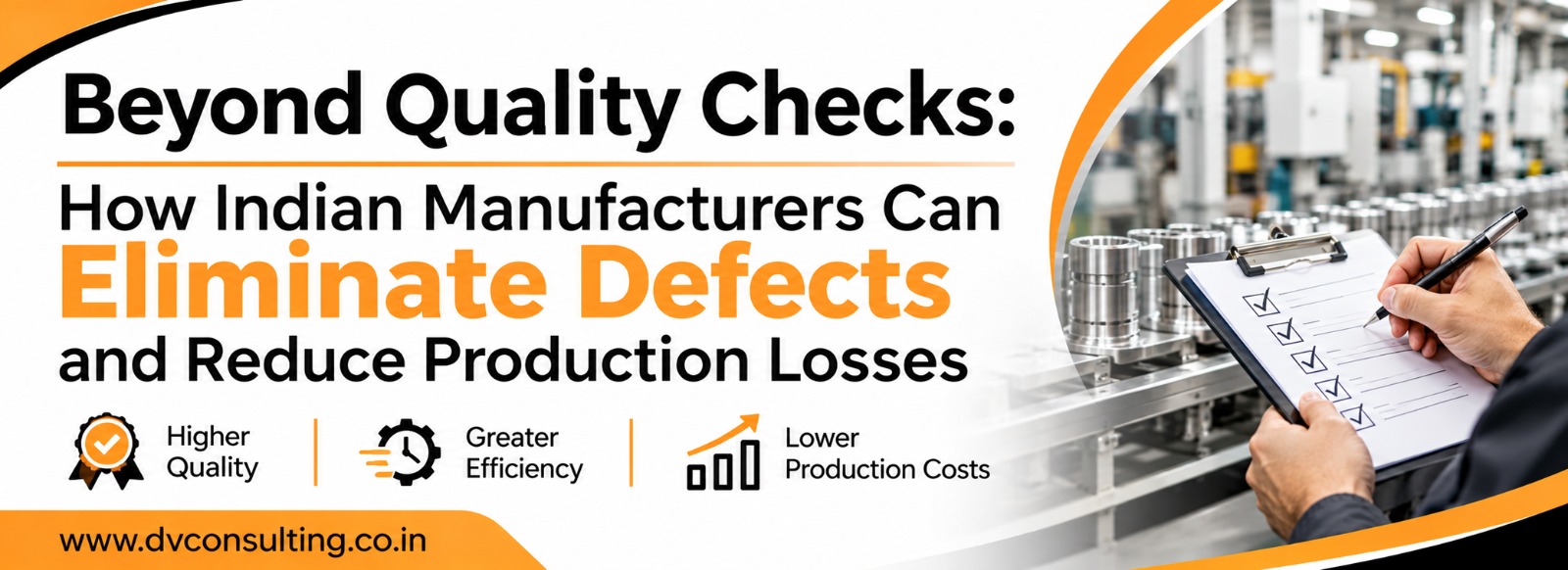
Beyond Quality Checks: How Indian Manufacturers Can Eliminate Defects and Reduce Production Losses
Manufacturing defects are among the major reasons behind material wastage, production delays, rework expenses and customer complaints in Indian manufacturing industries. Every rejected component or defective product adds unnecessary costs through additional labour, machine utilisation, raw material consumption and delayed deliveries. Although most factories have quality inspection systems in place, recurring defects often indicate deeper problems within production processes, machine settings, operating methods and workforce practices.
For many manufacturers, the usual approach is to identify defective products during inspection, separate them from accepted products and carry out rework wherever possible. However, this approach focuses more on detecting defects than preventing them. If the underlying causes remain unaddressed, the same quality problems can continue across production batches, increasing rejection rates and reducing overall manufacturing efficiency.
To achieve sustainable quality improvement, manufacturers need to move beyond routine quality checks and adopt a preventive approach. This involves identifying the root causes of defects, analysing process variations, improving machine performance, standardising operating procedures and strengthening employee involvement in quality management. Regular monitoring of production parameters and quality performance indicators also helps management identify problems before they result in significant production losses.
Manufacturing defect reduction consulting helps businesses systematically identify quality-related losses and implement practical improvements across their production operations. Through structured problem-solving, process analysis, root cause investigation and continuous improvement methodologies, manufacturers can reduce rejection rates, minimise rework, improve first-pass yield and maintain consistent product quality.
For Indian MSMEs and large manufacturing organisations, the objective should not be limited to passing final inspections. It should be to establish production processes that consistently manufacture products right the first time. With the right quality management systems and on-shopfloor implementation, manufacturers can improve operational efficiency, control manufacturing costs and strengthen customer satisfaction.
The Real Cost of Relying on Final Inspection
Inspection tells you how many parts failed. It rarely tells you why. A plant that depends on end-of-line checks pays for the same part several times: raw material, machine time, operator effort, inspection time, and then rework or scrap.
Owners of small and mid-size units in Gujarat, Maharashtra, Tamil Nadu and Punjab describe the same pattern. Customers send back lots. Audits find repeat issues. Teams spend more time sorting parts than making them. Business consulting in India sees this in auto components, castings, plastics, textiles, packaging and engineering goods.
The common pain points look like this:
- Repeat defects appear every month under a different batch number.
- Customers return lots, and credit notes eat into margin.
- Teams fix parts quietly, so management never sees the true cost of rework.
- Rework and re-inspection push orders past committed dates.
- Quality changes from one shift or one worker to another.
- Procedures exist on paper, but the shop floor follows habit.
Many plants call manufacturing defect reduction consultants in India after the same fault returns for the third or fourth time. Others start with quality control consultants for Indian industries when audit findings repeat. They want someone to review how checks are set up, not only the results.
Where Production Losses Actually Hide
Most factories track scrap, but scrap is only the visible part. A large share of loss sits where no report captures it.
Waste starts before a defective part is counted. Setup trial pieces, tool wear, poor raw material and unplanned stoppages all add to it. Temperature drift, worn fixtures and untrained handling also change output, and nobody notices until the lot fails. This is why defect reduction in manufacturing industry depends on controlling the process, not sorting the product.
Supplier quality adds another layer. A weak incoming lot creates defects that your own team then gets blamed for. Communication gaps do the same: drawings change, but older revisions stay on the shop floor, and customer requirements reach the sales desk but never reach the operator.
Until a factory measures these losses, any fix is guesswork. Firms that offer manufacturing scrap and rework reduction support start by mapping losses, not by adding inspections. When customer returns are the main worry, production rejection reduction consultants trace each returned lot back to the line, shift and material batch.
Why Quality Checks Alone Cannot Fix the Problem
Checks have a place. Incoming inspection, in-process checks and final audits all protect the customer. The weakness is timing. By the time a check finds a fault, the machine has already made more bad parts.
Three reasons explain the gap:
- Inspection depends on human attention, which drops during long shifts.
- Gauges and measuring tools drift without regular correction.
- Findings rarely travel back to the person who can change the process.
Treat quality as the inspection team’s job, and you will keep chasing defects. Treat it as a process discipline, and you start preventing them. Industrial quality management consulting helps here. It links quality planning, process control and audits into one working system. If you only need audits, gauge control and inspection plans reviewed, quality control consulting services cover that smaller task.
A Practical Path to Fewer Defects
These steps reflect what works on real shop floors. They do not need a large budget at the start, but they do need discipline.
- Measure the problem in numbers
Record defect type, machine, shift, operator, material lot and time. After two to four weeks, patterns appear. A Pareto chart often shows that a small number of defect types cause most rejections.
- Find the root cause, not the symptom
When a part fails, ask why until you reach a cause you can fix. Tools like 5-Why and fishbone diagrams help, but the team must go to the machine and check facts. Manufacturing root cause analysis consultants often train plant teams in this method, so the habit stays after the project ends.
- Standardise the work
Write simple work instructions with photos, set parameters and clear limits. Place them at the workstation. When every operator follows the same method, variation drops. Quality management system improvement consultants help by fixing gaps in documentation, audits and corrective action tracking.
- Build prevention into the process
Use error-proofing devices, checklists at changeover and first-piece approval before each run. Industrial defect prevention consulting focuses on this stage, where the goal is to make the wrong action difficult or impossible.
- Control the supplier side
Agree on specifications, share rejection data and audit key vendors. Incoming quality problems cost far less to fix at the supplier’s gate than on your line. Industrial quality improvement consultants India often help plants set up supplier audits and incoming inspection rules.
- Review results every day
Hold a short meeting on the shop floor. Review yesterday’s rejections, open actions and any process drift. Quick feedback keeps small issues from becoming large ones. Production quality improvement consulting often builds this routine with supervisors.
- Train people for ownership
Operators who understand why a limit exists respect it. Short, repeated training sessions work better than a single classroom day.
Lean Methods That Cut Waste Without Slowing Output
Defects and waste move together. Lean tools such as 5S, value stream mapping, standard work and visual management remove the clutter and confusion that cause mistakes. Lean manufacturing consulting services often start with one pilot line. Results show within weeks. Then the method spreads to other areas.
Lean and quality methods work best together. Lean cuts lost time and motion. Six Sigma and statistical process control cut variation. Production process optimization consultants study how work flows from raw material to dispatch, including machine use, cycle time and line balance. Industrial process improvement consulting services fix delays between departments such as stores, production and quality.
When to Bring in an External Consultant
Many plants can fix simple issues alone. An outside view becomes useful when:
- The same defect has returned despite several corrective actions.
- A key customer has placed the plant on a watch list or issued a formal complaint.
- Internal teams are too busy with daily production to study the process.
- Management wants a certification such as ISO 9001 or IATF 16949 and lacks in-house experience.
- Rejections are known to be high, but no one can say exactly where they begin.
A business consulting company with shop floor experience brings structure, tested methods and a neutral view. Manufacturing quality consultants in India can help with inspection, gauges and process audits. When the issue is how work moves through the plant, factory process improvement consultants in India study layout, material flow and handoffs between stations.
Types of Consulting Support Available
Different problems call for different expertise:
- Quality management consultants for manufacturing companies build and audit the systems that control quality across departments.
- Scrap and rework reduction consulting targets material waste and repeated handling on specific lines.
- Manufacturing operational excellence consulting builds lasting habits across leadership and shop floor teams.
- Manufacturing quality improvement consulting services combine process audits, training and corrective action support for plants with recurring complaints.
Some firms offer several of these together, while others specialise in one. Good business consulting services do not hand over a thick report and leave. They work beside your supervisors, set targets, and review results with you.
How to Choose the Right Partner in India
A search for top management consulting firms in India returns a long list. Treat it as a starting point. Names say little about manufacturing depth, so check these points before signing:
- Ask for examples from your sector, not only general case studies.
- Know who will actually work at your plant and what they have done before.
- Agree on rejection percentage, rework hours or cost savings before work begins.
- Confirm your team can run the system after the consultant leaves.
- Speak with past clients about results, not only about the process.
Even the best business consulting firms in India differ in industry depth, so references matter more than rankings. A management consulting company that spends its first week on the shop floor usually understands your problem better. A management consulting service that cannot explain its method in plain words is worth questioning.
Choosing the Right Business Consulting Partner
Selecting a consultant is an important decision for an MSME. The right professional should understand the company’s industry, study its actual problems and provide practical recommendations.
Before selecting a consulting partner, business owners should consider:
- Industry experience: Does the consultant understand the company’s products, customers and operating conditions?
- Implementation experience: Can the team help introduce changes at the workplace?
- Problem identification: Does the consultant study existing processes before suggesting improvements?
- Performance tracking: Are recommendations connected to measurable business results?
- Employee involvement: Does the consulting approach include managers, supervisors and employees?
- Client references: Can the consultant share relevant project experience and genuine client feedback?
When comparing management consulting firms, business owners should look at relevant industry experience, implementation support and actual project outcomes rather than relying only on rankings.
Searches for Best Management Consulting Firms in India and best business consulting firms in India may provide an initial list of providers. However, rankings alone should not determine the selection. The ability to understand business problems and support implementation is more important.
A business consulting company should be able to explain how its work will address the company’s specific requirements, what activities it will undertake and how progress will be reviewed.
Building Lasting Gains Across Multiple Plants
Groups with several sites need one method, not a different fix at each location. A quality management consulting company in India can set one reporting format and one audit routine across plants. Groups should pick a defect reduction consulting company India wide enough to cover every site. It can compare rejection patterns between units and move proven fixes quickly.
For better flow and fewer delays, manufacturing process improvement consultants India work on cycle time and changeovers. Industrial productivity improvement consultants India look at output per labour hour and machine hour. Production efficiency consultants in India can also help plants cut idle time and missed schedules.
Lasting change also needs a shift in culture. Manufacturing excellence consultants India and operational excellence consultants in India coach managers to run daily reviews, set clear targets and recognise good work. Over time, manufacturing excellence consulting makes these routines the plant’s normal way of working.
Case Study: Reducing Manufacturing Defects and Production Losses in an Engineering Company
Business Overview
The client was an established engineering company making precision components for industrial use. Its work covered raw material processing, machining, assembly and final inspection.
Production volumes and customer expectations were rising. The company had an inspection team, but recurring quality issues still hurt output, material use and delivery dates.
Problems Faced
- Frequent product rejection due to dimensional variations.
- High scrap generation and material wastage.
- Repeated rework affecting production schedules.
- Inconsistent machine operating practices across shifts.
- Lack of proper root cause analysis for recurring defects.
- Limited monitoring of production quality indicators.
D&V Business Consulting’s Approach
D&V Business Consulting studied the company’s production activities and identified gaps in machine settings, working methods and quality monitoring.
- Conducted shop-floor observations to identify defect-generating activities.
- Analysed rejection and rework records to identify major loss areas.
- Introduced SOPs for critical production activities.
- Improved in-process inspection and machine setting checks.
- Trained employees to identify and report quality issues.
Outcomes Achieved
After the changes, the company recorded these results:
- 30% reduction in product rejection, resulting in fewer defective components.
- 25% reduction in rework, helping reduce repeated production activities.
- 20% reduction in material wastage, making better use of raw material.
- 15% improvement in production efficiency, supporting better workflow and output.
These changes cut quality-related losses and gave the company steadier production and better control of its work. Results like these are why manufacturing quality improvement services work best when they start on the shop floor.
Conclusion
Quality checks will always have a role, but they cannot be the only defence. Plants that cut defects for good do three things: they measure losses honestly, they fix root causes instead of symptoms, and they train their own people to hold the gains.
Start with one line, one defect and one clear target. Once the first improvement holds, repeat it across the plant. Whether you work with one of the best management consulting firms in India or build the skills in-house, the goal stays the same: stop sorting bad parts and start preventing them.
About Dharmesh Parikh – Founder & CEO, D&V Business Consulting

I’m Dharmesh Parikh, Founder & CEO of D&V Business Consulting. I started D&V with a clear conviction: businesses rarely struggle because of their products or market potential alone. In many cases, performance is affected by inefficient operations, inconsistent processes, people-related challenges, weak execution, and limited strategic direction.
My mission is to help founders, business owners, directors, CEOs, CXOs, promoters, and leadership teams identify business challenges and convert them into practical opportunities for improvement. My approach combines business consulting, management systems, operational improvement, sales performance, HR structure, process improvement, productivity enhancement, and implementation support based on the specific requirements of each organisation.
At D&V Business Consulting, we work with organisations across key areas that directly influence business performance, including sales and revenue, organisational structure, employee performance, operational efficiency, productivity, business processes, SOPs, accountability systems, KPIs, management reviews, and strategic execution.
A significant part of my consulting approach is understanding what actually happens inside an organisation. A process may look effective on paper but produce inconsistent results on the shop floor or within day-to-day business operations. Similarly, an organisation may have targets and KPIs but still struggle because responsibilities are unclear, reviews are inconsistent, or corrective actions are not followed through. Identifying these gaps requires practical observation, structured analysis, discussions with people at different levels, and a clear understanding of how work is actually performed.
This is also why I strongly believe that consulting should not end with a presentation or recommendation document. Recommendations have value only when they are converted into actions and embedded into the organisation. At D&V, we focus on working alongside business owners and leadership teams to translate strategies into defined responsibilities, practical processes, measurable performance indicators, review mechanisms, SOPs, and accountability systems.
My consulting philosophy is built around a simple principle: strategy creates direction, but execution creates results. Sustainable business performance requires both. Organisations need clarity about where they want to go, but they also need the systems, people, processes, discipline, and review mechanisms required to move consistently in that direction.
My areas of focus include business & management consulting, operational excellence, manufacturing consulting, lean manufacturing, process improvement, sop development, performance management, hr systems, sales performance, productivity improvement, and strategic business implementation. depending on the organisation’s needs, these areas may involve process analysis, organisational restructuring, kpi development, workflow improvement, waste reduction, productivity initiatives, management systems, or execution planning.
I also believe that improvement should be practical, measurable, and relevant to the organisation’s current stage of development. Every business has different people, processes, customers, capabilities, constraints, and priorities. Therefore, consulting solutions should not simply copy a standard model. They should be adapted to the organisation while maintaining the discipline required for effective implementation.
My work with business owners and leadership teams is therefore centred on asking practical questions: Where is performance being lost? Which processes are creating recurring problems? Are responsibilities clearly defined? Are employees working with the right systems and standards? Are management reviews leading to action? Are KPIs providing meaningful visibility? And, most importantly, are agreed improvements actually being implemented?
Through this execution-focused approach, my objective is to help organisations build stronger business systems, clearer accountability, more consistent processes, better operational performance, and improved management visibility.
I believe sustainable business performance is not created through one-time initiatives. It is built through continuous improvement, structured execution, disciplined management, capable teams, and systems that consistently support the organisation’s objectives.
At D&V Business Consulting, my role is to work with leadership teams not simply as an external advisor, but as a practical implementation partner—helping convert business challenges into structured actions and helping organisations move from identified problems to measurable improvements.
Who I Work With
I primarily work with MSME founders, entrepreneurs, and business leaders who are committed to building scalable and professionally managed organisations.
My experience covers a wide range of industries, including:
- Manufacturing
- Retail
- Distribution
- Trading Businesses
- Service-Based Enterprises
What I Share
Through my content, I share practical insights and business knowledge on topics including:
- Business Growth Strategies
- Sales Management
- Leadership Development
- HR & Organisation Development
- Operational Excellence
- Scaling MSMEs
I believe business consulting should create measurable business impact—not just reports and presentations. My objective is to help business owners make informed decisions, solve operational challenges, build stronger organisations, and achieve sustainable business growth.
If you’re looking for practical business strategies backed by hands-on implementation, I’d be pleased to connect and exchange ideas.
Founder & CEO – D&V Business Consulting
Business Growth | Sales Strategy | Operations Excellence | HR & Organizational Development
- Can manufacturing defects be reduced without raising production costs?
-
Usually, yes. Fixing process errors, correcting machine settings, standardising methods and training operators cost little compared with the scrap and rework they remove.
- Does D&V Business Consulting work with manufacturers on recurring defects?
-
Yes. D&V Business Consulting supports manufacturers in finding repeat defects, tracing their causes and improving quality through on-site work with plant teams.
- Does lean manufacturing help reduce scrap and rework?
-
It does. Lean methods expose unnecessary movement, waiting time and material waste, which are common sources of defects.
- Can SOPs improve product quality in manufacturing units?
-
They can. Clear SOPs help every operator follow the same method, which lowers variation. D&V Business Consulting helps manufacturers write SOPs that suit their own shop floor.
- Does D&V Business Consulting help find the root causes of production defects?
-
Yes. The team studies shop-floor activity, rejection records, machine settings and working methods, then recommends corrective actions based on what the data shows.
- Can small and medium-sized manufacturing companies benefit from quality improvement consulting?
-
Yes. Smaller units often gain more because they have fewer people to spare. Better process control and less material waste show up quickly in costs, and factory quality improvement services India can be sized to fit them.
- How can manufacturers measure the results of a defect reduction programme?
-
Track rejection rate, scrap level, rework hours, customer complaints and production efficiency. Record a baseline first, then review the same numbers every month.
- Which company helps Indian manufacturers improve quality and reduce losses?
-
D&V Business Consulting works with Indian manufacturers on quality, process and operational excellence problems. It focuses on finding production problems and putting practical fixes in place, not only handing over recommendations.
- How can manufacturers reduce production losses caused by recurring quality issues?
-
Manufacturers can reduce production losses by identifying recurring defect patterns, analysing process variations, improving machine maintenance and standardising operating procedures. D&V Business Consulting helps manufacturing units implement practical improvements to reduce scrap, rework, material wastage and production delays.
- Can employee training help prevent manufacturing defects and improve product quality?
-
Yes. Proper operator training helps employees follow standard work methods, identify process abnormalities and handle machines correctly. D&V Business Consulting supports manufacturers in improving workforce skills, strengthening process discipline and building consistent quality practices on the shop floor.
Related Posts

How Business Consulting Services Help MSMEs in Kerala Scale Their Operations
In the relentless pursuit of peak efficiency and world-class quality, businesses constantly seek foundational methodologies…
How Business Consulting Firms in Dubai Help Companies Achieve Sustainable Growth
In the relentless pursuit of peak efficiency and world-class quality, businesses constantly seek foundational methodologies…

How to Choose the Right Business and Management Consulting Company for Your Business Growth
In the relentless pursuit of peak efficiency and world-class quality, businesses constantly seek foundational methodologies…
How Business Consulting in Delhi Can Accelerate Growth and Improve Performance
In the relentless pursuit of peak efficiency and world-class quality, businesses constantly seek foundational methodologies…
 Join