


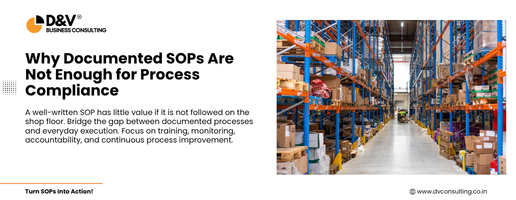
SOPs on Paper, Problems on the Shop Floor
Many businesses invest significant time in creating Standard Operating Procedures (SOPs), documenting processes, and defining the correct way to perform daily activities. Yet, a common problem remains: employees do not always follow SOPs consistently.
Business owners and management teams often ask questions such as, “Why are my employees not following SOPs?”, “Why do employees ignore standard operating procedures?” or “How can I get employees to follow SOPs?”
The problem is often not the absence of SOPs. It is the gap between documenting a process and implementing that process in daily business operations.
When SOPs exist only as documents, employees may continue using their own methods, experienced employees may rely on shortcuts, new employees may learn processes informally, and different departments may follow different ways of completing the same task.
This can lead to inconsistent work processes, quality issues, delays, rework, employee dependency, and operational inefficiency.
For growing businesses, effective SOP implementation requires more than creating documents. It requires process standardization, employee training, accountability, monitoring, and continuous improvement.
What Does It Mean When Employees Do Not Follow SOPs?
An SOP defines the standard method for completing a specific business activity. It can cover areas such as production, quality, sales, procurement, customer service, finance, HR, administration, inventory, or other operational processes.
However, creating an SOP does not automatically change employee behaviour.
For example, a company may have an SOP explaining how customer complaints should be handled. But employees may still:
- Follow their previous method
- Skip certain steps
- Use personal judgment instead of the defined process
- Maintain information in different formats
- Avoid documentation
- Follow instructions given verbally by senior employees
- Create shortcuts to complete work faster
This creates a gap between the defined process and the actual process.
That gap is one of the most common SOP implementation challenges faced by growing businesses.
Why Don't Employees Follow SOPs?
There is rarely one single reason why employees do not follow standard operating procedures. In many organizations, several factors work together.
1. Employees Were Not Involved in the Process
If SOPs are created by management without understanding how work is actually performed, employees may find the documented process difficult or impractical.
An SOP may look correct on paper but fail to reflect real operational conditions.
Employees are more likely to follow a process when they understand:
- Why the process exists
- What problem it solves
- How it makes their work easier
- What is expected from them
- What happens when the process is not followed
This is why effective business process standardization should consider both management requirements and actual workplace practices.
2. SOPs Are Too Complicated
Another common reason for poor SOP compliance is complexity.
If an SOP contains too many steps, unclear instructions, unnecessary approvals, or complicated documentation requirements, employees may start avoiding it.
A good SOP should make work clearer, not make work unnecessarily difficult.
The objective should be to create a process that is:
- Clear
- Practical
- Easy to understand
- Easy to access
- Easy to train
- Easy to monitor
3. Employees Were Not Properly Trained
One of the biggest mistakes businesses make is assuming that sharing an SOP means employees have been trained.
It does not.
Reading a document and understanding how to apply it in real work are two different things.
Employees may need:
- Process training
- Demonstration
- Practical examples
- Role-specific instructions
- Supervised implementation
- Feedback
- Periodic refresher training
Without proper training, employee compliance with SOPs can remain low even when the documentation is technically correct.
4. Management Does Not Monitor Compliance
Another reason SOPs fail in businesses is the absence of monitoring.
If employees know that SOP compliance is not checked, the documented process can gradually become optional.
Management should establish appropriate methods to monitor whether critical processes are being followed.
Depending on the business, this may include:
- Process audits
- Checklists
- KPI monitoring
- Review meetings
- Quality checks
- Process observations
- Documentation reviews
- Corrective actions
The objective is not to create unnecessary bureaucracy. It is to ensure that important processes are consistently executed.
SOPs on Paper vs. SOPs in Practice
There is a significant difference between having SOPs and implementing SOPs.
| SOPs on Paper | SOPs in Practice |
|---|---|
| Process is documented | Employees actually follow the process |
| Instructions are available | Employees understand the instructions |
| Management defines the standard | Teams apply the standard |
| Training may be limited | Employees receive practical training |
| Compliance is assumed | Compliance is monitored |
| Process remains static | Process is reviewed and improved |
This is why businesses should not measure SOP success by the number of SOP documents created.
The more important question is:
Are employees actually following the defined process consistently?
Why SOP Compliance Matters for Business Performance
Poor process compliance can create problems that may not immediately appear on the financial statement.
For example, inconsistent processes can result in:
- Rework
- Quality problems
- Customer complaints
- Delayed deliveries
- Process errors
- Duplicate work
- Higher operating costs
- Training difficulties
- Employee dependency
- Management intervention
- Poor accountability
When multiple employees perform the same task differently, the organization becomes dependent on individual experience rather than a standardized business process.
Over time, this can make the business harder to manage.
How Can You Get Employees to Follow SOPs?
Businesses often ask, “How can I make employees follow SOPs?”
The answer is not simply to tell employees to follow the document.
A more effective approach is to build SOP compliance into the way work is managed.
Step 1: Identify the Actual Process
Before creating or updating an SOP, understand how the process currently works.
Talk to the employees performing the activity. Observe the process. Identify variations, delays, unnecessary steps, and common workarounds.
This helps management distinguish between the documented process and the actual process.
Step 2: Simplify the Process
Remove unnecessary steps wherever possible.
An SOP should provide a practical standard that employees can realistically follow during daily operations.
Clear responsibilities, decision points, required documents, and expected outcomes should be defined.
Step 3: Train Employees
SOP implementation should include structured employee training.
Employees should understand not only what to do, but also:
- Why it needs to be done
- How it should be done
- When it should be done
- Who is responsible
- What records need to be maintained
- What to do when an exception occurs
Step 4: Establish Accountability
Employees should know who owns each process.
Clear accountability helps prevent situations where everyone assumes that someone else is responsible.
This is where SOP implementation can connect with performance management, role clarity, KPIs, and responsibility structures.
Step 5: Monitor SOP Compliance
Businesses need a practical system for checking whether processes are being followed.
This does not mean monitoring every activity continuously.
Instead, management can identify critical processes and establish appropriate review mechanisms.
Step 6: Review and Improve SOPs
Business processes change.
New technology, employees, products, customers, regulations, and operational requirements can make an existing SOP outdated.
Therefore, SOPs should be periodically reviewed.
An outdated SOP can become an operational problem instead of a solution.
Why SOPs Fail After Implementation
Even after an SOP implementation project, businesses may experience poor compliance.
Some common reasons include:
Lack of ownership
Nobody is responsible for maintaining and monitoring the process.
Poor communication
Employees receive the document but do not understand the expected change.
Inadequate training
Employees are expected to follow a new process without sufficient practical guidance.
Management inconsistency
Management itself allows employees to bypass the standard process whenever convenient.
No measurement
The organization has no method of identifying whether SOP compliance has improved.
SOPs are not updated
The documented process no longer reflects actual business requirements.
Too much focus on documentation
The company measures success by the number of SOPs created rather than their adoption and effectiveness.
These are some of the most common SOP implementation problems businesses need to address.
How Process Standardization Reduces Business Dependency on Individuals
One major benefit of effective SOP implementation is reducing dependency on individual employees.
Consider a business where only one experienced employee knows how to complete an important process.
If that employee is absent, leaves the company, or becomes unavailable, the process may slow down significantly.
This is a form of key-person dependency.
Well-designed SOPs help convert individual knowledge into organizational knowledge.
Instead of relying entirely on:
“Ask that employee; they know how to do it.”
The organization can establish:
“This is the standard process, and the responsible team is trained to execute it.”
This can improve continuity, training, accountability, and operational consistency.
SOP Implementation Should Connect With Performance Management
SOPs should not operate separately from HR and management systems.
If an organization expects employees to follow standardized processes, those expectations should be reflected in appropriate performance management mechanisms.
For example:
Role → Process → SOP → Training → KPI → Monitoring → Feedback → Improvement
This creates a stronger connection between employee responsibilities and business objectives.
It also helps management identify whether a performance issue is caused by:
- Lack of training
- Unclear responsibility
- Poor process design
- Insufficient resources
- Lack of supervision
- Lack of accountability
This approach is more effective than assuming every performance problem is simply an employee problem.
When Should a Business Consider SOP Consulting?
A business may benefit from professional SOP consulting services when:
- Processes differ between employees
- Employees frequently use their own methods
- Important processes depend on specific individuals
- New employees take too long to become productive
- Management frequently needs to intervene
- Quality or service consistency is difficult to maintain
- Existing SOPs are outdated
- SOPs exist but are not followed
- Departments operate with different processes
- Business growth is creating operational complexity
An SOP implementation consultant can help businesses assess existing processes, identify gaps, standardize workflows, develop practical SOPs, train employees, and establish mechanisms for monitoring compliance.
How Operational Excellence Supports SOP Compliance
SOP implementation is closely connected with operational excellence.
Operational excellence is not simply about documenting processes. It focuses on making business processes more consistent, efficient, measurable, and continuously improvable.
A strong operational approach can combine:
- Process mapping
- SOP development
- SOP implementation
- Employee training
- KPI definition
- Process monitoring
- Root-cause analysis
- Continuous improvement
- Management review
This helps move a business from person-dependent operations toward process-driven operations.
What Should Businesses Do If Employees Are Still Not Following SOPs?
If employees continue to ignore SOPs, management should avoid immediately assuming that employees are unwilling to cooperate.
First, ask:
- Is the SOP practical?
- Is the process clearly explained?
- Have employees been trained?
- Are responsibilities clearly defined?
- Is management following the same process?
- Are there unnecessary steps?
- Is compliance being monitored?
- Are employees given feedback?
- Is the SOP still relevant?
- Is there a clear owner for the process?
These questions help identify the root cause of SOP non-compliance instead of simply treating the symptom.
Conclusion
The real value of an SOP is not the document itself.
The value comes when the right process is understood, implemented, followed, measured, and continuously improved.
For this reason, businesses should not ask only:
“Do we have SOPs?”
They should ask:
“Are our employees consistently following the right processes?”
When SOPs are supported by proper implementation, training, accountability, monitoring, and continuous improvement, they can become an important part of business process standardization and operational excellence.
For businesses struggling with inconsistent processes, employee dependency, poor SOP compliance, or operational inefficiency, SOP implementation and business process improvement consulting can help convert documented processes into practical systems that teams can actually follow.
About Dharmesh Parikh – Founder & CEO, D&V Business Consulting

I’m Dharmesh Parikh, Founder & CEO of D&V Business Consulting.
I started D&V Business Consulting with one conviction: businesses rarely fail because of their products or market potential. More often, growth slows due to inefficient operations, inconsistent processes, people-related challenges, poor execution, and the absence of strategic direction. My mission is to help business owners overcome these challenges and build businesses that deliver consistent, sustainable growth.
What I Do
I work closely with founders, directors, and leadership teams to improve the critical areas that directly influence business performance.
At D&V Business Consulting, we help organisations:
- Increase sales performance and revenue.
- Build high-performing teams with structured HR systems.
- Improve operational efficiency and productivity.
- Support business transformation and sustainable growth.
- Develop structured processes and management systems that create long-term business value.
Our work goes far beyond providing recommendations. We partner with business owners throughout the implementation journey, helping leadership teams convert business strategies into measurable business outcomes.
Who I Work With
I primarily work with MSME founders, entrepreneurs, and business leaders who are committed to building scalable and professionally managed organisations.
My experience covers a wide range of industries, including:
- Manufacturing
- Retail
- Distribution
- Trading Businesses
- Service-Based Enterprises
What I Share
Through my content, I share practical insights and business knowledge on topics including:
- Business Growth Strategies
- Sales Management
- Leadership Development
- HR & Organisation Development
- Operational Excellence
- Scaling MSMEs
I believe business consulting should create measurable business impact—not just reports and presentations. My objective is to help business owners make informed decisions, solve operational challenges, build stronger organisations, and achieve sustainable business growth.
If you’re looking for practical business strategies backed by hands-on implementation, I’d be pleased to connect and exchange ideas.
Founder & CEO – D&V Business Consulting
Business Growth | Sales Strategy | Operations Excellence | HR & Organizational Development
- Why don't employees follow SOPs even when they are documented?
-
Employees may not follow SOPs because of inadequate training, complicated procedures, unclear responsibilities, lack of monitoring, outdated instructions, or resistance to changing existing work habits.
- How can a business make employees follow SOPs?
-
Businesses can improve SOP compliance through practical training, clear role ownership, simple procedures, regular monitoring, performance accountability, and continuous feedback.
- Why do SOPs fail after implementation?
-
SOPs often fail when businesses focus only on documentation and do not provide proper implementation, employee training, process monitoring, accountability, and periodic review.
- What is SOP implementation?
-
SOP implementation is the process of putting documented procedures into actual daily practice through employee training, role clarity, process monitoring, accountability, and continuous improvement.
- How can SOP implementation improve business operations?
-
Effective SOP implementation can improve process consistency, reduce errors and rework, clarify responsibilities, reduce employee dependency, and create more standardized business processes.
- How often should business SOPs be reviewed?
-
SOPs should be reviewed periodically and whenever there are significant changes in processes, technology, employees, products, customer requirements, or business operations.
- How does SOP compliance affect employee performance?
-
Clear SOPs provide employees with defined methods and expectations, while monitoring and accountability help management identify process gaps, training requirements, and performance issues.
- Can SOPs reduce dependency on key employees?
-
Yes. Well-designed and implemented SOPs can convert individual knowledge into documented organizational processes, making it easier to train other employees and maintain process continuity.
- When should a business hire an SOP implementation consultant?
-
A business may consider an SOP implementation consultant when employees follow different processes, existing SOPs are not being followed, important activities depend on individuals, or management faces recurring process and operational problems.
- How are SOP implementation and operational excellence connected?
-
SOP implementation creates standardized ways of working, while operational excellence focuses on improving those processes through monitoring, measurement, problem-solving, and continuous improvement.
Related Posts
Why SOP Consulting Services Are Essential for Business Growth in India
In the relentless pursuit of peak efficiency and world-class quality, businesses constantly seek foundational methodologies…
 Join
Join